PalV's Kasti
On this page
Tanchoi is a figured silk with a smooth satin or twill ground, and its history runs from China to Surat to Benares. It came to India through the Parsi trade with China in the nineteenth century. Firoza Punthakey Mistree describes the tanchoi as "an adaptation of a Chinese brocade", Indian in design and style. Parsi traders first brought the cloth from China. Demand from Indian women then led weavers in Surat, and later Varanasi (Benares), to learn to make it. The name, according to the Chhatrapati Shivaji Maharaj Vastu Sangrahalaya (CSMVS) in Mumbai, means "the material made by the three (tan) chhois", after three weavers who learned the technique in Shanghai. For Parsi families it became a festive fabric and part of the bridal trousseau.
શહેરેવર રોજ
Shehrevar Roj, Tir Mah · 1396 Y.Z.
What is tanchoi?
Tanchoi is a woven silk, not an embroidered one. The CSMVS catalogue says its basic technique is twill and sateen weaving, which gives a smooth coloured surface, and that a good piece shows no loose floats on its reverse. The RISD Museum in the USA catalogues two early saris of "tanchoi figured silk" as compound satin weave, with a small allover pattern in the weft.
Is it a brocade? The sources use both words. Mistree calls it "an adaptation of a Chinese brocade", and the Victoria and Albert Museum (V&A) in London catalogues one Gujarat tanchoi as a "sari of silk brocade". The museum records describe that ground as satin or twill, with a fine woven figure.
Where did tanchoi come from?
Tanchoi began in China. Mistree's chapter in the Routledge volume The Zoroastrian World says the gara and the tanchoi "emerged from the China Trade, during the nineteenth century", as textiles introduced by Parsi traders. She names "Parsi China Trader, Jamsetjee Jejeebhoy" as the man who introduced both.
The RISD Museum's checklist for its 2005 exhibition The Splendid Sari says Parsi traders at first imported this yardage straight from China. The Chinese weavers designed for more than one market. One RISD sari mixes Indian buta motifs rising from Chinese vases with a Chinese ball-and-pearl lattice and a "Buddha's hand" citron. Another has a floral trellis that leans towards European taste. RISD dates both to the early to mid-1800s.
The gara followed the same route. For the embroidered sari, see the Parsi gara saree. For the trade that carried both, read about the Chinese roots of Parsi embroidery.
Who were the three weavers behind the name tanchoi?
CSMVS, the Parzor Foundation and Live History India all trace the name to three weavers who learned the craft in China. They differ on the details.
| Source | Who the three were | Where they learned | What "choi" refers to |
|---|---|---|---|
| CSMVS, Mumbai | Three weavers from the Joshi family of Surat, sent by Jamsetjee Jejeebhoy | Shanghai, under the master weaver Chhoi | Their master's name, which they took: "the three (tan) chhois" |
| Parzor Foundation | Three Parsi brothers, spelt Joshi and Jokhi | China | China: "Joshi brothers from China (Choi)" |
| Kritika Sarda, Live History India (2017) | Three weavers of a Joshi family of Surat | China | Their Chinese teacher, Chhoi |
CSMVS and Live History India both say Jamsetjee Jejeebhoy sent the three. Live History India gives its account with the words "it is believed" and links "tan" to the Gujarati word for three. Parzor describes the brothers as Parsi. CSMVS and Live History India call them weavers of the Joshi family of Surat without naming a community.
How did tanchoi move from Surat to Benares?
The craft started in Surat and moved north. Parzor writes of "the famous Tanchois of Surat (and later of Benares)". Mistree says that as the number of Parsi weavers in Surat fell, weavers in Benares took tanchoi over and made it "wholly Indian in design". RISD also names Surat first and Varanasi later.
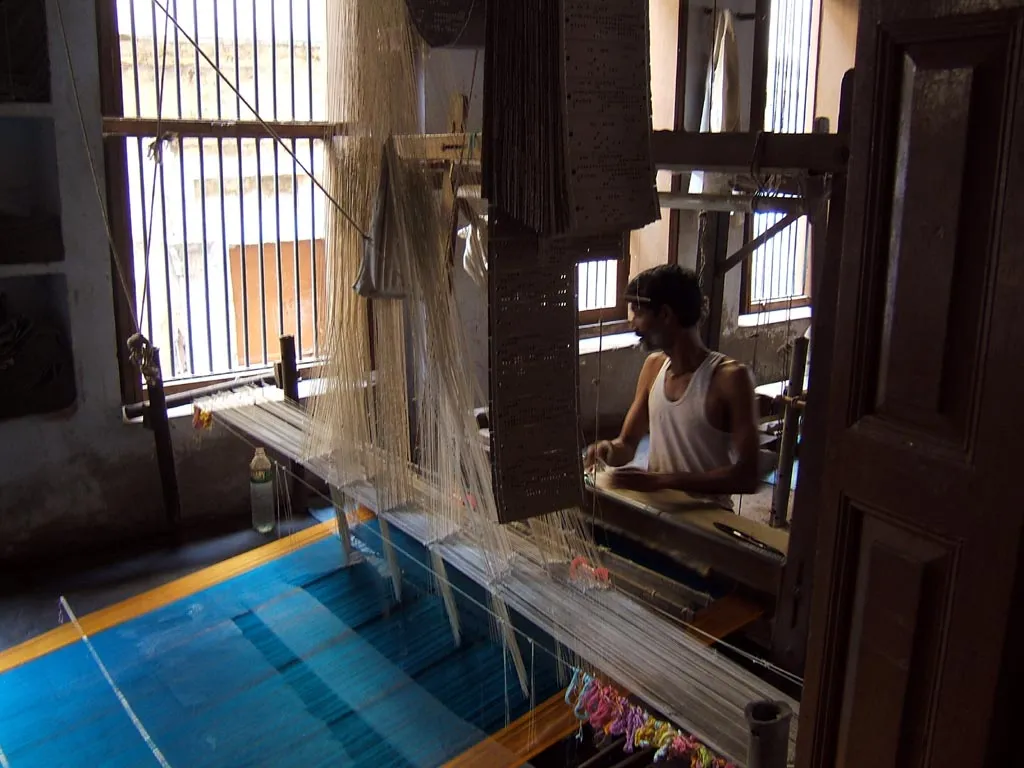
Parzor adds two details from its own research. Its team has located some of the first sample pieces of tanchoi, made on the looms with the family's seal woven into them. And it records that Gandhiji visited the Joshi family and, after Independence, invited them to organise Tanchoi Centres.
Kritika Sarda's Live History India article gives a later timeline. She writes that tanchoi saris were made in Bombay until the 1950s, and that around then Banaras weavers learned the technique, wove it more cheaply and began adding Benarasi designs.
What place did tanchoi have in Parsi homes?
For Parsi families, tanchoi was a festive and bridal fabric. Mistree writes that the tanchoi sari was part of every festive occasion in a Parsi home and of every girl's trousseau. CSMVS calls tanchoi a symbol of the Parsi community's nineteenth-century "heyday". It was so popular with Parsis, the museum says, that "practically every home possessed at least one".
Museums outside India record the same link. The V&A catalogues two red Gujarat tanchoi saris, dated late 19th to early 20th century, as woven "for the Parsi market". One record adds that the style was popular with the Parsi market of western India.
What motifs appear on tanchoi saris?
The early Chinese-made pieces mixed motifs from three traditions, as the RISD saris show: Indian buta, Chinese lattice and vases, and European-looking trellises. The V&A's two Gujarat tanchois show a more Indian layout:
| V&A sari | Field | End borders |
|---|---|---|
| T.247-1920, red | Staggered rows of small flowers in pale green, pale yellow and white | Two bands of large buti motifs, divided by bands of floral stems |
| T.248-1920, red | A diaper of small compartments formed by leafy scrolls enclosing blossoms | Five bands, two of them filled with rows of "'cone' devices" |
The V&A uses the same word, cones, for the boteh on a Kashmir shawl, which it describes as "large floral paisley cones, or boteh". We trace that shape from Persia to Scotland in the boteh (paisley) motif. Kritika Sarda writes that earlier tanchoi motifs were mostly Chinese florals and fauna, while modern Indian versions mostly use paisley.
Tanchoi is woven, not stitched. For the needlework that came from the same China trade, see our history of Parsi embroidery.
Why did tanchoi weaving decline?
Fashion and the power loom, according to CSMVS. With the power loom and a change in fashion, it says, tanchoi weaving "went out of vogue in the early 20th century".
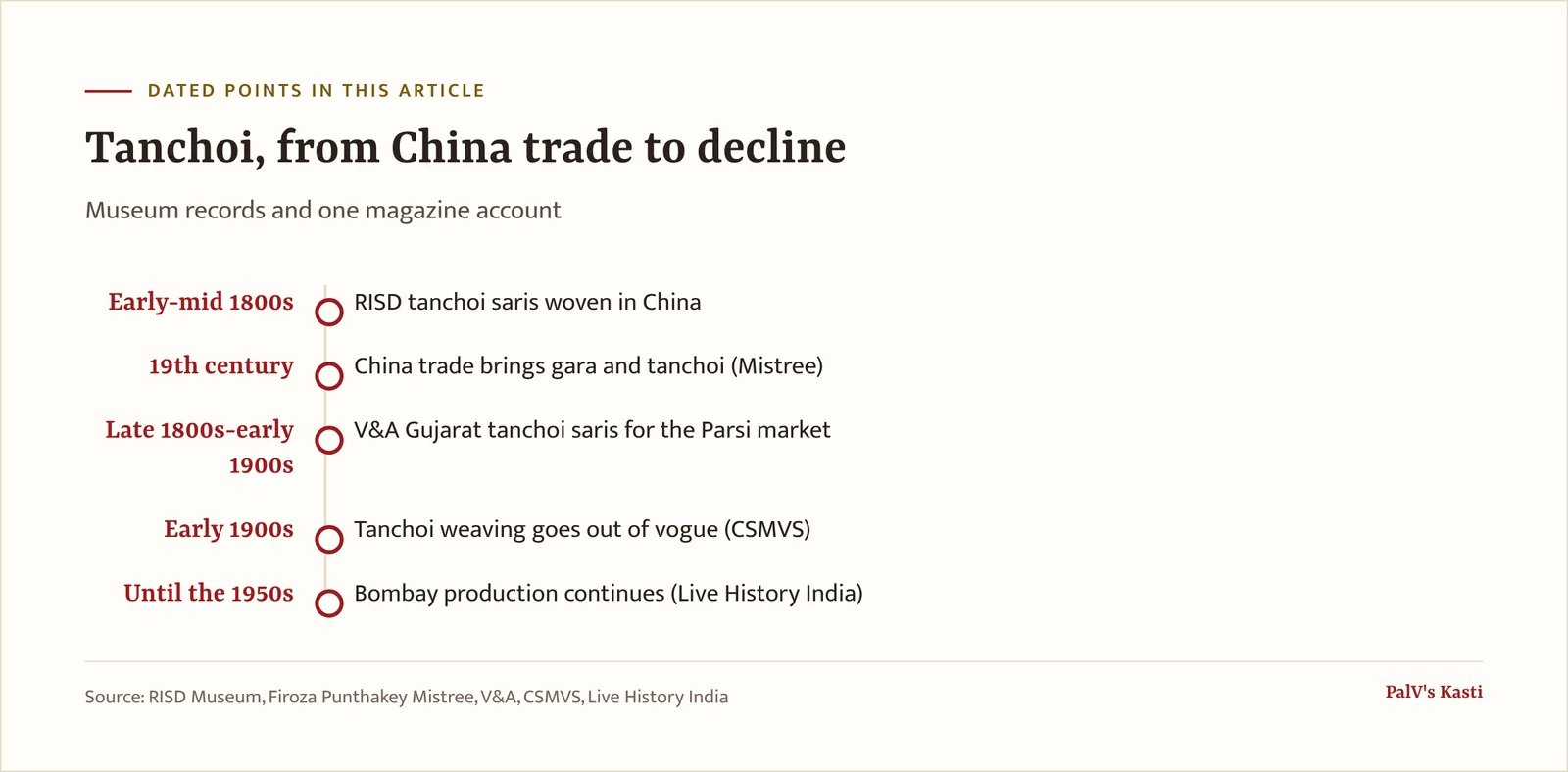
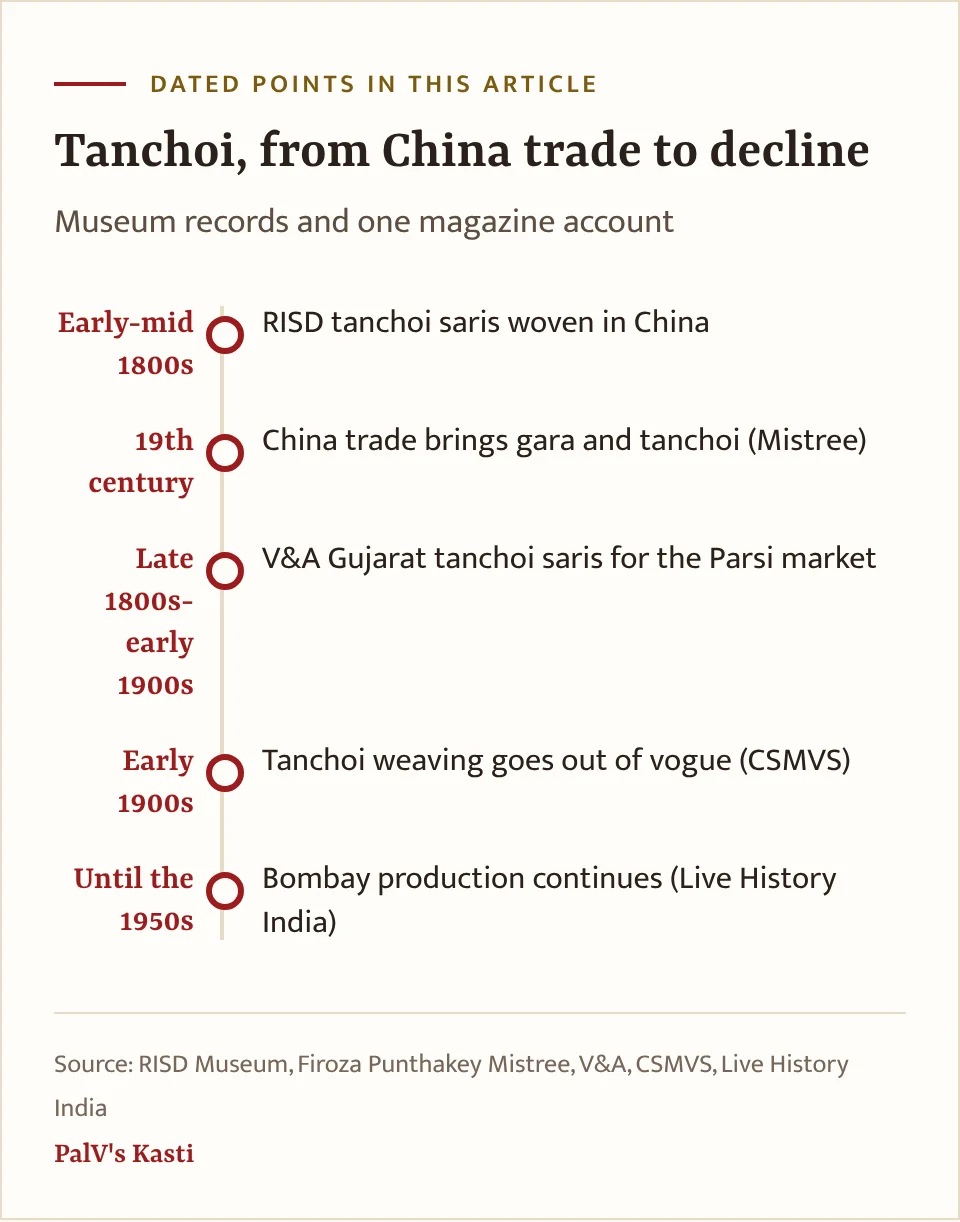
Live History India's account adds detail. By the early twentieth century, Sarda writes, European fashion had overtaken Chinese influence in Bombay, and georgette and lighter fabrics replaced silk in Parsi wardrobes. A descendant of the Joshi brothers, Kaikhushro, set up a factory in Surat to revive the fabric, which she calls a "miserable failure". Her account of Bombay production lasting until the 1950s sits alongside the CSMVS date for the decline, and the two sources don't fully agree.
Frequently asked questions
Is tanchoi a Banarasi saree?
Tanchoi weaving moved to Benares (Varanasi), but it didn't start there. Parzor, Firoza Punthakey Mistree and the RISD Museum all record that tanchoi weaving began in Surat and later moved to Benares. Mistree says it became wholly Indian in design once Benares weavers took it up.
What is the difference between tanchoi and brocade?
The sources treat tanchoi as a kind of brocade. Mistree calls it an adaptation of a Chinese brocade, and the V&A catalogues a tanchoi sari as silk brocade. What marks tanchoi out is its smooth twill or satin ground with a small woven figure, as CSMVS and the RISD Museum describe it.
Who brought tanchoi to India?
Parsi traders brought tanchoi to India from China, according to the RISD Museum and Firoza Punthakey Mistree. Mistree names the Parsi China trader Jamsetjee Jejeebhoy as the man who introduced it. Weavers from Surat then learned to make it themselves, and the craft later moved to Benares.
Why is it called tanchoi?
The name comes from three weavers who learned the craft in China. CSMVS glosses "tan" as three, and Live History India links it to the Gujarati word for three. For "choi", CSMVS and Live History India both name the master the weavers learned from in China, Chhoi, while Parzor ties "Choi" to China.
Is tanchoi a Parsi textile?
Tanchoi is closely tied to the Parsis, though it was woven by others too. Parsi traders introduced it, and Parzor says three Parsi brothers pioneered it in Surat. CSMVS calls it symbolic of the Parsi community's nineteenth-century heyday, and the V&A records that it was woven for the Parsi market of western India.