PalV's Kasti
On this page
- When did Parsi traders first go to China?
- How did Chinese embroidery become a Parsi sari?
- Why do some old garas have a seam down the length?
- Which museum pieces were made in China for Parsis?
- Which Parsi embroidery motifs came from China?
- Which stitches and materials came with the China trade?
- Who were the Chinese pedlars who sold embroidery door to door?
- When did the China connection end?
- Frequently asked questions
Parsi embroidery has Chinese roots because Parsi merchants traded with China. Hirji Jivanji Readymoney sailed to Canton (Guangzhou) in 1756, and Parsi traders later worked the ports of Canton, Macao, Hong Kong and Shanghai. Embroidered Chinese silk came home with them. At first their wives and daughters made it into garments. Later the merchants ordered saris, borders and children's tunics from workshops in China. Chinese pedlars then carried these pieces to Parsi homes in India, and Parsi women learnt the stitches by watching them. That is why several Parsi embroidery motifs are Chinese in origin: the divine fungus, the endless knot, pagodas and the "china-chini" figures of a Chinese man and woman.
This article traces that China route. The full mix of Persian, Indian, Chinese and European elements is covered in our companion piece on Parsi embroidery as an intercultural mix, and the main garment forms are explained in our guide to Parsi embroidery.
શહેરેવર રોજ
Shehrevar Roj, Tir Mah · 1396 Y.Z.
When did Parsi traders first go to China?
The Parzor Foundation says the link between Persia and China was an overland one that turned into a sea link with the Parsis of India. Parzor names Hirji Jivanji as the first Parsi to sail for China, in 1756. The RISD Museum gives the same man and the same year, under his fuller name Hirji Jivanji Readymoney, and notes that the port he reached, Guangzhou, was then called Canton by the British.
Guangzhou mattered because it was the only Chinese port where foreign merchants were allowed to do business, the RISD Museum essay explains. Parzor and the South China Morning Post both list Macao, Hong Kong and Shanghai alongside Canton as ports where Parsi traders worked. The Textile Research Centre (TRC) in Leiden adds that Parsi contact with China was especially strong from the mid-nineteenth century, when Parsi traders sold cotton at Canton.
The sources name slightly different goods, so we've set them side by side:
| Source | Goods named in the India-China trade |
|---|---|
| South China Morning Post (Huzan Tata) | Indian cotton, opium and spices sent out. Chinese tea, porcelain and silk brought back |
| RISD Museum | Opium sent out. Tea, porcelain, furniture and silk acquired in exchange |
| Asian Civilisations Museum, Singapore, garo 2017-00564 (Roots.gov.sg record) | Opium, cotton, tea and silk traded between Canton, India and the British Empire |
| Parzor Foundation | A fish gara made to order in China for Parsi merchants "dealing with Opium, Tea and Textiles" |
Opium appears on every list. The RISD essay is plain that Parsi merchants sailed from Bombay to take part in the opium trade from its start, and that in exchange for chests of opium, merchants acquired tea, porcelain, furniture and silk.
How did Chinese embroidery become a Parsi sari?
A family story sits at the beginning, and it should be read as a story. Parzor records it as a legend: a Parsi trader in Canton watched craftsmen embroidering a rich textile and asked them to work six yards of silk into a sari for his wife back in India. Huzan Tata, writing in the South China Morning Post, repeats it and calls it a rumour. Neither source names the trader.
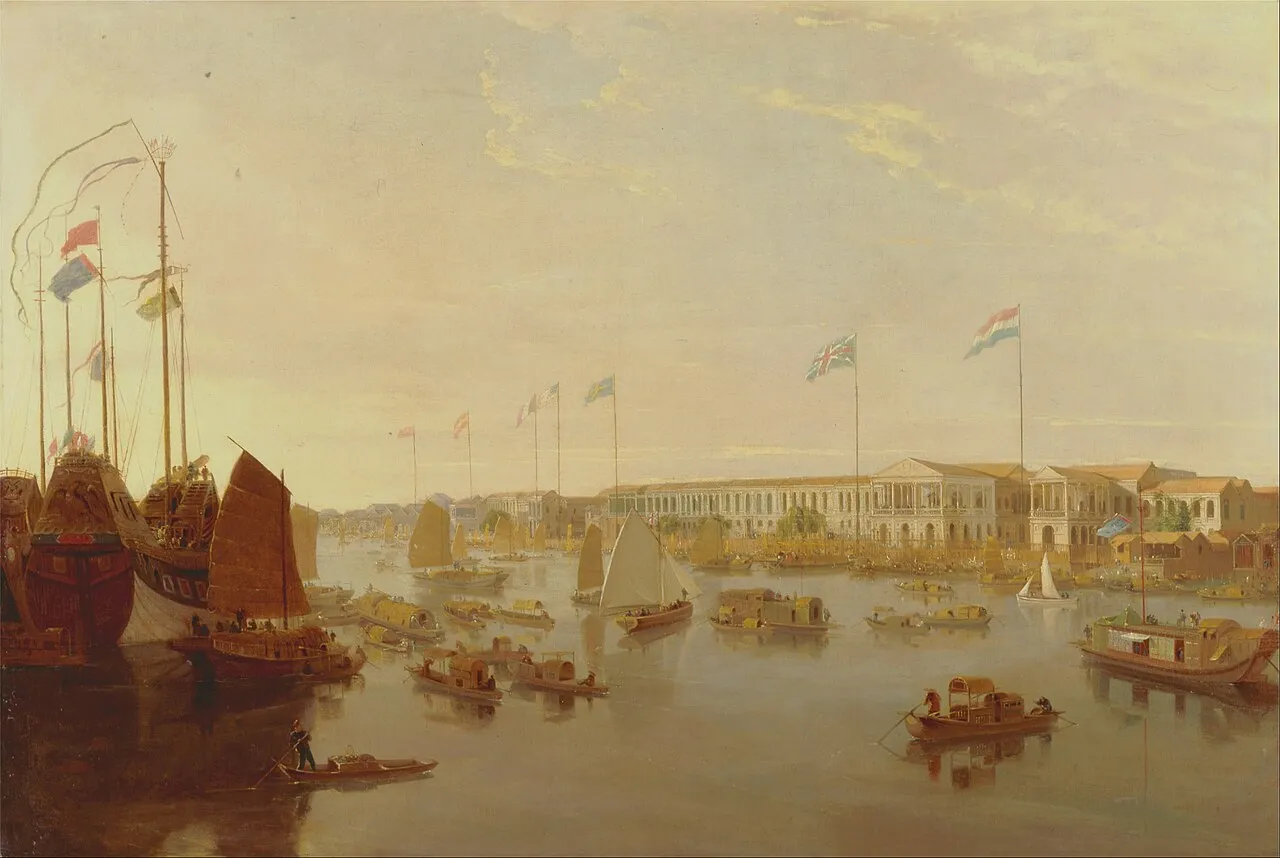
The documented route was slower. In the RISD Museum's account, textiles the merchants brought home were first adapted by their wives and daughters into local garments. Later, as more Parsi merchants reached Guangzhou, they commissioned workshops in China to make saris, sari borders, tunics and other Indian clothing. Foreign women were forbidden from entering the port of Guangzhou, so orders went through husbands and male relatives.
Parzor describes the first pieces as embroidered on satin with no borders or pallavs. They look like yardage and often carry Taoist and Buddhist symbols. TRC lists what China supplied for Parsi wardrobes: embroidered jublas (children's tunics), kors (embroidered bands sewn onto saris) and complete chiffon, gauze or satin saris called garas.
Some pieces carry their origin on them. The RISD essay notes that a few early saris have stamps in English and Gujarati showing they were made in China, though most have no mark. Parzor shows Gujarati seals found in the Chungtai area and reads them as a sign that the textile trade was customised for Parsi buyers.
Why do some old garas have a seam down the length?
TRC, citing Linda Lynton's book The Sari (1995), explains that Chinese hand looms were narrower than Indian ones. A Parsi sari made from Chinese-woven cloth therefore usually has a lengthwise seam where an extra half-width was joined on. TRC calls this a do-patti, or two-strip, sari.
Which museum pieces were made in China for Parsis?
The Victoria and Albert Museum (V&A) in London catalogues several:
- A black silk gauze sari worked in satin and stem stitches, made in China between 1900 and 1950 (T.24-1967). The V&A notes that on many Parsi pieces the edging was applied separately, as satin ribbon that Chinese artisans embroidered by the yard. On this sari, though, the edging is worked straight onto the silk.
- A black silk gauze sari with birds and flowering stems, made in China for the Indian Parsi community in the early 20th century (T.271-1922).
- A lady's tunic of dark blue silk, cut square and without sleeves, made in China for the Indian Parsi community in the 19th century (T.87-1925).
Which Parsi embroidery motifs came from China?
The Chinese motifs on Parsi embroidery include the divine fungus, the endless knot, pagodas, figures of Chinese men and women, Chinese flowers and the phoenix. Here is where each one is recorded:
| Motif | Recorded by |
|---|---|
| Divine fungus | Parzor, on a red child's jhabla. South China Morning Post, among the motifs of the first garas |
| Endless knot | Parzor, on a Surat engagement gara. South China Morning Post |
| Pagodas and Chinese figures | Parzor's craft page. South China Morning Post (pagodas) |
| China-chini (a Chinese man and woman) | Parzor's "China-Chini Gara". Designer Ashdeen Lilaowala, who glosses the Gujarati cheena cheeni as "Chinese man and woman" |
| Peonies, roses, chrysanthemums | TRC |
| People in Chinese dress, bridges spanning water | TRC |
| Butterflies and foliage | South China Morning Post |
| Chinese baskets, set inside pallav designs | Parzor |
| Phoenix, taken up by Parsis as the Simurgh | RISD Museum |
Parsi women didn't take everything on offer. Parzor says the pieces they made show a preference for the rooster and the fish, motifs with significance in Zoroastrian tradition, over the dragons and snakes popular in Chinese work. Not every import was Chinese either: Parzor shows a rare gara from Japan with chrysanthemums embroidered on black, from the collection of the late Khorshed Sethna of Ahmedabad.
What each motif means is a separate question. Our guide to gara embroidery designs and motifs covers it.
Which stitches and materials came with the China trade?
Parzor places Chinese chain stitch beside the Parsi khakho (seed pearl stitch), satin stitch, and long and short stitch. TRC lists Peking stitch, satin stitch and various knots on China-made Parsi pieces, and identifies the khakha as the Peking knot, the "forbidden stitch". According to Parzor, the khakho was so intricate that women lost their eyesight working it. How these stitches are worked is explained in our piece on Parsi hand work.
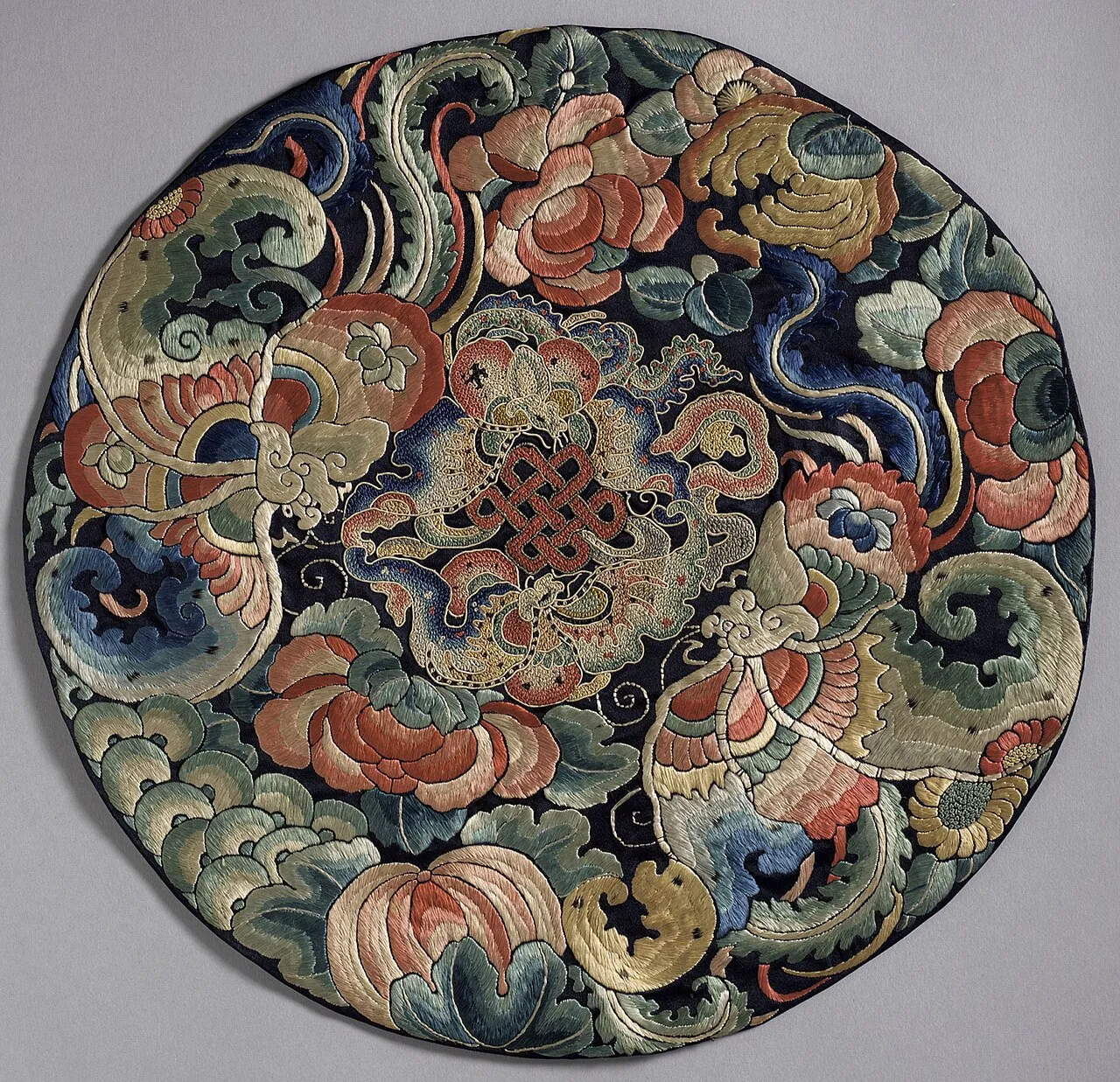
The look of the cloth came from China too. TRC describes designs worked in white silk thread on purple, red or black grounds. According to the RISD essay, the garas people prized most, up to the 1940s, had a ground of jewel-toned silk from China. A cheaper route was to bring plain Chinese silk to India, dye it purple, red or black there, and work it mostly in white thread. The V&A calls silk gauze a favoured material, with purple and black both common.
Weaving had its own China link. Parzor credits three Parsi brothers who learnt a weaving technique in China and brought it to India, the origin of tanchoi.
Who were the Chinese pedlars who sold embroidery door to door?
Parzor records that, until the early 1960s, Chinese pherawallas (travelling textile vendors) came regularly in winter to Parsi homes across Gujarat, the Deccan, Bombay and Calcutta. They couldn't afford storage, so they left heavy bundles of cloth on a particular veranda and came back for them after the morning's sales. Parzor cites community accounts, recalled by elders from Bharuch to Kolkata, of the pedlars working on small frames in the afternoons while Parsi women sat with them and watched. That is how the women picked up the stitches, Parzor says, including the pedlars' use of curved needles. The pedlars carried their original patterns on black cloth.
TRC describes the same trade from the buyer's side. Tunics, saris and sari borders made in China were brought to Bombay by itinerant Chinese traders and sold to Parsi women in their homes, and the women sewed the borders onto their own saris.
Buying turned into making. TRC says Parsi women soon began imitating the Chinese embroideries and developed a more hybrid style. The RISD essay says they commissioned local Indian embroiderers to copy the Chinese silks their husbands brought back, and it reports an oral tradition that some Chinese embroiderers may have settled in Surat. Parzor goes a step further and says Indo-Chinese embroidery settlements are believed to have grown up in western India to meet Parsi demand. Parzor also says the Indian-made work can be told apart: Chinese embroidery used fine thread and a balanced palette, while Parsi women in India used a wider range of colours.
When did the China connection end?
Our three main sources give different dates:
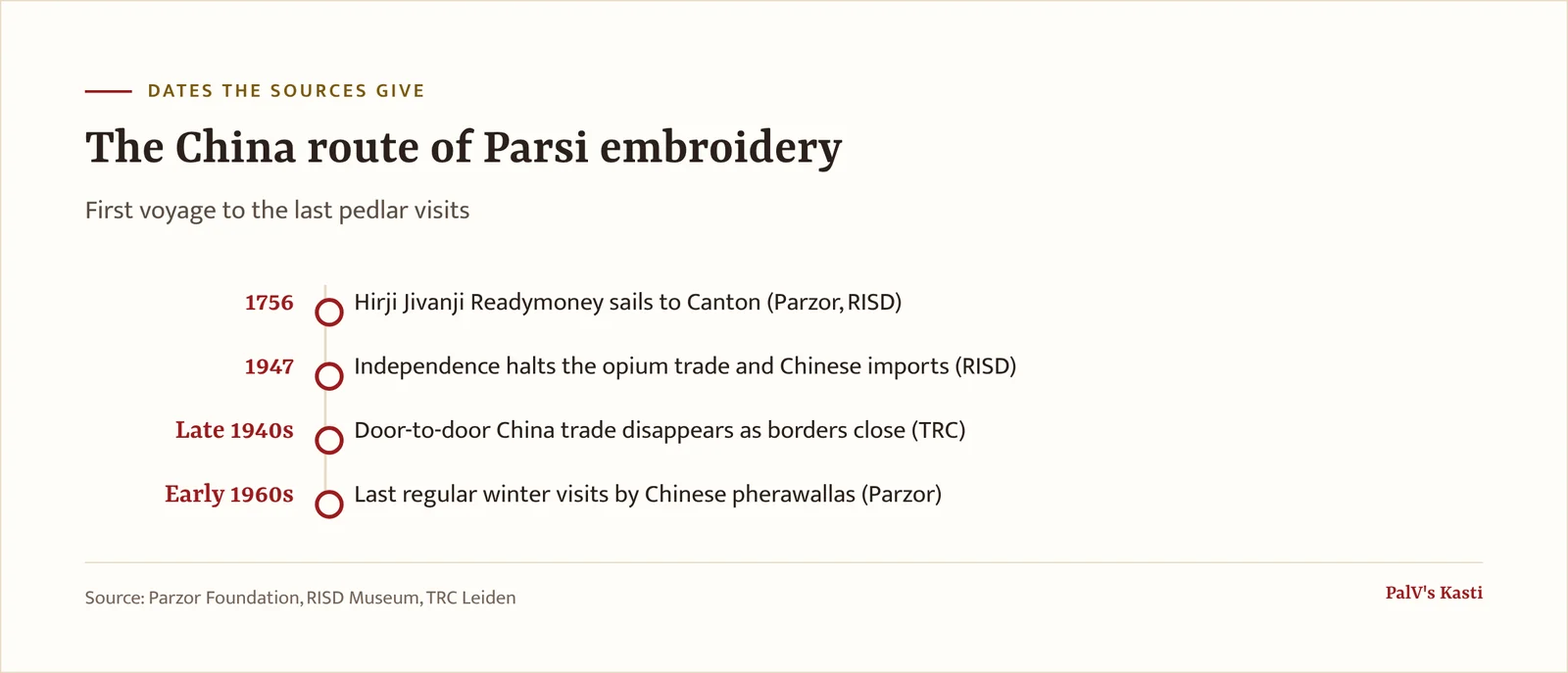
- TRC: the door-to-door trade disappeared in the late 1940s and early 1950s, when the Chinese authorities closed China's borders.
- RISD Museum: Indian Independence in 1947 halted the opium trade and abruptly ended the import of Chinese goods.
- Parzor: Chinese pherawallas kept visiting Parsi homes until the early 1960s.
None of the three explains the difference, so we've left all three as they stand. Parzor sums up the result: with the end of Parsi trading in China, the link is gone. The dated sequence from the first garas to today is set out in our history of the Parsi gara.
Frequently asked questions
Is Parsi gara embroidery Chinese or Indian?
It began as Chinese work made to Parsi orders and became Parsi work made in India. The V&A holds saris catalogued as made in China for the Parsi community. TRC and the RISD Museum record that Parsi women and Indian embroiderers then copied and adapted the Chinese pieces, developing a more hybrid style.
Who was the first Parsi to trade with China?
The Parzor Foundation and the RISD Museum both name Hirji Jivanji Readymoney, who sailed to Guangzhou, then called Canton by the British, in 1756. Parsi traders later also worked from Macao, Hong Kong and Shanghai, and embroidered Chinese silk was among the goods they brought home to India.
What is a china-chini gara?
A china-chini gara is embroidered with figures of a Chinese man and woman. Designer Ashdeen Lilaowala explains the Gujarati name cheena cheeni as "Chinese man and woman". The Parzor Foundation's exhibition on Parsi embroidery includes a China-Chini gara among its examples of the China connection.
Why does an old gara have a seam running down its length?
TRC Leiden, citing Linda Lynton's book The Sari, explains that Chinese hand looms were narrower than Indian looms. Saris made from Chinese-woven cloth needed an extra half-width of fabric joined along the length. TRC calls this two-strip construction a do-patti sari.
Did Chinese pedlars really teach Parsi women embroidery?
That is what Parsi community memory recorded by the Parzor Foundation says. Elders recall Chinese pedlars leaving cloth bundles on Parsi verandas and embroidering on small frames in the afternoons, while Parsi women watched and learnt their stitches, including the use of curved needles.