PalV's Kasti
On this page
A Roj date is a date in the Parsi calendar, written as the name of the day (Roj) followed by the name of the month (Mah), for example Adar Roj, Adar Mah. Every month has 30 Roj, and each Roj has a name rather than a number. Twelve months of 30 days make 360 days, and five Gatha days are added at the end of the year to make 365, as FEZANA's calendar lesson plan sets out. A Roj runs from sunrise to sunrise, not from midnight. FEZANA's glossary defines the first watch of the day, Havan, as running "from sunrise till noon" and the last, Ushahin, "from midnight till sun-rise". And the same Gregorian day carries a different Roj date in the Shenshai, Kadmi and Fasli calendars, so a Roj date only makes full sense once you know which calendar it follows.
શહેરેવર રોજ
Shehrevar Roj, Tir Mah · 1396 Y.Z.
What is a Roj date?
A Roj date names a day by the divine being it honours instead of by a number. FEZANA's glossary defines roz, roj and ruz as "Day" and Mah as "Moon or month". Its calendar lesson plan explains that the calendar has 30 days and 12 months, and that each day "has a name and not a number".
So where a Gregorian date says "the 9th", a Roj date says "Adar", the 9th Roj of the month in the day list on avesta.org. To find out what each of the 30 names means, see our table of the thirty Roj names and their meanings. The 12 month names are covered in our Parsi calendar months name list, and every named unit of the calendar, from Roj and Mah to Geh and Gatha, is set out in our overview of Parsi calendar names. If you'd like a short thought to carry through each day, we've written a reflection for each Roj.
How is a Parsi date written?
Day first, month second. FEZANA writes its examples as "Adar roj (day), Adar mah (month)" and "Tir roj (day), Tir mah (month)". The pattern is old. E. W. West's translation of the Bundahishn, chapter 25, as published on avesta.org, dates the seasons as "the auspicious day Ohrmazd of the month Frawardin" and "the auspicious day Adar of the month Din". In both, the day's name comes first and then the month in which it falls.
Here's how some common Roj dates break down. The day numbers follow the order of the day list on avesta.org, and the month numbers follow the month list in FEZANA's lesson plan.
| Written as | Roj (day of the month) | Mah (month of the year) |
|---|---|---|
| Hormazd Roj, Fravardin Mah | Hormazd, day 1 | Fravardin, month 1 |
| Tir Roj, Tir Mah | Tir, day 13 | Tir, month 4 |
| Meher Roj, Meher Mah | Meher, day 16 | Meher, month 7 |
| Avan Roj, Avan Mah | Avan, day 10 | Avan, month 8 |
| Adar Roj, Adar Mah | Adar, day 9 | Adar, month 9 |
A date may also carry a year. FEZANA dates the Shenshai calendar from the start of the reign of Yezdegard III, the last Sassanian Zoroastrian king. How those years are numbered is explained in counting Zoroastrian years.
When does a Roj begin and end?
A Roj begins at sunrise and ends at the next sunrise. The Zoroastrian Association of Northern California (ZANC) puts it plainly on its calendar page: a roj "starts at sunrise" and runs to the next sunrise, rather than starting at midnight. FEZANA's glossary calls Havan the "first watch of the day, from sunrise till noon" and Ushahin the last watch, "from midnight till sun-rise". The Bundahishn gives the same order. It says it is necessary "first to count the day and afterwards the night", and names "the period of day-break" as Hawan.
This matters for anything that happens in the early hours. A time an hour before sunrise falls in Ushahin, the last watch of the Roj that began at the previous sunrise. The Roj changes only when Havan begins. Because the boundaries are tied to sunrise and sunset, their clock times shift with your city and the season, so we don't give fixed times here. Each watch is explained in our guide to the five Gehs.
Why does the same day have three different Roj dates?
The Shenshai, Kadmi and Fasli calendars use the same names but start their years on different days. FEZANA states that all three calendars share the same day and month names. It also says the Kadmi calendar "differs by one month" from the Shenshai one because of a difference in calculation, and that the Fasli calendar was instituted in 1906 to start the new year on the spring equinox, 21 March.
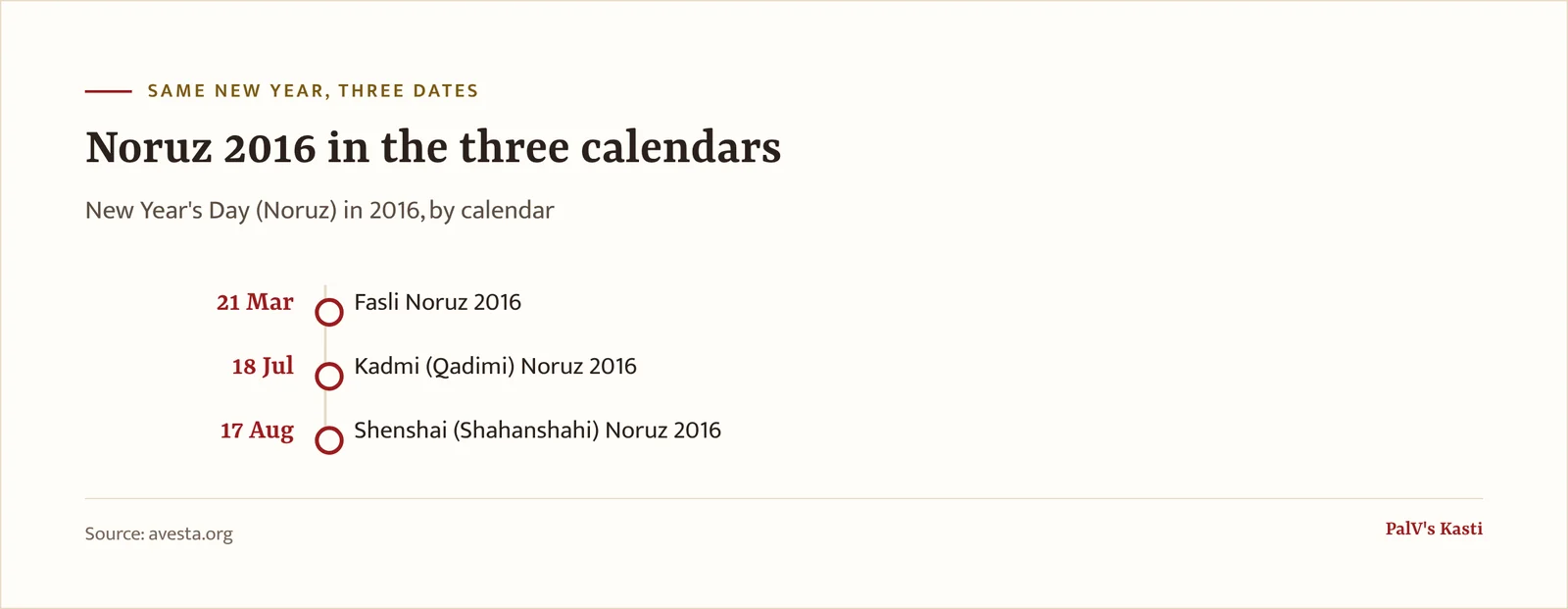
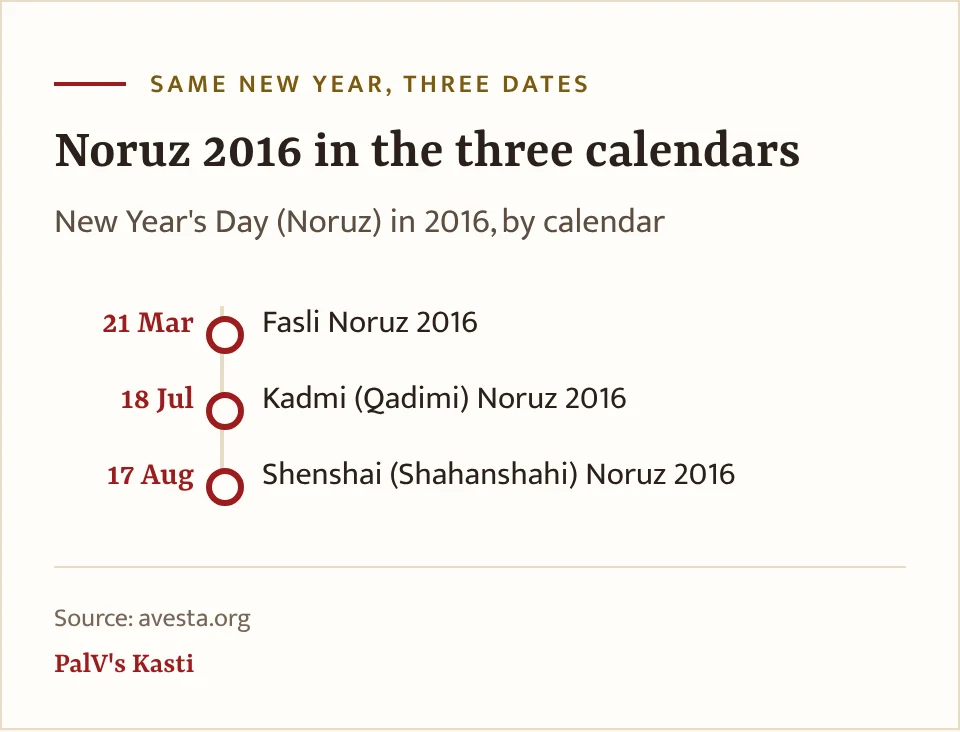
The avesta.org calendar page shows what this does to dates. For 2016 it gives the New Year (Noruz) as 21 March in the Fasli calendar, 17 August in the Shahanshahi calendar and 18 July in the Qadimi calendar. One Gregorian day therefore has three possible Roj dates, and a Roj date means little until you know which calendar it belongs to. The reasons for the split are covered in Shenshai, Kadmi and Fasli: the difference between the three Parsi calendars, and the wider system in our guide to the Zoroastrian calendar. To look up a date in your own calendar, use our Parsi Roj calendar.
What is it called when the Roj and Mah have the same name?
When the day and the month share a name, the day is a Parab. FEZANA's lesson plan defines it as the day "when the day and month coincide", giving Adaryan Parabh (Adar Roj, Adar Mah) and Tirgan Parabh (Tir Roj, Tir Mah) as examples. Its glossary describes parab as an occasion when the Yazata or Ameshaspand of the day is also that of the month. The avesta.org calendar marks these days as "Name day feasts" and calls them "particularly sacred".
How are the five Gatha days written?
The five Gatha days aren't Roj of any month, so they aren't written as a Roj and a Mah. The Bundahishn calls them "the five supplementary days at the end of the month Spandarmad", and FEZANA's lesson plan says they are "5 additional days known as the Gathas days" that bring the year to 365. Each has its own name, and those names and their place in the year are covered in the five Gatha days.
Frequently asked questions
What are Roj dates?
Roj dates are dates in the Parsi calendar, written with the name of the day followed by the name of the month, such as Adar Roj, Adar Mah. Each month has 30 named days instead of numbered ones. Twelve such months plus five Gatha days make a 365-day year, as FEZANA's calendar lesson plan explains.
What is the Parsi Roj date for today?
It depends on which calendar you follow. The Shenshai, Kadmi and Fasli calendars share the same Roj and Mah names, but FEZANA notes that Kadmi runs one month apart from Shenshai and that Fasli begins its year on 21 March. Check today's Roj and Mah for your own calendar on our Parsi Roj calendar page.
Does the Roj change at midnight?
No. A Roj runs from sunrise to sunrise, as ZANC's calendar page states. FEZANA's glossary defines Ushahin, the last watch of the day, as running from midnight till sunrise, and Havan, the first watch, from sunrise. The Bundahishn likewise counts the day first and the night after it, so the hours before dawn belong to the previous Roj.
Why do Parsi dates use names instead of numbers?
Each of the 30 days in the Zoroastrian calendar is named after a divine being, so the name itself identifies the day. FEZANA's lesson plan says each day "has a name and not a number" and that the 30 Roj represent 30 Yazatas. Adar Roj, for instance, is the 9th day, and avesta.org glosses Adar as fire.
Is a Roj date the same in the Shenshai, Kadmi and Fasli calendars?
The names are the same, but the Gregorian dates aren't. The avesta.org calendar gives the 2016 Noruz as 21 March in the Fasli calendar, 18 July in the Kadmi and 17 August in the Shenshai. So the same Roj and Mah fall on different Gregorian days, and you should always say which calendar a Roj date follows.