PalV's Kasti
On this page
- What year is it in the Zoroastrian calendar right now?
- What does Y.Z. stand for?
- Why do Parsis count years from Yazdegerd III?
- When exactly does the Yazdegerdi era begin?
- How do you convert a Gregorian year to a Y.Z. year?
- What is the Zarathushtrian Religious Era (ZRE)?
- Is the Shahanshahi era the same as the Shahanshahi calendar?
- Frequently asked questions
The Zoroastrian calendar year is usually counted in the Yazdegerdi era, written Y.Z. or AY. This era numbers the years from the coronation of Yazdegerd III, the last Sasanian king, in 631 or 632 CE depending on the source. Parsi Khabar reported that Parsis welcomed 1395 Y.Z. at the Shenshai Navroz of 15 August 2025. The count goes up by one at every Navroz, so since Navroz in August 2026 the Shenshai year has been 1396 Y.Z. On the seasonal Fasli calendar the number turns over on 21 March instead: avesta.org's Fasli calendar moves to AY 1395 at Noruz on 21 March 2025, which makes the Fasli year from 21 March 2026 1396 as well. A second count, the Zarathushtrian Religious Era (ZRE), is used by some Zoroastrians and puts the year in the 3760s.
શહેરેવર રોજ
Shehrevar Roj, Tir Mah · 1396 Y.Z.
What year is it in the Zoroastrian calendar right now?
On 16 November 2026 it is 1396 in the Yazdegerdi count, but that only holds because every reckoning has already passed its New Year. Each calendar adds one to the year at its own New Year, and those New Years fall on different days. avesta.org's table for 2016 to 2021 lists Noruz on 21 March for Fasli, on 16 or 17 August for Shahanshahi and on 17 or 18 July for Qadimi (Kadmi). So the year numbers line up for part of the year and differ for the rest.
| Reckoning | Year changes at | Year on 16 November 2026 | How we know |
|---|---|---|---|
| Shenshai (Shahenshahi) | Navroz, in August | 1396 Y.Z. | 1394 at Navroz 2024 (All India Radio), 1395 at Navroz 2025 (Parsi Khabar), plus one at Navroz 2026 |
| Fasli | Navroz, 21 March | 1396 Y.Z. (AY) | AY 1395 from 21 March 2025 (avesta.org), plus one on 21 March 2026 |
| Kadmi | Kadmi New Year, about a month before the Shenshai one | Same Yazdegerdi count | No published Kadmi year label found outside our own calendar, which shows 1396 |
| ZRE | 21 March | 3764 ZRE | 3739 began on 21 March 2001 (Ali A. Jafarey), plus 25 |
The 1396 and 3764 figures are our own arithmetic from those published anchors. All India Radio reported Navroz greetings on 15 August 2026 and on 21 March 2026, which confirms both New Years have passed this year. Our Parsi Roj calendar for 2026-27 follows the Shenshai reckoning and is labelled 1396 Y.Z. Use it for today's Roj and Mah.
Between 21 March and the August Navroz, a Fasli family has already moved to the new number while a Shenshai family hasn't. In 2025, for example, the Fasli year 1395 began on 21 March and the Shenshai year 1395 began on 15 August. Navroz itself follows the five Gatha days that close the year, which we cover in the Gatha days on a Zoroastrian calendar app.
What does Y.Z. stand for?
Y.Z. stands for the Yazdegerdi era. The Zoroastrian Society of British Columbia describes its calendar years as "marked with the suffix Y.Z. (Yazdegerdi Era)". The same count also appears as AY: avesta.org's Fasli calendar labels its 2025 months AY 1394 and AY 1395.
Y.Z. and AY are two labels for one count. Parsi community news uses Y.Z., as in Parsi Khabar's 2025 headline "Happy New Year 1395 Y.Z."
Why do Parsis count years from Yazdegerd III?
Because their calendar dates its years from his accession. Encyclopaedia Britannica notes that the Parsis "continue to count the years from Yazdegerd's accession". Yazdegerd III was the last king of the Sasanian dynasty, reigning from 632 to 651, and he was killed at Merv, Britannica records. FEZANA's calendar lesson calls him the last Sassanian Zoroastrian king and says the Shenshai calendar takes its beginning from the start of his rule.
In the Encyclopaedia Iranica, Antonio Panaino writes that the Kadmi and Shenshai calendars are both dated from Yazdegerd's coronation. The Fasli calendar uses the same count too. avesta.org's 2025 Fasli calendar carries AY year numbers, and Ali A. Jafarey lists the Fasli, Shahenshahi and Qadimi calendars together as using the Yazdegerdi era.
Not everyone accepts this starting point. Jafarey, whose writings on the Zarathushtrian Religious Era are published by the Zarathushtrian Assembly, wrote that the Yazdegerdi era "has no religious significance at all". The Yazdegerdi count is still the one Parsi community news uses to mark each New Year. We set out both positions in the ZRE and Mazdayasni calendar debate.
When exactly does the Yazdegerdi era begin?
Sources don't agree on the year. Panaino's Encyclopaedia Iranica entry puts the coronation in 631 CE. Simone Cristoforetti, writing in Annali di Ca' Foscari, says the era is "believed to have started" with Yazdegerd's rise to the throne in 632 CE. The Zoroastrian Society of British Columbia and Jafarey also give 632.
There's a finer question too. Cristoforetti's 2014 study argues that the first Yazdegerdi year should fall in the third year of a four-year cycle, not the first year as current conversion tables assume. For day-to-day use this changes nothing. If you are converting an exact medieval date, it matters.
How do you convert a Gregorian year to a Y.Z. year?
Subtract 630 from the Gregorian year once your calendar's New Year has passed, and 631 before it. This is our own working, and it fits every published year number we checked.
- Find your calendar's New Year: 21 March for Fasli, Navroz in August for Shenshai.
- If the date is on or after that New Year, subtract 630 from the Gregorian year.
- If it is before, subtract 631.
| Date | Reckoning | Working | Y.Z. year | Published by |
|---|---|---|---|---|
| Navroz, 15 August 2024 | Shenshai | 2024 − 630 | 1394 | All India Radio |
| 21 March 2025 | Fasli | 2025 − 630 | 1395 | avesta.org |
| Navroz, 15 August 2025 | Shenshai | 2025 − 630 | 1395 | Parsi Khabar |
| January to February 2025 | Fasli | 2025 − 631 | 1394 | avesta.org |
Panaino's example in the Encyclopaedia Iranica, 1358 Yazdegerdi = 1989, fits the subtract-631 half of the rule.
For a ZRE year from 21 March onwards, add 1738. So 2001 + 1738 gives 3739, the year Jafarey says began on 21 March 2001, and 2026 + 1738 gives 3764.
What is the Zarathushtrian Religious Era (ZRE)?
It's a year count that tries to start from Zarathushtra's own mission instead of a king's reign. Ali A. Jafarey wrote that the early Zarathushtrians counted the ZRE from Nowruz, the vernal equinox, of 1737 BCE, and he linked that date to the day Zarathushtra proclaimed his mission. According to Jafarey, the Zarathushtrian Assembly has observed this era since its founding in 1990, and the Zartoshti community in Iran began to observe it in 1993. He credited the calculation to the late Iranian scholar Zabih Behruz.
Jafarey also wrote that followers of the Shahenshahi calendar, which he calls the calendar of most Parsis, and of the Qadimi calendar use the Yazdegerdi era. So the two counts exist side by side, and you'll see both. The arguments for and against the ZRE, and the related "Mazdayasni calendar" proposals, have their own article: see the ZRE era debate.
Is the Shahanshahi era the same as the Shahanshahi calendar?
No. The Shenshai or Shahenshahi calendar of the Parsis counts its years in Y.Z. The "Shahanshahi era" was a separate, short-lived civil era of the Iranian state.
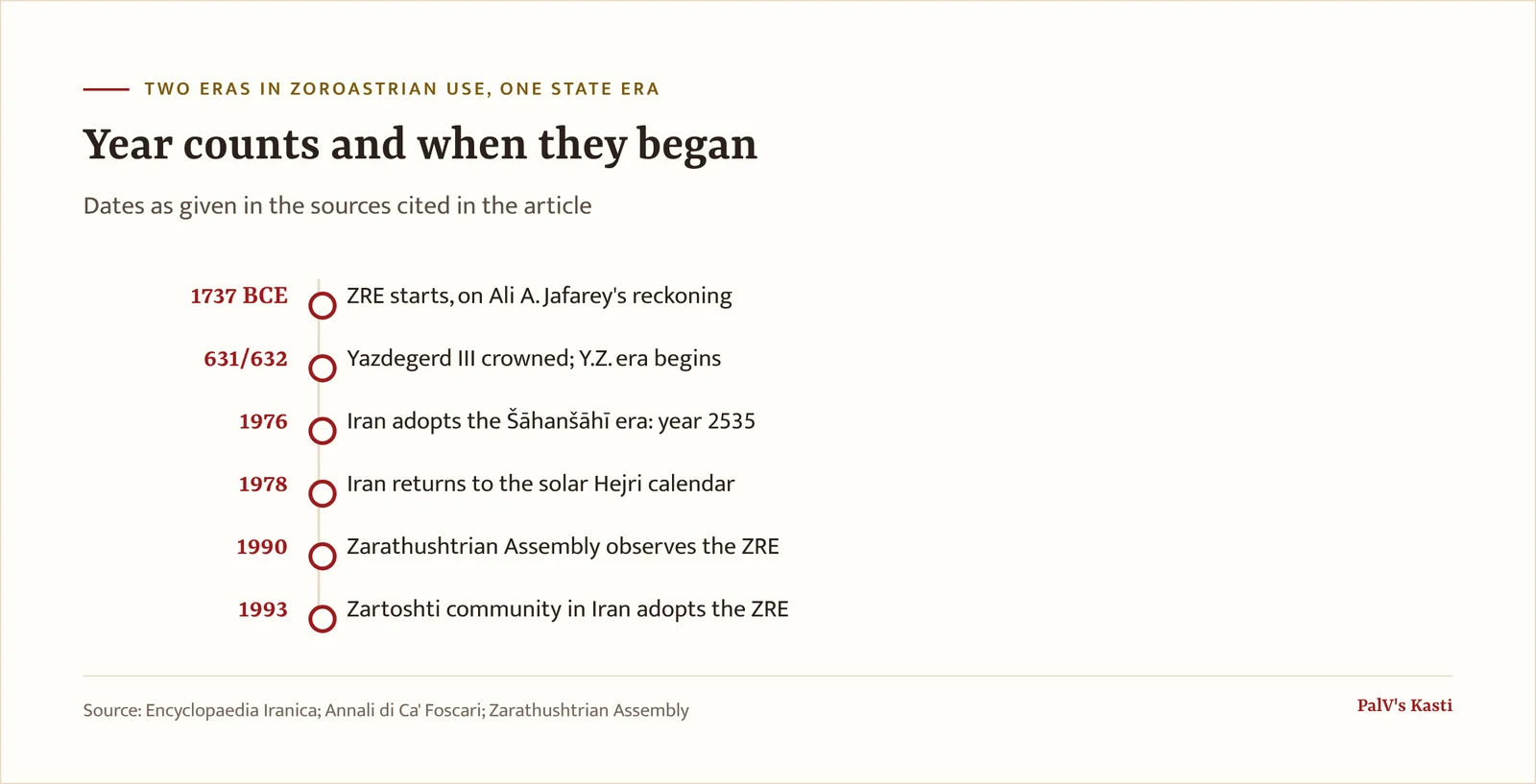

Writing in the Encyclopaedia Iranica, Reza Abdollahy records that Iran adopted a new era based on the accession of Cyrus the Great, so that 21 March 1976 became Nowruz of the year 2535 in the Šāhanšāhī era. Ehsan Yarshater's chronology in the Encyclopaedia Iranica gives the same year, 2535, and notes the change was "resented by the clergy". Abdollahy dates the return to the solar Hejri calendar to 27 August 1978, in the face of the coming revolution. A year such as 2535 is therefore not a Zoroastrian religious year. For how the Parsi calendars relate to the Iranian solar calendar, see the Zoroastrian calendar compared with the Gregorian and Iranian calendars.
For the wider picture of Roj, Mah and the three reckonings, start with our guide to the Zoroastrian calendar and the difference between Shenshai, Kadmi and Fasli. To read the year, Roj and Mah on a printed calendar, see how to read a Parsi Roj calendar.
Frequently asked questions
What is the current Parsi year?
For most Parsis in India, who follow the Shenshai calendar, the current year is 1396 Y.Z. Parsi Khabar reported that the count reached 1395 Y.Z. at Navroz on 15 August 2025, and it moved on by one at Navroz in August 2026. Fasli reckoners have also been in 1396 since 21 March 2026.
What does Y.Z. mean in the Parsi calendar?
Y.Z. means the Yazdegerdi era, the year count that starts from the coronation of Yazdegerd III, the last Sasanian king, in 631 or 632 CE depending on the source. avesta.org's Fasli calendar writes the same count as AY. A Parsi year such as 1396 Y.Z. is a year in this era.
What is today's date in the Zoroastrian calendar?
A Zoroastrian date has three parts: year, Mah (month) and Roj (day). On 16 November 2026 the year is 1396 Y.Z. in both the Shenshai and Fasli reckonings. The reckonings start their years on different days, so the same day carries a different Roj and Mah in each. Our Parsi Roj calendar page shows them.
Why do some Zoroastrians write a year like 3764?
A number in the 3700s comes from the Zarathushtrian Religious Era (ZRE), not the Yazdegerdi era. Ali A. Jafarey dated the ZRE from the vernal equinox of 1737 BCE. On his figures, 3739 began on 21 March 2001, which makes the year that began on 21 March 2026 3764 ZRE.
Do Shenshai, Kadmi and Fasli use different year numbers?
No. Shenshai, Kadmi and Fasli all count from Yazdegerd III, but each calendar adds one to the year at its own New Year. Fasli turns over on 21 March and Shenshai at Navroz in August, so between those two dates a Fasli year is one ahead of the Shenshai year for the same day.
Is 2535 a Zoroastrian year?
No. 2535 belongs to the Šāhanšāhī era that the Iranian state brought in from 21 March 1976, counted from the accession of Cyrus the Great. The Encyclopaedia Iranica records that the government went back to the solar Hejri calendar on 27 August 1978. It has nothing to do with the Parsis' Shenshai calendar, which counts in Y.Z.