PalV's Kasti

On this page
- How do the calendars compare at a glance?
- How does the Zoroastrian year differ from the Gregorian year?
- How close is the Fasli calendar to the Gregorian?
- How is the Iranian solar calendar related to the Zoroastrian calendar?
- Why does the same month name start on different days?
- Which calendar should Zoroastrians follow?
- Frequently asked questions
The Zoroastrian religious calendar has a 365-day year made of 12 months of 30 days each, plus five Gatha days at the end, and every day carries a name rather than a number. That's how FEZANA's calendar lesson for students sets it out. The Gregorian calendar has no block of extra days. It adds a leap day, 29 February, by the rule of four, 100 and 400. Iran's official calendar, the Solar Hijri, uses the same twelve month names as the Zoroastrian calendar in Persian form, but it gives its first six months 31 days and starts the year at the March equinox. Among the Zoroastrian reckonings, the Shenshai and Kadmi calendars keep a 365-day year with no regular leap day, so their Navroz has moved through the seasons and the Shenshai Navroz now falls in August. The Fasli calendar fixes its Navroz on 21 March and adds a leap day every fourth year.
શહેરેવર રોજ
Shehrevar Roj, Tir Mah · 1396 Y.Z.
How do the calendars compare at a glance?
| Feature | Shenshai and Kadmi | Fasli | Gregorian | Iranian Solar Hijri |
|---|---|---|---|---|
| Months | 12 of 30 days | 12 of 30 days | 12, with 29 February added in leap years | 6 of 31, 5 of 30, 1 of 29 or 30 |
| Extra days at year end | 5 Gatha days | 5 Gatha days | None | None |
| Leap day | None, a 365-day year | One every fourth year, after the Gatha days | Every fourth year, except century years not divisible by 400 | Set by the Jalali rule of intercalation |
| New Year | Moves through the seasons, now in August for Shenshai | Fixed on 21 March | 1 January | Navroz, fixed at the March equinox |
| Year count | Yazdegerdi era (Y.Z.) | Not stated in our sources | Not covered here | From AD 622 |
How does the Zoroastrian year differ from the Gregorian year?
The first difference is the extra quarter-day. The U.S. Naval Observatory puts the cycle of the seasons, the tropical year, at "approximately 365.2422 days", and Britannica gives the astronomical year as "about 365.242 days". The Gregorian calendar absorbs the gap with leap days. Years divisible by 4 are leap years, except century years that can't be divided evenly by 400, and the USNO says this gives an average calendar year of 365.2425 days. Britannica states the same century rule, with 1600 and 2000 as its examples.
The Shenshai year is a fixed 365 days. The Zoroastrian Association of Northern California (ZANC) sets it against the Gregorian calendar, which handles a solar year of "around 365 1/4 days" by adding a leap day every four years. The Zoroastrian Society of British Columbia (ZSBC) says the Shenshai calendar drifted because leap-year adjustments "were not consistently applied".
Mary Boyce, in the Encyclopaedia Iranica, describes the result. A 365-day calendar "slipped back slowly" against the seasons, she writes, and lost a month every 120 years. ZSBC adds that the Zoroastrian New Year "now falls in August". In 2026 the Government of Maharashtra's holiday list put Parsi New Year (Shahenshahi) on Saturday, 15 August, and the Prime Minister's Office posted Navroz greetings the same day. For a future year, check our Parsi calendar rather than counting forward yourself. Our article on the astronomy behind the Parsi calendar works through the drift.
Month shapes differ too. Every Zoroastrian month has exactly 30 days, and FEZANA notes that the five Gatha days are added after the twelfth month to make 365. Why the year is built this way is the subject of our article on the Zoroastrian calendar's 360 days plus 5, and the days themselves are covered in the five Gatha days. Gregorian months aren't a uniform 30 days, and Britannica names 29 February as the intercalary, or leap, day.
The day starts at a different moment as well. M. N. Dhalla, in Zoroastrian Civilization (Oxford University Press, 1922), writes that the new day was counted "according to the Iranian calendar, from sunrise". A Gregorian date changes at midnight.
How close is the Fasli calendar to the Gregorian?
It's the Zoroastrian reckoning built to keep pace with the Gregorian year. FEZANA records that it was introduced in 1906 so that the year would begin on the spring equinox, 21 March. Boyce describes it as having "a fixed Nowrūz on 21 March", with one extra day inserted every fourth year after the epagomenae, the five extra days. ZANC names that leap day Avardad-sal-Gah and says it's "patterned after the Gregorian calendar's leap day". Antonio Panaino, also in the Encyclopaedia Iranica, calls the 1906 reform "a new calendar similar to the Gregorian".
The Fasli calendar keeps the Zoroastrian shape, though. ZANC confirms its year still has 12 months of 30 days and five Gatha days. Only the anchor to 21 March and the leap day tie it to the Gregorian year.
How is the Iranian solar calendar related to the Zoroastrian calendar?
The Solar Hijri is Iran's official calendar. Reza Abdollahy writes in the Encyclopaedia Iranica that the law making it the official Persian calendar was passed by the Majles on 31 March 1925.
Its month names come from the same source as the Zoroastrian ones. Abdollahy states that the months of the solar Hejri and Shahanshahi calendars "are named for the ancient Iranian months". Set the Parsi Mah names from FEZANA beside the Iranian names in the Persian course of the University of Texas at Austin, and they're the same twelve in the same order:
| No. | Parsi Mah (FEZANA spelling) | Iranian month (Persian form) |
|---|---|---|
| 1 | Fravadin | Farvardin |
| 2 | Ardibehesht | Ordibehesht |
| 3 | Khordad | Khordad |
| 4 | Tir | Tir |
| 5 | Amardad | Mordad |
| 6 | Shehrevar | Shahrivar |
| 7 | Meher | Mehr |
| 8 | Avan | Aban |
| 9 | Adar | Azar |
| 10 | Dae | Dey |
| 11 | Bahman | Bahman |
| 12 | Aspandarmad | Esfand |
The structure is where the two part ways. Abdollahy gives the Iranian month lengths as 31 days for each of the first six and 30 for each of the next five. The University of Texas course adds that Esfand, the last month, has 29 days, or 30 in a leap year. That adds up to the same 365 days as the Zoroastrian year. The Zoroastrian calendar keeps its five extra days together as the Gatha days. The Iranian calendar spreads them across its first six months.
The start rule is different too. Abdollahy explains that the 1925 reform set out to fix Navroz, the first day of the year, at the vernal equinox, and that leap years follow the Jalali rule of intercalation over a 128-year cycle. Iranian years are counted from AD 622, the epoch of the Hijri era. Shenshai and Kadmi years are counted from the coronation of Yazdegerd III, according to Panaino and ZSBC. Our article on counting Zoroastrian years covers the Y.Z. era.
Iranian Zoroastrian communities took up a solar reckoning of their own. Panaino records that "in Iran the Jalālī calendar" was adopted by several Zoroastrian communities, with the five or six extra days placed after the month Esfandarmad. The Pluralism Project at Harvard notes that the Fasli calendar is "most often followed by Irani Zoroastrians".
Why does the same month name start on different days?
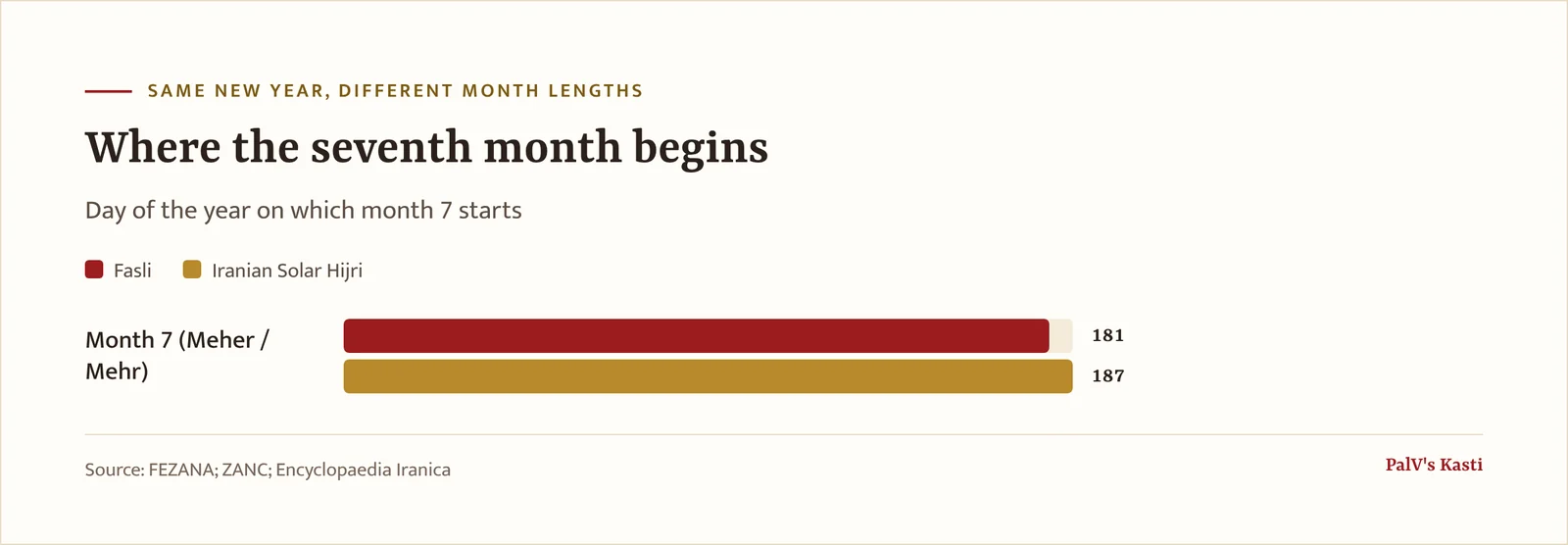
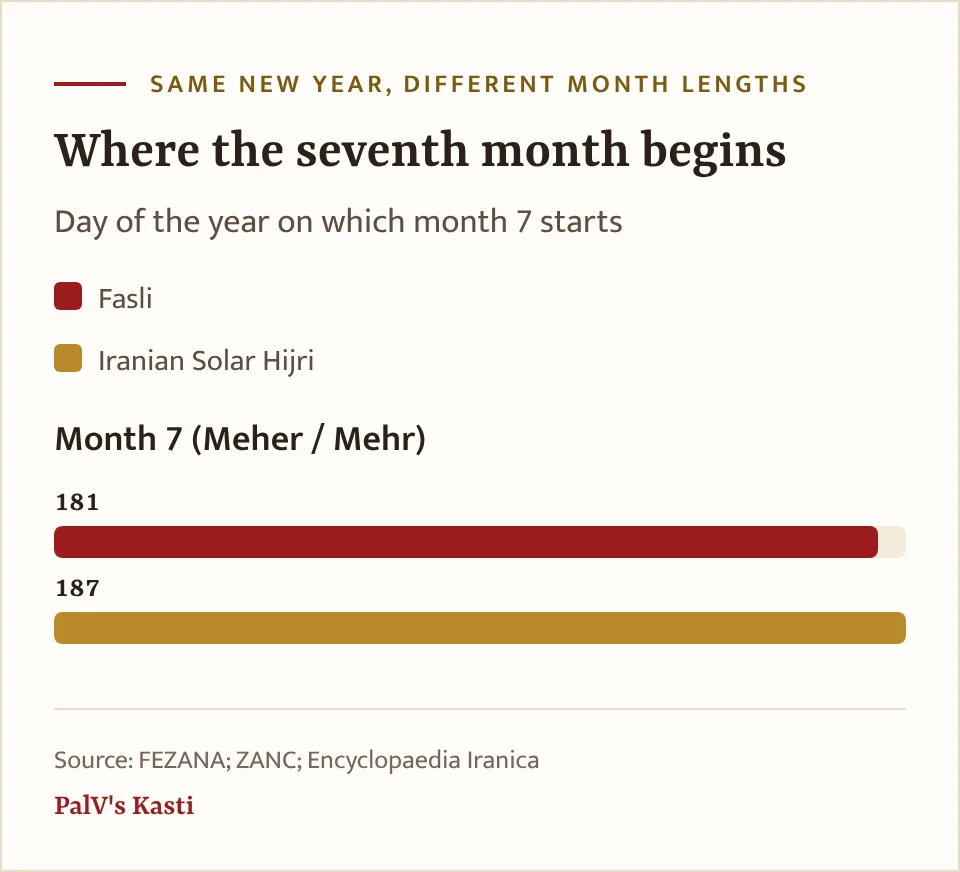
The 31-day months make the difference. Take a year in which the Fasli and the Iranian calendars both begin on the same day. Fasli months are 30 days long, so Fasli Meher, the seventh month, begins on day 181 of the year. Iranian months one to six are 31 days long, so Iranian Mehr begins on day 187. By the seventh month, two calendars that share a New Year are six days apart in their month names.
The gap closes by the end of the year. The Iranian calendar's last six months are shorter, and the Fasli year ends with its five Gatha days, so both come round to the next New Year together.
The Shenshai calendar is a separate case. Its months carry the same names again, but its year began on 15 August in 2026, so Shenshai Meher and Iranian Mehr fall in different seasons altogether. To match a Roj or Mah to a Gregorian date, use our Parsi calendar or our guide to converting dates between the Parsi calendars.
Which calendar should Zoroastrians follow?
This is debated, and we take no side. The Pluralism Project reports "much debate amongst Zoroastrians" over whether the community should adopt a unified calendar. ZANC records that the Kadmi, a group of Indian Zoroastrians who took up the Iranian count after an Iranian priest's visit in the 1700s, did so "believing it to be more authentic". Panaino notes that the rasmi, or Shenshai, Parsis answered that it was the Iranian community whose calendar was a month behind. The Fasli calendar was set up to start the year on 21 March and stay with the seasons. Our articles on the ZRE era and the Mazdayasni calendar and on Shenshai, Kadmi and Fasli set out each position, and the Zoroastrian calendar guide covers the whole system.
Practice varies between families and Agiaries; your family priest's guidance comes first.
Frequently asked questions
What is the Persian calendar?
The Persian, or Solar Hijri, calendar is Iran's official calendar, made law by the Majles on 31 March 1925. It has six months of 31 days, five of 30 and a last month, Esfand, of 29 or 30. Its year starts with Navroz at the March equinox, and its years are counted from AD 622.
When did the Fasli calendar begin?
FEZANA records that the Fasli calendar was introduced in 1906 to start the year on the spring equinox, 21 March. It keeps 12 months of 30 days and five Gatha days, but adds a leap day called Avardad-sal-Gah every fourth year, which ZANC says was patterned on the Gregorian leap day.
Does the Zoroastrian calendar have leap years?
It depends on the reckoning. The Shenshai and Kadmi calendars keep a 365-day year, and Mary Boyce notes that such a year slips against the seasons by a month every 120 years. The Fasli calendar adds one leap day every fourth year after the five Gatha days, which keeps its Navroz on 21 March.
Why is Parsi New Year in August but Iranian Navroz in March?
The Shenshai calendar, which FEZANA says Parsis brought from Iran to India, keeps a 365-day year with no regular leap day. Over centuries its New Year moved away from spring, and in 2026 it fell on 15 August. The Iranian calendar fixes Navroz at the March equinox, so the Iranian New Year stays in March.
Do the Parsi and Iranian calendars use the same month names?
Yes. Both use the twelve ancient Iranian month names in the same order, from Farvardin (Fravadin) to Esfand (Aspandarmad). The Parsi forms differ in spelling, such as Amardad for Mordad and Dae for Dey. The month lengths differ, so after the first month a Fasli month and its Iranian namesake begin on different days.