PalV's Kasti
On this page
- What does one day on a Parsi Roj calendar show?
- What are the Roj and the Mah?
- When does a new Roj begin?
- What do the Geh timings on the calendar mean?
- What is a parab on a Parsi calendar?
- How are the Gahambar and Muktad days shown?
- Why do the Shenshai, Kadmi and Fasli columns show different Roj?
- What other labels appear on a Parsi calendar?
- Frequently asked questions
A Parsi Roj calendar sets each English (Gregorian) date beside its Zoroastrian Roj, the named day, and its Mah, the named month. The Zoroastrian year has 12 Mah of 30 Roj each, and five Gatha days are added at the end to make 365 days. Days are known by name, not by number, and each of the 30 names belongs to a Yazata. When the Roj and the Mah carry the same name, the calendar marks a parab, a feast of that divinity. A calendar like ours also shows the five Geh timings, festival labels and the year in Y.Z., and it prints the Roj in all three reckonings: Shenshai (printed as Shahenshahi), Kadmi and Fasli. The three use the same names but fall on different dates.
શહેરેવર રોજ
Shehrevar Roj, Tir Mah · 1396 Y.Z.
What does one day on a Parsi Roj calendar show?
Take a single box from our own Parsi Roj calendar, the one for Monday, 16 November 2026. It reads "Shehrevar Roj, Tir Mah, 1396 Y.Z." for the Shenshai calendar, then "Kadmi Shehrevar Roj, Amardad Mah" and "Fasli Hormazd Roj, Adar Mah". Nine days later, on 25 November 2026, the same calendar carries the label "Tir Month Parab Jashan".
| Part of the entry | Example from our calendar | What it tells you |
|---|---|---|
| English date | Monday 16 November 2026 | The civil date |
| Roj and Mah | Shehrevar Roj, Tir Mah | The Shenshai day and month |
| Year | 1396 Y.Z. | The year in the Yazdegerdi era |
| Kadmi and Fasli | Shehrevar Roj, Amardad Mah · Hormazd Roj, Adar Mah | The same date in the other two reckonings |
| Label | Tir Month Parab Jashan (25 November 2026) | A parab: the Roj and Mah share a name |
You can check that box by hand. The Shenshai New Year fell on Saturday, 15 August 2026, according to the Government of Maharashtra's public holiday notification for 2026 and the Zoroastrian Association of Metropolitan Washington's event listing. Count from there and 16 November is the 94th day of the year. Ninety days fill the first three months, which makes it the 4th Roj of the fourth month. FEZANA lists Tir as the fourth Mah, and J.J. Modi gives the 4th day of the month as Shehrevar.
Our calendar does this counting for every day of the year, so you don't have to.
What are the Roj and the Mah?
The Roj is the day. FEZANA's teaching material on the calendar puts it simply: the "30 days or Roj represents 30 Yazatas". Mary Boyce, in the Encyclopaedia Iranica, describes the same scheme as one that dedicated every day of the month "to one of the yazatas". Modi, writing in Bombay in 1922, adds that each of the 12 months likewise "bears the name of the Yazata" believed to preside over it.
FEZANA lists the 12 Mah in this order: (1) Fravadin, (2) Ardibehesht, (3) Khordad, (4) Tir, (5) Amardad, (6) Shehrevar, (7) Meher, (8) Avan, (9) Adar, (10) Dae, (11) Bahman and (12) Aspandarmad. Our guides to the thirty Roj names and their meanings and the twelve Parsi months cover what each name means.
Ahura Mazda's name appears four times in every month. M.N. Dhalla notes that the 1st, 8th, 15th and 23rd days "of each month are also named after Ahura Mazda", which divides the month into two stretches of seven days and two of eight. Modi names those four days Hormazd, Dae-pa-Adar, Dae-pa-Meher and Dae-pa-Din.
The five Gatha days sit outside the 30-day pattern. They come after the twelfth month and take their names from the five Gathas, as Antonio Panaino records in the Encyclopaedia Iranica. FEZANA calls them the Gatha days. They're covered in our article on the five Gatha days.
When does a new Roj begin?
A Roj begins at sunrise, not at midnight. Dhalla states that "the new day was counted, according to the Iranian calendar, from sunrise". Modi lists Havan as the first Geh of the day and says it "begins with the dawn of the day". Ramiyar Karanjia, writing on his own website, also calls Havan the first Geh and Ushahin the last, with Ushahin running from midnight up to sunrise.

So the Roj printed against an English date runs from that morning's sunrise. The hours between midnight and sunrise fall in the Ushahin Geh, the last Geh of the Roj that began the previous morning. If a birth, a death or a ceremony fell in those hours, confirm the Roj with your family priest before you record it.
What do the Geh timings on the calendar mean?
A Geh is one of the five periods into which each day is divided for ritual and prayer. Havan starts at sunrise, and Uziran gives way to Aiwisruthrem at sunset, so those boundaries move with the season and from town to town. The noon, 3 pm and midnight changes are tied to the clock, but even those depend on whose clock you follow.
Ramiyar Karanjia gives these timings, with the Indian Standard Time (IST) figures used in India:
| Geh | Standard timing | Timing in IST (India) |
|---|---|---|
| Havan | Sunrise to 12:00 noon | Sunrise to 12:38 pm |
| Rapithwan | 12:00 noon to 3:00 pm | 12:38 pm to 3:38 pm |
| Uziran | 3:00 pm to sunset | 3:38 pm to sunset |
| Aiwisruthrem | Sunset to midnight | Sunset to 12:38 am |
| Ushahin | Midnight to sunrise | 12:38 am to sunrise |
Modi's 1922 description matches the standard column, with Havan from dawn to noon, Rapithwan from noon to three, and Ushahin from midnight to dawn.
Why the odd 38 minutes? Geh changes follow local time, and IST is set for a longitude east of Mumbai. The Weekly Zoroastrian Scripture Extract no. 297 on avesta.org puts Mumbai local time "39 mins. behind IST", which moves the Rapithwan change to 12:39 pm IST in Mumbai. It adds that the Udwada, Gujarat, one of the holiest Zoroastrian fire temples.">Iranshah Atash Behram at Udvada changes Geh by Mumbai time and uses 12:40 pm. Our own calendar prints 12:40 pm and 3:40 pm. A minute or two of difference between two calendars comes from whose reckoning each follows, and a family outside Mumbai and the Gujarat coast will be further out still.
Rapithwan isn't recited for part of the year. Karanjia explains that from the beginning of Avan Mah to the Vahishtoisht Gatha, the Havan Geh is recited in Rapithwan's time and is then called the biji (second) Havan. The calendar table on avesta.org, which gives Fasli dates, names the noon watch "Rapithwin or Second Hawan" and marks the Rapithwan season as beginning on 23 March and ending on 16 October. Our hub on the five Gehs and the article on Rapithwan Geh explain both in full.
Practice varies between families and Agiaries; your family priest's guidance comes first.
What is a parab on a Parsi calendar?
A parab is the day in each month when the Roj and the Mah have the same name. FEZANA's lesson plan says: "When the day and month coincide, it is known as a 'Parabh'". Boyce describes the day as one celebrated as a festival for that yazata "whenever a day- and month-name had the same dedication". Modi calls these days Jashan days, and the avesta.org calendar marks them as "Name day feasts".
Each month has one parab, except Dae, which has four because Ahura Mazda's four days all fall in his own month.
| Mah (number) | Parab Roj | Roj number |
|---|---|---|
| Fravardin (1) | Fravardin | 19 |
| Ardibehesht (2) | Ardibehesht | 3 |
| Khordad (3) | Khordad | 6 |
| Tir (4) | Tir | 13 |
| Amardad (5) | Amardad | 7 |
| Shehrevar (6) | Shehrevar | 4 |
| Meher (7) | Meher | 16 |
| Avan (8) | Avan | 10 |
| Adar (9) | Adar | 9 |
| Dae (10) | Hormazd, Dae-pa-Adar, Dae-pa-Meher, Dae-pa-Din | 1, 8, 15, 23 |
| Bahman (11) | Bahman | 2 |
| Aspandarmad (12) | Aspandarmad | 5 |
Roj numbers and pairings are from Modi's list of Jashan days, checked against the name-day feasts marked on avesta.org. Some parabs have their own names. FEZANA lists Tirgan, Mehergan and Adaryan, among others, and Modi records that on Avan Roj of Avan Mah hundreds of people, "especially the ladies", went to the sea-shore and riverbanks to pray.
Practice varies between families and Agiaries; your family priest's guidance comes first.
How are the Gahambar and Muktad days shown?
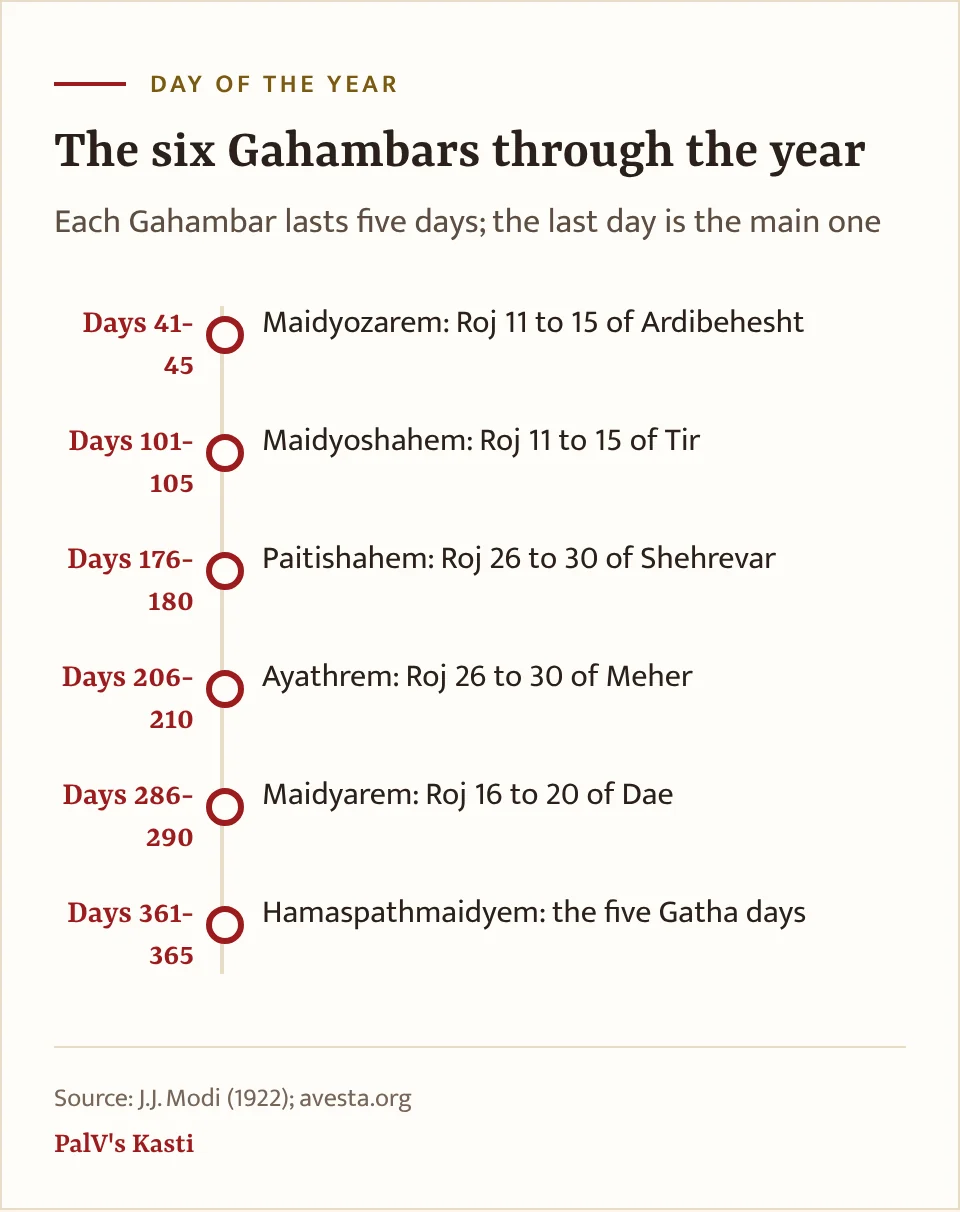
The six Gahambars are seasonal festivals of five days each. Modi gives their place in the year by day count, and the avesta.org calendar marks the same starting days:

| Gahambar | Days of the year | Roj and Mah |
|---|---|---|
| Maidyozarem | 41st to 45th | Roj 11 to 15 of Ardibehesht |
| Maidyoshahem | 101st to 105th | Roj 11 to 15 of Tir |
| Paitishahem | 176th to 180th | Roj 26 to 30 of Shehrevar |
| Ayathrem | 206th to 210th | Roj 26 to 30 of Meher |
| Maidyarem | 286th to 290th | Roj 16 to 20 of Dae |
| Hamaspathmaidyem | 361st to 365th | The five Gatha days |
The names are given in FEZANA's spelling. The last of the five days is the main one. Modi wrote that "the principal day of the Gahambar is the last day", and FEZANA notes that "nowadays it is the last day that is usually observed".
The Muktad, or Fravardegan, days are the last ten of the year. Modi dates them from Astad Roj, the 26th day of Aspandarmad, to the Vahishtoisht Gatha. FEZANA describes the same span as the last five days of the twelfth month together with the five Gatha days.
Practice varies between families and Agiaries; your family priest's guidance comes first.
Why do the Shenshai, Kadmi and Fasli columns show different Roj?
All three calendars use the same names for days and months, but they count from different starting points. Boyce writes that with three calendars in use, "the same festal days are celebrated, but on different dates". FEZANA says the Kadmi calendar "differs by one month" from the Shenshai, and that the Fasli calendar was instituted in 1906 to start the year on the spring equinox, 21 March. Boyce adds that the Fasli calendar intercalates a day every fourth year after the five Gatha days.
Our 16 November 2026 box shows the effect: Tir Mah in the Shenshai column, Amardad Mah in the Kadmi column one month ahead, and Adar Mah in the Fasli column.
Which reckoning is the right one has been argued over since at least 1720. The Encyclopaedia Iranica entry on calendars records that in 1720 Jamasb Welayati, a visitor from Kerman, found the Parsi calendar "a month behind that of Iran", while the majority of Parsis kept their count, called it rasmi ("traditional"), and held that it was the Iranian community that was a month behind. We take no side here. Our article on Shenshai, Kadmi and Fasli sets out each position.
What other labels appear on a Parsi calendar?
- Y.Z. The Zoroastrian Society of British Columbia explains the suffix as the Yazdegerdi Era, counted from the coronation of Yezdegerd III. The Encyclopaedia Iranica entry on calendars also dates the Shenshai and Kadmi years from Yazdegerd III's coronation. Our article on counting Zoroastrian years covers the era, and the ZRE era debate explains a proposed alternative count.
- Fire temple anniversaries. Boyce notes that every Parsi Atash Behram keeps a yearly festival for "the day of its sacred fire's enthronement", and Modi describes the Jashan recited on the anniversary of a fire temple. Our calendar lists these as Salgreh entries, for example three Adaran anniversaries, including the Adaran at Tavdi (now Navsari), on 21 November 2026.
- Humkara and unrojo days. FEZANA calls certain days "Humkara" days, giving Hormazd, Ardibehesht, Adar, Avan, Sarosh and Behram as examples. It also says some Parsis do not eat meat on the "unrojo" days of Bahman, Mohor, Gosh and Ram Roj. Modi records the same abstinence on Bahman Roj of Bahman Mah and on the 12th, 14th and 21st days of that month. Practice varies between families and Agiaries; your family priest's guidance comes first.
- Hindu tithi and Indian holidays. Our calendar prints Hindu tithis, Amas, full moons and Indian public holidays because Parsi families in India live by both calendars.
The Zoroastrian calendar hub explains how all these pieces fit into the year.
Frequently asked questions
How do I find today's Parsi Roj?
Open a Parsi Roj calendar and find today's English date. The box shows the Roj and Mah, and our calendar also shows the Kadmi and Fasli equivalents. For example, our calendar shows Monday, 16 November 2026 as Shehrevar Roj of Tir Mah in the Shenshai reckoning. Remember that the Roj changes at sunrise, not at midnight.
What calendar do Zoroastrians use?
Zoroastrians today use three religious calendars: Shenshai (Shahenshahi), Kadmi and Fasli. All three use the same names for the 30 Roj and 12 Mah. The Kadmi runs one month apart from the Shenshai, and the Fasli, introduced in 1906, starts its year on 21 March. So the same festival falls on different dates in each.
Which date was Parsi New Year 2026?
The Shenshai Parsi New Year in 2026 fell on Saturday, 15 August 2026. The Government of Maharashtra listed it as "Parsi New Year (Shahenshahi)" in its public holiday notification for 2026, and the Zoroastrian Association of Metropolitan Washington listed the same date. Kadmi and Fasli followers keep their New Year on other dates, because their calendars count the year differently.
What does parab mean on a Parsi calendar?
A parab is the day when the Roj and the Mah share the same name, such as Avan Roj of Avan Mah or Adar Roj of Adar Mah. It is kept as a feast of that divinity. Every month has one parab, except Dae Mah, which has four, because Ahura Mazda's four days fall in his month.
Why are some Geh times shown as 12:38 or 12:40 instead of noon?
Geh changes follow local time, but calendars printed in India use Indian Standard Time. Mumbai's local time is about 39 minutes behind IST, so local noon falls at about 12:38 to 12:40 pm on the clock. Ramiyar Karanjia gives 12:38 pm, and the Udvada Iranshah Atash Behram uses 12:40 pm.
What does Y.Z. mean on a Parsi calendar?
Y.Z. stands for the Yazdegerdi Era. Shenshai and Kadmi years are counted from the coronation of Yazdegerd III, the last Sasanian king. A Parsi calendar shows the Y.Z. year beside the Roj and Mah. Our calendar, for instance, shows Monday, 16 November 2026 as Shehrevar Roj of Tir Mah, 1396 Y.Z.