PalV's Kasti
On this page
- What is the Zarathushtrian Religious Era (ZRE)?
- Who introduced the ZRE, and who uses it?
- What is the "Mazdayasni calendar"?
- Why do supporters want a new era?
- What do critics and traditionalists say?
- Has calendar reform divided Zoroastrians before?
- How do you read a date written in ZRE or "Z"?
- Frequently asked questions
The Zarathushtrian Religious Era (ZRE) is a year count that some Zoroastrians use instead of, or next to, the traditional Yazdegerdi era (Y.Z.). One advocate, Ali A. Jafarey of the Zarathushtrian Assembly, counted it from the vernal equinox of 1737 BCE, a date he linked to the start of Zarathushtra's mission. On his figures the year that began on 21 March 2026 is 3764 ZRE. The "Mazdayasni calendar" published by Fariborz Rahnamoon uses the same kind of number, labelling 2016-17 as 3754 Z. Encyclopaedia Iranica's survey of Zarathushtra states that his date is not known. Meanwhile Parsi community news and FEZANA's teaching material still work in the Yazdegerdi count. Here is what each side says and where each claim comes from.
શહેરેવર રોજ
Shehrevar Roj, Tir Mah · 1396 Y.Z.
What is the Zarathushtrian Religious Era (ZRE)?
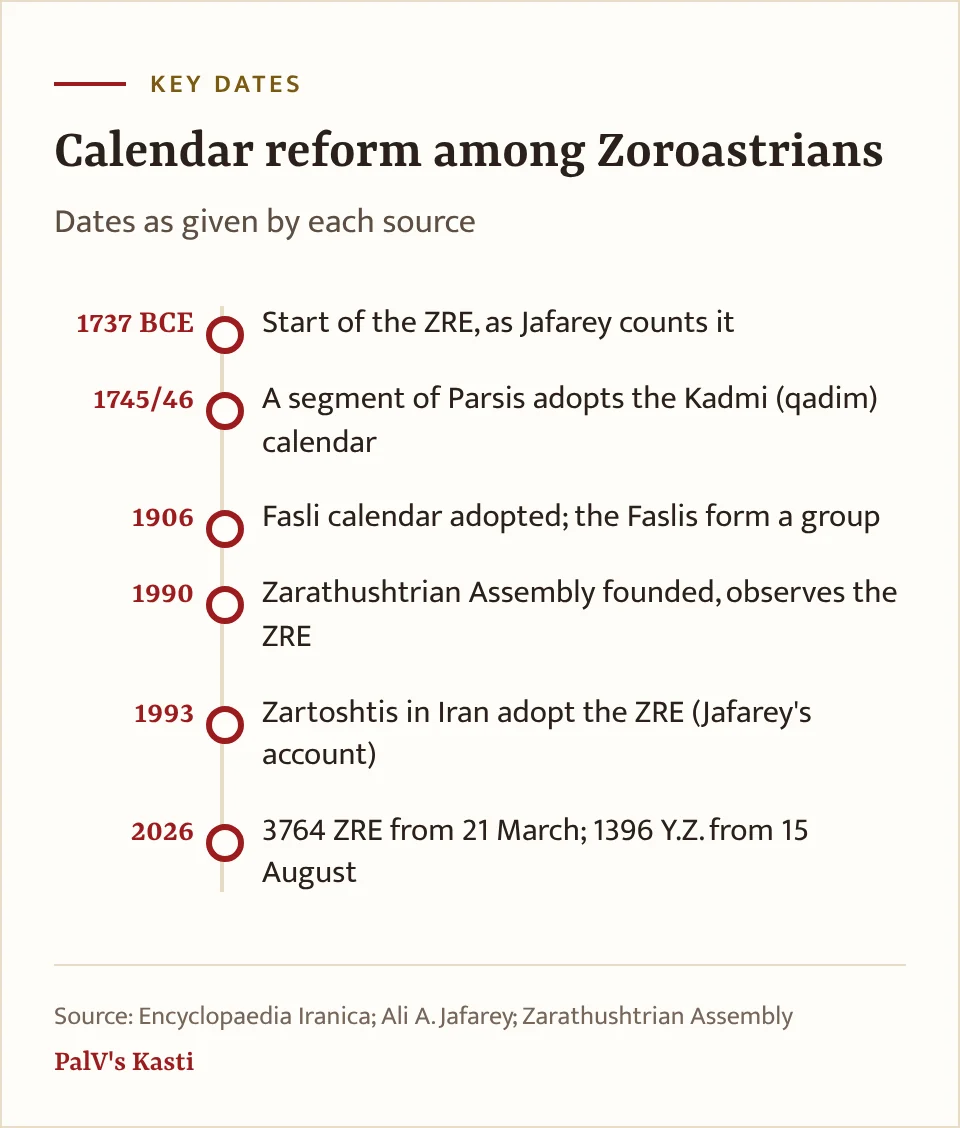
The ZRE is an era meant to start from Zarathushtra's mission rather than from a king's reign. Jafarey wrote that, according to Pahlavi writings, the religious era began on "the day Zarathushtra proclaimed his Divine Mission". He placed that proclamation on the vernal equinox, at the point when, by the precession of the equinoxes, the period of Aries was supposed to begin.

In a later article Jafarey gave the starting point as Nowruz, the vernal equinox, of 1737 BCE. He credited the precise calculation to the Iranian scholar Zabih Behruz.
On Zarathushtra's own date, William W. Malandra's survey in Encyclopaedia Iranica, which does not discuss the ZRE, quotes H. Lommel: "When and where Zaraθuštra lived, one does not know". Malandra notes that reputable scholars have proposed dates as early as about 1750 BCE, and argues that serious proposals fall between the mid-second millennium and the early 6th century BCE.
Jafarey's own year numbers show how the count runs:
| ZRE year | Began on | Other calendar given by Jafarey |
|---|---|---|
| 3739 | 21 March 2001 | none given |
| 3743 | 21 March 2005 | 1384 Khorshidi (Iranian solar year) |
Add one for each March equinox since, and the year that began on 21 March 2026 is 3764 ZRE. A calendar compendium compiled by Rohinton Erach Kadva lists the same figure, "1396 A.Y. (2026-2027 C.E.) 3764 ZRE".
Who introduced the ZRE, and who uses it?
The Zarathushtrian Assembly says Jafarey and six co-founders established it in Los Angeles in 1990, and describes its purpose as studying Zarathushtra's philosophy "as taught in the Gathas". Jafarey wrote that the Assembly "has, since its establishment in 1990, observed" the ZRE as the beginning of the Zarathushtrian calendar. In his account, Zoroastrians in Iran began in 1993 to "observe ZRE as its calendar". He described the era as "practically revived" by the Assembly, holding that it had been abandoned under the Achaemenian monarchy.
The ZRE also turns up beside the traditional count. Kadva's compendium of Fasli monthly calendars, compiled in Bangalore in 2009 "for common use of the entire Zoroastrian community", labels each year in its contents with both numbers: 1390 A.Y. sits beside 3758 ZRE, and 1400 A.Y. beside 3768 ZRE. In each pair the ZRE number is 2,368 higher than the A.Y. number.
We couldn't find a current statement from an Iranian Zoroastrian body saying how widely the 1993 adoption holds today, so we don't estimate it.
What is the "Mazdayasni calendar"?
The Mazdayasni calendar is a calendar proposal by Fariborz Rahnamoon. His explanatory text for the year 3754 Z, which covers 2016-2017, sets out the design:

- The year starts at the vernal equinox, which he says takes care of the leap year automatically.
- The first six months have 31 days, the next five have 30, and the last has 29 or 30.
- The 31st day of each of the first six months is called "Avardad", which he glosses as the Pahlavi for "extra day".
- Four festivals are marked: Now Rooz, Tirgan, Mehregan and Deygan (Yalda), at the two equinoxes and two solstices.
The text describes the calendar as "updated by Zarathushtra" and says he coined the name Now Rooz in 1725 BCE, after calculating that the sun would rise at Balkh on that year's equinox. It doesn't say how the number 3754 is worked out. That number does match the ZRE count: on Jafarey's figures, the year that began in March 2016 was 3754 ZRE.
The month pattern is the one Encyclopaedia Iranica gives for Iran's official solar Hejri calendar: six months of 31 days, five of 30, and a last month of 29 days, or 30 in a leap year. Jafarey's "precise Iranian calendar" uses the same pattern.
| Feature | Traditional Shenshai and Kadmi | ZRE / Mazdayasni proposals |
|---|---|---|
| Year count | From the coronation of Yazdegerd III | From the vernal equinox of 1737 BCE (Jafarey), "Z" years (Rahnamoon) |
| Months | 12 months of 30 days plus 5 Gatha days, 365 days | Six of 31, five of 30, one of 29 or 30 |
| New Year | Shenshai Navroz in August (15 August in 2026) | Vernal equinox |
| Year on 16 November 2026 | 1396 Y.Z. (Shenshai) | 3764 ZRE |
Why do supporters want a new era?
Supporters object to dating the faith from a king. Jafarey wrote that the Yazdegerdi era is based on the accession of Yazdegerd III and "has no religious significance at all". He added that the era "reminds one of the last Emperor", the king overthrown by the Arab invasion. He also judged the existing calendars "neither precisely 'Gathic' nor astronomically scientific".
Accuracy is the second argument. Jafarey wrote that a New Year fixed "exactly at the beginning of the equinox" removes any need to worry about leap years. Rahnamoon calls the Mazdayasni calendar "the most accurate calendar that has ever existed". His text also says the Arab conquerors "imposed their inferior lunar calendar" on Iranians, and that the Parsis who settled in Gujarat lost track of the ancient calendar.
What do critics and traditionalists say?
The first critique concerns the man Jafarey credits with the 1737 BCE calculation. Encyclopaedia Iranica's entry on Zabih Behruz (1889 to 1971), by Paul Sprachman, describes him as a Persian satirist. It reports that he calculated Zarathushtra's birth and death "to the precise day", putting the death on 1 January 1691 BC at the age of 77. The entry points to "a barbed review" of his calendar book Taqwīm by Mojtaba Minovi in 1953, and says Behruz's scholarship was "subject to gross distortions". Rahnamoon's 1725 BCE date sits against the same background: Malandra's survey says the date of Zarathushtra himself isn't known.
Then there is plain practice. Parsi Khabar greeted the Shenshai New Year of 15 August 2025 as "1395 Y.Z.", and our own Parsi calendar prints 1396 Y.Z. for the year that began on 15 August 2026. FEZANA's calendar lesson dates the Shenshai calendar from the beginning of the rule of Yazdegerd III. Jafarey himself noted that Shahenshahi, Qadimi and Parsi Fasli Zoroastrians follow the Yazdegerdi era.
We haven't found a published statement from a Parsi priestly body on the ZRE era itself. The nearest priestly debate we could trace concerned the seasons, not the era. In 1994 Dr Kersey H. Antia, arguing for a season-based calendar, wrote about how Dasturjis Mirza, Jamasp Asa and Kotwal responded to what he called "the recent movement for a unified Zarthoshti calendar", one based on the seasons. Antia quotes them as saying that the Fasli calendar "cannot boast of correcting" a system "prevalent since times immemorial".
Has calendar reform divided Zoroastrians before?
Yes. The Encyclopaedia Iranica entry on calendars records that in 1745, or 1746 by other accounts, one segment of the Parsis adopted the Persian calendar and called it qadim, "old", while "the majority of Parsis, however, rejected this innovation". In 1906 a new calendar similar to the Gregorian was adopted in an attempt to settle the matter. It "provoked the formation of a new group", the Faslis, concentrated in western India. The entry adds that the old "hostility and polemics" are today "only a memory". That history is told in full in our article on the 18th-century Kadmi split, and our guide to Shenshai, Kadmi and Fasli sets the three calendars side by side.

How do you read a date written in ZRE or "Z"?
To turn a ZRE year into the Fasli year count, take away 2,368. That gap holds in every pair Kadva lists, from 3758 ZRE = 1390 A.Y. to 3768 ZRE = 1400 A.Y. So 3764 ZRE corresponds to 1396.
- Check the New Year. A ZRE year starts at the March equinox.
- Subtract 2,368 to get the Fasli A.Y. number, which is also the Shenshai Y.Z. number from Navroz in August onwards.
- Remember that a Shenshai family moves to the new Y.Z. number only at Navroz in August. Between 21 March and 14 August 2026, 3764 ZRE overlapped with 1395 Y.Z. in the Shenshai count.
A "Z" year on Rahnamoon's calendar, such as 3754 Z for 2016-2017, reads the same way. For the full method of counting Zoroastrian years, including Gregorian conversion, see counting Zoroastrian years, and for how a Y.Z. year appears in a calendar box, see how to read a Parsi Roj calendar. For the reasons behind the 30-day months and the five Gatha days of the traditional calendar, see the 360+5 structure. For how the Iranian solar calendar compares, see the Zoroastrian calendar compared with the Gregorian and Iranian calendars. And for the whole system, start from the Zoroastrian calendar.
Frequently asked questions
What does ZRE stand for?
ZRE stands for Zarathushtrian Religious Era, also written Z.E.R. It is a year count that Ali A. Jafarey of the Zarathushtrian Assembly dated from the vernal equinox of 1737 BCE, which he linked to the day Zarathushtra proclaimed his mission. It is an alternative to the traditional Yazdegerdi era, Y.Z.
What year is it in the ZRE?
From 21 March 2026 the year is 3764 ZRE. Jafarey gave 21 March 2001 as the start of 3739 ZRE, and each March equinox adds one. Rohinton Kadva's calendar compendium lists 3764 ZRE beside 1396 A.Y. for 2026-2027, and pairs every ZRE year with an A.Y. year at a fixed gap of 2,368.
Who uses the Zarathushtrian Religious Era?
Ali A. Jafarey wrote that the Zarathushtrian Assembly, founded in Los Angeles in 1990, has observed the ZRE since its founding. He also wrote that the Zartoshti community in Iran began observing it in 1993. Parsi community news continues to number the New Year by the Yazdegerdi era, Y.Z.
What is the Mazdayasni calendar?
The Mazdayasni calendar is a proposal published by Fariborz Rahnamoon, labelled 3754 Z for 2016-17. It starts each year at the vernal equinox and uses six 31-day months, five 30-day months and a last month of 29 or 30 days. That is the same month pattern as Iran's official solar Hejri calendar.
Do Parsi priests accept the ZRE?
We have not found a published statement by a Parsi priestly body on the ZRE era itself. Parsi community news and FEZANA's teaching material use the Yazdegerdi count. In 1994, Dr Kersey Antia reported three Dasturjis opposing a separate, season-based unified calendar movement. That dispute was about seasons, not the era.
Is Zarathushtra's date known?
No. William W. Malandra's survey in Encyclopaedia Iranica quotes H. Lommel that when and where Zarathushtra lived is not known. Malandra notes that reputable scholars have proposed dates as early as about 1750 BCE. He places serious proposals between the mid-second millennium and the early 6th century BCE, and treats the traditional Pahlavi date with caution.