PalV's Kasti
On this page
- What started the Kadmi and Shenshai dispute?
- When did the Kadmis break away, and who led them?
- What did each side argue about the leap month?
- How did the dispute move from Surat to Bharuch and Bombay?
- How bitter did the Kabisa controversy become?
- Was either side right?
- Are Kadmis and Shenshais still divided today?
- Kadmi split timeline: what happened when?
- Frequently asked questions
The Kadmi split began in Surat in 1720-1721, when Dastur Jamasp Vilayati, a priest from Kerman in Iran, found that the Parsi religious calendar and the Iranian one were a month apart. Some Surat Zoroastrians then started following the Iranian reckoning, and in 1745 (1746 in two other accounts) a Surat group led by Dastur Kaus Fardunji Monajjem formally dropped a month to match Iran. They took the name Kadmi, from the Arabic qadim, "old, ancient". Most Parsis kept the calendar they already had and became known as Shenshais. The quarrel that followed, remembered as the Kabisa (intercalation) controversy, spread to Bharuch and Bombay and was still being fought in Bombay in the 19th century.
For how the three calendars differ today, see our guide to Shenshai, Kadmi and Fasli calendars.
શહેરેવર રોજ
Shehrevar Roj, Tir Mah · 1396 Y.Z.
What started the Kadmi and Shenshai dispute?
It started with a visitor. Wealthy Zoroastrians in Surat invited Dastur Jamasp Vilayati from Kerman to advise them on religious questions, and Ramiyar P. Karanjia's Encyclopaedia Iranica entry on the Kadmis says he left Surat in October 1721 to return to Iran by way of Bombay. John R. Hinnells, also writing in the Encyclopaedia Iranica, dates his arrival in Surat to 1720. Dosabhai Framji Karaka's 1884 History of the Parsis gives the year in the Parsi era as Yazdegerdi 1090.
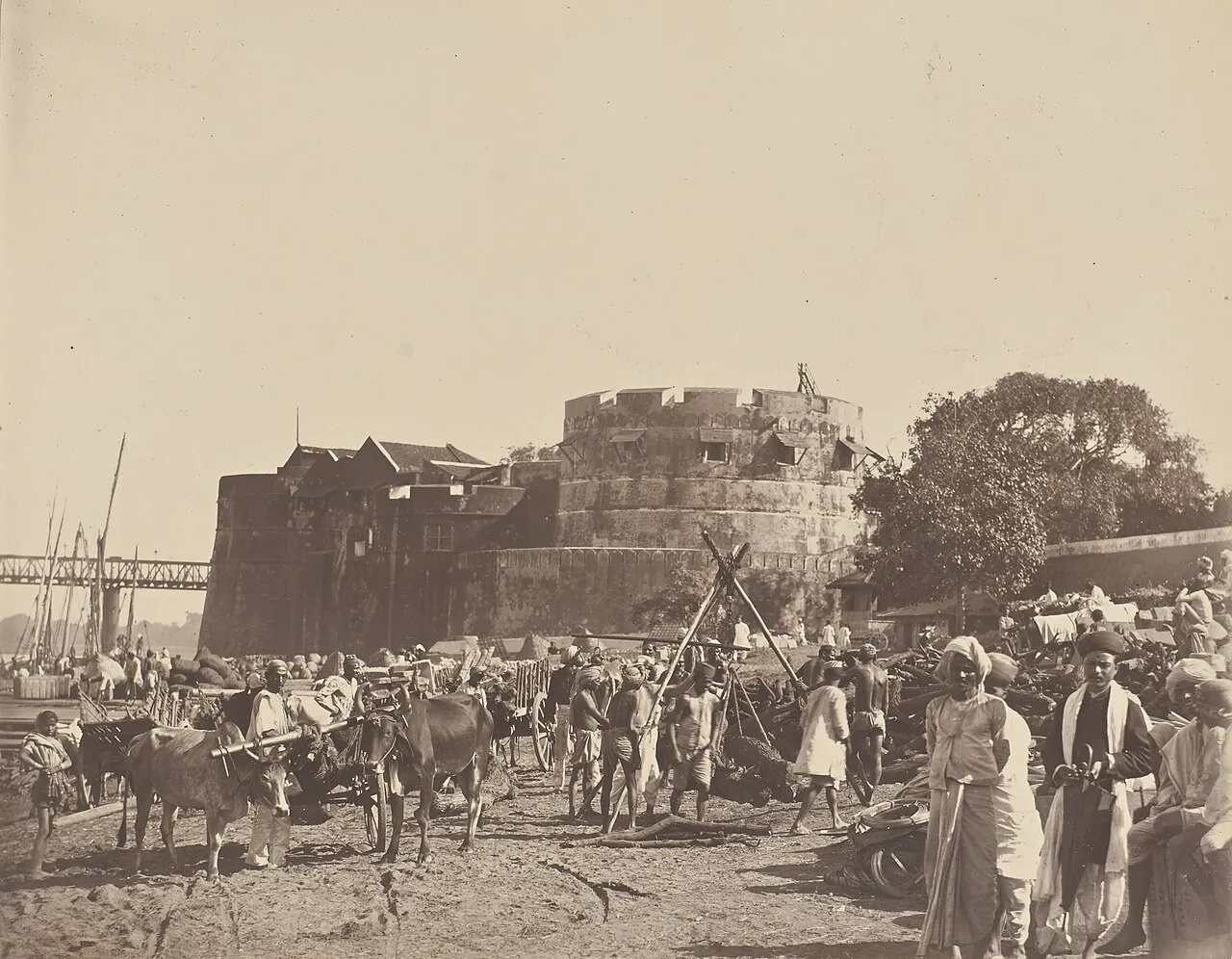
He found the two reckonings a whole month apart. Our sources describe his reaction differently:
- M. N. Dhalla (1938) says Jamasp found the Indian Parsis "one month behind the Zoroastrians of Persia" and "strongly advocated a reform in the matter".
- Hinnells says Jamasp held back from making the discrepancy public, because Surat was already divided over funeral practices. Instead he taught Zand and Pahlavi to three priests: Dastur Darab (Kumana Dadaru) of Surat, Dastur Kamdin of Broach and Dastur Jamaspasa of Navsari.
On Jamasp's advice, Hinnells writes, a layman named Maneckji Edulji A. Dalal began praying by the qadmi calendar, which caused further disputes. Karanjia also records that some Surat Zoroastrians adopted the Iranian calendar after the visit, and that this created tensions in the community.
When did the Kadmis break away, and who led them?
The formal break came more than twenty years after Jamasp's visit. Karanjia and Hinnells agree that in 1736 an Iranian layman named Jamshid, well versed in astronomy, came to Surat and began explaining the difference between the Iranian and Parsi calendars. He taught astronomy to a Surat priest, Dastur Kaus Fardunji Monajjem, who concluded that Jamshid was right. Hinnells spells the name Murzban Kaus Fredun Munajjam and gives his dates as 1717-1779.
Karanjia records that Monajjem's group became the first Parsis in Surat to follow the Iranian calendar. They "dropped a month", counting the eighth month, Aban, as the ninth, Adar, and Monajjem became the first Kadmi dastur.
The year of that change is not settled in our sources:
| Source | Year given | Who it credits |
|---|---|---|
| Karanjia, Encyclopaedia Iranica "Kadimi" (2009) | 1745 | Dastur Kaus Fardunji Monajjem's group in Surat |
| Boyce and Kotwal, Encyclopaedia Iranica "Dadyseth" (1993) | 1746 | "the Kadmi movement (started in Surat in 1746)" |
| Karaka, History of the Parsis (1884) | Yazdegerdi 1114, or 1746 | "an Irani named Jamshid", with a few mobeds |
| Panaino, Encyclopaedia Iranica "Calendars iv" (1990) | 17 June 1745; notes that Boyce (1979) and Hinnells (1981) give 1746 | one section of the Parsi community |
Antonio Panaino is the only source we opened that gives an exact day, and he takes it from the scholar James Darmesteter. We have not found a second source that confirms 17 June, so treat the day as his.
What is agreed is where it happened. Karaka puts it plainly: Surat is where "the Parsis were first divided into two sects". Those who changed called themselves Kadmis. Dhalla renders the two names as "the Ancients" for the Kadmis and "the Imperials" for the Shenshais, and Hinnells links Shenshai to the Persian šāhanšāhi, "royal". In Karaka's words, "the bulk of the people" kept the old date and became known as Shehenshais, as he spells it.
What did each side argue about the leap month?
The argument was about kabisa, the intercalation of an extra month. Karaka sets out the two positions as they were argued in his time, and we report them as he does, without taking a side.
- **The Shenshai case:** the religion acknowledged one month's intercalation at the end of every 120 years. One such intercalation was made while the Parsis' ancestors lived in Khorasan, but the practice was not continued in India, which is why the Shenshai date sat a month behind the Kadmi one.
- **The Kadmi case:** "intercalation was forbidden in the Zoroastrian calendar" and had "occurred in political calculations alone". The Kadmis held that no such intercalation ever took place in Khorasan.
Historian Dan Sheffield reads the quarrel as being about more than arithmetic. In his account, one side kept the Indian calendar and stopped recognising the priestly authority of Iran, while the other kept Iran at the centre of Zoroastrian sacred history. "What was in effect at stake was the politics of memory," he writes.
The arithmetic of the one-month gap has its own page: why Kadmi and Shenshai New Years are a month apart.
How did the dispute move from Surat to Bharuch and Bombay?
Bharuch and Surat both became Kadmi strongholds, Karanjia writes. The next step was led from Surat by a businessman, Dhunjishah Manjishah, who became leader of the Kadmis. He sent Kaus Rustam Jalal, whom Karaka describes as a learned priest of Broach (Bharuch), to Iran with questions on the calendar. Kaus Jalal stayed twelve years and studied intercalation there, returning to India in 1780.
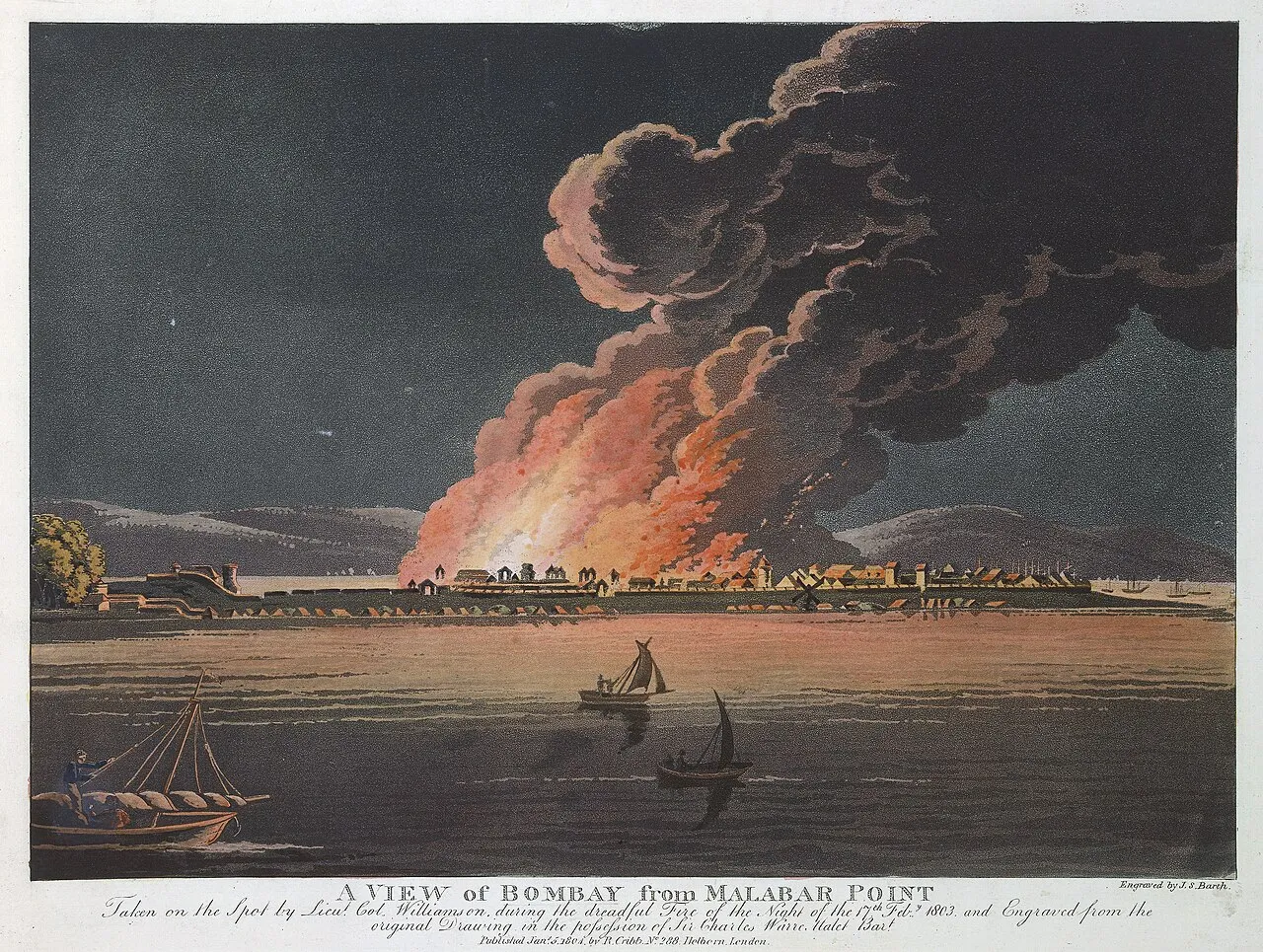
Bombay is where the Kadmis built their lasting institutions. Mulla Kaus, as Kaus Jalal came to be known, persuaded the Bombay philanthropist Dadibhai Noshirwanji Dadyseth to join the Kadmi movement, and Dadyseth went on to found and endow an Atash Behram for the Bombay Kadmis. The Dadyseth Atash Behram was consecrated by Kadmi rites on Roj Sarosh, Mah Farvardin, 1153 Y.Z., which was 29 September 1783, with Mulla Kaus bringing Kadmi priests from Surat for the ceremony. Hinnells calls it the first Atash Behram in Bombay, and Kotwal and Boyce write that for nearly half a century it was the city's only one.
Mulla Kaus's son, Mulla Feroze, succeeded him as the Kadmi dastur.
How bitter did the Kabisa controversy become?
Bitter enough that the community split into two sects, each with its own places of worship, Dhalla writes. He adds that the Shenshais "annoyed the latter by their mocking derision", that ordinary people took the quarrel up, "resorting to abuses and sometimes even to blows", and that social relations between the two groups became "most strained".
It did not stop at words. Karaka writes that the Parsis of Broach "grew furious on the subject" in 1782-83 and turned to violence. Karanjia's Iranica entry records that the clashes between Shenshais and Kadmis in those two years led to several deaths and imprisonments.
Paper was the main weapon. Dhalla mentions "innumerable tracts and pamphlets". Karaka describes newspapers and pamphlets for each party, English-language local journals filled with letters on the subject, and public meetings in Bombay called to argue the question. He names Edalji Dorabji Sanjana as the Shenshai chief dastur in that debate, and Mulla Kaus's successor and the priest Fardunji Marzbanji as "the two champions on behalf of the Kadmi sect". Sheffield confirms that rival priests kept publishing treatises in Bombay well into the 19th century.
One good thing came of it, in Dhalla's view. Priests on both sides went back to the original scriptures to prove their case, and the controversy "gave new life to literary activities".
Was either side right?
Our sources do not award the argument to either calendar, and neither do we. Dhalla wrote in 1938 that modern research had shown "both the parties were wrong" in their calculations. Karaka, writing in 1884, concluded that in the Kabisa controversy "both parties were in the wrong". He also records that K. R. Cama, himself a Kadmi, wrote a study of the Yazdegerdi era that tried to show both sects were wrong, and in Karaka's summary Cama held that the Parsi New Year properly began on 21 March. The seasonal reckoning that later grew from that idea has its own page on the Fasli calendar, and the reason a 365-day year slips against the seasons is explained in the astronomy behind the Parsi calendar.
Are Kadmis and Shenshais still divided today?
The division has outlasted the anger. Dhalla noted in 1938 that the two sects endured, though time and education had removed the bitter feelings. Karanjia's 2009 entry states that "there are not any social or religious restrictions" between the two groups and that they agree on Zoroastrian theology and doctrine.
The differences that remain are small and practical. Karanjia lists some prayer pronunciations, minor differences in outer rituals such as the Afrinagan and Yasna, and one extra nine-day Bareshnum purification in the Kadmi priestly initiation (navar). Karaka noted the same kind of pronunciation difference in 1884: where Shenshais say "Ahu", Kadmis say "Ahee", with slight differences in some Pazand prayers that, he wrote, do not touch the tenets of the faith. Practice varies between families and Agiaries; your family priest's guidance comes first.
What the Kadmi calendar looks like today, and who keeps it, is covered in our article on the Kadmi calendar.
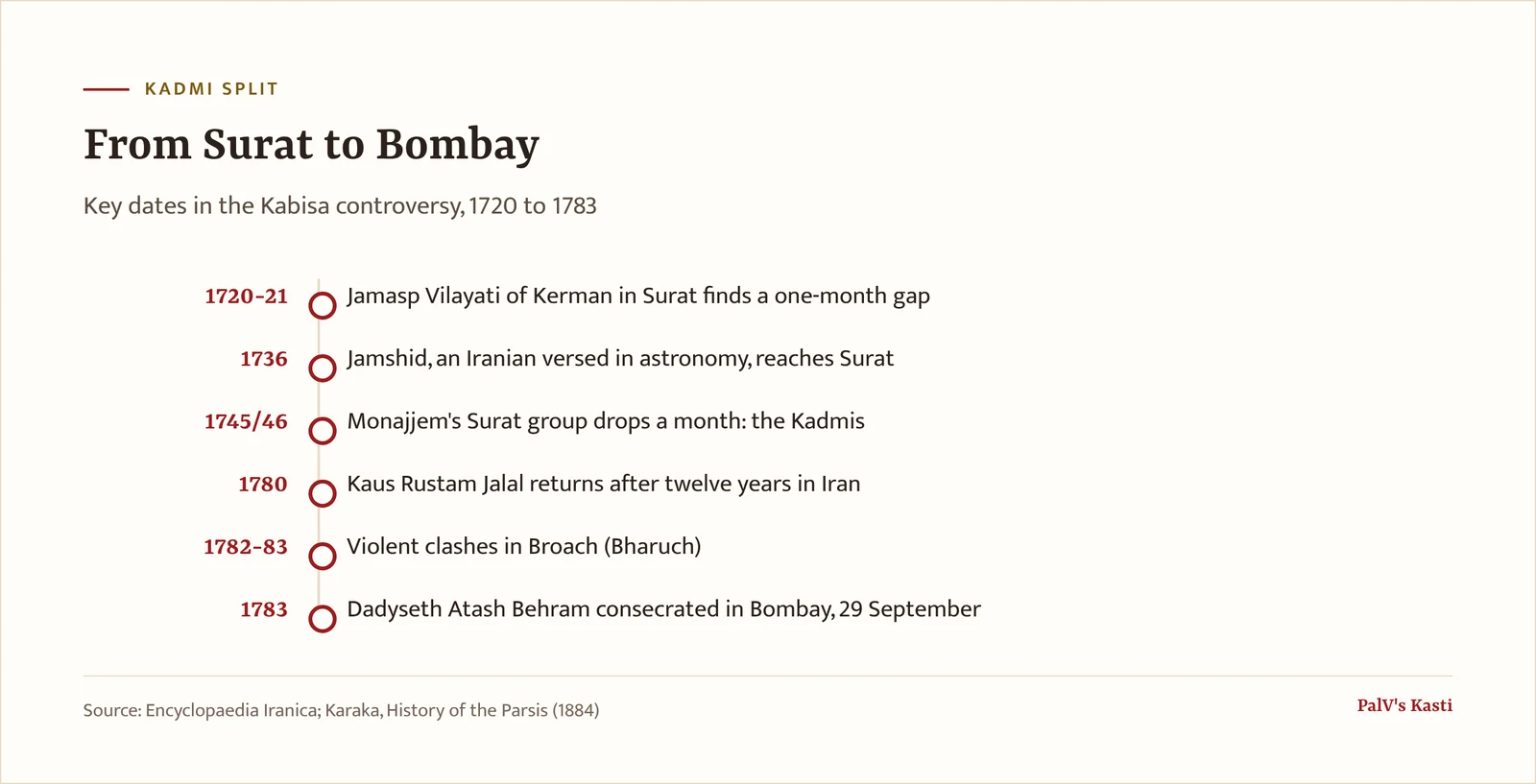
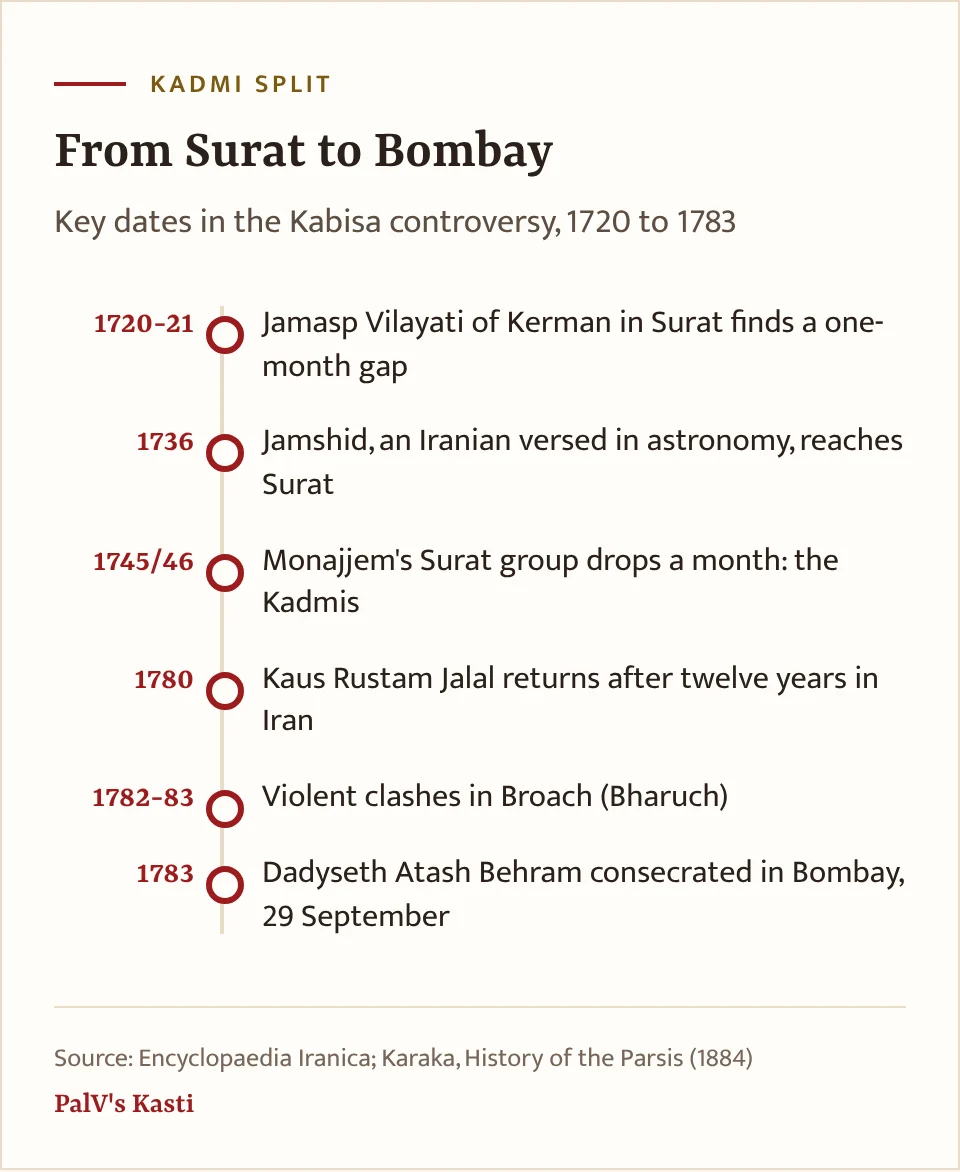
Kadmi split timeline: what happened when?
| Year | Event |
|---|---|
| 1720-1721 | Dastur Jamasp Vilayati of Kerman is in Surat, notices the one-month difference and leaves via Bombay in October 1721 |
| After 1721 | Some Surat Zoroastrians, including the layman Maneckji Edulji A. Dalal, begin following the Iranian reckoning |
| 1736 | Jamshid, an Iranian layman versed in astronomy, arrives in Surat |
| 1745 or 1746 | A Surat group led by Dastur Kaus Fardunji Monajjem drops a month and the Kadmi group is formed |
| 1780 | Kaus Rustam Jalal returns after twelve years in Iran |
| 1782-1783 | Violent clashes between Shenshais and Kadmis, notably in Broach (Bharuch) |
| 29 September 1783 | Dadyseth Atash Behram consecrated in Bombay under Kadmi rites |
Frequently asked questions
What does Kadmi mean?
Kadmi comes from the Arabic word qadim, meaning "old" or "ancient". The Kadmis, also spelled Kadimi, Qadmi or Qadimi, took the name because they regarded the Iranian calendar they adopted as the older one. Dhalla calls the Kadmis "the Ancients" and the Shenshais "the Imperials", a name Hinnells links to the Persian word for "royal".
When did the Kadmi split happen?
The discrepancy was noticed in Surat in 1720-1721, during the visit of Dastur Jamasp Vilayati from Kerman. The formal break came later. Encyclopaedia Iranica's entry on the Kadimis dates it to 1745, while Karaka's 1884 History of the Parsis and Iranica's Dadyseth entry give 1746. All three place it in Surat.
Who was Dastur Jamasp Vilayati?
Dastur Jamasp Vilayati was an Iranian Zoroastrian priest from Kerman, invited to Surat to advise its Zoroastrians on religious questions. During his stay in 1720-1721 he found the Parsi and Iranian calendars a month apart. Sources differ on whether he openly pressed for reform or held back and taught three Parsi priests instead.
What is the Kabisa controversy?
The Kabisa controversy is the Parsi name for the 18th and 19th century dispute over kabisa, the intercalation of an extra month into the calendar. Shenshais held that one intercalation had been made in Khorasan and not repeated. Kadmis denied any such intercalation. The quarrel produced pamphlets, public meetings and separate places of worship.
Did the Kadmis build their own fire temples?
Yes. The Dadyseth Atash Behram in Bombay was consecrated by Kadmi rites on 29 September 1783, founded and endowed by Dadibhai Noshirwanji Dadyseth, who had joined the Kadmi movement. It was the first Atash Behram in Bombay. Dhalla records that the split led the two groups to found separate places of worship.
Is there still bad feeling between Kadmis and Shenshais?
Not according to the Encyclopaedia Iranica entry on the Kadimis, written by Ramiyar P. Karanjia in 2009, which says there are no social or religious restrictions between the two groups. They agree on theology and doctrine. The differences that remain are in calendar dates, some prayer pronunciations, minor outer rituals and priestly initiation.