PalV's Kasti
On this page
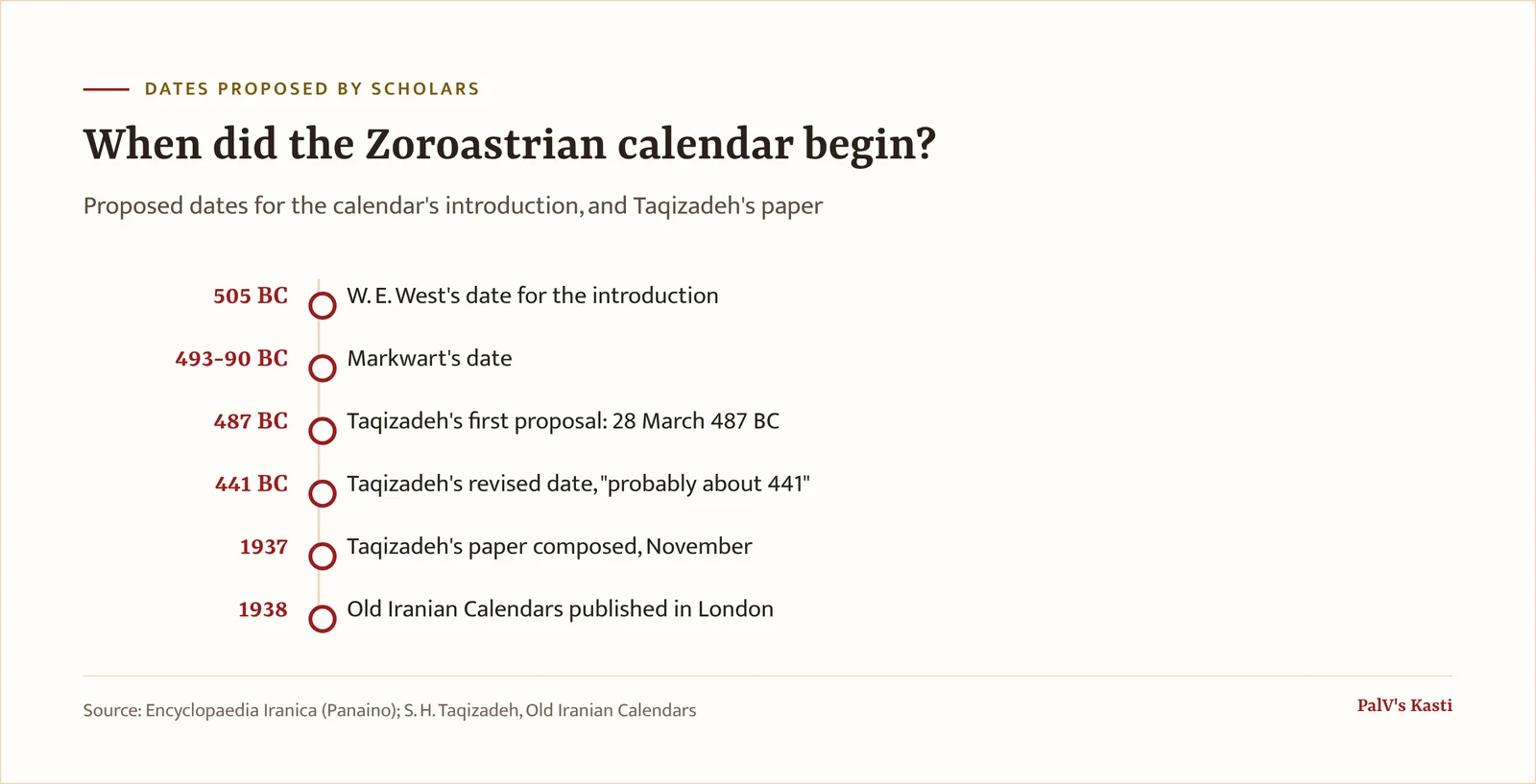
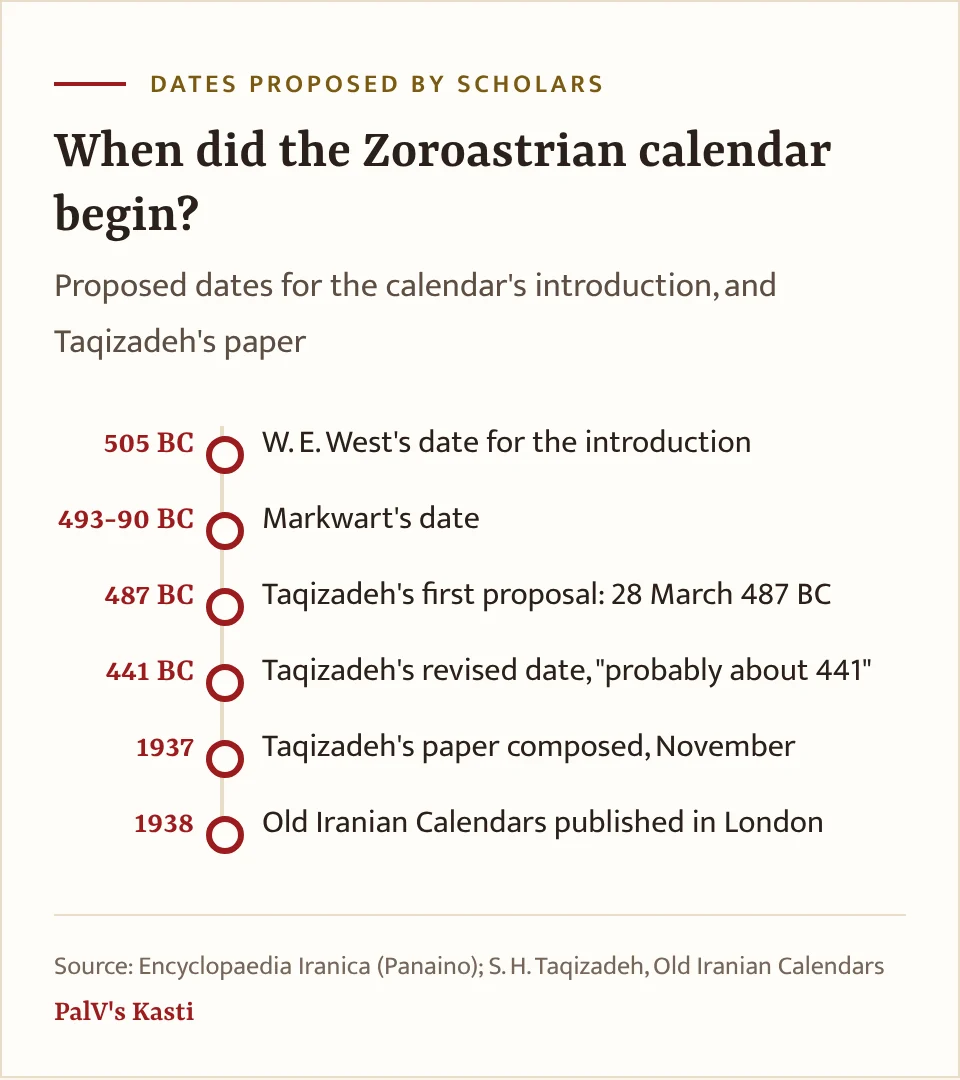
Before the Zoroastrian calendar of named days that Parsis still use, the Achaemenid Persians kept an Old Persian calendar. It was lunisolar, like the Babylonian one, with twelve months of thirty days, and its days were numbered, not named. Eight of its month names survive in the Old Persian inscriptions, from Garmapada, the "heat-station" month, to Bāgayādiš, the month of the worship of baga. A detailed study of these early systems is S. H. Taqizadeh's paper "Old Iranian Calendars", published in London in 1938. Taqizadeh separated the Old Persian calendar from an "Old-Avestan" calendar of the Zoroastrian community, and argued that both gave way to the Young-Avestan, or Zoroastrian, calendar, made official "probably about 441" BC. That date is still argued over. Antonio Panaino, in Encyclopaedia Iranica, calls the date of introduction "a matter of debate".
શહેરેવર રોજ
Shehrevar Roj, Tir Mah · 1396 Y.Z.
What is Taqizadeh's "Old Iranian Calendars"?
"Old Iranian Calendars" is a paper by S. H. Taqizadeh. A note in the paper records that it "was composed in November, 1937", and Encyclopaedia Iranica lists it as published in London in 1938. The full text is hosted on avesta.org.
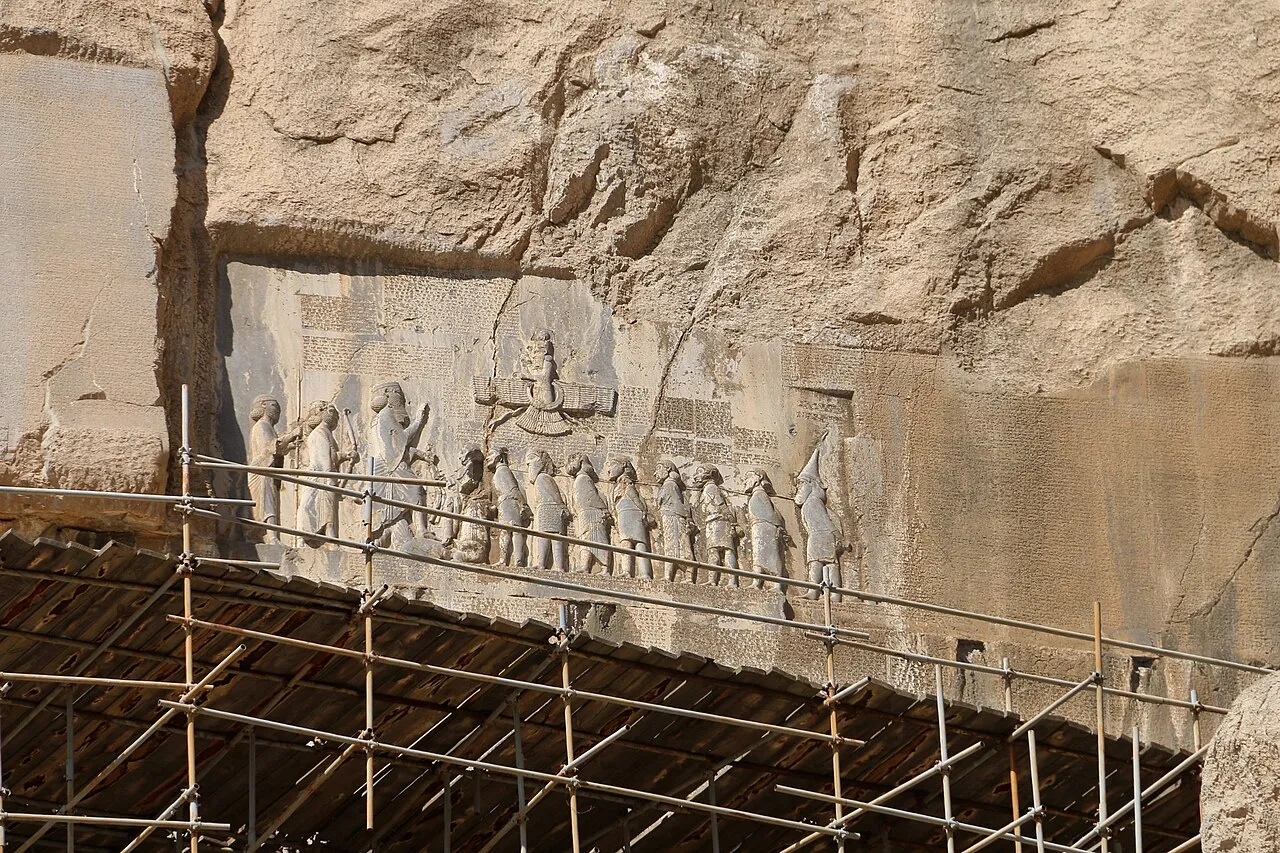
Taqizadeh works with three Iranian calendars. Two older ones, the Old-Persian and the Old-Avestan, are in his words "attested by the Behistun inscription". He adds that the Avestan texts prove them by deduction. The third is the one he says is generally called the Persian, Parsi, Mazdayasnian, Zoroastrian or Young-Avestan calendar. He also notes that the Syro-Macedonian calendar was used in Iran in the Macedonian and Parthian periods.
| Calendar (Taqizadeh's name) | Who used it, in his account | Year, in his account |
|---|---|---|
| Old-Persian | The Achaemenian court and state | Luni-solar, months parallel with the Babylonian |
| Old-Avestan | The Zoroastrian community | Presumably 360 days, beginning at the summer solstice |
| Young-Avestan | Officially the Persian empire by the Sasanian period; still the Zoroastrians' religious calendar | Twelve months of thirty days plus five days |
All three rows come from Taqizadeh's paper. The middle row is disputed, as explained below.
What was the Old Persian calendar?
The Old Persian calendar was the reckoning of the Achaemenid state. Panaino describes it in Encyclopaedia Iranica as a lunisolar calendar "like that of the Babylonians". It had twelve months, each of thirty days. And its days, he writes, "were numbered but not named".

Taqizadeh reached the same view of the year. In his reading, the Persian months ran "strictly or almost parallel" with the Babylonian months, so the year must have been luni-solar like the Babylonian one. The two calendars differed in only two ways. The month names were different. And while the Babylonian year began near the spring (vernal) equinox, the Persian year probably began "near the autumnal equinox". He called the Old Persian reckoning "the official system for the computation of time for the State".
Numbered days set it apart from the Zoroastrian calendar, in which, as Mary Boyce puts it, each of the month's thirty days "is devoted to a yazata". That later system is explained in our guide to the Zoroastrian calendar.
What were the Old Persian month names?
"Only eight month names are mentioned in the Old Persian inscriptions", Panaino writes. A fuller list survives too, "only partial in Old Persian script but complete in Elamite script". He gives these eight, with these meanings, in this order:
| Old Persian month name | Meaning, as given by Panaino | Babylonian month, as given by Taqizadeh |
|---|---|---|
| Ādukanaiša | meaning and etymology uncertain | not stated |
| Θūravāhara | possibly "(month) of strong spring" | the second month, Iyyâr |
| Θāigraciš | "garlic-collecting month" | not stated |
| Garmapada | "heat-station (month)" | not stated |
| Bāgayādiš | "(month) of the worship of baga", that is, of Miθra | "almost certainly" the seventh month, Tishrîtu |
| Āçiyādiya | "(month) of the worship of the fire" | not stated |
| Anāmaka | "month of the nameless god(?)" | not stated |
| Viyax(a)na | "digging-up (month)" | not stated |
The two scholars read Θūravāhara a little differently. Panaino offers "(month) of strong spring", while Taqizadeh, who spells it Thuravâhara, remarks that the name "means also mid-spring".
Bāgayādiš had a later life. Taqizadeh argued that its bagayâda feast was taken into the Young-Avestan year "and was renamed Mithrakân". For the twelve month names that replaced these, see the twelve Parsi months (Mah).
What was the Old-Avestan calendar, and did it exist?
This part of the subject is disputed, so we set out both positions.

Taqizadeh reconstructed an Old-Avestan calendar kept by the Zoroastrian community before the reform. Its year, he wrote, "seems to have been called yâr". It began with maidyoshahem, the summer solstice, and was "presumably of 360 days", split into two halves of 180 days each, like the Indian ayanas. Before the reform, in his account, the shortfall of "eleven or five days" in that year had been made up "by a three- or six-yearly intercalation".
Panaino is more cautious. In his words, the precise differences between "a supposed Old Avestan" calendar and a Later Avestan one "seem ambiguous", because both have been rebuilt from the same Avestan and Pahlavi sources. He also reports Bīrūnī's statement that the "Pīšdādian" kings had reckoned a year of 360 days, in twelve months of thirty days, and adds: "It is doubtful, however, that such a calendar ever existed".
So the Old Persian calendar is attested in inscriptions, while the Old-Avestan calendar is a scholarly reconstruction that Panaino treats with doubt. We take no side.
When did the Zoroastrian calendar replace the older ones?
Taqizadeh saw the change as two reforms.
In the first, the Zoroastrian community's leaders in Persia "adopted the Egyptian system of time reckoning", and with it brought in the Young-Avestan calendar. The community took the same twelve months of thirty days, with five extra days added at the end of each year. He described the reform as copying the Egyptian vague year "in all respects", down to where the New Year fell. The structure that came out of it is covered in why the year has 12 months of 30 days plus 5.
In the second, the court joined the religious community. Taqizadeh wrote that the New Year was then placed near the vernal equinox, "not far from the Babylonian zagmûg", and that this union came in the decade from 450 to 441 BC, "probably about 441". He had earlier proposed a different epoch, "the 28th March, 487 BC", and changed his mind after "a later study of the question". In his account, the Young-Avestan calendar then stayed in general use in Persia, and it has continued ever since as the Zoroastrians' religious calendar. How Parsis keep it today is covered in our guide to Shenshai, Kadmi and Fasli.
Other scholars dated the change differently. Panaino records that "W. E. West put it in 505 B.C.", that "Markwart lowered it to 493-90", and that Taqizadeh proposed 441. His verdict: "Nevertheless, the problem remains open".
Frequently asked questions
Who was Taqizadeh and what did he write on calendars?
S. H. Taqizadeh wrote "Old Iranian Calendars", a paper composed in November 1937 and published in London in 1938. It reconstructs the Old-Persian, Old-Avestan and Young-Avestan calendars, and dates the Young-Avestan calendar's adoption as Persia's official calendar to about 441 BC.
Did the Old Persian calendar name its days?
No. Encyclopaedia Iranica describes the Old Persian calendar as lunisolar, like the Babylonian, with twelve months of thirty days, and says "the days were numbered but not named". Naming every day after a divinity belongs to the later Zoroastrian calendar, where Mary Boyce notes that every one of the thirty days is devoted to a yazata.
How many Old Persian month names are known?
Eight month names are mentioned in the Old Persian inscriptions, according to Antonio Panaino in Encyclopaedia Iranica. They are Ādukanaiša, Θūravāhara, Θāigraciš, Garmapada, Bāgayādiš, Āçiyādiya, Anāmaka and Viyax(a)na. A list that is only partial in Old Persian script survives complete in Elamite script.
When was the Zoroastrian calendar introduced?
Nobody knows for certain. Taqizadeh argued for about 441 BC, after first proposing 487 BC. Encyclopaedia Iranica records other dates, including 505 BC from West and 493 to 490 BC from Markwart, and calls the date "a matter of debate". Panaino concludes that "the problem remains open".
Was there an Old-Avestan calendar of 360 days?
Scholars disagree. Taqizadeh reconstructed an Old-Avestan year, possibly called yâr, of presumably 360 days starting at the summer solstice. Panaino calls the difference between a supposed Old Avestan and Later Avestan calendar "ambiguous" and, discussing Bīrūnī's report of a 360-day year, doubts "that such a calendar ever existed".