PalV's Kasti
On this page
- How does 12 × 30 + 5 make the Zoroastrian year?
- Why does every month have exactly 30 days?
- How does the Bundahishn group the 12 months?
- Was there ever a 360-day Zoroastrian year?
- Why were five days added to make 365?
- How were the five new days received?
- Is 365 days the full solar year?
- Did other calendars use 12 months of 30 days plus 5?
- Frequently asked questions
The Zoroastrian calendar has 12 months of 30 days, which makes 360 days, and five extra days, the Gatha days, are added at the end to reach 365. The month has 30 days because each day of the month is dedicated to its own divine being, a yazata. The five days came later. Mary Boyce writes in the Encyclopaedia Iranica that the 365-day calendar was created "on the Egyptian model", with the five days inserted before Navroz, and that the new days were at first distrusted as "stolen". Priests then linked them to the five Gathas of Zarathushtra. When the 365-day year was adopted is still open. The proposals Antonio Panaino records run from 505 BCE to 441 BCE, and Panaino doubts that a pure 360-day year ever existed.
શહેરેવર રોજ
Shehrevar Roj, Tir Mah · 1396 Y.Z.
How does 12 × 30 + 5 make the Zoroastrian year?
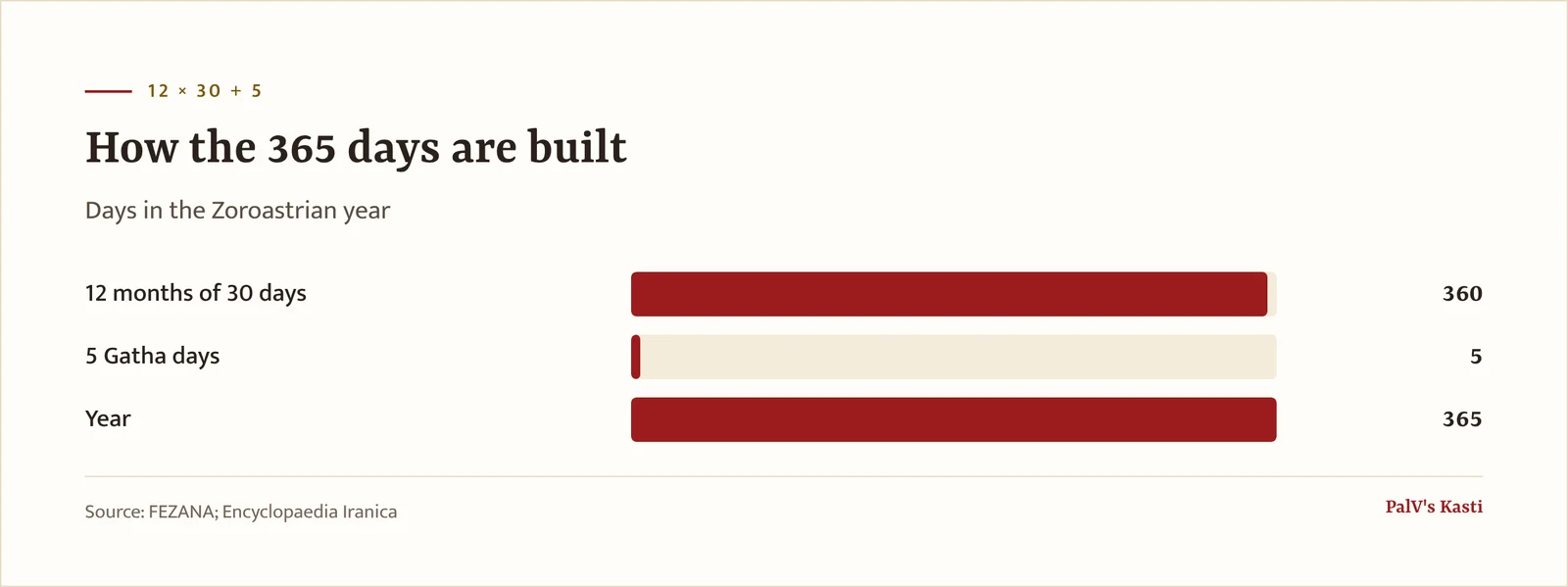
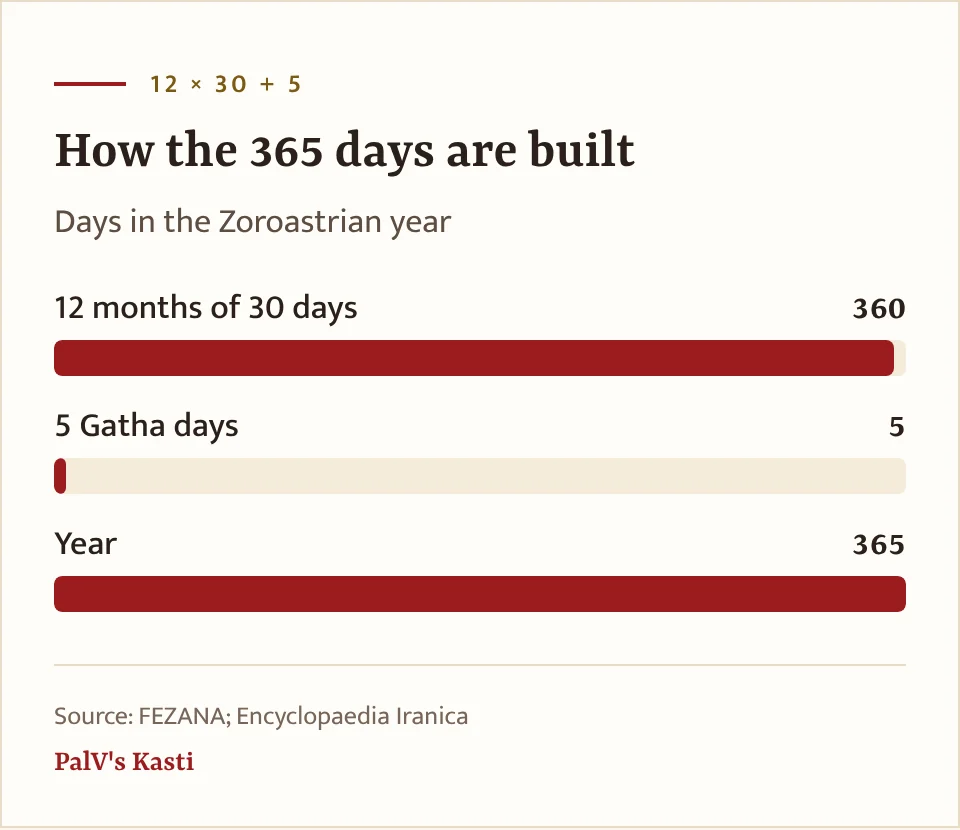
Panaino's entry in the Encyclopaedia Iranica states the base unit directly: "The Zoroastrian calendar consisted of twelve months of thirty days each". FEZANA's religious education lesson for Grades 6 to 8 says the same for students, and adds five Gatha days after the last month to give 365.
| Part | Days |
|---|---|
| 12 months (Mah) × 30 days (Roj) | 360 |
| 5 Gatha days after the twelfth month | 5 |
| Year | 365 |
The Pahlavi Bundahishn treats 365 as the number of creation. Chapter 25, "The religious calendar", in E. W. West's translation, opens with a line from revelation: the creatures of the world were created "complete in three hundred and sixty-five days".
Why does every month have exactly 30 days?
Each of the 30 days has its own presiding being, and the month is that list. Boyce, in her Iranica article on Zoroastrian festivals, says the calendar was built by dedicating each of the 30 days of a month to one of the yazatas. FEZANA's lesson puts it plainly: the 30 days, or Roj, represent 30 Yazatas.
The Avesta keeps the full set of day names. Panaino notes that Avestan sources name all thirty days, but only seven of the twelve months. A prayer text follows the same order. Enrico Raffaelli's Iranica entry on the Sih-rozag, whose name may be translated as "relating to the thirty days", says its first 30 paragraphs are titled with the names of the beings the days of the month are named after.
Since each day has a name, the month needs no weekday cycle. We explain that in why the Zoroastrian calendar has no weeks.
Practice varies between families and Agiaries; your family priest's guidance comes first.
How does the Bundahishn group the 12 months?
The Bundahishn gives two ways of dividing the twelve months into seasons, both in chapter 25:
| Scheme in Bundahishn 25 | Months |
|---|---|
| Four seasons of three months (25.20) | Spring: Frawardin, Ardwahisht, Hordad. Summer: Tishtar, Amurdad, Shahrewar. Autumn: Mihr, Aban, Adar. Winter: Din, Vohuman, Spandarmad |
| Two seasons (25.7) | "the summer of seven months", from Frawardin to Mihr, and "the winter of five months", from Aban to the end of the five supplementary days |
The month names are given as West printed them, so Din stands for Dae and Tishtar for Tir.
Was there ever a 360-day Zoroastrian year?
Scholars answer this differently, so we set out each view rather than pick one.
Boyce: a 360-day year did exist. In her Gahambar article she writes that the old seasonal feasts were "distributed unevenly through a 360-day year".
Panaino: the earliest calendar that is fully preserved is Achaemenid, and it was a different kind. "The Old Persian calendar was lunisolar, like that of the Babylonians", he writes. He also reports al-Biruni's claim that the legendary Pishdadian kings counted a year of 360 days, and comments: "It is doubtful, however, that such a calendar ever existed".
The Old Persian month names and that earlier calendar are covered in old Iranian calendars.
Why were five days added to make 365?
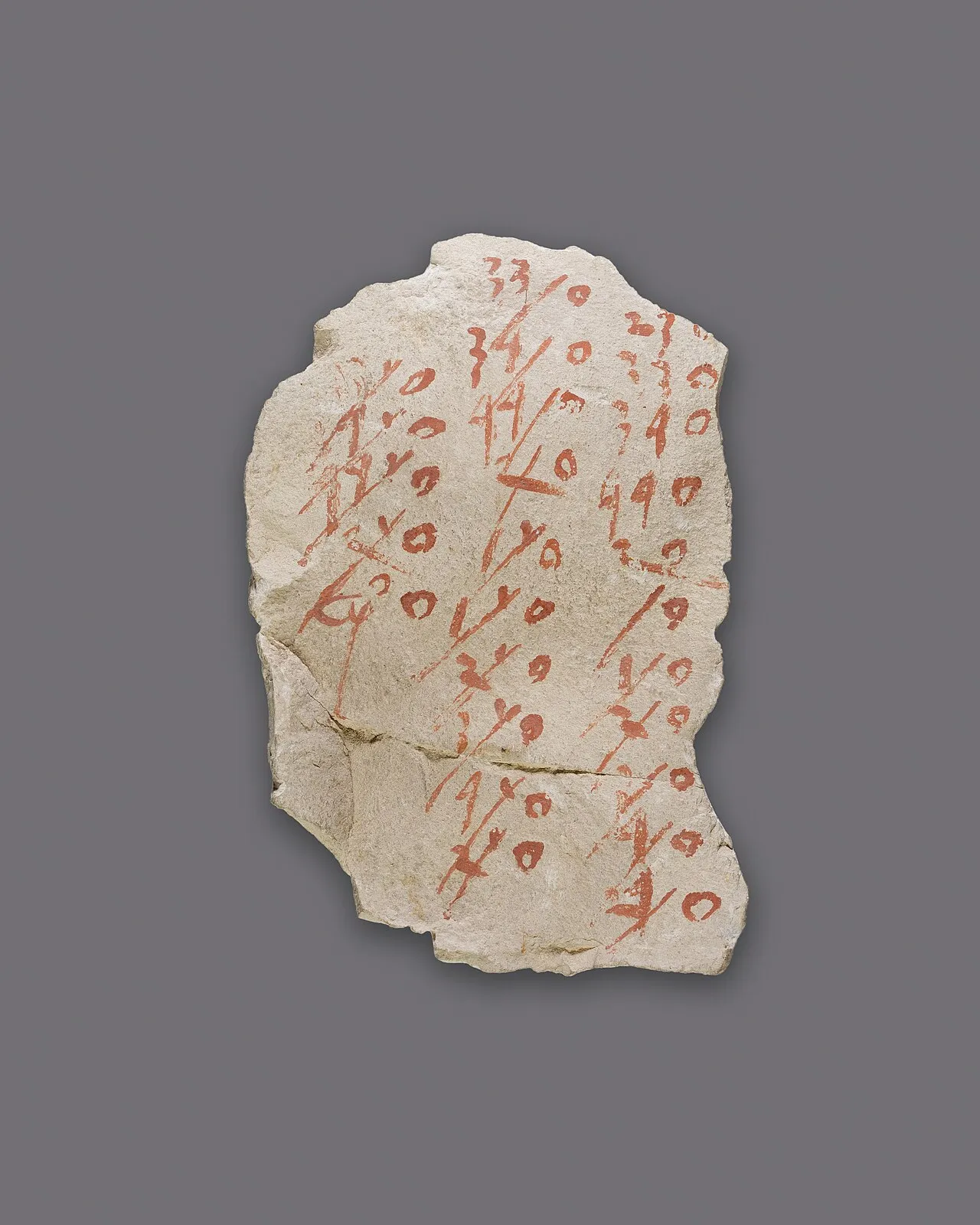
Boyce's answer is Egypt. In her article on the Gahambars she writes that the 365-day calendar was made "on the Egyptian model", with five epagomena, or extra days, inserted between 30 Spendarmad and Navroz. Persia's direct contact with Egypt is well dated. M. A. Dandamayev's Iranica entry on Cambyses records: "In 525 B.C. Cambyses marched against Egypt".
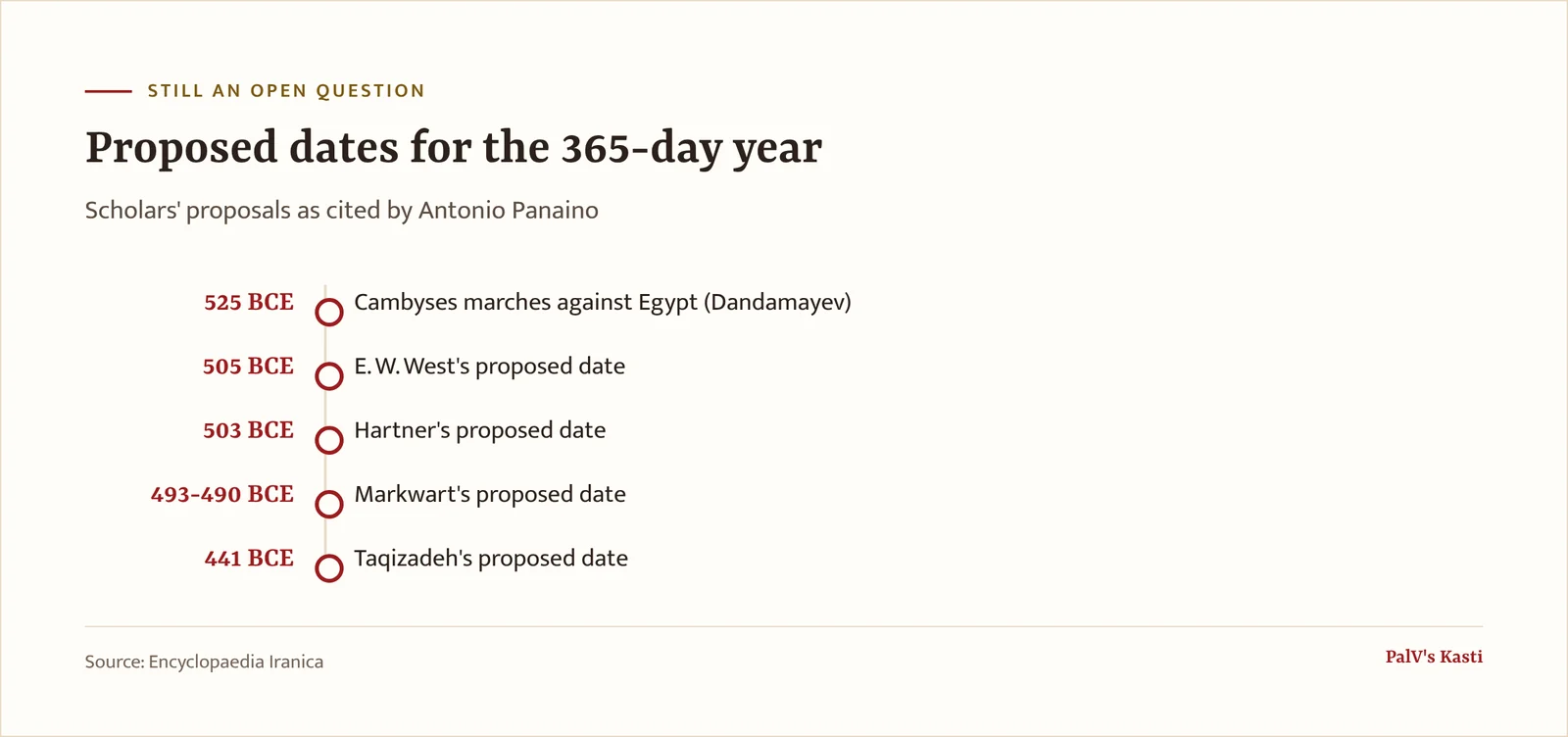
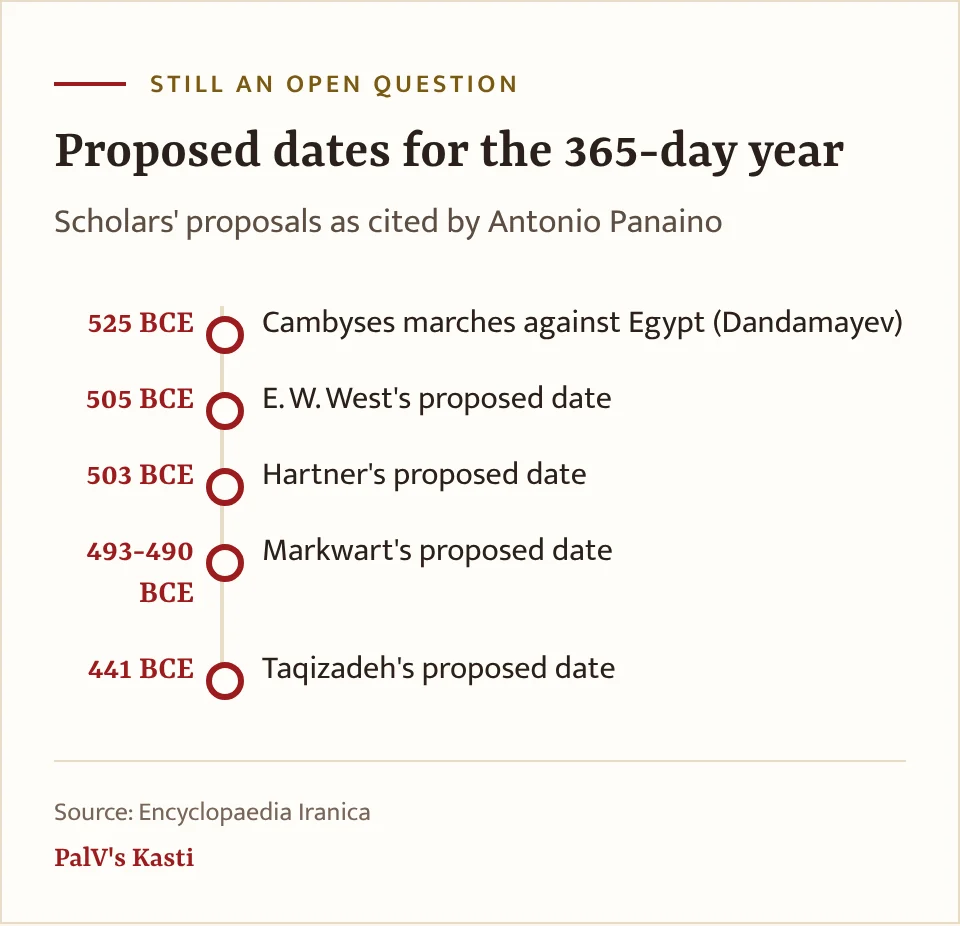
The date of the reform isn't settled. Panaino lists four proposals and leaves the question open:
| Scholar (as cited by Panaino) | Proposed date |
|---|---|
| E. W. West | 505 BCE |
| Hartner | 503 BCE |
| Markwart | 493 to 490 BCE |
| Taqizadeh | 441 BCE |
His own conclusion is short: "the problem remains open".
How were the five new days received?
Not warmly, at first. Boyce writes that the extra days were at first regarded "with general distrust, as 'stolen' days", and that Persian priests tried to sanctify them by linking them with Zoroaster's five Gathas. Panaino confirms the outcome: the five extra days, the epact, "took their names" from the five Gathas.
The change also unsettled the festival year. According to Boyce, "The change caused widespread confusion". The faithful kept the Gahambars on their old dates and then again five days later on the new ones. She adds that all seven feasts were at first one-day observances.
The last Gahambar, Hamaspathmaedaya, came to fall in the five extra days themselves. The Bundahishn describes "the season of Hamaspathmaidyem" as the five supplementary days at the end of the month Spandarmad, and Boyce records that the feast became known as "the gāhānbār of the pentad". In the calendars Parsis use today, FEZANA places the five Gatha days at the end of the twelfth month. Their place has not always been the same, though: Panaino notes that some Zoroastrian villages around Natanz in Iran put them after Bahman. Their names, their observance and the history of where they fell are in the five Gatha days.
Is 365 days the full solar year?
No, and the Bundahishn itself says so. It describes the sun returning to its starting point in 365 days "and six short times (hours)". Over the years those six hours add up. Panaino describes the old correction as "the intercalation of one month in every 120 years". The Zoroastrian Association of Northern California (ZANC) records that the Parsis last added that month in 1129 CE, which is why the Shenshai New Year has since moved from March to August. What that leftover quarter-day has done to Parsi dates is explained in the astronomy behind the Parsi calendar, and how the year compares with the Gregorian one is in Zoroastrian calendar vs Gregorian calendar and the Iranian solar calendar.

Did other calendars use 12 months of 30 days plus 5?
Yes. Panaino traces the same frame in neighbouring calendars. The Armenian calendar, he notes, also has twelve 30-day months plus five epagomenal days. The Chorasmian calendar, he writes, has twelve 30-day months with the extra days after the last month. And the calendar of Cappadocia "was an imitation of the Zoroastrian calendar".
For the whole calendar, from Roj names to the three Parsi reckonings, start with our guide to the Zoroastrian calendar. To find today's Roj and Mah, use our Parsi calendar.
Frequently asked questions
Was there ever a 360-day year in the Zoroastrian calendar?
Scholars disagree. Mary Boyce wrote that the old seasonal feasts were spread unevenly through a 360-day year. Antonio Panaino notes that the earliest fully preserved calendar, the Old Persian one, was lunisolar like the Babylonian, and he doubts al-Biruni's report of a 360-day year under the legendary Pishdadian kings.
Why did the Zoroastrian calendar change from 360 to 365 days?
Mary Boyce writes that the 365-day calendar was created on the Egyptian model, with five extra days inserted between 30 Spendarmad and Navroz. When this happened is still open. Antonio Panaino lists proposals by West, Hartner, Markwart and Taqizadeh ranging from 505 BCE to 441 BCE, and concludes that the problem remains open.
Why does each Zoroastrian month have 30 days?
Each of the 30 days of the month is dedicated to its own divine being, or yazata, as Mary Boyce and FEZANA both describe. The Avesta preserves the names of all 30 days but, as Antonio Panaino notes, of only seven of the twelve months. The Sih-rozag text follows the same order of 30 names.
What are the five extra days called?
They are the Gatha days, named after the five Gathas of Zarathushtra. Mary Boyce writes that they were first distrusted as "stolen" days, and that priests sanctified them by linking them with the Gathas. The last Gahambar, Hamaspathmaedaya, falls in these five days, at the end of the twelfth month.
Do the Shenshai, Kadmi and Fasli calendars all use 360 + 5?
Yes. FEZANA's calendar lesson says the three calendars have the same names of the days and months, with five Gatha days added after the twelfth month. The Fasli calendar, introduced in 1906, was designed to start its year on the spring equinox, 21 March. Our guide to Shenshai, Kadmi and Fasli compares them.