PalV's Kasti
On this page
- Why does the Zoroastrian calendar have no weeks?
- What takes the place of a week in the Zoroastrian month?
- Where did the idea of naming every day after a divinity come from?
- Do Shenshai, Kadmi and Fasli use the same day names?
- What happens when the day and the month share a divinity?
- How do Zoroastrian prayers use the named days?
- Was a seven-day week known in ancient Iran?
- Do the five Gatha days have divinity names too?
- Frequently asked questions
The Zoroastrian calendar has no seven-day week because its month isn't made of weekday names that repeat. Each of the thirty days has a name of its own, and that name belongs to a divinity: Ahura Mazda, one of the Amesha Spentas or one of the Yazatas. FEZANA's calendar lesson for schools puts it plainly: each day "has a name and not a number". The only regular division inside the month comes from the days of the Creator. Day 1 is named for Ahura Mazda, and days 8, 15 and 23 carry the Creator's epithet, according to William Malandra in the Encyclopaedia Iranica. Those four days split the month into two stretches of seven days and then two of eight. That is the nearest thing to a week the calendar has.
શહેરેવર રોજ
Shehrevar Roj, Tir Mah · 1396 Y.Z.
Why does the Zoroastrian calendar have no weeks?
The sources we checked don't argue against a week. They describe a calendar built around something else: one divinity for each day. Mary Boyce, in the Encyclopaedia Iranica, writes that a "specifically Zoroastrian form" of the calendar was created by dedicating each of the thirty days of the month to a yazata. She places this in what she calls the "Young Avestan" period. Malandra says the names of the yazatas, which he glosses as "benign divinities", were given both to the twelve months and to the thirty days of each month.
A Pahlavi text shows how firmly the days and the divinities were tied together. Chapter XXII of the Shayast la-Shayast, in E. W. West's translation, is a benediction that calls down a blessing from each of the thirty. West's footnote calls them the thirty "archangels and angels" after whom the days of the Parsi month are named.
So every month has thirty day names, not seven weekday names used four times over. FEZANA's lesson for grades 6 to 8 adds that the 30 Roj "represents 30 Yazatas". We have not found a source that gives a separate reason for leaving the week out, and we don't invent one.
What takes the place of a week in the Zoroastrian month?
The days of the Creator do. Malandra writes that the first day of each month was called ahurahe mazda, "(day) of Ahura Mazdā", and that the eighth, fifteenth and twenty-third days bore the epithet daθušō, "(day) of the Creator". As he puts it, these days cut the thirty-day month into two runs of seven and then two runs of eight.
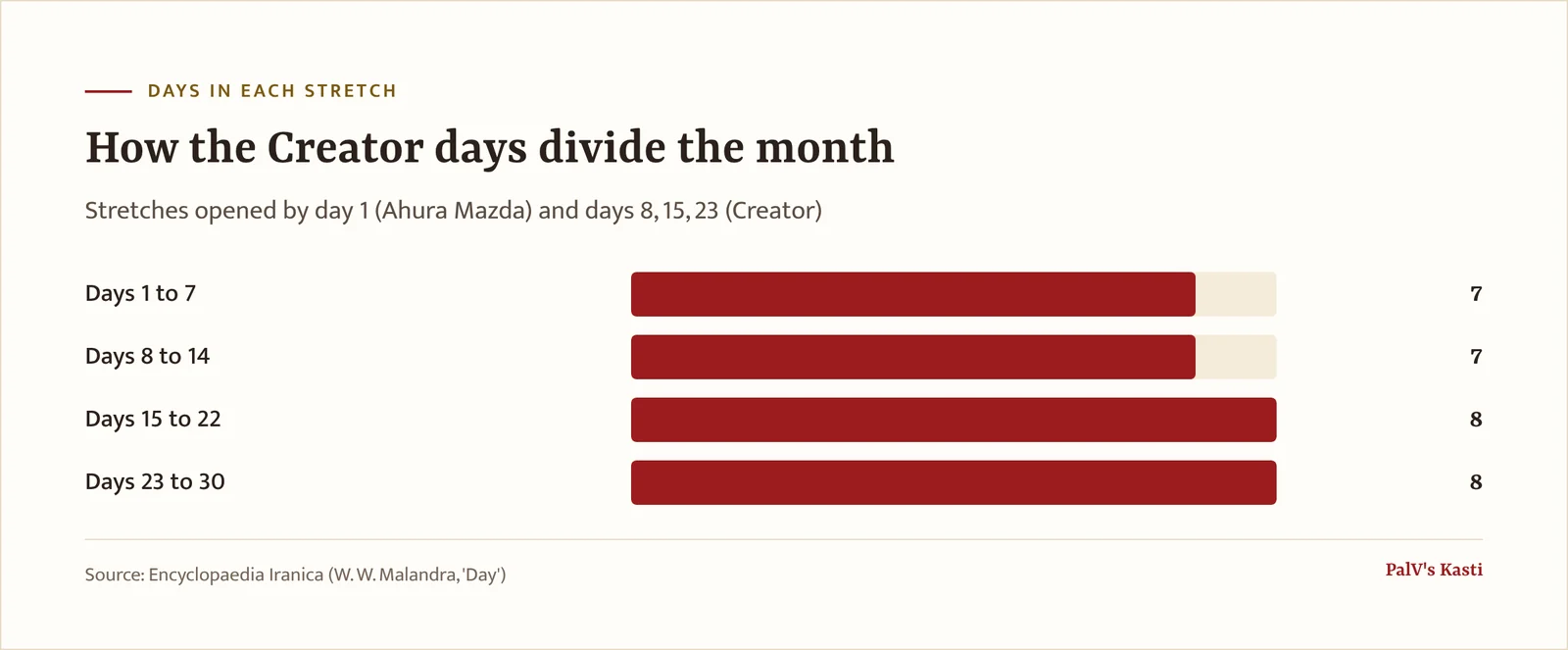
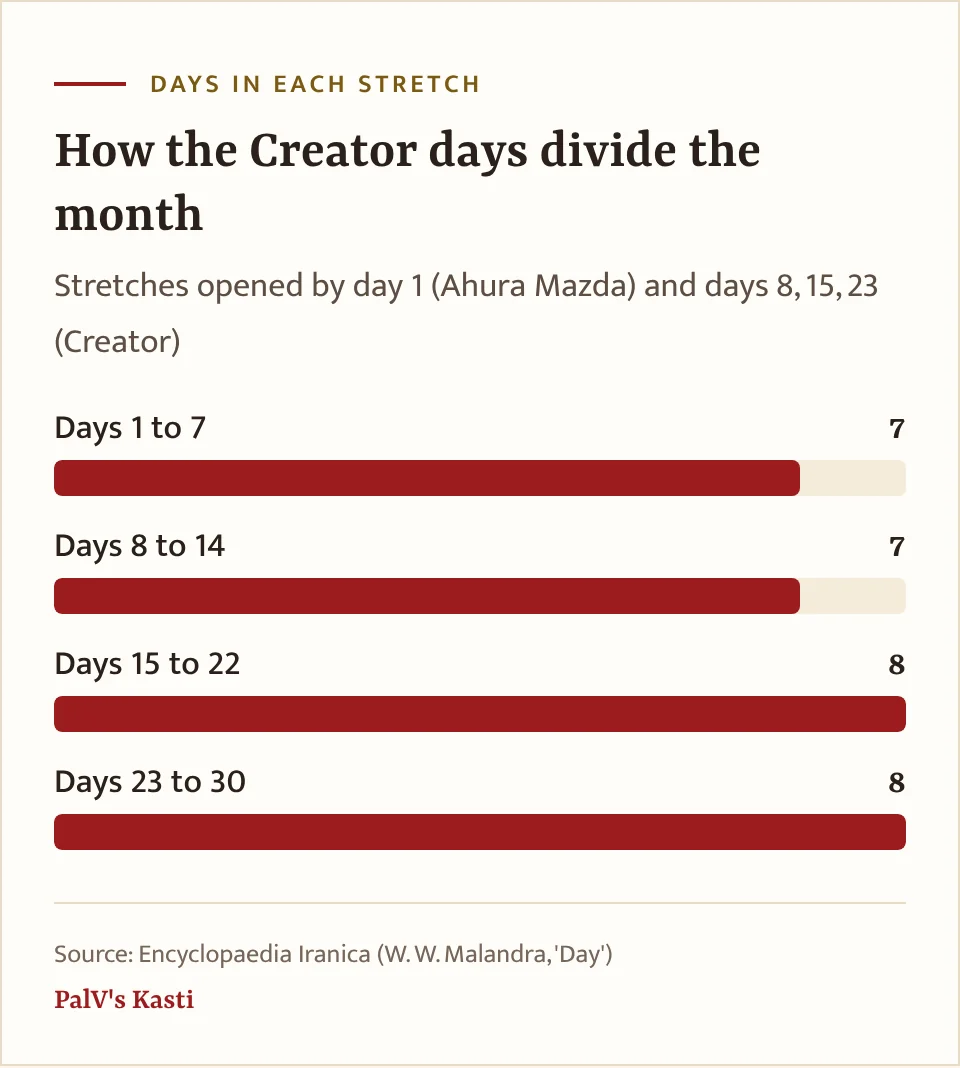
| Stretch of the month | Days | Opens with |
|---|---|---|
| First | 1 to 7 (seven days) | Day of Ahura Mazda |
| Second | 8 to 14 (seven days) | Creator day |
| Third | 15 to 22 (eight days) | Creator day |
| Fourth | 23 to 30 (eight days) | Creator day |
The Sirozah, the prayer of the thirty days, shows the pattern in its own words. In James Darmesteter's translation for the Sacred Books of the East, the first day is headed Ormazd and invoked "To Ahura Mazda, bright and glorious", together with the Amesha Spentas. The eighth is headed Dai pa Adar and invoked "To the Maker Ahura Mazda". Darmesteter's footnote explains the name: "The day before Adar", from the Persian word for "yesterday".
Boyce adds a historical note. She suggests that at the Young Avestan stage the 8th, 15th and 23rd days were devoted to other divinities: Apam Napat, Haoma and Dahma Afriti. She qualifies this with "it seems". That is her reading, not a settled fact. How the full set of thirty Roj falls into groups is explained in how the 30 Roj names are grouped.
Where did the idea of naming every day after a divinity come from?
Scholars give different answers. We set out each one as its author states it and don't take a side.
- A Zoroastrian creation of the Young Avestan period. This is Boyce's position: the calendar took its specific Zoroastrian form when each of the thirty days was dedicated to a yazata.
- Old Iranian in origin. Antonio Panaino, in the Iranica, argues that the day names are "of Old Iranian origin and not merely Middle Iranian innovations". His evidence is that they are recorded in Old Iranian "genitive singular forms". He also notes that Avestan sources name all thirty days but only seven of the twelve months.
- Borrowed from the Semites. Darmesteter thought the idea of giving each of the thirty days to certain gods "seems to have been borrowed from the Semites". He pointed to tablets from the library of Assurbanipal that hold an Assyrian Sirozah, a list of the gods who preside over the thirty days of the month.
The genitive point also explains a habit of speech. A day name such as Hormazd works as "the day of" its divinity, which is how Malandra glosses day 1: "(day) of Ahura Mazdā".
Do Shenshai, Kadmi and Fasli use the same day names?
Yes. FEZANA's lesson lists the three calendars followed by Zoroastrians today and says that all three "have the same names of the days and months". Where they differ is in when the year begins, which we cover in Shenshai, Kadmi and Fasli.
What happens when the day and the month share a divinity?
That day becomes a feast. Boyce writes that whenever a day name and a month name had the same dedication, for example Mithra day in Mithra month, the day was kept as "a festival for that yazata". FEZANA's lesson calls such a day a "Parabh". Among its examples are Avan Roj in Avan Mah, the Avan Yazad Parab, and Tir Roj in Tir Mah, the Tirgan Parab.
Our Parsi Roj calendar shows the Roj and Mah for every day, so you can see where they meet. What each Roj name means is covered in the thirty Roj names and their meanings.
How do Zoroastrian prayers use the named days?
The clearest case is the Sirozah. Darmesteter explains that the name means "thirty days" and describes the prayer as thirty invocations addressed to the Izeds who preside over the thirty days of the month. Enrico Raffaelli, in the Encyclopaedia Iranica, notes that its paragraphs 1 to 30 are titled with the names of the entities the days are named after. He also observes that the text took shape after the Zoroastrian calendar had been worked out, as its paragraph headings show.
The Sirozah is linked with remembrance of the dead. Raffaelli writes that the whole text is recited in rites held thirty days after a death and at fixed dates after that. Darmesteter, describing practice in India in his day, says it is recited for the dead a month after death, on the thirtieth day, and again on the thirtieth day of the sixth and twelfth months.
Practice varies between families and Agiaries; your family priest's guidance comes first.
Was a seven-day week known in ancient Iran?
It was known among the Manichaeans. Panaino records that Manichaean texts have "a system of seven weekdays", and he suggests that this planetary week was spread by the Nestorian and Manichaean communities. The Zoroastrian month that Malandra and Boyce describe keeps its thirty named days instead.
Do the five Gatha days have divinity names too?
No. The five days added at the end of the year stand outside the thirty-day pattern. Panaino writes that these five days of the epact were named after the five Gathas, not after the divinities of the month. The five Gatha days have their own article, and the reason the year is built from twelve months of thirty days plus five is set out in the 360 plus 5 structure. For the calendar as a whole, start with our guide to the Zoroastrian calendar.
Frequently asked questions
Does the Zoroastrian calendar have weeks?
No. The Zoroastrian month has thirty days, and each day carries its own name, that of a divinity, rather than a weekday name. The nearest thing to a week is the division made by the days of the Creator, days 1, 8, 15 and 23, which split the month into stretches of seven, seven, eight and eight days.
How many named days are there in a Zoroastrian month?
There are thirty. Each day of the month is named after a divinity, Ahura Mazda, an Amesha Spenta or a Yazata, according to the Encyclopaedia Iranica and FEZANA. The five Gatha days at the end of the year are different: they take their names from the five Gathas, not from the divinities of the month.
What is a Parab in the Parsi calendar?
A Parab is a day when the Roj and the Mah have the same name. Mary Boyce writes in the Encyclopaedia Iranica that such a day was celebrated as a festival for that yazata. FEZANA's lesson gives Avan Roj in Avan Mah, the Avan Yazad Parab, and Tir Roj in Tir Mah, Tirgan, among its examples.
Which days of the month belong to Ahura Mazda?
Day 1 is named for Ahura Mazda, and days 8, 15 and 23 carry the epithet of the Creator, according to William Malandra in the Encyclopaedia Iranica. Darmesteter's translation of the Sirozah heads day 1 Ormazd and day 8 Dai pa Adar. These four days divide the thirty-day month into four stretches.
Why is the Sirozah connected with the thirty days?
The Sirozah, whose name means "thirty days", is a prayer of thirty invocations, one for the divinity of each day of the month. The Encyclopaedia Iranica notes that its first thirty paragraphs carry the names the days are named after, and that the whole text is recited in rites held thirty days after a death.