PalV's Kasti
On this page
The thirty Roj of the Parsi month fall into four groups, and each group opens with a day of Ahura Mazda. Roj 1 carries his own name. Roj 2 to 7 belong to the six Amesha Spentas, so the first group is what Mary Boyce calls the Heptad: Ahura Mazda and the six Amesha Spentas. Roj 8, 15 and 23 are also Ahura Mazda's days, honoured as the Creator, and each one begins a new group. That gives a month of 7, 7, 8 and 8 days. William Malandra describes "two segments of seven days" and then "two segments of eight days". Boyce sums up the result: Ahura Mazda was honoured "by the dedication to him of four days".
The other named parts of the calendar, from Mah to Gahambar, are covered in our guide to Parsi calendar names.
શહેરેવર રોજ
Shehrevar Roj, Tir Mah · 1396 Y.Z.
What are the four groups of Roj?
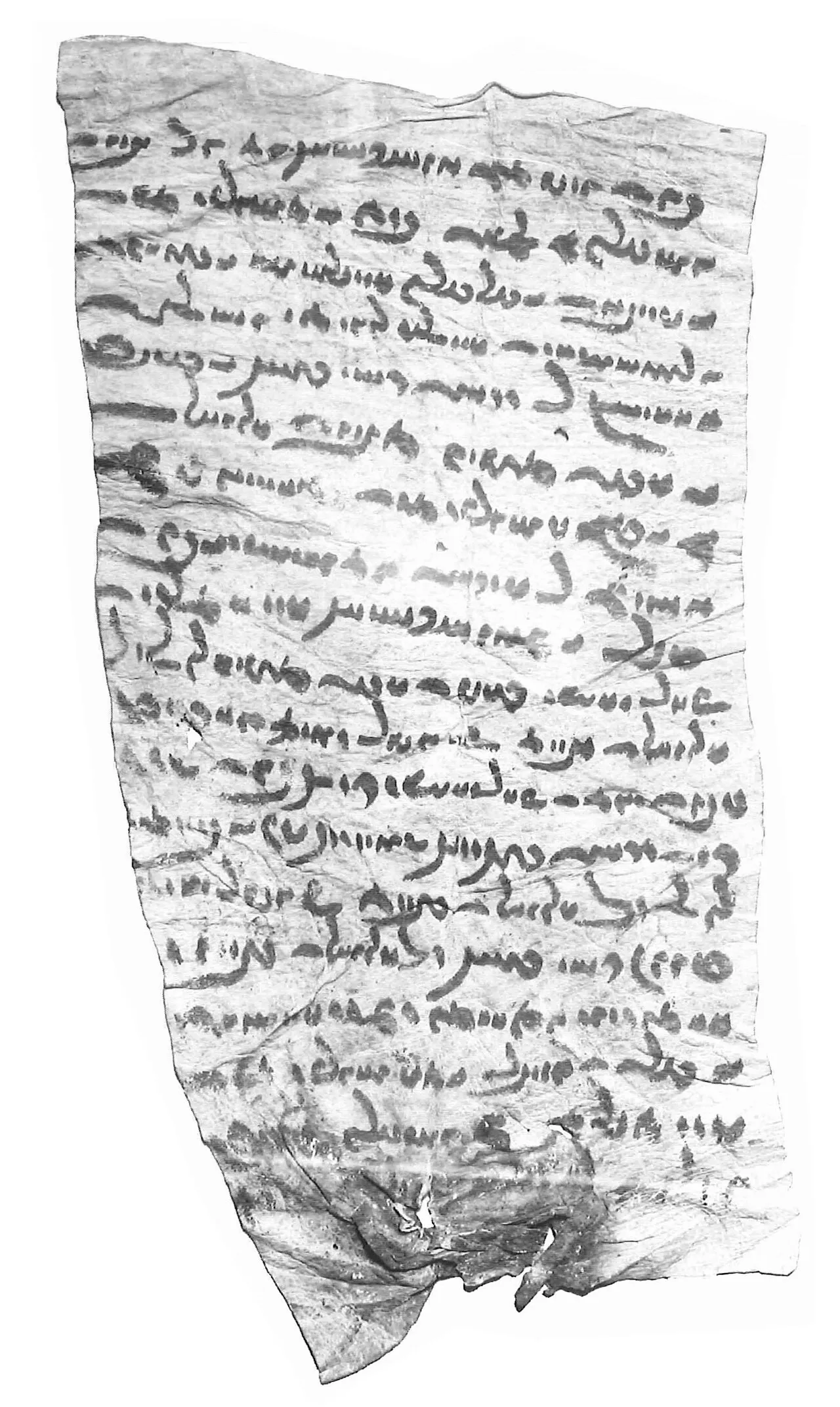
E. W. West translated a short Pahlavi text that praises the thirty day-divinities, printed as chapter XXIII of the appendix to the Shayast la-Shayast in his 1880 volume. In a footnote he observed that the days of the Parsi month form "four nearly equal divisions, resembling weeks". The Pahlavi text itself praises the thirty in four paragraphs, one per group. West was careful about its age, though: he wrote that there is no evidence the last two chapters are "quite five centuries old".
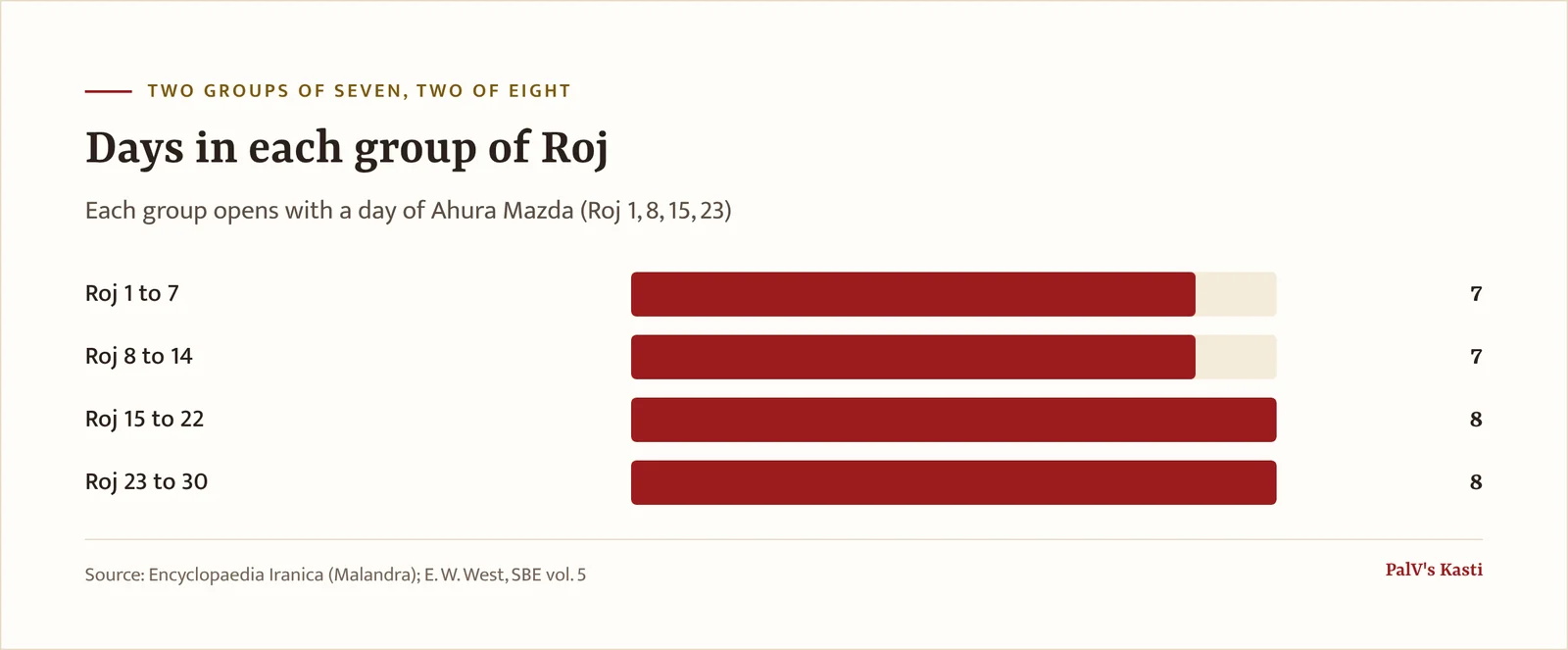
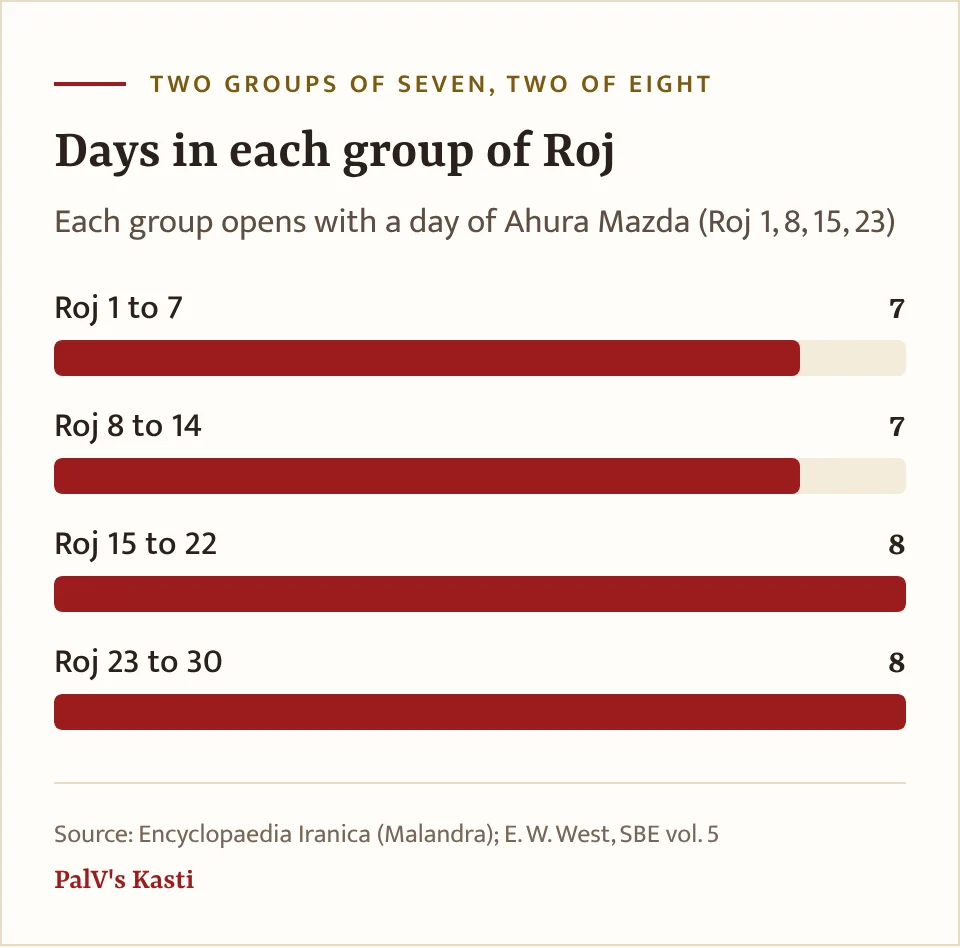
His footnote describes what each group contains. The table follows it.
| Group | Opens with | Roj | Days | What West says follows |
|---|---|---|---|---|
| First | Roj 1, Ahura Mazda by his own name | 1 to 7 | 7 | "six days named after the six archangels" |
| Second | Roj 8, the Creator day before Adar | 8 to 14 | 7 | days of "fire, waters, the sun, the moon, Mercury, and the primeval ox" |
| Third | Roj 15, the Creator day before Mihr | 15 to 22 | 8 | days of "solar light, obedience, and justice", the guardian spirits, and "victory, pleasure, and wind" |
| Fourth | Roj 23, the Creator day before Din | 23 to 30 | 8 | days of "religion, righteousness, rectitude, the sky, the earth", the liturgy and the fixed stars |
The day counts match Malandra's two segments of seven and two of eight. One detail in West's list is worth flagging. For Roj 13 (Tir) he writes "Mercury", while the Avestan Siroza, in James Darmesteter's translation, addresses that day's divinity as "Tistrya, the bright and glorious star". We give both as printed.
Which Roj belong to Ahura Mazda?
Four Roj belong to Ahura Mazda: Roj 1, 8, 15 and 23.
Roj 1 is named after him directly. Roj 8, 15 and 23 carry his title as Creator. Malandra explains that these three days "also bore the epithet daθušō (aiiarə)", meaning "(day) of the Creator". The Siroza treats all four almost alike. In Darmesteter's translation, Roj 1 is addressed "To Ahura Mazda, bright and glorious", and Roj 8, 15 and 23 "To the Maker Ahura Mazda", with the Amesha Spentas named alongside him each time. Roj 23 differs only in punctuation.
The Pahlavi text West translated makes the same point in its own way. It opens the second, third and fourth groups with a Creator day that "is just like Aûharmazd". Malandra adds that in Pahlavi each of the three Creator days is "further specified by the days following", which is why Darmesteter lists them as Dai pa Âdar, Dai pa Mihir and Dai pa Dîn. How they're named and what they mean is covered in the Dae days within every month. Malandra also notes that the same epithet of Ahura Mazda became the name of the tenth month, which we explain in what Dae Mah is.
Practice varies between families and Agiaries; your family priest's guidance comes first.
Which Roj belong to the Amesha Spentas?
Roj 2 to 7 belong to the six Amesha Spentas. Boyce writes that in the Zoroastrian calendar "the first seven days are dedicated to the Heptad". She lists them as Ahura Mazda, Vohu Manah, Asha Vahishta, Khshathra Vairya, Spenta Armaiti, Haurvatat and Ameretat. West's note agrees. His first group "consists of the day Aûharmazd" followed by "six days named after the six archangels".
| Roj | Name (as Darmesteter prints it) | Amesha Spenta | Boyce's rendering |
|---|---|---|---|
| 2 | Bahman | Vohu Manah | "Good Purpose" |
| 3 | Ardibehest | Asha Vahishta | "Best Righteousness" |
| 4 | Shahrêvar | Khshathra Vairya | "Desirable Dominion" |
| 5 | Sapendârmad | Spenta Armaiti | "Holy Devotion" |
| 6 | Khordâd | Haurvatat | "Wholeness" |
| 7 | Murdâd | Ameretat | "Immortality" |
The names are the section headings of Darmesteter's Siroza translation (Sacred Books of the East, vol. 23, 1883). The renderings are Boyce's, from her Encyclopaedia Iranica entry on the Amesha Spentas.
What every Roj name means is set out in the thirty Roj names and their meanings. How the same names look in Avestan, in Pahlavi and on a Parsi calendar is in Roj names in Avestan, Pahlavi and Parsi use. And for a thought drawn from the old texts for each day, see a reflection for each Roj.
Are the four groups of Roj weeks?
Not in the sense of a repeating seven-day week. The groups are 7, 7, 8 and 8 days long, so the first half of the month has 14 days and the second has 16. West called them divisions "resembling weeks". Malandra speaks of "segments". We prefer Malandra's word, because two of the four groups run to eight days.
Why the calendar names every day instead of numbering weeks is a separate question, answered in why the Zoroastrian calendar has no weeks. For how the months, Gatha days and Gahambars fit around the Roj, start with our guide to the Zoroastrian calendar.
Frequently asked questions
How many Roj are dedicated to Ahura Mazda?
Four. Roj 1 bears Ahura Mazda's own name, and Roj 8, 15 and 23 bear his epithet as Creator, each told apart by the day that follows it. Mary Boyce writes in Encyclopaedia Iranica that Ahura Mazda was honoured "by the dedication to him of four days" in every month of the calendar.
Which Roj are the Amesha Spenta days?
Roj 2 to 7. In Darmesteter's spelling they are Bahman (Vohu Manah), Ardibehest (Asha Vahishta), Shahrêvar (Khshathra Vairya), Sapendârmad (Spenta Armaiti), Khordâd (Haurvatat) and Murdâd (Ameretat). With Roj 1, Ahura Mazda's own day, they form the Heptad, which Boyce describes as filling the first seven days of the month.
Why is the Parsi month split 7, 7, 8 and 8?
The split comes from the four days of Ahura Mazda. Roj 1, 8, 15 and 23 each open a group, so the groups run 1 to 7, 8 to 14, 15 to 22 and 23 to 30. William Malandra describes this in Encyclopaedia Iranica as two segments of seven days followed by two of eight.
Which Roj begin each group?
Roj 1, 8, 15 and 23. Roj 1 bears Ahura Mazda's own name and opens the first group of seven. Roj 8, 15 and 23 are his days as Creator, and each opens one of the other three groups. E. W. West, translating a Pahlavi text, called the result "four nearly equal divisions, resembling weeks".
Is the four-part grouping found in an old text?
Yes. A short Pahlavi text, which E. W. West translated as chapter XXIII of the appendix to the Shayast la-Shayast, praises the thirty day-divinities in four paragraphs, one for each group. West added that there is no evidence these closing chapters are "quite five centuries old", so the text's exact age is not known.