PalV's Kasti
On this page
Each of the thirty days of the Zoroastrian month is devoted to a divinity, and the first seven belong to Ahura Mazda and the six Amesha Spentas. So a reflection for each Roj doesn't have to be invented. Two old texts already give one. The Siroza, whose name means "thirty days", is a prayer of thirty invocations to the divine beings who preside over the days of the month. A Pahlavi benediction, kept in the appendix of the Shayast la-Shayast, asks each of the same thirty for a gift, in the order of the days: wisdom from Vohuman on Roj 2, understanding and intellect from Ardwahisht on Roj 3, a helper from Ashtad on Roj 26. That gift is the virtue to reflect on. Below, every Roj has both lines side by side. Take the line for today's Roj as your thought for the day. If you're not sure which Roj it is, our Parsi Roj calendar will tell you.
શહેરેવર રોજ
Shehrevar Roj, Tir Mah · 1396 Y.Z.
Where do these Roj reflections come from?
Every day-line quoted below comes from one of two old texts in published translation, so you can check it yourself.

The first is the Siroza in James Darmesteter's translation for the Sacred Books of the East, as published on avesta.org. Darmesteter explains that there are two Sirozas, that the formulas of the first "are shorter", and that the epithets are sometimes fuller in the second. Enrico Raffaelli, writing in the Encyclopaedia Iranica, calls them the "little" and the "great" Sih-rozag. Both have thirty-three paragraphs: paragraphs 1 to 30 carry the names of the entities the days are named after, and 31 to 33 are for Apam Napat, Haoma and Dahma Afriti. We quote the shorter one.
The Siroza is also a prayer for the departed. Darmesteter, citing Anquetil, wrote that in India it is recited for the dead: on the thirtieth day after death, on the thirtieth day of the sixth and of the twelfth months, and after that each year, thirty days from the anniversary. Raffaelli records the same recital thirty days after death and at fixed dates afterwards.
Practice varies between families and Agiaries; your family priest's guidance comes first.
The second text is a Pahlavi benediction that E. W. West translated as chapter 22 of the Shayast la-Shayast. The chapter list in his translation describes it as "Blessings invoked from the thirty angels and archangels", the ones who preside over the days of the month. West was frank about its age. The last two chapters survive on folios added to the beginning of the manuscript M6, and he wrote: "As regards the last two chapters we have no evidence that they are quite five centuries old."
The Roj sit inside a larger naming system of months, Gehs, Gatha days and Gahambars, set out in our guide to Parsi calendar names.
What do the first seven Roj ask of us?
The first seven Roj are dedicated to the Heptad, Ahura Mazda and the six Amesha Spentas, "in the order given above", as Mary Boyce puts it in the Encyclopaedia Iranica. For these seven, the divinity's name already names a quality, such as good purpose or devotion. Boyce and Darmesteter translate the names a little differently, so we give both. The Pahlavi lines here follow the avesta.org edition of West's translation.
| Roj | Divinity | Rendering (Boyce / Darmesteter) | The Siroza says | The Pahlavi blessing asks |
|---|---|---|---|---|
| 1 Ohrmazd | Ahura Mazda | not given | "To Ahura Mazda, bright and glorious, and to the Amesha-Spentas" | "give thee the august rank and throne of a champion" |
| 2 Vohuman | Vohu Manah | "Good Purpose" / "good thought" | "To Vohu-Mano; to Peace, whose breath is friendly" | "May Vohuman give thee wisdom!" |
| 3 Ardwahisht | Asha Vahishta | "Best Righteousness" / "excellent holiness" | "To Asha-Vahishta, the fairest" | "give thee understanding and intellect" |
| 4 Shahrewar | Khshathra Vairya | "Desirable Dominion" / "perfect sovereignty" | "To Khshathra-vairya; to the metals; to Mercy and Charity." | "grant thee wealth from every generous one" |
| 5 Spandarmad | Spenta Armaiti | "Holy Devotion" / "divine piety" | "To the good Spenta-Armaiti, and to the good Rata" | "grant thee praise through the seed of thy body" |
| 6 Hordad | Haurvatat | "Wholeness" / "health" | "To Haurvatat, the master; to the prosperity of the seasons" | "grant thee plenty and prosperity" |
| 7 Amurdad | Ameretat | "Immortality" / "immortality" | "To Ameretat, the master; to fatness and flocks" | "grant thee herds of four-footed beasts" |
Each of the seven also has a special charge. In Boyce's list, "Ohrmazd is the especial guardian of the just man", Vahman guards cattle, Ardvahisht fire, Shahrevar metals, Spendarmad earth, Hordad water and Amurdad plants. Darmesteter gives a similar pattern, with Vohu Manah over "the living creation" and Haurvatat and Ameretat together over "waters and trees". Why the month opens with these seven is covered in how the 30 Roj are grouped.
What do Roj 8 to 30 reflect on?
After the Creator day of Roj 8, the lines turn to the yazatas, and fire, the waters, the sun and the moon come first. The Roj names below are the headings of the avesta.org Siroza. For how the names look in Avestan, Pahlavi and Gujarati, see Roj names in Avestan, Pahlavi and Parsi use, and for what each name means, see the thirty Roj names and their meanings.
| Roj | The Siroza says | The Pahlavi blessing asks |
|---|---|---|
| 8 Dai-pa-Adar | "To the Maker Ahura Mazda" | "the support of the creator Ohrmazd" |
| 9 Adar | "To Atar, the son of Ahura Mazda" | "the light of the sublime Adar" to "hold thy throne in heaven" |
| 10 Aban | "To the good Waters, made by Mazda" | "grant thee wealth from every generous one" |
| 11 Khwarshed | "To the undying, shining, swift-horsed Sun." | "hold thee without mystery and doubt among the great" |
| 12 Mah | "To the Moon", keeper of "the seed of the Bull" | "give thee an assistant, who is the assistant of champions" |
| 13 Tishtar | "To Tistrya, the bright and glorious star" | "a traveler in the countries of the seven regions" |
| 14 Gosh | "to the soul of the Cow" | "Goshorun the archangel is the protection of four-footed beasts." |
| 15 Dai-pa-Mihr | "To the Maker Ahura Mazda" | "the support of the creator Ohrmazd" |
| 16 Mihr | "To Mithra, the lord of wide pastures" | "May Mihr be thy judge" |
| 17 Srosh | "To the holy, strong Sraosha" | "keep greed, wrath, and want far from thee" |
| 18 Rashn | "To Rashnu Razishta" | "May Rashn be thy conductor to the resplendent heaven!" |
| 19 Frawardin | "To the awful, overpowering Fravashis of the holy ones." | "offspring, which may bear the name of thy race" |
| 20 Warharan | "to Verethraghna, made by Ahura" | "Warharan the victorious is the stimulator of the warlike." |
| 21 Ram | "To Rama Hvastra" | "keep thee perfect" |
| 22 Wad | "To the bounteous Wind" and "to the manly Courage" | "May Wad bring thee peace from the resplendent heaven!" |
| 23 Dai-pa-Den | "To the Maker, Ahura Mazda" | "the support of the creator Ohrmazd" |
| 24 Den | "to the good Law of the worshippers of Mazda" | "May Den become thy guest in thy home and dwelling!" |
| 25 Ard | "To Ashi Vanguhi" | "the beautiful, is the resplendent glory of the Kayanians." |
| 26 Ashtad | "To Arstat, who makes the world grow" | "May Ashtad be thy helper" |
| 27 Asman | "To the high, powerful Heavens" | "bless thee with all skill and wealth" |
| 28 Zam | "To the bounteous Earth" | "destroy for thee the demon and fiend" |
| 29 Mahraspand | "To the holy, righteousness-performing Mathra Spenta" | "hold thee a throne in the resplendent heaven" |
| 30 Anagran | "To the eternal and sovereign luminous space" | "with every kind of all wealth, become thy desire" |
Siroza lines are from Darmesteter's translation. Pahlavi lines are from West's.
Three of the Pahlavi lines are statements rather than requests. On Roj 14, 20 and 25 the text describes the divinity (Ard appears there as Ashishwangh) instead of asking it for anything. A few blessings repeat, too. Roj 4 and Roj 10 ask for exactly the same thing, "wealth from every generous one", and the helpers of Roj 12 and Roj 26 are both called "the assistant of champions".
Why do Roj 8, 15 and 23 share one reflection?
Roj 8, 15 and 23 belong to Ahura Mazda as the Creator. William Malandra explains in the Encyclopaedia Iranica that the eighth, fifteenth and twenty-third days bore the epithet daθušō, "(day) of the Creator". In Pahlavi each is told apart by the day that follows it: day pad ādur, day pad mihr and day pad dēn. The texts treat the three alike. In the Siroza all three are addressed to "the Maker" Ahura Mazda, "bright and glorious", and in the Pahlavi benediction all three ask for "the support of the creator Ohrmazd". For more on these three days, see the Dae days within every month.
Which Roj have a Yasht for a longer reflection?
If one line isn't enough, many Roj have a whole hymn. Darmesteter notes that the Parsis arranged the Yashts in "exactly the order of the Sirozah", and that a Yasht is named from the opening name in the matching Siroza formula. His table pairs these days with a Yasht:
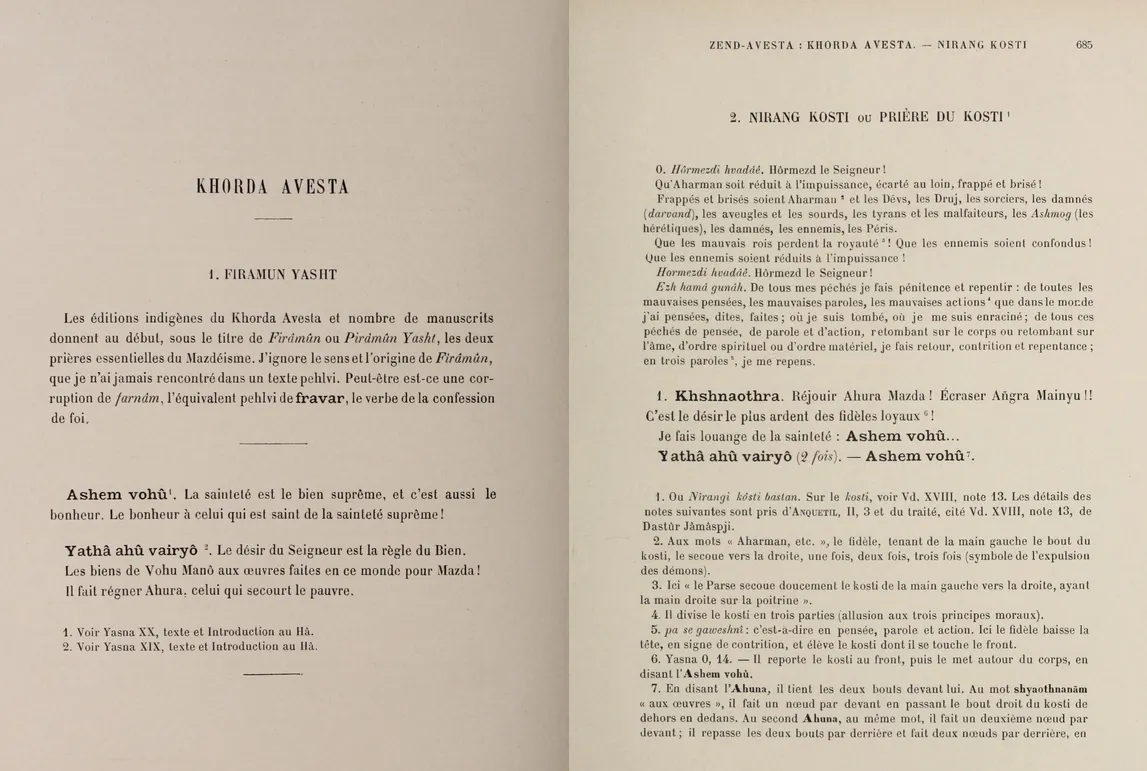
- Ohrmazd: Yasht 1, sections 1 to 23
- Vohuman (Bahman): Yasht 1, sections 24 to 33
- Ardwahisht: Ardibehest Yasht (Yasht 3)
- Hordad: Khordad Yasht (Yasht 4)
- Aban, Khwarshed, Mah, Tishtar and Gosh: Yashts 5 to 9
- Mihr, Srosh, Rashn, Frawardin, Warharan and Ram: Yashts 10 to 15
- Den, Ard and Ashtad: Yashts 16 to 18 (Ard's is the Ashi Yasht)
- Zam: Zemyad Yasht (Yasht 19)
Darmesteter treats the second Yasht, the Yasht of the seven Amesha Spentas (the Haptan Yasht), as common to the seven Yashts of the Amesha Spentas rather than a hymn of its own. Its opening lines on avesta.org repeat the first seven Siroza invocations almost word for word.
Frequently asked questions
What is the Siroza?
The Siroza, whose name means "thirty days", is a prayer of thirty invocations, one for each divinity presiding over a day of the Zoroastrian month. It comes in two versions, a shorter "little" Siroza and a longer "great" Siroza with fuller epithets. Both have thirty-three paragraphs, the last three for Apam Napat, Haoma and Dahma Afriti.
When is the Siroza recited?
Darmesteter wrote that in India the Siroza is recited for the dead on the thirtieth day after death, on the thirtieth day of the sixth and twelfth months, and then every year. The Encyclopaedia Iranica also records its recital thirty days after death and at fixed dates afterwards. Your family priest will guide the details.
How old is the Pahlavi blessing for each Roj?
West translated the blessing as chapter 22 of the Shayast la-Shayast. He found it on folios added to the beginning of the manuscript M6 and wrote that there is no evidence these last two chapters are "quite five centuries old". The Siroza, by contrast, is an Avestan prayer, translated by Darmesteter in the second part of the Zend-Avesta.
Which Roj are dedicated to Ahura Mazda?
Four Roj belong to Ahura Mazda. Roj 1 carries his own name. Roj 8, 15 and 23 carry the epithet "(day) of the Creator" and are told apart by the day that follows each one: Adar, Mihr and Den. Mary Boyce notes that four days were dedicated to him, so he "was honored above the rest".
Why do some Roj share the same blessing?
In the Pahlavi benediction, Roj 4 and Roj 10 both ask for "wealth from every generous one". The helpers of Roj 12 and Roj 26 are both described as "the assistant of champions". And Roj 8, 15 and 23, the three Creator days, all ask for the support of the creator Ohrmazd, matching their identical lines in the Siroza.
Does every Roj have its own Yasht?
No. In Darmesteter's table, nineteen Roj are paired with a Yasht, and the first two Roj draw on different sections of Yasht 1. Shahrewar, Spandarmad, Amurdad, Adar, Wad, Asman, Mahraspand and Anagran, along with the three Creator days, have no Yasht of their own in his list, which he explains as Yashts that were lost.