PalV's Kasti

On this page
- What is the Farvardin Yasht?
- How is the hymn laid out?
- What do the Fravashis do, according to the hymn?
- Whose Fravashis does the hymn honour?
- Is the Fravashi the same as the soul?
- What does the hymn say about the Fravashis visiting homes?
- How many Fravashis are there?
- Where is the Farvardin Yasht recited today?
- Frequently asked questions
The Farvardin Yasht (Yasht 13, also spelt Frawardin or Fravardin Yasht) is the Avestan hymn to the Fravashis, and at 158 verses it is the longest of the Yashts. In it Ahura Mazda tells Zarathushtra that through the Fravashis of the faithful he holds up the sky and the earth, and that without their help "the material world would belong to the Druj". The hymn says the Fravashis fight for their own people, seek water for their kin, and go through the settlements for ten nights at Hamaspathmaidyem, asking to be remembered. Verses 87 to 145 honour the Fravashis of the righteous by name, from Gaya Maretan, the First Man, to the Saoshyant. All verse quotations below are from James Darmesteter's translation in the Sacred Books of the East, as published on avesta.org.
શહેરેવર રોજ
Shehrevar Roj, Tir Mah · 1396 Y.Z.
What is the Farvardin Yasht?
The Farvardin Yasht is "the thirteenth of the Zoroastrian yašts", Mary Boyce writes in Encyclopaedia Iranica, and it is counted "one of the eight great yašts". In her separate Iranica entry on the Fravashis she calls Yasht 13 "the principal source for knowledge of them". What the word fravashi means is a separate question, covered in our guide to the meaning of Fravashi.
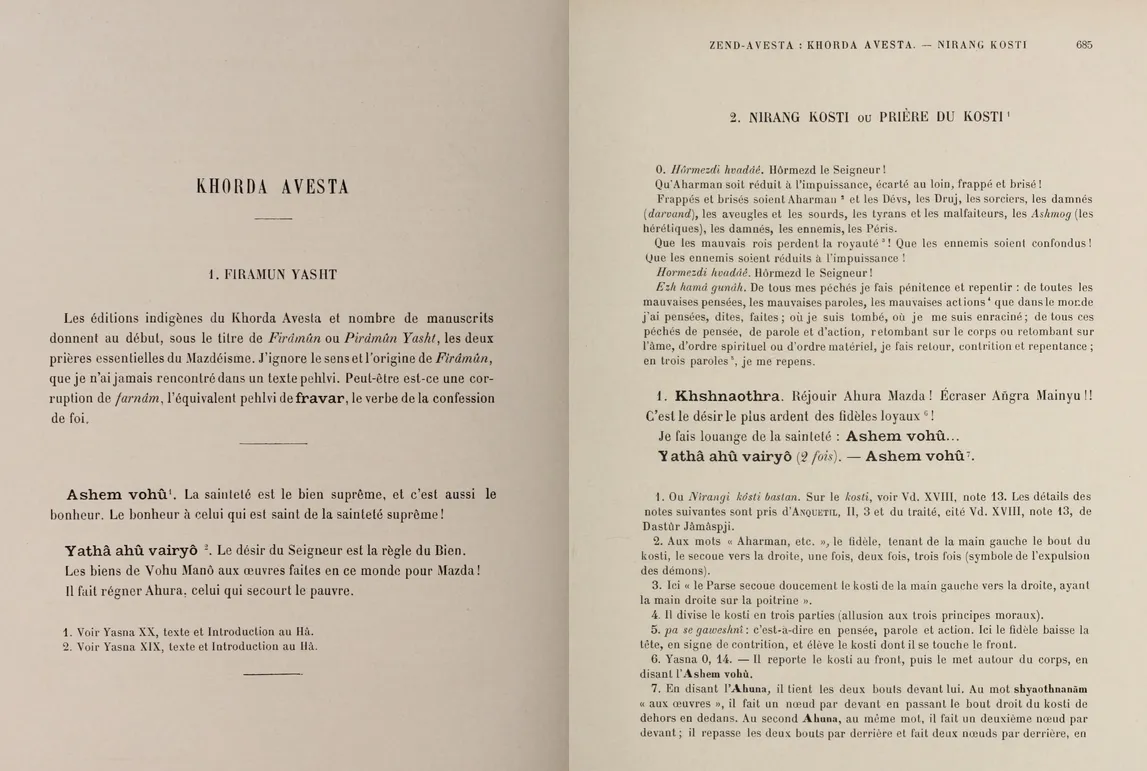
A repeated line of worship, which Boyce gives as "We worship the good, strong, bounteous fravašis of the righteous", to some extent "divides the yašt into long and short sections (karda)". Darmesteter's text ends at verse 158 with the Yatha Ahu Vairyo and Ashem Vohu.
How old is it? Boyce's view is that the hymn is "the work of generations of priests", composed "within a fluid oral tradition". That is one scholar's account of its making, so we give it as hers.
How is the hymn laid out?
The verses we refer to in this article fall into these blocks. Verse numbers follow Darmesteter. The range of the roll of names follows Boyce.
| Verses | What they contain |
|---|---|
| 1 | Ahura Mazda asks Zarathushtra to proclaim the strength of the Fravashis |
| 2, 9-10, 12-13 | What the Fravashis help Ahura Mazda maintain, and what would happen without them |
| 17, 23-24, 31, 67 | Help in battle and help to those who invoke them |
| 21-22 | Whose Fravashis are worshipped, and their care of the unborn child |
| 49-52 | The ten nights of Hamaspathmaidyem |
| 53-54, 57, 65-66 | Paths for the waters and the stars, the great host of Fravashis, and their search for water |
| 59-62 | The 99,999 Fravashis who watch over the sea Vouru-Kasha, the stars Haptoiringa, the body of Keresaspa and the seed of Zarathushtra |
| 80-81, 85-86 | The Fravashis of Ahura Mazda and of other divine beings |
| 87-145 | The roll of named Fravashis, from Gaya Maretan to the Saoshyant, with the list of names at 96-144 |
| 154-158 | Closing worship and the prayer that the Fravashis bless "this house" |
What do the Fravashis do, according to the hymn?
The opening is a charge from Ahura Mazda to proclaim "the vigour and strength, the glory, the help and the joy" in the Fravashis of the faithful (13.1).

They help hold the world together
"Through their brightness and glory, O Zarathushtra! I maintain that sky", Ahura Mazda says, the sky "shining and seen afar" (13.2). The same refrain is used of "the wide earth made by Ahura" (13.9). Verse 22 adds that they "maintain in the womb the child that has been conceived". Verse 57 says they "showed their paths to the stars", to the moon, the sun and the endless lights.
The strongest claim comes at verse 12. Without the Fravashis, "those animals and men of mine" would not survive, and strength, dominion and finally "the material world would belong to the Druj". Boyce reads verses 12 and 13 the same way: without the Fravashis' aid, cattle and men "would have belonged to Aŋra Mainyu".
They come to help when called
Verse 17 calls them "the wisest for help" in "fearful battles". They "give victory to their invoker" and "give health to the sick man" (13.24), and in battle they "break the dread arms of their foes and haters" (13.31). Verse 67 says each one fights in battles "fought in their own place and land".
They seek water for their own people
When the waters rise from the sea Vouru-Kasha, the Fravashis go forward "seeking water for their own kindred, for their own borough", and on for their town and country (13.65-66). Boyce describes the same passage: "Every year when rain comes", she writes, they "strive among themselves" to win water for their own.
Whose Fravashis does the hymn honour?
The circle is wide. Verse 21 worships the Fravashis "of those that are", of those that have been and of those that will be, and "all the Fravashis of all nations".
The divine beings have Fravashis too. "Of all those ancient Fravashis", verse 80 says, "we worship the Fravashi of Ahura Mazda", and verse 81 adds that his soul "is the Mathra Spenta". Verses 85 and 86 go on to the Fravashis of the fire, of Sraosha, Rashnu, Mithra, the Mathra Spenta and the sky.
Then come people. Verse 87 begins with the Fravashi of Gaya Maretan, "who first listened unto the thought and teaching of Ahura Mazda", and the same verse moves straight to the Fravashi of the holy Zarathushtra. Zarathushtra is praised as the one who "first thought what is good", and who first spoke and did it (13.88). Boyce describes verses 96 to 144 as "a list of names of Zoroaster's first disciples", along with leading figures of the early community. That list includes women by name, such as "the holy Hvovi" and "the holy Freni" (13.139). It ends with the Fravashis of holy men and women "in the Aryan countries" and in the Turanian, Sairimyan, Saini and Dahi countries (13.143-144).
The roll closes at verse 145, which worships all the good Fravashis of the faithful from Gaya Maretan "down to the victorious Saoshyant".
Is the Fravashi the same as the soul?
The hymn lists them separately. Verse 155 worships "the spirit, conscience, perception, soul, and Fravashi" of holy men and women. Boyce notes that the Fravashis were "sometimes directly identified as urvans", the souls.
What does the hymn say about the Fravashis visiting homes?
Verses 49 to 52 describe the Fravashis who "come and go through the borough" at Hamaspathmaidyem, and "they go along there for ten nights". William Malandra in Iranica points to Yasht 13.49 as the oldest source for Frawardigan, the year-end festival, one that "already recognizes it as lasting ten nights".
The Fravashis ask questions as they go: "Who will praise us? Who will offer us a sacrifice?" They ask, too, who will meditate upon them and who will bless them (13.50). To the man who receives them "with meat and clothes in his hand" and a prayer, they reply with a blessing: "May there be in this house flocks of animals and men!" (13.51-52).
The hymn ends on the same note. Verse 156 prays that "these Fravashis come satisfied into this house", and verse 157 that they not leave "this house of us" complaining. Boyce sums up the ending as a prayer that the Fravashis may come to "this house," be satisfied.
How many Fravashis are there?
For the whole host the hymn gives no total. It speaks of "many and many hundreds, many and many thousands", and tens of thousands more (13.65). Verses 59 to 62 do name one number: 99,999 Fravashis, written "ninety thousand, and nine thousand, and nine hundred, and ninety-nine", who watch over the sea Vouru-Kasha, the stars Haptoiringa, the body of Keresaspa and the seed of Zarathushtra. Boyce cites verse 65 for her picture of the Fravashis as "a vast host".
Where is the Farvardin Yasht recited today?
Two sources on avesta.org connect the hymn with the Farokhshi. Ervad Ratanshah R. Motafram's description of the Farokhshi ceremony says the Farvardin Yasht is recited "in its entirety" together with the Stum prayer, and that a single priest is needed. He recommends the prayer in memory of the departed on their anniversaries, on the 19th day of every month and during the Farvardegan days. A weekly scripture newsletter on avesta.org, signed "Soli", says of Farvardegan day at the Doongerwadi that "the Mobeds perform the prayers of Farokhshi (Farvardin Yasht)".
For the month named after the Fravashis, see our guide to Farvardin Mah.
Practice varies between families and Agiaries; your family priest's guidance comes first.
Frequently asked questions
What is the Farvardin Yasht?
The Farvardin Yasht is Yasht 13 of the Avesta, the hymn in praise of the Fravashis of the faithful. Encyclopaedia Iranica describes it as one of the eight great Yashts and the longest of them all, at 158 verses. Mary Boyce calls it the principal source for knowledge of the Fravashis.
What does the Farvardin Yasht say the Fravashis do?
In Darmesteter's translation, Ahura Mazda says that through the Fravashis he maintains the sky and the earth, and that without them the material world would belong to the Druj. The hymn also says they help in battle, aid those who invoke them, and seek water for their own people.
Does Ahura Mazda have a Fravashi?
Yes, according to the hymn. Verse 80 worships "the Fravashi of Ahura Mazda", and verse 81 says his soul is the Mathra Spenta. Verses 85 and 86 also honour the Fravashis of the fire, Sraosha, Rashnu, Mithra and the sky, so divine beings have Fravashis as well as people.
What does the Farvardin Yasht say about Hamaspathmaidyem?
Verses 49 to 52 say the Fravashis of the faithful go through the settlements for ten nights at Hamaspathmaidyem, asking who will praise them and offer them sacrifice. They bless the household that receives them with meat, clothes and prayer. Encyclopaedia Iranica calls verse 49 the oldest source for this year-end festival.
How many verses does the Farvardin Yasht have?
The Farvardin Yasht has 158 verses, which makes it the longest Yasht, according to Mary Boyce in Encyclopaedia Iranica. Darmesteter's translation also ends at verse 158. Verses 96 to 144 hold the long list of named Fravashis of Zarathushtra's first disciples and early community members.
Is the Farvardin Yasht recited in the Farokhshi?
Yes. Ervad Ratanshah R. Motafram's description of the Farokhshi ceremony on avesta.org says the Farvardin Yasht is recited in its entirety together with the Stum prayer. He recommends it on the 19th day of every month, on anniversaries of the departed and during the Farvardegan days.