PalV's Kasti
On this page
- What do the Shenshai, Kadmi and Fasli calendars have in common?
- What is the Shenshai calendar?
- What is the Kadmi calendar, and why is it a month ahead?
- What is the Fasli calendar?
- How do the three Parsi calendars compare?
- Which calendar do Parsis follow today?
- Is the Shahanshahi calendar of 1970s Iran the same thing?
- How do you find a date in each calendar?
- Frequently asked questions
The Shenshai, Kadmi and Fasli calendars are three versions of one Zoroastrian calendar. All three use the same names for the days and the months, with 12 months of 30 days and five Gatha days to close the year. What separates them is where the year begins, so the same festival day is kept on different Gregorian dates. The Shenshai calendar (also spelt Shahenshahi or Shahanshahi) is the one most Parsis follow. The Kadmi runs a month ahead, following the Iranian reckoning that a section of the Parsi community took up in the 18th century. The Fasli, introduced in 1906, adds a day every fourth year so that its New Year stays on 21 March.
અસપંદામેદ રોજ
Asfandarmad Roj, Tir Mah · 1396 Y.Z.
What do the Shenshai, Kadmi and Fasli calendars have in common?
Far more than they differ. FEZANA's calendar lesson plan for teachers puts it plainly: all three calendars have the same names of the days and months. Each year has 12 months (Mah) of 30 days, every day (Roj) carries a name rather than a number, and five additional days known as the Gatha days follow the twelfth month to make 365. Mary Boyce, writing in Encyclopaedia Iranica, describes the same shape: a year of twelve 30-day months, with five extra days set at the year's end.
So a date written as a Roj and a Mah names the same day in all three systems. The only question is which Gregorian date that day lands on. Boyce sums up the result: the same festal days are celebrated, but on different dates. For the Gatha days themselves, see our guide to the five Gatha days, and for the calendar as a whole, the Zoroastrian calendar.
What is the Shenshai calendar?
The Shenshai calendar is the traditional calendar of the Parsis of India. Boyce gives the name as Šenšāī, with Šāhānšāhī as the popular variant. Antonio Panaino, also in Encyclopaedia Iranica, notes that its followers called it rasmī, meaning "traditional", and were known as Shenshais. FEZANA calls it the Imperial Calendar followed by the Parsi Zoroastrians who moved from Iran to India.
Years in the Shenshai reckoning are counted from the start of the rule of Yazdegerd III, the last Sasanian king, according to both FEZANA and Panaino. Its New Year (Navroz) is the Parsi New Year on public holiday lists. In 2026 it fell on Saturday, 15 August: the Government of Maharashtra's holiday notification listed "Parsi New Year (Shahenshahi)" on that date, as reproduced by the Mumbai-based MUCB bank and reported by Oneindia.
We cover the Shenshai calendar on its own, including the spellings and who keeps it, in the Shahenshahi (Shenshai) calendar.
What is the Kadmi calendar, and why is it a month ahead?
The Kadmi (also Kadimi or Qadimi) calendar follows the reckoning of the Zoroastrians of Iran. The name comes from the Arabic qadim, "old, ancient", because its followers regard the Irani calendar as the ancient one. Boyce records that the Parsi calendar was a month behind that of the Persian Zoroastrians, whose calendar came to be called Qadimi (Parsi Kadmi). FEZANA states the same gap: the Kadmi calendar differs by one month from the Shenshai, due to a difference in calculation.
Why the month appeared is the contested part, and the sources record more than one view:
- The Kadmi position. Ramiyar Karanjia, writing in Encyclopaedia Iranica, explains that the Kadimis consider the Irani calendar the ancient one.
- The Shenshai (rasmī) position. Panaino records that the rasmīs claimed the reverse: that it was the Iranian community that was a month behind, because it had not added a month after each 120-year cycle.
- Mary Boyce's view (Encyclopaedia Iranica). Boyce writes that the last reform of the 365-day calendar was made by Parsis, who repeated a month as a "Second Spendarmad". She also considers it highly doubtful that a month was ever added regularly every 120 years.
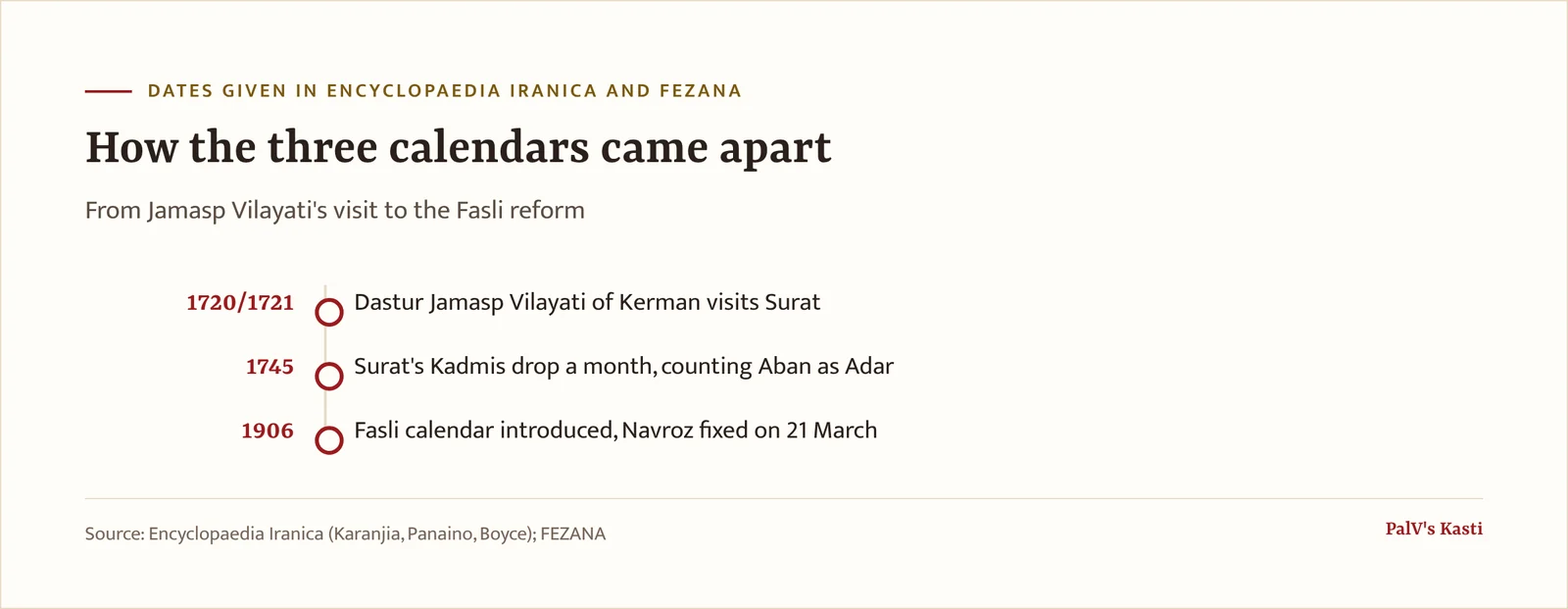
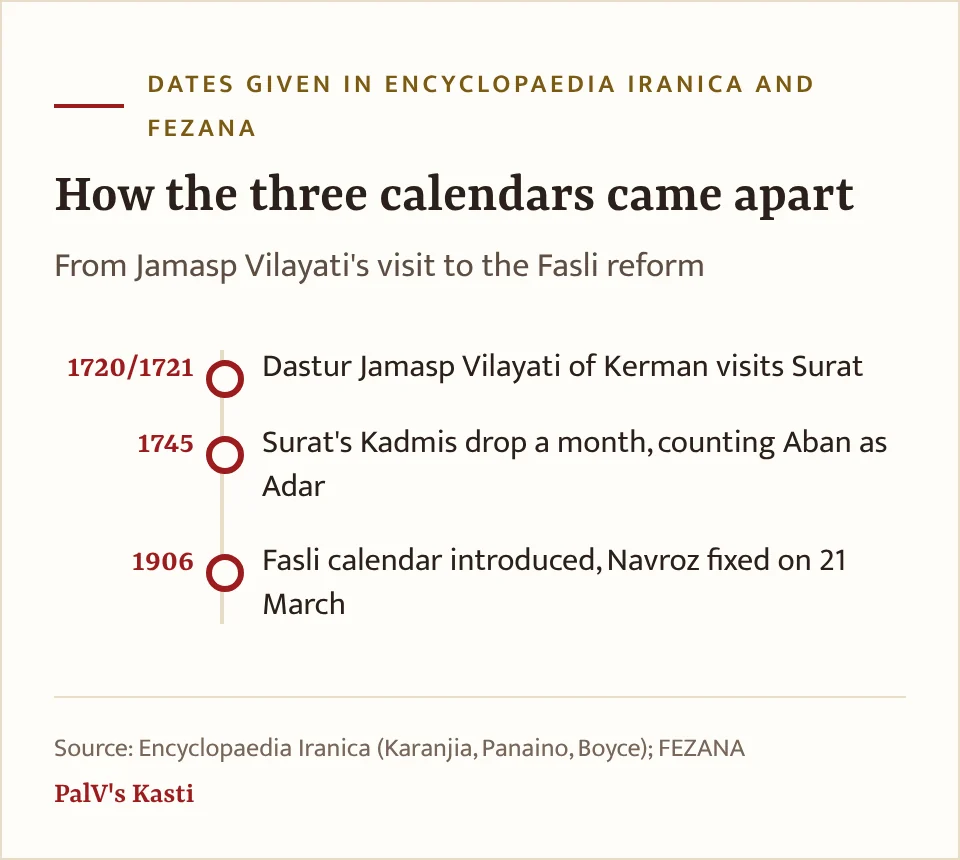
The sources differ slightly on dates too. Karanjia says Surat's Zoroastrians invited Dastur Jamasp Vilayati from Kerman in early 1721, and that the Surat community changed in 1745 by counting the 8th month, Aban, as the 9th month, Adar. Panaino, following Darmesteter, dates the visit to 1720 and the change to 17 June 1745, or 1746 according to Boyce. The full story is in the 18th-century Kadmi split.
Because the Kadmi calendar is a month ahead, Kadmi Navroz comes about a month before Shenshai Navroz. More on that in why Kadmi and Shenshai New Years are a month apart, and on the calendar itself in the Kadmi calendar.
What is the Fasli calendar?
The Fasli calendar is the seasonal version. Boyce writes that in the early 20th century a group of Parsis, inspired by Kharshedji Rustamji Cama, adopted a calendar she describes as Gregorian, known as the Fasli, with a fixed Nowruz on 21 March and a day added every fourth year after the five Gatha days. FEZANA dates it to 1906 and says its purpose was to start the New Year on the spring equinox, 21 March. Panaino also gives 1906, describing it as an attempt to resolve the controversy with a new calendar similar to the Gregorian.
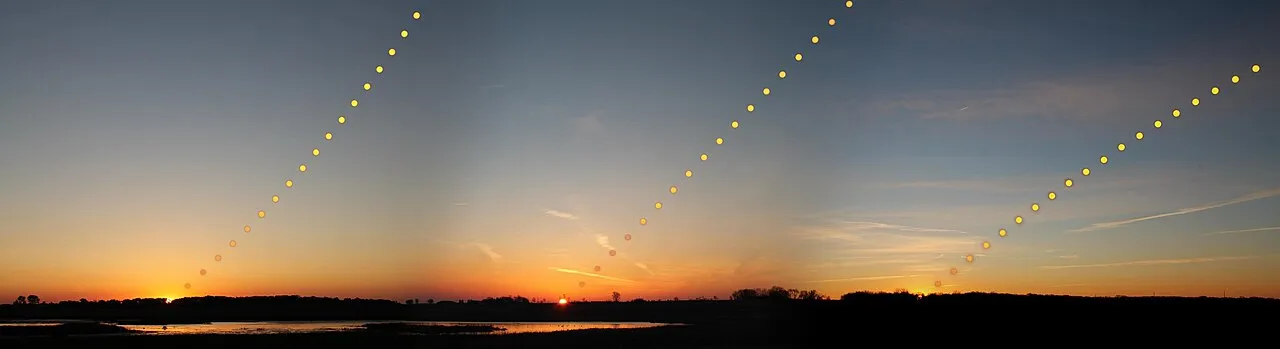
That extra day is what keeps the Fasli in step with the seasons. The Shenshai and Kadmi years stay at 365 days (12 × 30 + 5), and Boyce notes that a 365-day calendar slowly falls behind the natural year, by about a month every 120 years. The Fasli year doesn't slip, so its New Year stays in March. The leap day and the month names are covered in the Fasli calendar, and the drift itself in the astronomy behind the Parsi calendar.
How do the three Parsi calendars compare?
| Shenshai | Kadmi | Fasli | |
|---|---|---|---|
| Other names and spellings | Shahenshahi, Shahanshahi, Shenshahi; also called rasmī ("traditional") | Kadimi, Qadimi | Faṣlī |
| Day and month names | Same in all three | Same in all three | Same in all three |
| Length of year | 365 days: 12 months of 30 days + 5 Gatha days | 365 days, same structure | 365 days, plus 1 day every fourth year after the Gatha days |
| How it began | The Parsis' traditional reckoning, the last to be reformed (by repeating a month), per Boyce | Adopted by Surat's Parsis in 1745 per Karanjia; 17 June 1745 or 1746 per Panaino | Introduced in 1906 |
| New Year (Navroz) | In August in recent years; Saturday, 15 August in 2026 | About one month before Shenshai Navroz | Fixed on 21 March |
| Who follows it | Most Parsis | A section of the Parsi community | A group of Parsis inspired by K.R. Cama; most often Irani Zoroastrians, per the Pluralism Project |
Which calendar do Parsis follow today?
Most Parsis follow the Shenshai calendar. Karanjia writes that most Parsis did not change their calendar and are known as Shenshahis, and the Pluralism Project at Harvard University notes that the Shenshai and the Kadmi are the calendars often followed by Parsis. The Fasli, according to the same Pluralism Project page, is most often followed by Irani Zoroastrians.
Because each calendar starts its year on a different date, the community marks more than one New Year. The Pluralism Project notes that three New Year celebrations are observed, and that Jamshedi Navroz is kept at the spring equinox. Why there's both an August and a March New Year is covered in why there are two Parsi New Years and Jamshedi Navroz and the three calendars.
Whether the community should move to a single calendar is still argued. The Pluralism Project records much debate among Zoroastrians on adopting a unified calendar. We set out the positions as the sources give them and take no side.
Is the Shahanshahi calendar of 1970s Iran the same thing?
No. "Shahanshahi" also names a short-lived state era in Pahlavi Iran, unrelated to the Parsi religious calendar. Encyclopaedia Iranica's chronology of Iranian history records that Iran adopted a new calendar in 1976, counted from the founding of the Persian Empire in the 6th century BC, under which the year beginning 21 March 1976 was numbered 2535 in the šāhanšāhi era. Iran returned to its previous calendar just before the 1979 revolution. A search for "Shahanshahi calendar" can bring up either, so check which one a page means.
How do you find a date in each calendar?
For the Shenshai Roj and Mah of any day, use our Parsi Roj calendar. It's also the place to check Navroz and other dates for 2027 and later years. To work out the same day in the Kadmi or Fasli reckoning, or to convert a Gregorian date such as a birthday or a death anniversary, see converting dates between the calendars. If you're explaining all this to a child, our Parsi calendar for children keeps it simple.
Frequently asked questions
What is the Shenshai calendar?
The Shenshai calendar is the traditional Zoroastrian calendar kept by most Parsis in India. It has 12 months of 30 days, each day with its own name, followed by five Gatha days, making 365 days with no leap day. Encyclopaedia Iranica gives Shahanshahi as its popular variant name, and its followers also called it rasmī, "traditional".
Is Shahenshahi the same as Shenshai?
Yes. Shenshai, Shenshahi, Shahenshahi and Shahanshahi are spellings of the same Parsi calendar. Mary Boyce, in Encyclopaedia Iranica, gives Šenšāī with Šāhānšāhī as the popular variant, and the Government of Maharashtra lists the August holiday as "Parsi New Year (Shahenshahi)". Don't confuse it with the Iranian state era of 1976, which shares the name.
Which calendar do Parsis follow?
Most Parsis follow the Shenshai calendar, according to Ramiyar Karanjia in Encyclopaedia Iranica. A smaller section of the community follows the Kadmi calendar, which runs one month ahead, and a group of Parsis took up the seasonal Fasli calendar introduced in 1906. The Pluralism Project at Harvard notes that the Fasli is most often followed by Irani Zoroastrians.
Why is the Kadmi New Year a month before the Shenshai New Year?
The Kadmi calendar follows the Iranian reckoning, which was a month ahead of the Parsi one when the two were compared in the 18th century. Kadmis regard it as the ancient one. Shenshai followers held that the Iranians had failed to add a month, while Mary Boyce records that the last reform of the calendar was made by the Parsis.
When was Shenshai Navroz in 2026?
Shenshai Navroz fell on Saturday, 15 August 2026, the date the Government of Maharashtra's holiday notification gave for "Parsi New Year (Shahenshahi)". Because the Shenshai year has 365 days and no leap day, its Gregorian date shifts slowly over the years, so check our Parsi Roj calendar for 2027 and later.
Does the Fasli calendar have a leap year?
Yes. The Fasli calendar adds one day every fourth year, placed after the five Gatha days, according to Mary Boyce in Encyclopaedia Iranica. That extra day keeps its New Year fixed on 21 March, the spring equinox, which FEZANA gives as the purpose of the calendar introduced in 1906. The Shenshai and Kadmi calendars have no such day.