PalV's Kasti
On this page
- What do "Shenshai" and "Shahenshahi" mean, and how are they spelt?
- How is the Shenshai year built?
- Why does Shenshai Navroz move against the Gregorian calendar?
- How did the Shenshai calendar come to differ from the Iranian one?
- Who uses the Shenshai calendar today?
- Is the Shenshai calendar the same as Iran's Shahanshahi calendar?
- How can I find today's Shenshai Roj and Mah?
- Frequently asked questions
The Shahenshahi or Shenshai calendar is the traditional religious calendar that most Parsis follow, according to Ramiyar Karanjia in Encyclopaedia Iranica. Its year has 12 months (Mah) of 30 days, each day (Roj) has its own name, and five Gatha days close the year, making 365 days, as FEZANA's calendar lesson plan sets out. It adds no leap day. That's why its New Year, Navroz, now falls in August and moves slowly against the Gregorian calendar. In 2026 it fell on Saturday, 15 August, the date on the Government of Maharashtra's public holiday list. It is one of three Zoroastrian calendars in use, alongside the Kadmi and the Fasli.
શહેરેવર રોજ
Shehrevar Roj, Tir Mah · 1396 Y.Z.
What do "Shenshai" and "Shahenshahi" mean, and how are they spelt?
They're two spellings of one name. Mary Boyce, writing in Encyclopaedia Iranica, gives the calendar's name as Šenšāī, with Šāhānšāhī as the popular variant. Ramiyar Karanjia, also in Encyclopaedia Iranica, calls its followers Shenshahis. Antonio Panaino adds a third name: the majority adopted the name rasmī, meaning "traditional", for their calendar, and were known as Shenshais.
FEZANA's calendar lesson plan calls it "The Imperial Calendar", the one kept by the Parsi Zoroastrians who came to India from Iran. The Government of Maharashtra's holiday notification spells it Shahenshahi. You will also see Shahanshahi, Shenshahi and Shehenshahi. All of them mean the same Parsi calendar.
How is the Shenshai year built?
It follows the common Zoroastrian pattern. FEZANA sets it out as 12 months, or Mahs, of 30 days each, plus five additional days known as the Gatha days. That gives 365 days, every year. Boyce describes the same design: a 360-day year of twelve 30-day months, with five extra days set at the year's end.
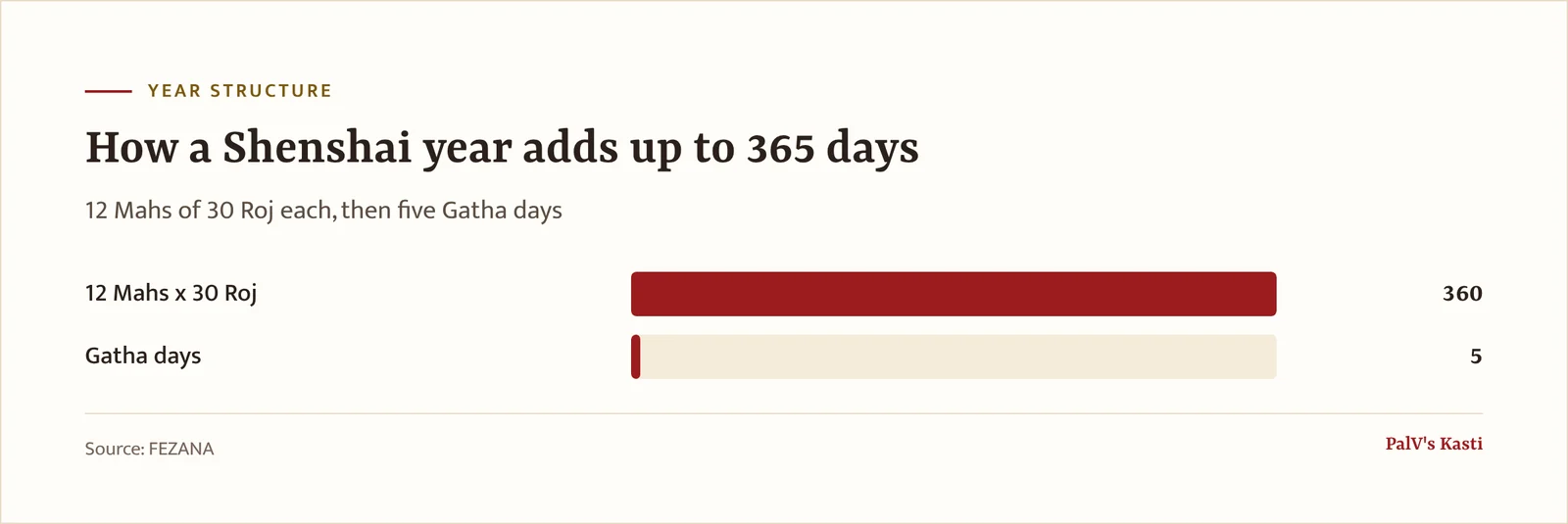
The day and month names aren't special to the Shenshai calendar. FEZANA notes that all three Zoroastrian calendars use the same names for the days and months. Shenshai years are counted from the start of the rule of Yazdegerd III, the last Sasanian king, according to both FEZANA and Panaino. For how that count works, see counting Zoroastrian years, and for the wider system, our guide to the Zoroastrian calendar.
Why does Shenshai Navroz move against the Gregorian calendar?
Because a 365-day year is shorter than the year of the seasons. Boyce explains that the 365-day calendar slowly fell behind the natural year, by about a month every 120 years. The Shenshai calendar keeps that 365-day year unchanged.
The Fasli calendar shows the contrast. Boyce records that it adds a day every fourth year after the Gatha days, which keeps its New Year fixed on 21 March. The Shenshai calendar has no such day, so its Navroz sits in August today. The arithmetic behind the slip is in the astronomy behind the Parsi calendar.
How did the Shenshai calendar come to differ from the Iranian one?
The Parsi and Iranian Zoroastrian calendars ended up a month apart. Boyce writes that Parsis made the last reform of the 365-day calendar, repeating a month as "Second Spendarmad". She calls this "the only certain instance of the theory being put into practice". As a result, the Parsi calendar was a month behind that of the Persian Zoroastrians, whose calendar came to be called the Qadimi, or Kadmi in Parsi usage.
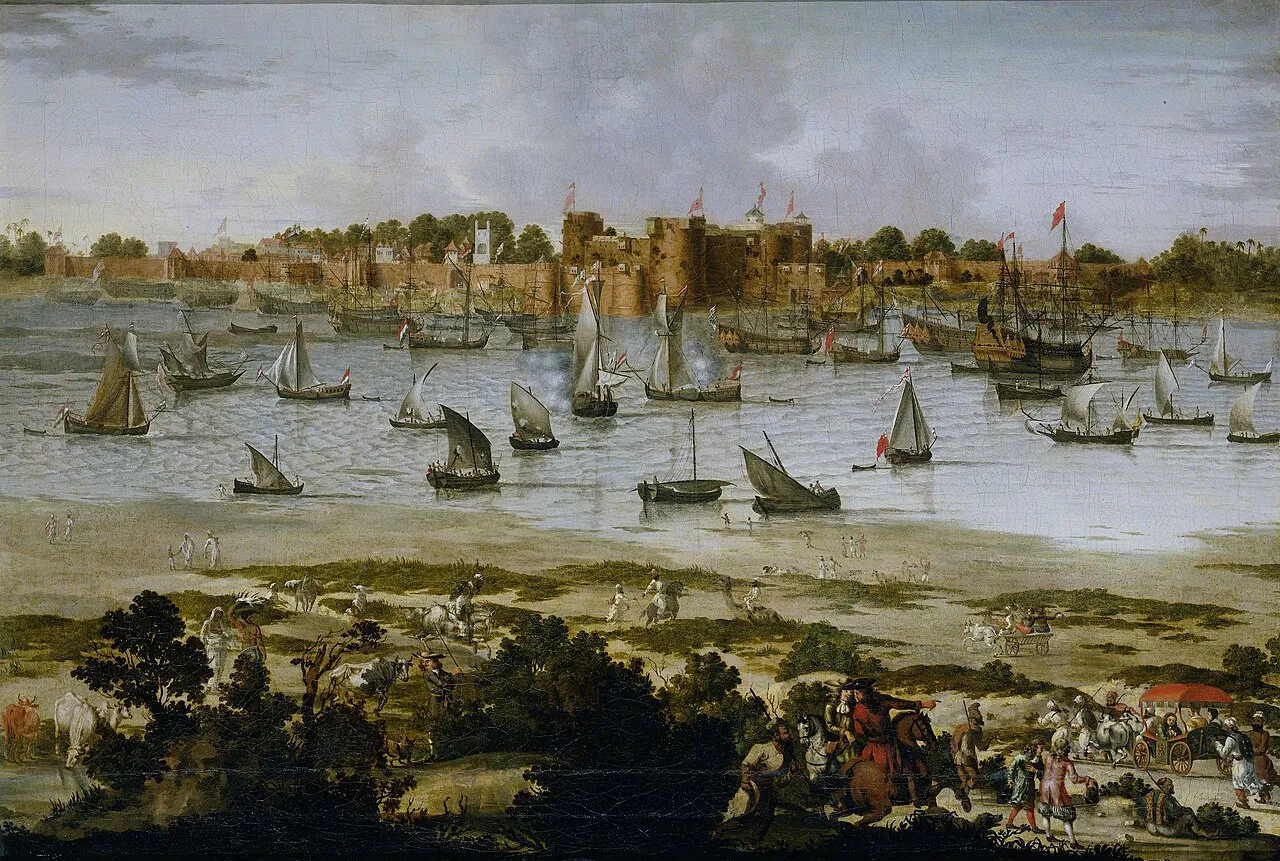
In the 18th century a priest from Iran pointed out the gap. Karanjia writes that in early 1721 Zoroastrians in Surat invited Dastur Jamasp Vilayati of Kerman to advise them. Panaino gives 1720 for his arrival in Surat and records that he noted the Parsi calendar was a month behind Iran's. One segment of the community then adopted the Iranian reckoning and became Kadmis, Panaino writes. Most Parsis did not change their calendar, and Karanjia notes they are known as Shenshahis.
Each side read the gap differently. Panaino records that the rasmīs claimed it was the Iranian community that was a month behind, because it had not added a month after each 120-year cycle. Karanjia notes that the Kadimis consider the Irani calendar the ancient one. We record both positions and take no side. The full story is in the 18th-century Kadmi split, and the month's difference in New Year dates in why Kadmi and Shenshai New Years are a month apart.
Who uses the Shenshai calendar today?
Most Parsis. Karanjia's Encyclopaedia Iranica entry states that most Parsis did not change their calendar and are known as Shenshahis. The Pluralism Project at Harvard University notes that the Shenshai and the Kadmi are the calendars often followed by Parsis, while the Fasli is most often followed by Irani Zoroastrians.
The Shenshai Navroz is also the date on Maharashtra's public holiday list. The Government of Maharashtra's notification of 5 December 2025 lists "Parsi New Year (Shahenshahi)" on Saturday, 15 August 2026, and All India Radio reported the Vice President's and Prime Minister's Navroz greetings that same day. Why Parsis also mark a New Year in March is covered in the New Year of Parsis. For how the Shenshai calendar sits beside the other two, see our comparison of Shenshai, Kadmi and Fasli.
Is the Shenshai calendar the same as Iran's Shahanshahi calendar?
No. Pahlavi Iran had a state calendar era with the same name, and it has nothing to do with the Parsi calendar. Reza Abdollahy, in Encyclopaedia Iranica, records that it counted years from the supposed accession of Cyrus the Great, with 21 March 1976 as its first New Year. Iran went back to its previous calendar on 27 August 1978, on the eve of the 1979 revolution. Search results for "Shahanshahi calendar" can show either one, so check which is meant.
How can I find today's Shenshai Roj and Mah?
Use our Parsi Roj calendar, which gives the Shenshai Roj and Mah for each day. If you're new to the way a Roj calendar page is laid out, our guide on how to read a Parsi Roj calendar walks through the Roj, Mah and Geh entries.
Frequently asked questions
How many days are there in a Shenshai year?
A Shenshai year has 365 days. FEZANA's calendar lesson plan describes 12 months, or Mahs, of 30 days each, followed by five additional days known as the Gatha days. Each of the 30 days in a month has its own name, and the same day and month names are used in the Kadmi and Fasli calendars.
Does the Shenshai calendar have a leap day?
No. The Shenshai calendar keeps a 365-day year every year. Mary Boyce, in Encyclopaedia Iranica, explains that the 365-day calendar slips slowly against the natural year. The seasonal Fasli calendar is the one that adds a day every fourth year, after the Gatha days, so that its New Year stays on 21 March.
When was the Shenshai New Year in 2026?
The Government of Maharashtra's holiday notification of 5 December 2025 listed "Parsi New Year (Shahenshahi)" on Saturday, 15 August 2026. Because the year has no leap day, its Gregorian date shifts slowly over time, so check our Parsi Roj calendar or your community calendar for the date in later years.
Why is the Shenshai calendar called rasmī?
Rasmī means "traditional". Antonio Panaino, in Encyclopaedia Iranica, records that the majority of Parsis, who kept their existing calendar, adopted the name rasmī for it. FEZANA calls the same calendar the Imperial Calendar, and Mary Boyce gives Šenšāī, with Šāhānšāhī as its popular variant.
From which year are Shenshai years counted?
Shenshai years are counted from the start of the rule of Yazdegerd III, the last Sasanian king. FEZANA states this in its calendar lesson plan, and Antonio Panaino, in Encyclopaedia Iranica, dates both the Shenshai and Kadmi eras from Yazdegerd III's coronation as king.