PalV's Kasti
On this page
The Parsi calendar is the calendar Parsis use for their prayers and festivals. It has 12 months, called Mah, and each month has 30 days, called Roj. At the end of the year come 5 extra days, the Gatha days, so the year has 365 days. Every day has a name instead of a number, and each name belongs to a divine being. When the day's name and the month's name are the same, that day is a special festival called a Parabh. Parsis follow three versions of the calendar, so the New Year doesn't fall on the same date for everyone. For Shenshai Parsis, the New Year in 2026 was on Saturday, 15 August.
This guide is written so you can read it with a child, or a child can read it alone. Each section answers one question.
શહેરેવર રોજ
Shehrevar Roj, Tir Mah · 1396 Y.Z.
How many days are there in a Parsi year?
A Parsi year has 365 days. FEZANA's calendar lesson for children explains it as a sum: 30 days times 12 months makes 360 days, and then 5 extra days "known as the Gathas days" go on the end of the 12th month, making 365. The Encyclopaedia Iranica says the same thing in grown-up words: the calendar "consisted of twelve months of thirty days each".
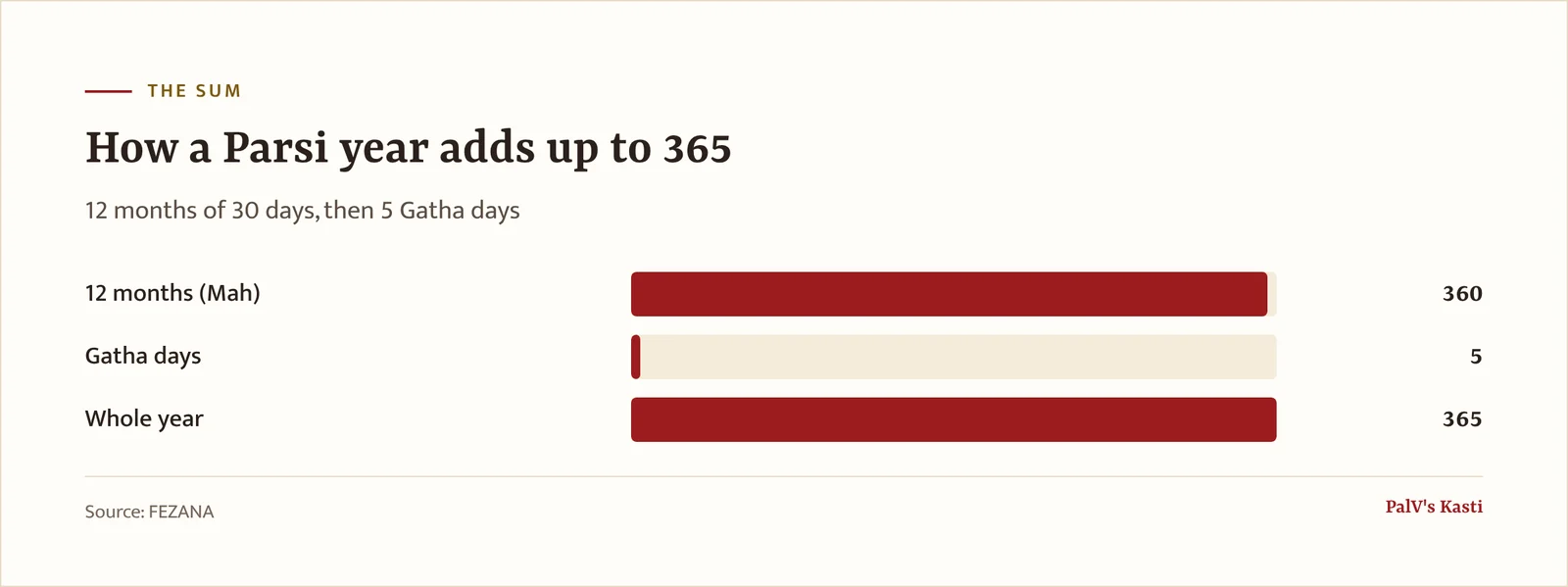
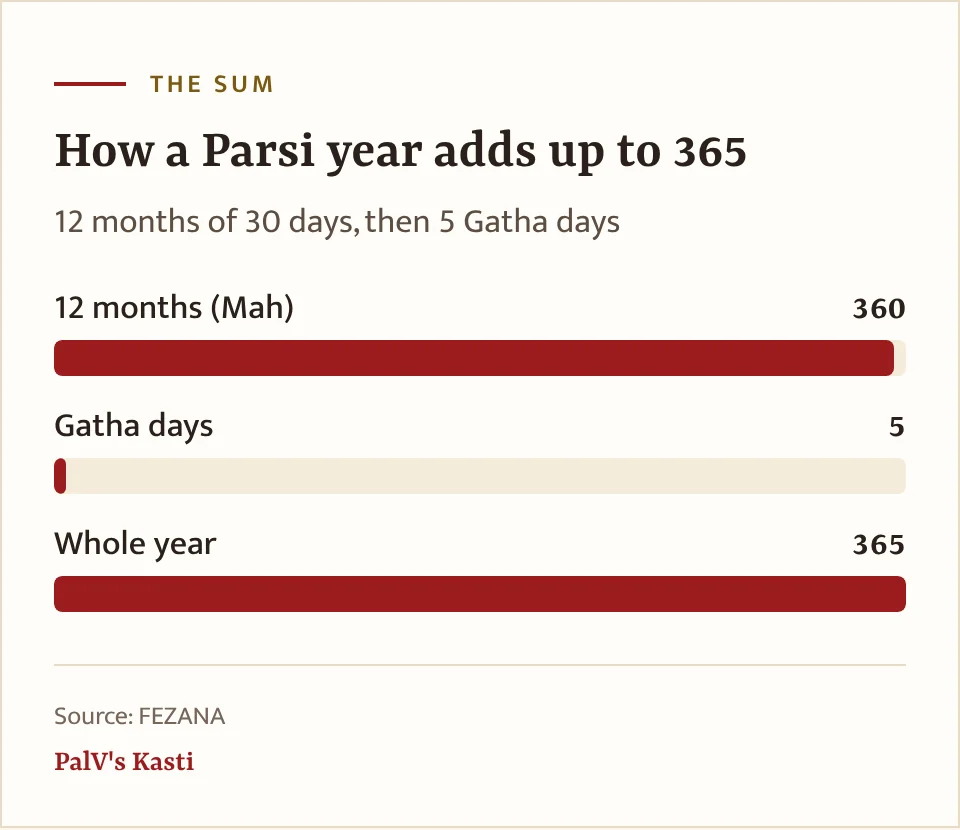
| What | How many | Days |
|---|---|---|
| Months (Mah) | 12 | 12 × 30 = 360 |
| Gatha days | 5 | 5 |
| Whole year | 365 |
FEZANA's lesson for the youngest children adds that each day "has a name and not a number".
What are the 12 Parsi months called?
Here are the 12 Parsi months in order, as FEZANA's lesson lists them:
- Fravadin
- Ardibehesht
- Khordad
- Tir
- Amardad
- Shehrevar
- Meher
- Avan
- Adar
- Dae
- Bahman
- Aspandarmad
You'll see other spellings too, such as Farvardin for the first month. They're the same months. To learn what each month's name means, read our guide to the twelve Parsi months.
Why does every Parsi day have a name?
Because each of the 30 days of the month is set aside for a divine being. FEZANA's lesson says the 30 Roj represent 30 Yazatas. Mary Boyce, a well-known scholar of the Zoroastrian religion, writes in the Encyclopaedia Iranica that the calendar was given its Zoroastrian form by dedicating each of the thirty days "to one of the yazatas".
An old prayer called the Siroza, which means "thirty days", calls on all of them in order. James Darmesteter, who translated it for the Sacred Books of the East in 1883, describes it as a prayer of "thirty invocations" addressed to the Izeds who preside over the thirty days of the month.
Here are the 30 Roj. The middle column uses the Parsi spellings from FEZANA's lesson. The right-hand column shows who each day's line of the Siroza is addressed to first, in Darmesteter's translation.
| Day | Roj name | Siroza is addressed to |
|---|---|---|
| 1 | Hormazd | Ahura Mazda |
| 2 | Bahman | Vohu Mano |
| 3 | Ardibehsht | Asha Vahishta |
| 4 | Shehrevar | Khshathra Vairya |
| 5 | Asfandarmad | Spenta Armaiti |
| 6 | Khordad | Haurvatat |
| 7 | Amardad | Ameretat |
| 8 | Dae pa Adar | the Maker Ahura Mazda |
| 9 | Adar | Atar |
| 10 | Ava | the good Waters |
| 11 | Khorshed | the Sun |
| 12 | Mohor | the Moon |
| 13 | Tir | Tistrya, the bright and glorious star |
| 14 | Gosh | the body and the soul of the Cow |
| 15 | Dae pa Mehr | the Maker Ahura Mazda |
| 16 | Mehr | Mithra |
| 17 | Sarosh | Sraosha |
| 18 | Rashne | Rashnu Razishta |
| 19 | Fravadin | the Fravashis of the holy ones |
| 20 | Behram | the well-shapen, tall-formed Strength; Verethraghna |
| 21 | Ram | Rama Hvastra |
| 22 | Govad | the bounteous Wind |
| 23 | Dae pa Din | the Maker Ahura Mazda |
| 24 | Din | Chista, the most right |
| 25 | Ashishvangh | Ashi Vanguhi |
| 26 | Ashtad | Arstat |
| 27 | Asman | the Heavens |
| 28 | Zamyad | the bounteous Earth |
| 29 | Mahrespand | Mathra Spenta |
| 30 | Aneran | the eternal and sovereign luminous space |
FEZANA's lesson adds that "each day embodies an ethical concept for Zoroastrians to live by". What each Roj name means is explained in our article on the thirty Roj names and their meanings.
Practice varies between families and Agiaries; your family priest's guidance comes first.
What are the Dae days?
The Dae days are three days in every month that belong to Ahura Mazda, the Maker: day 8 (Dae pa Adar), day 15 (Dae pa Mehr) and day 23 (Dae pa Din). Ahura Mazda also has the very first day of the month, Hormazd. Boyce writes that Ahura Mazda is the one "to whom the first day of the month was devoted". Our article on the Dae days of the month explains them in more detail.
Darmesteter explains in a note to the Siroza that the eighth, fifteenth and twenty-third days are under the rule of Ahura and the Amesha Spentas, so they have no name of their own and take the name of the day that follows. That's why day 8, just before Adar, is called Dae pa Adar. He also notes that "the month was divided into four weeks", the first two of seven days and the last two of eight. So the Dae days split each month into four parts: 7 days, 7 days, 8 days and 8 days.
What is a Parabh?
A Parabh is a festival day that comes when the name of the Roj and the name of the Mah are the same. FEZANA's lesson says: "When the day and month coincide, it is known as a 'Parabh'", and gives the example of Adar roj in Adar mah, called Adaryan Parabh. Boyce explains the same idea: whenever a day and a month were dedicated to the same divine being (her example is "day of Mithra, month of Mithra"), that day became its feast.
Here's a way to find one yourself. Look at the table of Roj above. Day 9 is Adar, and month 9 is Adar. So Adar roj of Adar mah is a Parabh. Can you find the one for Tir? (Day 13, month 4.)
Practice varies between families and Agiaries; your family priest's guidance comes first.
What are the five Gatha days?
The five Gatha days are extra days at the very end of the Parsi year. FEZANA's lesson describes them as added to the 12th month to make the year 365 days long. The Encyclopaedia Iranica says they "took their names from the five Gathas", and Boyce writes that each of the five days was dedicated to one of Zoroaster's five Gathas. After the fifth Gatha day, the New Year begins. Our article on the five Gatha days tells you more.

Why do Parsis have three calendars?
Because the community came to count the year in three ways, and each way starts the year on a different date. The Kadmi way was taken up in India in the 18th century, after a one-month difference with the calendar kept in Iran was noticed. Ramiyar Karanjia's Iranica article dates the first Kadmi change to Surat in 1745. FEZANA describes the three like this:
| Calendar | What FEZANA says about it |
|---|---|
| Shenshai (Shahenshahi) | "The Imperial Calendar" of the Parsi Zoroastrians who moved from Iran to India |
| Kadmi | "meaning 'ancient one'", and it "differs by one month from the Shehenshahi calendar" |
| Fasli | Set up to start the new year on the Spring Equinox (21st March) |
According to the Zoroastrian Society of British Columbia, the Shenshai calendar hasn't added leap days regularly, so it has slowly moved against the seasons. The Society says that because of this, "the Zoroastrian New Year now falls in August" for Shenshai followers. The Fasli calendar uses leap-year days so its New Year stays at the spring equinox. Different families follow different calendars.
Grown-ups who want the full story can read our guide to Shenshai, Kadmi and Fasli, our article on why the Kadmi and Shenshai New Years are a month apart, and our explainer on why there are two Parsi New Years. To work out the same day in each calendar, see converting Parsi dates. For the calendar as a whole, there's our Zoroastrian calendar guide.
How can children learn the Parsi calendar?
By using it. FEZANA's lesson plan suggests activities like these:
- Find out which Roj you were born on, and what that Roj means.
- Choose your favourite Roj and say why you like it.
- Play "Bingo with the rojes".
- Make a picture chart of the 30 Roj, with a drawing for each one.
- Write a "thought for the day" for each day of one month.
To find your birth Roj, ask a grown-up to help you look up your birthday in our Parsi Roj calendar. It's also the place to check this year's New Year dates for each calendar.
Frequently asked questions
How many months are in the Parsi calendar?
The Parsi calendar has 12 months, called Mah. Each month has 30 days, called Roj, which makes 360 days. Five extra days, the Gatha days, are added at the end of the year, so a Parsi year has 365 days. The months run from Fravadin, the first, to Aspandarmad, the twelfth.
What is a Roj?
A Roj is a day in the Parsi calendar. There are 30 Roj in every month, and each one has its own name, such as Hormazd for day 1 or Adar for day 9. Each Roj is set aside for a divine being. The Siroza prayer calls on the beings of all thirty days in order.
What is Hormazd Roj?
Hormazd Roj is the first day of every Parsi month, and it belongs to Ahura Mazda. Ahura Mazda also has three more days in each month, called the Dae days: day 8, Dae pa Adar; day 15, Dae pa Mehr; and day 23, Dae pa Din. These days split the month into four parts.
What is a Parabh day?
A Parabh is a festival that falls when the day's name and the month's name are the same. For example, Adar Roj in Adar Mah is called Adaryan Parabh. FEZANA's lesson for children explains this, and the scholar Mary Boyce says such a day became the feast of the divine being it was dedicated to.
When is the Parsi New Year?
It depends on which calendar a family follows. For Shenshai Parsis, the New Year fell on Saturday, 15 August in 2026. The Kadmi New Year comes one month before the Shenshai one. The Fasli calendar starts its New Year on 21 March, the spring equinox. Our Parsi calendar shows each year's dates.