PalV's Kasti

On this page
- How far apart are the Kadmi and Shenshai New Years?
- Do the two calendars differ in anything except where the year starts?
- Where did the extra month come from?
- How does each side explain the one-month gap?
- Is the Kadmi calendar a month ahead or a month behind?
- Why hasn't the gap grown or shrunk?
- Which side was right about the leap month?
- Frequently asked questions
The Kadmi and Shenshai New Years are a month apart because the two calendars disagree about one leap month. Both keep the same 365-day year of twelve 30-day months and five Gatha days, but Ervad Ramiyar Karanjia places the Kadmi Navroz in mid-July and the Shenshai Navroz in mid-August. Encyclopaedia Iranica describes an old calendar corrected, "theoretically at least", by adding one month every 120 years, and Dosabhai Framji Karaka's 1884 History of the Parsis reports the same rule. Shenshais held that their ancestors added one such month in Khorasan and never again, which left the Parsi date a month behind the Iranian one. Kadmis held that intercalation belonged to political reckoning, not religion, and that none was added, so the Iranian date is the original. In 1745 (1746 in Karaka's account) the first Kadmis dropped a month to match Iran. The gap has stayed one month ever since.
For the wider picture of all three calendars, see our hub on Shenshai, Kadmi and Fasli calendars.
શહેરેવર રોજ
Shehrevar Roj, Tir Mah · 1396 Y.Z.
How far apart are the Kadmi and Shenshai New Years?
One month, and it has been one month for a long time. Both New Years fall on the same named day, Roj Hormazd of Mah Farvardin, as Karanjia notes. They simply reach it a month apart.
| Kadmi New Year | Shenshai New Year | Source | |
|---|---|---|---|
| When Karaka wrote (1884) | 19 August | 19 September | Karaka, History of the Parsis |
| Today | mid-July | mid-August | Ramiyar Karanjia |
Parsi Times, writing in July 2023, likewise placed the Kadmi New Year in July and the Shenshai one in August. For the exact date in a given year, check our Parsi calendar.
Do the two calendars differ in anything except where the year starts?
Not in their structure. The Zoroastrian calendar "consisted of twelve months of thirty days each", and the five extra days "took their names from the five Gathas", as Antonio Panaino puts it in Encyclopaedia Iranica. Karaka describes the Parsi year the same way, as a year of "three hundred and sixty-five days".
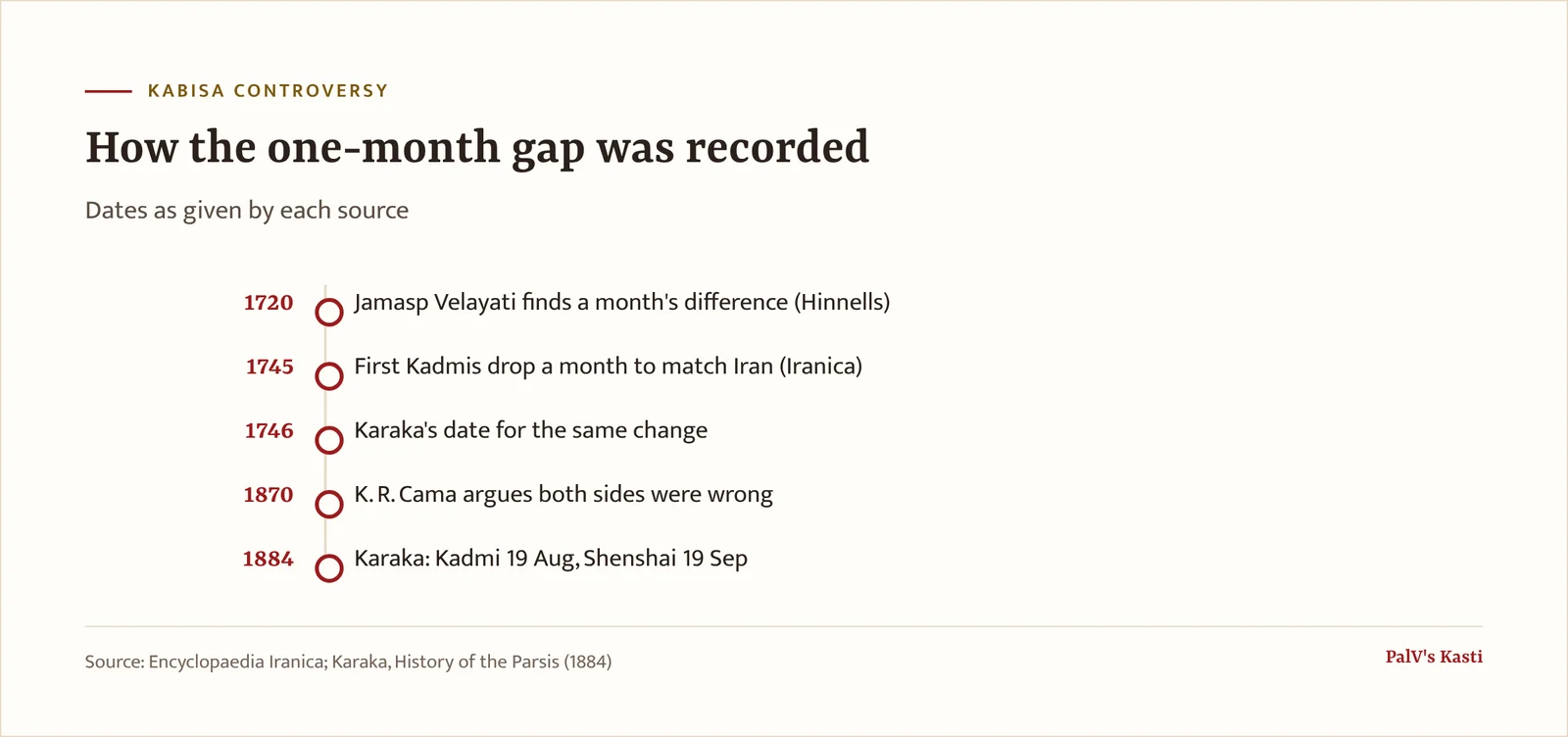
The difference is one of alignment. When the first Kadmi community changed over in 1745, it did so, in Karanjia's words in Encyclopaedia Iranica, by counting the 8th month, Ābān, as "the 9th month Āḏar". Every Roj and Mah after that point fell a month earlier for Kadmis than for Shenshais. Karaka dates the change to 1746. How it came about is told in our article on the 18th-century Kadmi split.
Where did the extra month come from?
The month at issue is a kabisa, an intercalated or leap month. Panaino describes a second calendar in which the yearly quarter-day lag was corrected, "theoretically at least", by adding one month in every 120 years. He also notes that, according to Biruni, a 116-year system was used.
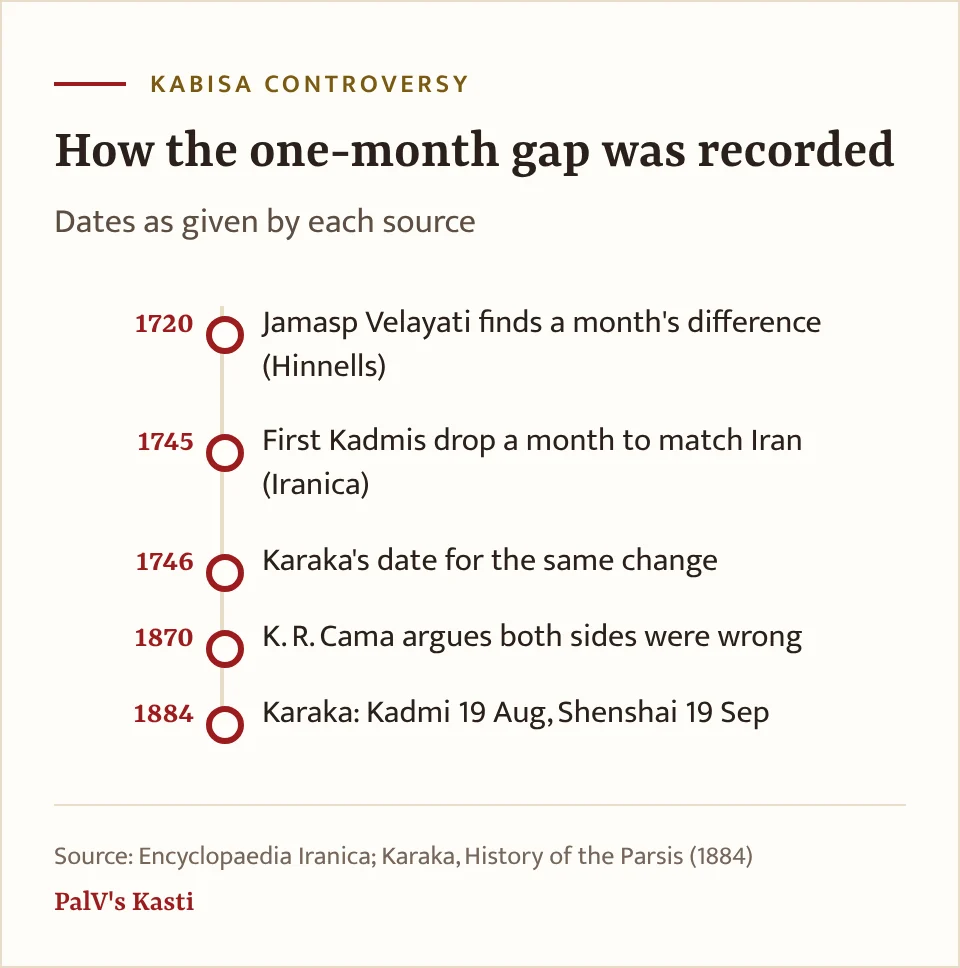
Karaka gives the same rule with the same caution. The ancient Persians "are reported to have", every 120 years, "made the 'Kabisa' or intercalation", which he glosses as having "added a month to the period".
He then reports what happened after the empire fell. In his telling, the Zoroastrians of Iran dropped the Kabisa once they "lost the sovereignty of their land". The Parsis, by contrast, "are reported to have once intercalated" during their stay in Khorasan. If that single month was added on one side and not the other, the two reckonings would end up exactly one month apart. Karaka says this is what "brought into existence the two sects".
That account is the Shenshai one, though, and the Kadmis rejected it.
How does each side explain the one-month gap?
Karaka sets out both positions as they were argued in what he calls the "Kabisa" controversy. We report them without choosing between them.
| Shenshai position | Kadmi position | |
|---|---|---|
| Is a leap month part of the religion? | Yes: the religion "acknowledged one month's intercalation" every 120 years | No: "intercalation was forbidden in the Zoroastrian calendar" and "occurred in political calculations alone" |
| Was a month added after the empire fell? | Yes, once, "while they lived as fugitives in Khorassan", but in India the practice was not continued | No: "no such intercalation ever took place in Khorassan" |
| What the gap means | Their date was therefore "one month behind that of the Kadmis" | The Iranian date is the unaltered, ancient one |
The Kadmi name itself carries their argument. Karanjia's Iranica entry says the Kadimis "consider the Irani calendar the ancient one", from the Arabic qadim, "old, ancient". M. N. Dhalla, in his 1938 History of Zoroastrianism, called the two groups "the Imperials" and "the Ancients".
Is the Kadmi calendar a month ahead or a month behind?
It depends on whose wording you read, which is why we describe the gap by dates above.
- Dhalla wrote that, by the reckoning of their year, India's Parsis stood "one month behind" the Zoroastrians of Persia.
- Karaka wrote that the Kadmis counted their year "fully one month in advance" of the Shenshais.
- John R. Hinnells, in Encyclopaedia Iranica, wrote that Jamasp Velayati found in 1720 that the Parsi calendar was "one month in advance" of the Persian one.
Dhalla and Karaka agree with each other. Hinnells uses "in advance" the other way round. On the calendar itself there is no dispute: the Kadmi New Year comes first in the Gregorian year, in July, and the Shenshai New Year follows in August.
Why hasn't the gap grown or shrunk?
Because the two calendars count the year in exactly the same way. Karaka notes that the extra "five hours and fifty-four seconds" of the solar year "are not taken into consideration" in Parsi reckoning. Neither calendar adds anything for them, so both New Years move against the Gregorian calendar together, and the month between them stays a month. The record shows it: 19 August and 19 September when Karaka wrote in 1884, mid-July and mid-August now.

Why both dates move at all is a separate question, answered in our article on the astronomy behind the Parsi calendar.
Which side was right about the leap month?
Our sources' verdict is that neither was. Karaka, after giving both cases, concluded that "in the hot-headed 'Kabisa' controversy both parties were in the wrong". Dhalla wrote in 1938 that "modern researches" had shown both parties wrong in their calculations. Karaka also records that K. R. Cama, himself a Kadmi, published a study in 1870 arguing that both sides were wrong.
We take no side. The practical point for families is simpler: the month between the two calendars is fixed, and which New Year you keep follows your family's tradition. You can read more about the Kadmi reckoning in our article on the Kadmi calendar, and about the March New Year in why Parsis have two New Years.
Practice varies between families and Agiaries; your family priest's guidance comes first.
Frequently asked questions
Why is Kadmi Navroz in July and Shenshai Navroz in August?
Both calendars have 365 days, but they start the year a month apart. Shenshais held that their ancestors once added a leap month in Khorasan and never again, while Kadmis held that no such month was added. When the first Kadmis adopted the Iranian date in 1745 or 1746, their year moved a month earlier.
Do the Kadmi and Shenshai calendars use the same months and days?
Yes. Both use twelve months of 30 days followed by five Gatha days, and both New Years fall on Roj Hormazd of Mah Farvardin. The only difference is alignment. When the first Kadmi community changed over in 1745, it counted the 8th month, Aban, as the 9th, Adar, to match Iran.
Will the Kadmi and Shenshai New Years ever fall on the same day?
Not while both calendars are kept as they are. Neither adds a leap day or leap month, so both New Years move against the Gregorian calendar together and the one-month gap stays the same. Karaka recorded them a month apart in 1884, on 19 August and 19 September, and they are a month apart today.
What is a kabisa?
A kabisa is an intercalated, or leap, month. Encyclopaedia Iranica describes a calendar in which, theoretically at least, one month was added every 120 years. The dispute between Kadmis and Shenshais over whether such a month had been added after the fall of the Persian empire is the Kabisa controversy, as Karaka recorded in 1884.
Is one calendar more correct than the other?
Encyclopaedia Iranica records that Kadmis regard the Iranian calendar as the ancient one, while Shenshais kept the reckoning their ancestors brought to India. Karaka's 1884 history concluded that both parties were wrong, and Dhalla wrote in 1938 that modern research had shown both calculations wrong. We take no side, and families follow their own tradition.