PalV's Kasti
On this page
The Kadmi calendar is one of the three religious calendars kept by Parsi and Irani Zoroastrians, alongside the Shenshai and Fasli calendars. Its followers, the Kadmis, took up the Iranian Zoroastrian reckoning in 18th-century Surat and regard it as the original one: Kadmi comes from the Arabic qadim, "old, ancient". Most Parsis follow the Shenshai calendar, so the Kadmis are a minority. The Kadmi New Year, Roj Hormazd of Mah Farvardin, falls in mid-July, about a month before the Shenshai Navroz in mid-August.
How it compares with the other two calendars is set out in our guide to Shenshai, Kadmi and Fasli calendars.
શહેરેવર રોજ
Shehrevar Roj, Tir Mah · 1396 Y.Z.
What is the Kadmi calendar?
The Kadmi calendar is the reckoning of the Kadmis, whom Ramiyar P. Karanjia's Encyclopaedia Iranica entry (2009) describes as "a Zoroastrian sect (Ar. qadim 'old, ancient')". The Kadmis, he writes, "consider the Irani calendar the ancient one". You'll see the name spelled Kadmi, Kadimi, Qadmi and Qadimi. M. N. Dhalla, in his History of Zoroastrianism (1938), wrote that the dissenters "styled themselves the Kadimis, or the Ancients".
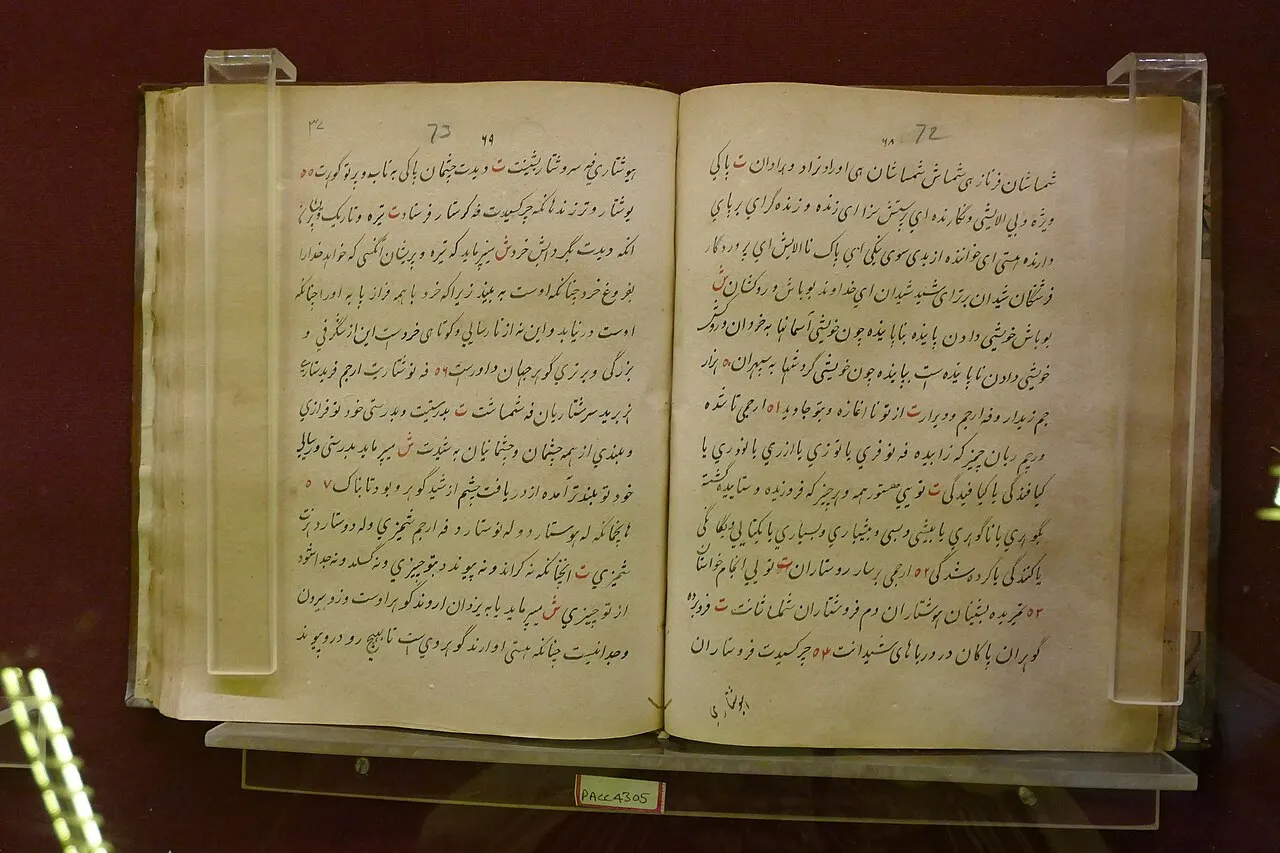
In practice, Kadmi means using the Iranian date. Dosabhai Framji Karaka's History of the Parsis (1884) records that an Irani named Jamshid and a few priests "introduced the date as observed by the Persian Zoroastrians" and took the name Kadmis. Karanjia describes how a Surat group made that switch in 1745 by dropping a month, counting the 8th month, Aban, as the 9th, Adar. Karaka dates the same change to 1746. The full story is told in our article on the 18th-century Kadmi split.
How is the Kadmi year built?
The Kadmi year has the same frame as the Shenshai year. It just starts a month earlier. Karaka sets out the Parsi year as twelve months of thirty days, from Farvardin to Spendarmad, followed by five days "named Gathas", which together make 365 days. He adds that the remaining "five hours and fifty-four seconds" of the solar year "are not taken into consideration" in Parsi reckoning. Mary Boyce, writing in Encyclopaedia Iranica, describes the Shenshai calendar as "a month behind" the calendar of the Persian Zoroastrians, which, she writes, came to be called "the Qadimi (Parsi Kadmi)".
| Feature | Kadmi calendar |
|---|---|
| Months | 12 Mah of 30 days each |
| Extra days | 5 Gatha days at the end of the year |
| Days in a year | 365 |
| New Year | Roj Hormazd, Mah Farvardin |
| New Year in the Gregorian year | mid-July |
| Gap with Shenshai | about one month |
The Kadmi New Year has not stayed fixed in the Gregorian year. In Karaka's day it fell on 19 August. Now it falls in July. Why a 365-day year without a leap day drifts is explained in our article on the astronomy behind the Parsi calendar.
When is the Kadmi New Year?
The Kadmi New Year falls on Roj Hormazd, the first day, of Mah Farvardin, the first month. That's the same Roj and Mah as every Navroz. Karanjia's own glossary, Zarthoshti-pedia, puts it plainly: the Shenshai Navroz falls "in mid August, the Kadimi in mid-July". The religious calendar on avesta.org lists the Kadmi Noruz on 18 July from 2016 to 2019 and on 17 July in 2020 and 2021. A Parsi Times report marking the Kadmi New Year in 2023 also placed it in July.
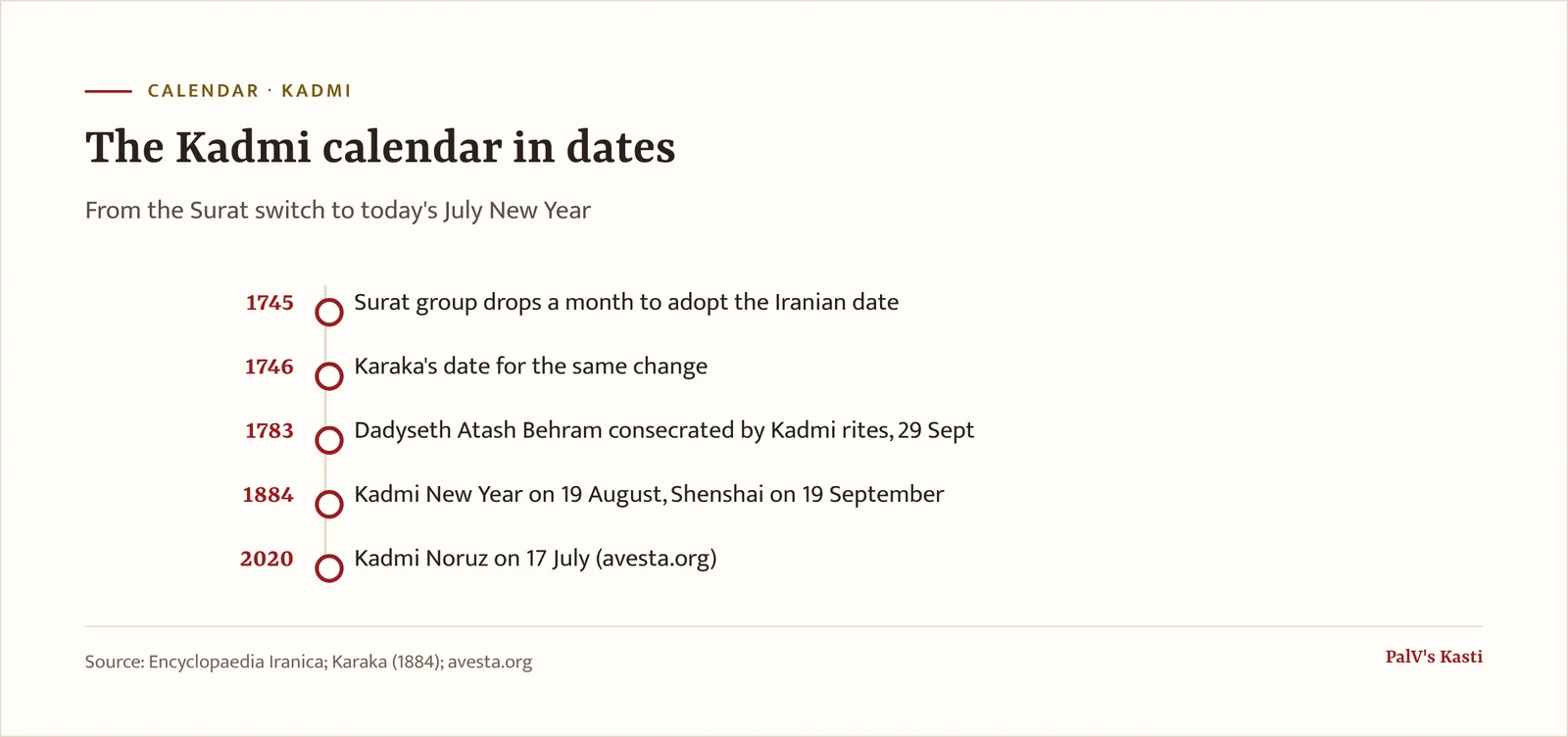
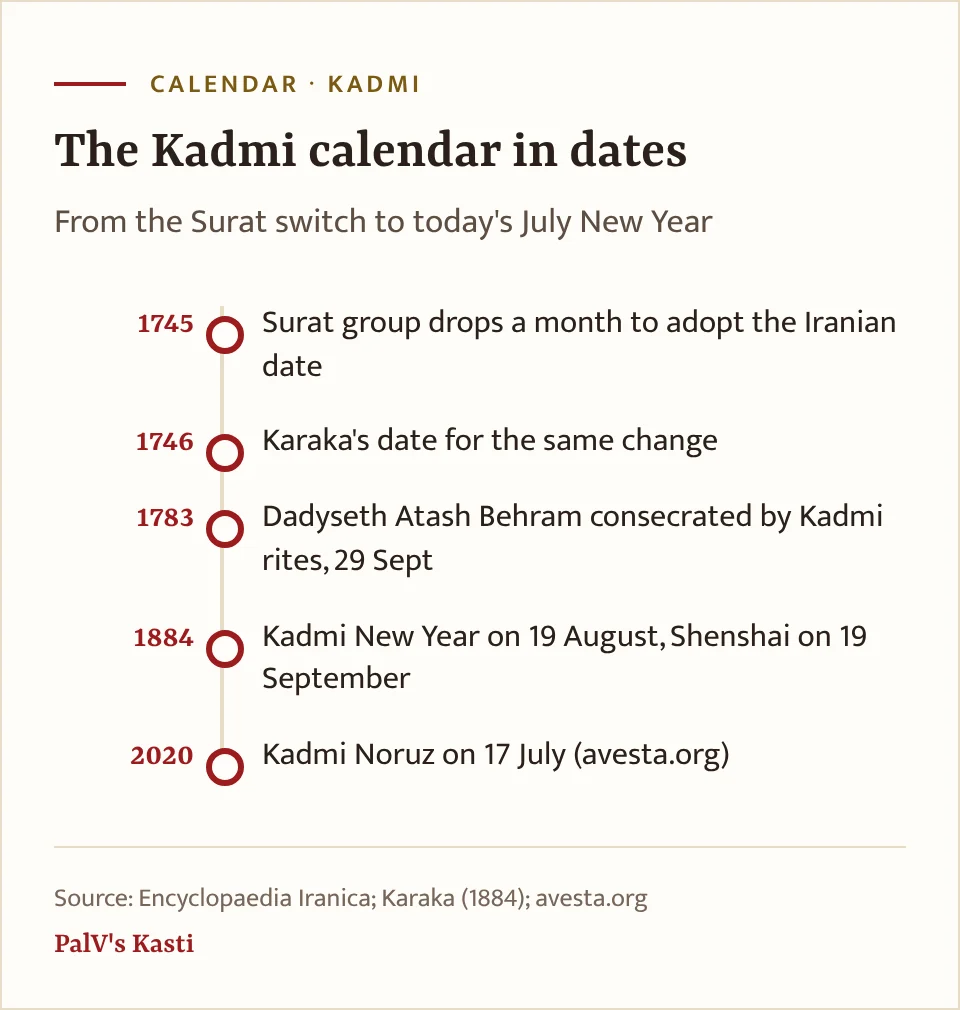
The one-month gap is old. When Karaka wrote in 1884, the Kadmi new year began "on the 19th of August" and the Shenshai one on 19 September. Both dates have since moved earlier, and the gap between them has stayed at a month. The arguments each side gives for that gap are on our page asking why Kadmi and Shenshai New Years are a month apart.
For the exact Gregorian date in a given year, check our Parsi calendar or your Agiary's calendar. We don't print a single date here because it moves.
Who follows the Kadmi calendar?
A minority of Parsis. Karanjia's Iranica entry says that most Parsis "did not change their calendar, and they are known as Shenshahis", and his Zarthoshti-pedia notes that "the Shahenshahis are maximum in number". Karaka, in 1884, called the Shenshais "the bulk of the people".
Historically the Kadmis were strongest in Gujarat and Bombay:
- Surat, where the split began. Karaka names Surat as the place where the Parsis "were first divided into two sects".
- Bharuch (Broach). Karanjia records that Bharuch and Surat both "emerged as Kadimi strongholds".
- Bombay, where the Kadmis were influential. The Dadyseth Atash Behram was consecrated by Kadmi rites on 29 September 1783, a date both Karaka and Mary Boyce and Firoze Kotwal's Iranica entry give. Boyce and Kotwal write that Dadibhai Dadyseth founded it "to serve the Kadmis in Bombay", and that for nearly half a century it was Bombay's only Atash Behram.
We have not found a recent, independently confirmed count of Kadmi Parsis, so we don't give one.
How do Kadmis differ from Shenshais in practice?
Very little outside the calendar, according to the sources we have. Karanjia's Iranica entry says the two groups agree on theology and doctrine and that "there are not any social or religious restrictions" between them. Karaka had already noted "an entire absence of discord" between Shenshais and Kadmis in 1884.
Karanjia records a few smaller differences, which we report as he gives them:
- Prayer pronunciation. "The Shenshahis say 'vohu' and 'ahu' whereas the Kadimis say 'vahi' and 'ahi'." Noshir H. Dadrawala's 2017 Parsi Times article gives the same example from the Ahem and Yatha prayers.
- Outer rituals. Karanjia notes minor differences in rituals such as the Afringan, Yasna and Boi. Dadrawala lists the same three.
- Priestly initiation. The Kadmi Navar "requires one more purification rite", in Karanjia's Iranica words. His Zarthoshti-pedia spells it out: the initiation begins with two Bareshnums, "three in case of the Kadimis".
Practice varies between families and Agiaries; your family priest's guidance comes first.
Jamshedi Navroz in March sits apart from both religious New Years. How it relates to each calendar is in Jamshedi Navroz and the three Parsi calendars, and the wider system is covered in our guide to the Zoroastrian calendar.
Frequently asked questions
What does Kadmi mean?
Kadmi comes from the Arabic word qadim, meaning "old" or "ancient". The Kadmis took the name because they hold the Iranian calendar, which they adopted in 18th-century Surat, to be the ancient and original Zoroastrian reckoning. The name is also spelled Kadimi, Qadmi and Qadimi, and M. N. Dhalla rendered it in 1938 as "the Ancients".
When is the Kadmi New Year?
The Kadmi New Year falls on Roj Hormazd of Mah Farvardin. In the Gregorian year it now comes in mid-July, about a month before the Shenshai Navroz in mid-August. The avesta.org calendar gives 17 July for 2020 and 2021. In 1884 Karaka recorded it on 19 August, a month before the Shenshai New Year.
Is the Kadmi calendar the same as the Iranian calendar?
The Kadmi calendar follows the Iranian Zoroastrian reckoning that a group in Surat adopted in the 18th century. Karaka's 1884 history says the first Kadmis brought in "the date as observed by the Persian Zoroastrians". Encyclopaedia Iranica describes the Kadmis as a group who consider that Irani calendar the ancient one.
Do most Parsis follow the Kadmi calendar?
No. Most Parsis follow the Shenshai calendar. Ramiyar Karanjia's Encyclopaedia Iranica entry says most Parsis did not change their calendar and are known as Shenshahis. Kadmis are a minority whose historic centres were Surat, Bharuch and Bombay, where the Dadyseth Atash Behram was founded in 1783 to serve them.
Can a Kadmi and a Shenshai family share ceremonies?
Ramiyar Karanjia's Encyclopaedia Iranica entry says there are no social or religious restrictions between the two groups and that they share the same theology. The differences he records are in calendar dates, some prayer pronunciations, minor outer rituals and the priestly initiation. Your family priest can advise on any specific ceremony.
How many days are in the Kadmi year?
The Kadmi year has 365 days: twelve months of 30 days, followed by five Gatha days. Karaka's 1884 history notes that the extra hours of the solar year are not counted in Parsi reckoning. The Kadmi year has the same frame as the Shenshai year and differs only in where its months fall.