PalV's Kasti
On this page
- When did Parsi women start wearing garas?
- What does a timeline of the Parsi gara look like?
- How did the China trade bring the gara to India?
- How did the gara's design change in the 19th century?
- When did garas start being embroidered in India?
- How did Chinese pedlars sell garas, and when did that trade end?
- How old is gara embroidery?
- What happened to the gara after the 1950s?
- Frequently asked questions
Parsi garas are silk saris covered in Chinese-style embroidery, and their history follows the Parsi trade with China. The UNESCO Parzor project names Hirji Jivanji, who sailed for China in 1756, as the first Parsi to make that voyage. In the 19th century, Parsi women in western India took up the embroidered gara and made it their own. The first garas were stitched in China. Later, workshops in Surat and embroiderers in Parsi homes made them in India as well. Chinese pedlars kept selling garas, borders and tunics to Parsi women until that trade closed in the middle of the 20th century, though the sources put the end anywhere between 1947 and the early 1960s. Parzor dates the current revival to its own craft workshops, and its research project on Zoroastrian embroidery with designer Ashdeen Lilaowala ran in 2005-06. Designers have reworked the gara since.
શહેરેવર રોજ
Shehrevar Roj, Tir Mah · 1396 Y.Z.
When did Parsi women start wearing garas?
The best-supported answer is the 19th century. The sources don't agree on the exact starting point, though.
Tulsi Vatsal, in the Indian Journal of Gender Studies (2013), writes that Parsi women started wearing elaborately embroidered saris known as garas in the 19th century. Firoza Punthakey Mistree, in a chapter for Routledge's The Zoroastrian World, says the gara emerged from the China trade during the same century and was "adopted and adapted by the women in the community".
The RISD Museum in the United States reaches further back. Its October 2025 essay says the wives of Parsi merchants first wore garas "starting in the 1700s". Mumbai's CSMVS museum takes a middle line: by the early 19th century prominent Parsis owned shipping companies trading with China, and these traders ordered embroidered silks for their families.
Of the museum records we could open, none dates a gara earlier than the last quarter of the 19th century. The oldest is the RISD Museum's akho garo (a fully embroidered gara), catalogued as ca. 1875-1900. For what a gara is and what sets it apart, start with our guide to the Parsi gara saree.
What does a timeline of the Parsi gara look like?
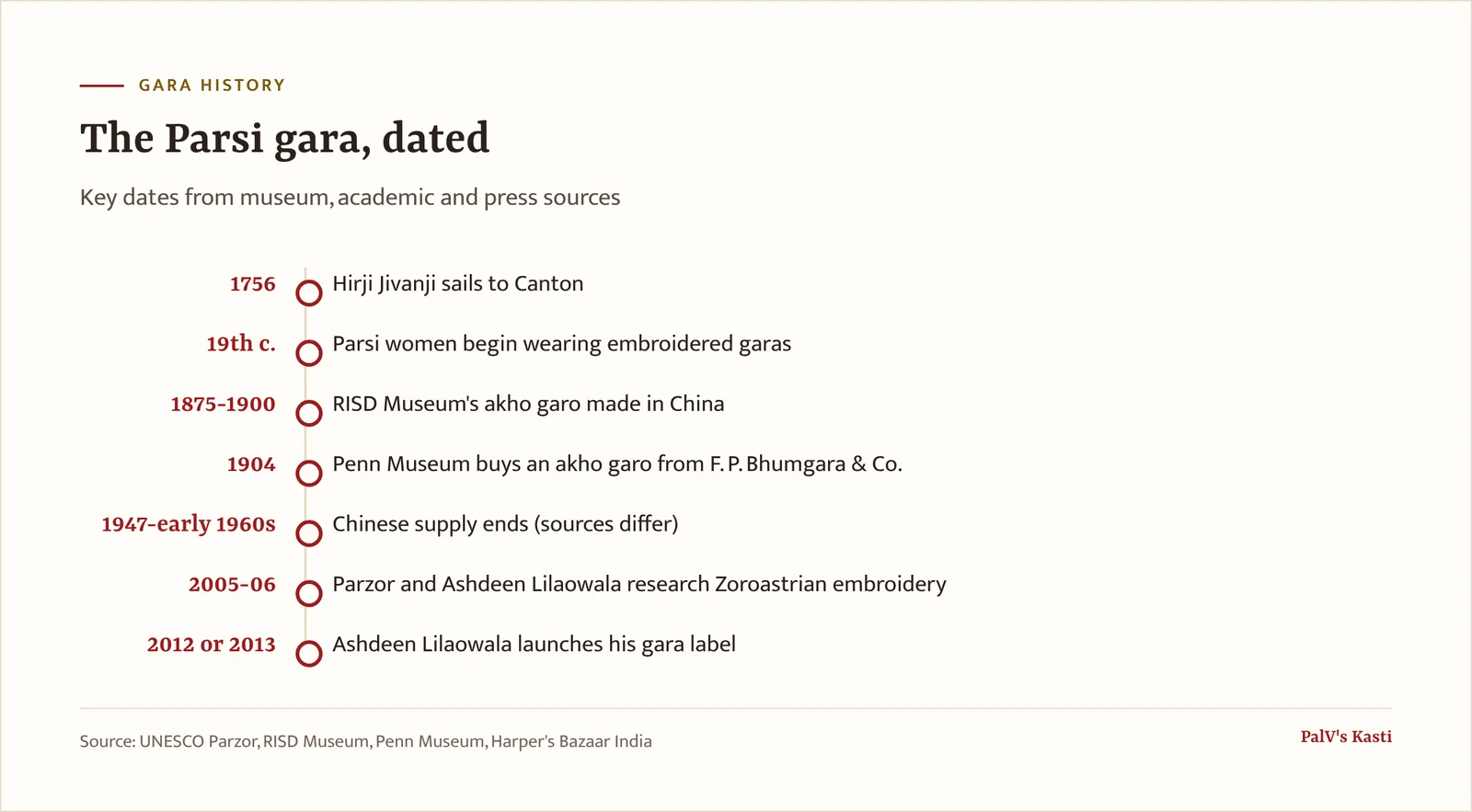
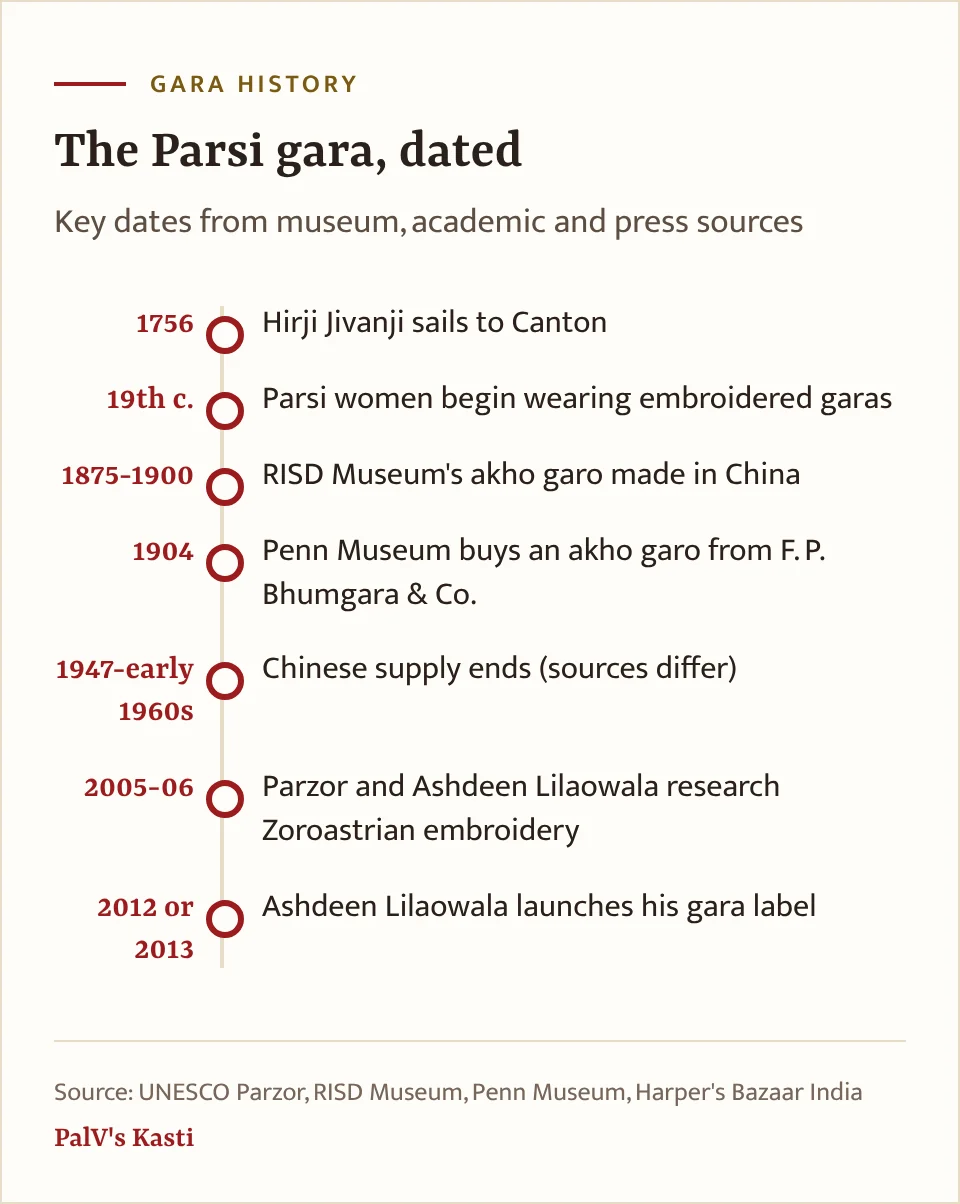
| Date | What happened |
|---|---|
| 1756 | Hirji Jivanji (Readymoney) sails to Canton (Guangzhou). Parzor calls him the first Parsi to sail for China |
| By the early 1800s | Parsi merchants have built a profitable China trade, with cotton and opium as the main exports |
| 19th century | Parsi women begin wearing embroidered garas |
| From the mid-1800s | Parsi traders selling cotton at Canton come into contact with Chinese embroiderers |
| ca. 1875-1900 | The RISD Museum's akho garo is made in China on sali ghaj silk satin |
| 1904 | The Penn Museum buys a black silk akho garo from F. P. Bhumgara & Company |
| 1900-1950 | The V&A's sari made in China for the Parsi community |
| Early to mid-1900s | Gold-coloured badla work, applied Chinese satin borders and sequins on net come into fashion |
| 1947 to early 1960s | Chinese supply ends. Sources give different dates (see below) |
| 2005-06 | Parzor Foundation and Ashdeen Z. Lilaowala research Zoroastrian embroidery for the Ministry of Textiles |
| 2010 | Peonies & Pagodas: Embroidered Parsi Textiles from the TAPI Collection is published |
| 2012 or 2013 | Ashdeen Lilaowala launches his gara label (sources differ on the year) |
| January 2014 | "Across Oceans and Flowing Silks: From Canton to Bombay 18th to 20th Centuries" is on show at the National Gallery of Modern Art, Mumbai |
| December 2015 | "Parsi Silk and Muslin from Iran, India and China" at the East West Center Gallery, curated by Firoza Punthakey Mistree and Pheroza Godrej |
| 2023-25 | Artist Bhasha Chakrabarti and the Ashdeen studio make an embroidered saree tracing the gara's trade history, acquired by the RISD Museum |
| 2025 | Natasha Poonawalla wears a Manish Malhotra ensemble made from two vintage garas at the Met Gala |
How did the China trade bring the gara to India?
Parsi merchants from Bombay shipped cotton and opium to China. SOAS University of London names these two as the principal exports and says Parsis had built a profitable China trade by the early nineteenth century. The Parzor account says Parsi traders worked at Canton, Macao, Hong Kong and Shanghai for almost 200 years. At Canton, according to the Textile Research Centre in Leiden, they came into contact with Chinese embroiderers.
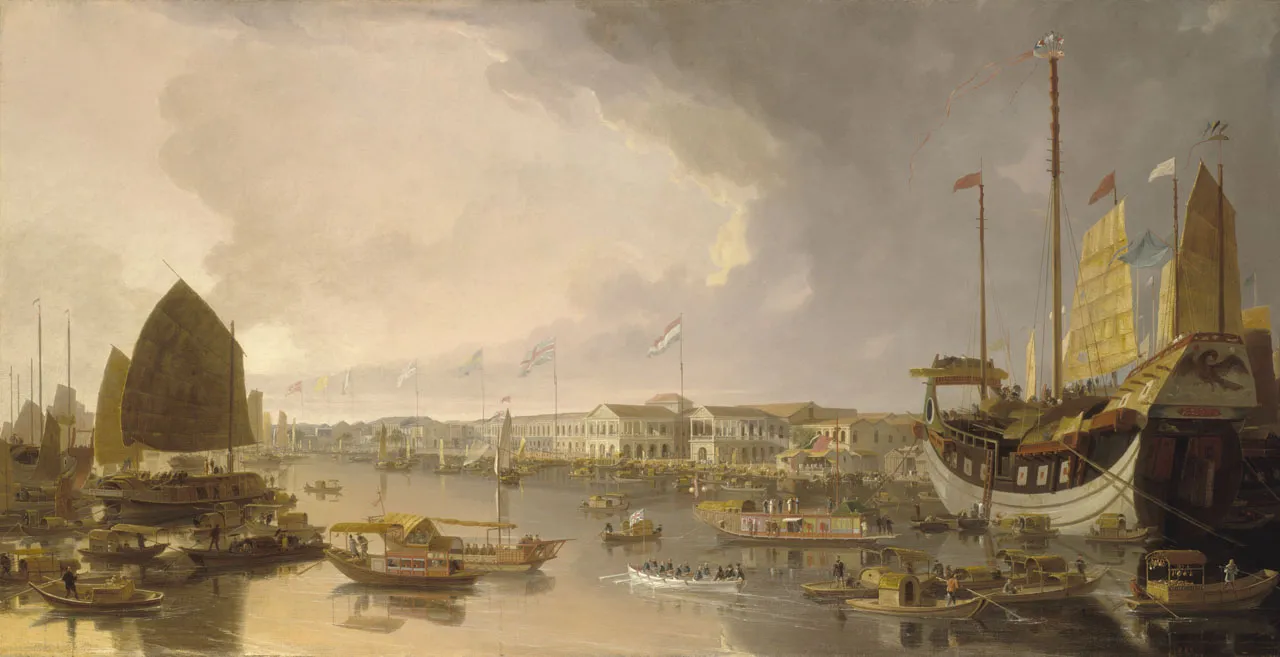
Parzor also records a legend about the first gara. A Parsi trader in Canton watched craftsmen embroidering a rich textile and asked them to embroider six yards of silk as a sari for his wife in India. Parzor presents it as a legend, not a dated event. The full background to this exchange is in our article on the Chinese roots of Parsi embroidery.
How did the gara's design change in the 19th century?
The first garas looked more like dress fabric than finished saris. Parzor describes them as embroidered satin with no borders or pallavs, often carrying Taoist and Buddhist symbols. The design then settled into what Parzor calls the Parsi gara sari: an embroidered length framed on all four sides by a kor, or border. Parsi women began designing kors to match the inner embroidery, and designed the pallav, the front of the sari, to highlight the design. Stand-alone kors became popular too, and we explain how a kor differs from a full gara in a separate guide.
Two construction details show how the Chinese supply shaped the sari. The V&A notes that on many Parsi pieces the edging was applied separately, using yards of satin ribbon that Chinese artisans embroidered for the purpose. And because Chinese hand looms were smaller than Indian ones, many China-made Parsi saris carry a lengthwise seam where an extra half-width of cloth was added. The Textile Research Centre, citing Linda Lynton's The Sari (1995), calls these do-patti, or two-strip, saris.
When did garas start being embroidered in India?
Over time, production spread to India. Vatsal writes that workshops producing "Chinese" embroidery sprang up in Surat, and that Parsi housewives, especially in smaller towns, later took up the craft as a source of income. The RISD essay says Parsi women soon began commissioning local Indian embroiderers, and that oral tradition suggests some Chinese embroiderers settled in Surat. Parzor's oral histories add that Parsi women learnt stitches and motifs from Chinese pedlars, who carried their original patterns on black cloth.
The Indian work developed its own look. The Textile Research Centre describes a hybrid style that kept Chinese peonies, roses and chrysanthemums but added the cypress tree, the chakla chakli pair of birds, the lotus and the peacock. Parzor contrasts the fine thread and balanced colours of Chinese work with the range of colours Parsi women brought to pieces made in India. The Penn Museum's 1904 purchase shows how blurred the line became: its catalogue says the sari was likely made either in China or by Chinese embroiderers in Bombay. Our hub on Parsi embroidery covers the craft beyond the sari.
How did Chinese pedlars sell garas, and when did that trade end?
Many garas and borders reached Parsi women at home. The Textile Research Centre describes itinerant Chinese traders bringing tunics, saris and sari borders to Bombay and selling them directly to Parsi women, who sewed the borders onto their own saris. Parzor's oral histories call these sellers pherawallas and say they came regularly in winter to Parsi homes in Gujarat, the Deccan, Bombay and Calcutta. Other embroidered Parsi garments beyond the sari are covered in our guide to jhablas and ijars.
The sources give three different end points for this supply:
- 1947. The RISD essay says Indian Independence stopped the opium trade, and with it the import of Chinese goods ended abruptly.
- Late 1940s and early 1950s. The Textile Research Centre says the pedlar trade disappeared when the Chinese authorities closed China's borders.
- Early 1960s. Parzor says Chinese pherawallas came regularly until then.
None of the sources we read reconciles these dates, so we have listed all three. Why the gara faded after this period is the subject of why gara embroidery is disappearing.
How old is gara embroidery?
Designer Ashdeen Lilaowala, writing in Harper's Bazaar India on 9 June 2025, called the gara a "centuries-old art" of fine hand embroidery. The dated garments we could check are younger than that phrase suggests. These are the museum records we opened, with the dates each museum gives:
| Museum | Object | Date given | What the record says |
|---|---|---|---|
| RISD Museum | Akho garo sari, 55.286 | ca. 1875-1900 | Made in China. Sali ghaj silk satin, embroidered |
| Penn Museum | Sari, A574 | Late 19th to early 20th century | Purchased from F. P. Bhumgara & Company in 1904 |
| Victoria and Albert Museum | Sari, T.24-1967 | 1900-1950 | Made in China for the Parsi community. Black silk gauze |
| CSMVS, Mumbai | Akho garo | 20th century | Belonged to Meheran Bhabha, mother of Sir Homi Bhabha |
What happened to the gara after the 1950s?
Parzor dates the current revival to its own workshops. In 2005-06 the Parzor Foundation and textile designer Ashdeen Z. Lilaowala carried out a research project on Zoroastrian embroidery for India's Ministry of Textiles. Lilaowala travelled through Iran, researched the embroidery of southern China, and ran four Parzor training workshops in Ahmedabad, Navsari, Mumbai and Delhi. Mistree names Zenobia Davar and Ashdeen Lilaowala as young Parsi fashion designers who reworked Chinese motifs.
Lilaowala's label dates to 2012 according to Open magazine, Harper's Bazaar India (January 2026) and the RISD Museum, and to 2013 in his own Harper's Bazaar column. Open magazine reported in February 2025 that around 300 to 350 artisans worked across the label's embroidery units.
Exhibitions brought old garas back into view. The National Gallery of Modern Art, Mumbai, showed "Across Oceans and Flowing Silks: From Canton to Bombay 18th to 20th Centuries" in January 2014, when the Godrej India Culture Lab held a talk with Lilaowala alongside it. Hawaiʻi Public Radio reported on 1 December 2015 on "Parsi Silk and Muslin from Iran, India and China" at the East West Center Gallery, curated by Firoza Punthakey Mistree and Pheroza Godrej. In June 2025 Lilaowala wrote that Natasha Poonawalla had worn a custom Manish Malhotra ensemble, made from two vintage Parsi garas, at the then recently concluded Met Gala.
The people keeping the craft going now are profiled in reviving gara embroidery. How Parsi women wore and styled the gara through its long heyday is covered in gara saris and Parsi women's fashion.
Frequently asked questions
Where were the first Parsi garas made?
The first garas were embroidered in China. The RISD Museum says early garas were made there before Parsi women began commissioning Indian embroiderers. Tulsi Vatsal records workshops producing "Chinese" embroidery in Surat, and the Penn Museum says a gara it bought in 1904 was likely made in China or by Chinese embroiderers in Bombay.
Why is the Parsi sari called a gara?
Museums give two explanations. The CSMVS in Mumbai says garo comes from the Gujarati word for a sari, which over time came to mean the Chinese-embroidered sari. The RISD Museum says the Gujarati word garo means a width of cloth. Both agree the word ended up describing this one embroidered sari.
Who was the first Parsi to sail to China?
Hirji Jivanji, also known as Hirji Jivanji Readymoney, sailed to Canton (Guangzhou) in 1756. Both the UNESCO Parzor project and the RISD Museum give this date. Parzor calls him the first Parsi to sail for China, at the start of almost 200 years of Parsi trade at Canton, Macao, Hong Kong and Shanghai.
When did Chinese pedlars stop selling garas in India?
Sources differ. The RISD Museum says Indian Independence in 1947 abruptly ended imports of Chinese goods. The Textile Research Centre in Leiden says the pedlar trade ended in the late 1940s and early 1950s, when China closed its borders. Parzor's oral histories say pherawallas kept visiting Parsi homes until the early 1960s.
Are Parsi garas still hand-embroidered today?
Yes. Hand-embroidered garas are being made again. The UNESCO Parzor project dates the revival to its craft workshops, and its research project on Zoroastrian embroidery ran in 2005-06. Designers including Ashdeen Lilaowala and Zenobia Davar have reworked the Chinese motifs. Open magazine reported in February 2025 that around 300 to 350 artisans worked across his label's units.