PalV's Kasti
On this page
- Who first brought gara work back into the spotlight?
- What does the UNESCO Parzor Foundation do for gara embroidery?
- Which designers make Parsi gara work today?
- Who does the needlework, and does it pay?
- Is machine-made gara part of the revival?
- Where has revived gara work been seen recently?
- Frequently asked questions
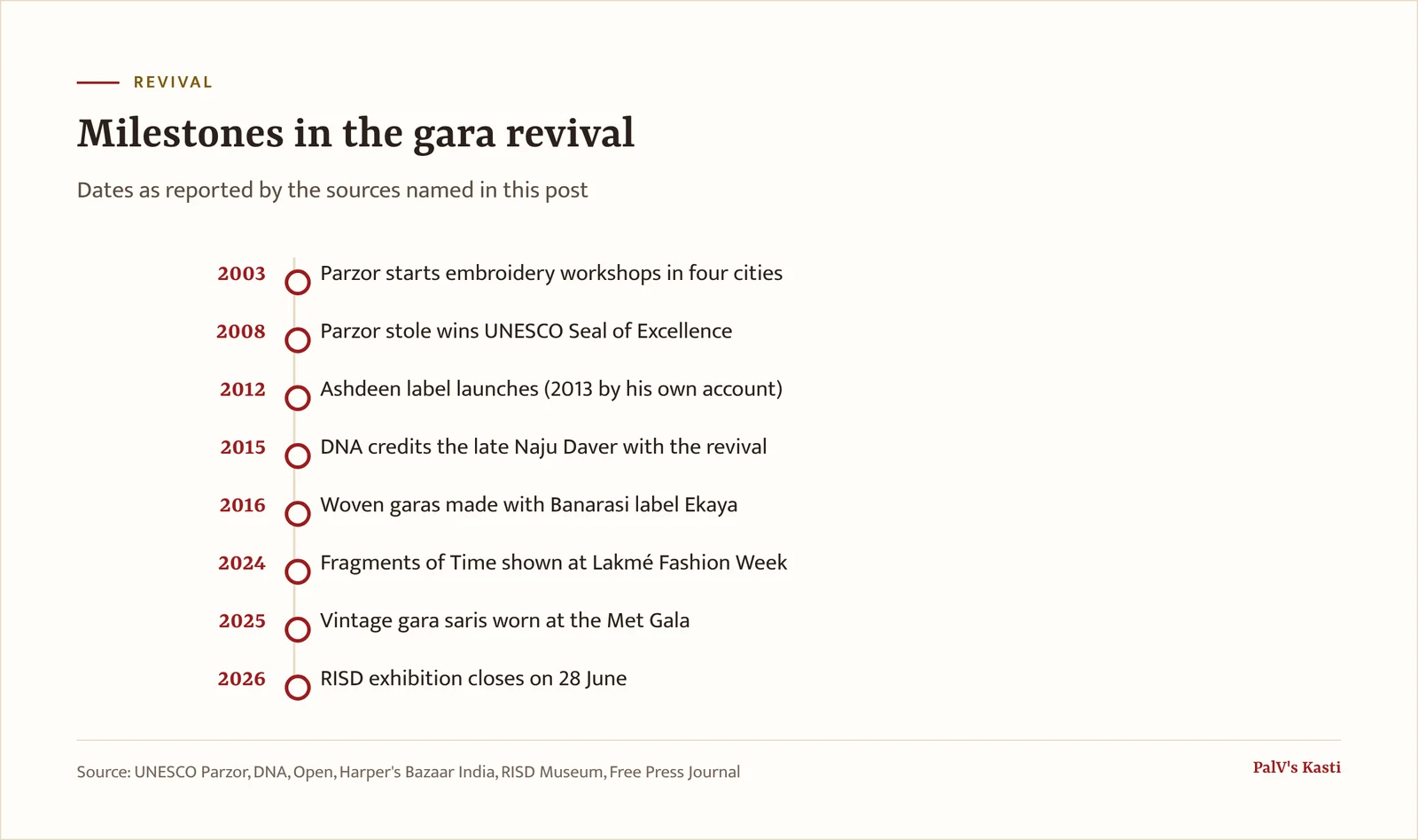
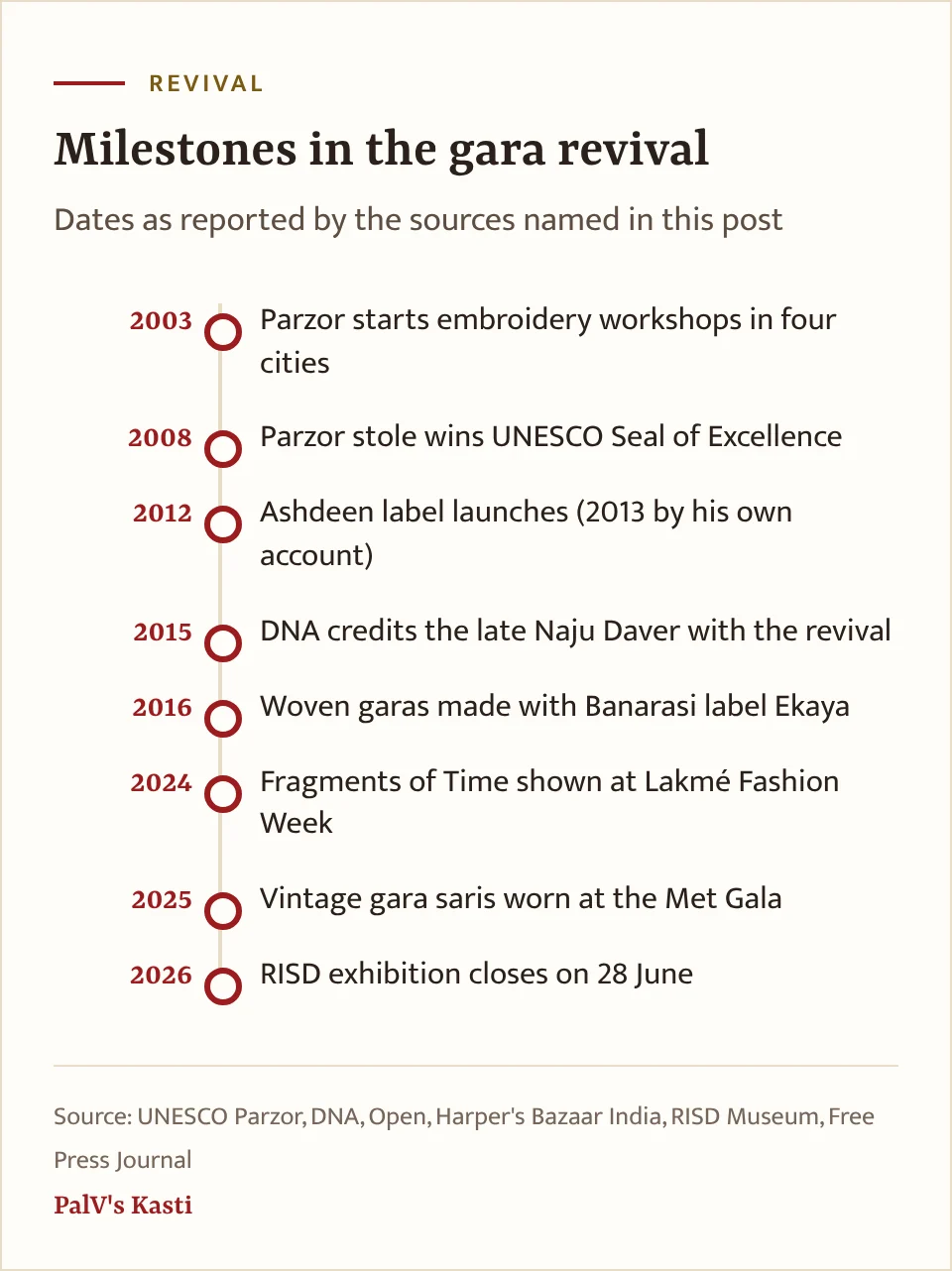
Parsi gara work, the silk embroidery on the Parsi gara sari, is being kept alive by a short chain of people rather than one big institution. A DNA report from 2015 credits the late Naju Daver with bringing the gara back into view, and also names the Sir Ratan Tata Institute and Roshan Davar. Since 2003 the UNESCO Parzor Foundation has run embroidery workshops in Ahmedabad, Mumbai, Navsari and Delhi. Ashdeen Lilaowala, who documented the gara for Parzor, now runs a label whose embroidery, Open magazine reported in 2025, is done by around 300 to 350 artisans. The weak point, going by the most recent press report on artisans we could find (The Pioneer, April 2025), is what the embroiderers are paid.
અસપંદામેદ રોજ
Asfandarmad Roj, Tir Mah · 1396 Y.Z.
Who first brought gara work back into the spotlight?
At one point the gara had faded so far that DNA's Marisha Karwa described it as having "passed into near oblivion". Her report credits the late Naju Daver with its return. Daver's daughter, Farzeen Daver-Boomla, told the paper that it started with an attempt to salvage an old family gara that was in tatters.
Daver also wanted families to value the garas they already owned instead of cutting them up for cushions and curtains.
The same DNA report names the Sir Ratan Tata Institute and a handful of Parsi women, Roshan Davar among them, as the others who pulled gara out of obscurity. Attitudes shifted after that. Farzeen Daver-Boomla said women now see a gara as "a piece of art and a must-have" in a trousseau.
What does the UNESCO Parzor Foundation do for gara embroidery?
The UNESCO Parzor Foundation trains craftspeople to revive Parsi embroidery "in contemporary adaptations of original designs", according to its own textiles page. Its work, as Parzor describes it:
- Workshops since 2003 in Ahmedabad, Mumbai, Navsari and Delhi.
- Parzor Crafts, which turns original designs into home furnishings, accessories and decor, and gives craftspeople a livelihood.
- Craft documentation that Parzor says has run across India for two decades. The researchers it names include Priya Mani, Ashdeen Z. Lilaowala and Wei Zhu An.
- Recognition: UNESCO chose one of Parzor's hand-embroidered stoles for its Seal of Excellence Award for 2008.
Parzor's page also places itself at the origins of a kor revival that it describes as "sweeping across India". The kor is the embroidered border, explained in Kor: the embroidered sari border. For the wider family of Parsi needlework, see our guide to Parsi embroidery.
Parzor is frank about the risk. It says the elderly Parsi women who have helped it are among the few left who still know the intricate, rare stitches. Why the craft shrank in the first place is the subject of why gara embroidery is disappearing.
Which designers make Parsi gara work today?
These are the makers that press reports describe in enough detail to check.
| Who | What the reports say | Reported by |
|---|---|---|
| Ashdeen Lilaowala | NID Ahmedabad graduate (2003) who researched and documented the gara with Parzor. Open reported in February 2025 that he has stores in Delhi, Mumbai and Hyderabad | Outlook Traveller, 2023; Open, 2025 |
| Zenobia Davar | Had custom-made garas for more than a decade by 2015 and could spend up to six months on a single gara. Named in February 2025 as the expert who revived Nita Ambani's heirloom gara | DNA, 2015; SheThePeople, 2025 |
| Sadhna Haiswal | Runs a small Parsi gara workshop and told The Pioneer she has "a lot of hope for the revival of karigari" | The Pioneer, April 2025 |
| Manish Malhotra | Made Natasha Poonawalla's 2025 Met Gala ensemble from two vintage gara saris, as Lilaowala reported in June 2025 | Harper's Bazaar India, 2025 |
Ashdeen Lilaowala's label
The reports don't agree on the launch year. Outlook Traveller and Open give 2012. Lilaowala's own article in Harper's Bazaar India says 2013. Open reported in February 2025 that he estimates around 300 to 350 artisans work across his units, located between Delhi and Bengal, and the Free Press Journal put the team at over 300 craftspeople in May 2026.
He has carried gara motifs onto other Indian textiles. Open lists woven garas with the Banarasi handloom label Ekaya in 2016 and gara motifs embroidered on Kanjeevaram saris for Kanakavalli. His Tarana collection, covered by the Free Press Journal on 15 May 2026, pairs gara embroidery with bandhani from the label Neelgar. What the motifs themselves show is covered in Parsi gara embroidery: the motifs and what they mean.
Two things he has said explain his approach. "Parsi Gara is an aesthetic rather than a technique," he told Open. And about 80 per cent of his clients are not Parsi, by his own account to the same magazine.
Zenobia Davar
In DNA's 2015 report Zenobia Davar described her work as "painting with a needle". Lilaowala used the same phrase for his own studio's work in a 2014 Deccan Chronicle interview. Ten years on, SheThePeople reported in February 2025 that Manish Malhotra credited "saree expert Zenobia S. Davar" with reviving the deep blue heirloom gara Nita Ambani wore to a Harvard conference. That restoration story is told in the Parsi gara as a family heirloom.
Who does the needlework, and does it pay?
The two accounts we found pull in opposite directions.
Lilaowala told Open in 2025 that his label has brought younger generations into the work "because we have made the work lucrative". The Pioneer's April 2025 report, by Manisha Gawade, found the opposite at the bench: craftsmen paid "merely around Rs. 400 per day", and three of the five artisans it interviewed seriously considering a change of profession. It names Sheikh Khadim Ali, Sheikh Raju and Sohan Bimal among those affected.
The work is slow, which is why pay matters so much. Outlook Traveller reported that one gara takes three weeks to two months with six to eight artisans on the piece. The Pioneer gives two to eight months.
Is machine-made gara part of the revival?
It depends on whom you ask. DNA noted in 2015 that the gara is now often machine-embroidered on lighter fabrics such as georgette, and that the Chinese silks once used as the base are rarely available, if at all.
Lilaowala doesn't see machine work as a threat. Machine-made pieces and prints don't bother him, he told Open, because in those forms too "the craft lives" and reaches new people. His prints and collaborations, the magazine says, make the look both accessible and affordable.
If you're buying, knowing which is which matters. See how to tell a hand-embroidered gara from a machine-made one.
Where has revived gara work been seen recently?
- The 2025 Met Gala. Harper's Bazaar India reported in May 2025 that Natasha Poonawalla's Manish Malhotra look had a fishtail skirt made from vintage gara saris. Lilaowala, writing in the same magazine in June 2025, said the ensemble was crafted from two of them.
- Lakmé Fashion Week. Lilaowala showed his Fragments of Time collection there in October 2024.
- The RISD Museum in Providence. A sari by artist Bhasha Chakrabarti with Ashdeen, dated 2023 to 2025 and commissioned by the museum, held the centre case of the exhibition The Flower, The Labor, and The Sea, which ran from 27 September 2025 to 28 June 2026. Museum collections abroad are covered in the global gara.
Even its champions keep expectations modest. Lilaowala told Harper's Bazaar India in January 2026 that the gara "will never be mainstream", though it will have "moments in the spotlight". For what a gara is and why it costs what it does, start with our guide to the Parsi gara saree.
Frequently asked questions
What is Parsi gara work?
Parsi gara work is the silk embroidery on the gara, the embroidered sari worn by Parsi women. The Victoria and Albert Museum calls the gara "a distinctive type of elaborately embroidered sari" and notes it is still in production today. It grew out of the Chinese embroidered textiles that Parsi merchants brought back and ordered from China.
Who revived Parsi gara embroidery?
A 2015 DNA report credits the late Naju Daver with bringing the gara back into view, helped by the Sir Ratan Tata Institute and Parsi women such as Roshan Davar. Since 2003 the UNESCO Parzor Foundation has trained craftspeople, and designer Ashdeen Lilaowala, a former Parzor researcher, runs a label built on the craft.
Where is Parsi gara made?
Museum examples such as the V&A's sari T.24-1967 were made in China for the Parsi community, and the V&A records that Chinese embroiderers also settled in Surat. Today the work is done in India too. Open reported in 2025 that Ashdeen Lilaowala's embroidery is done in units located between Delhi and Bengal, alongside his studio.
Why is Parsi gara so expensive?
Mostly because of the time it takes. Outlook Traveller reported that one Parsi gara sari takes three weeks to two months, with six to eight artisans working on it together. The Pioneer gives two to eight months. Our guide to the Parsi gara saree explains the other reasons a gara costs what it does.
Is Parsi gara work still done by hand?
Yes, though not always. The Free Press Journal reported in May 2026 that Ashdeen Lilaowala's label works with over 300 craftspeople who render the embroidery by hand. DNA noted in 2015 that garas are also often machine-embroidered on lighter fabrics such as georgette, so ask the seller before you buy.