PalV's Kasti

On this page
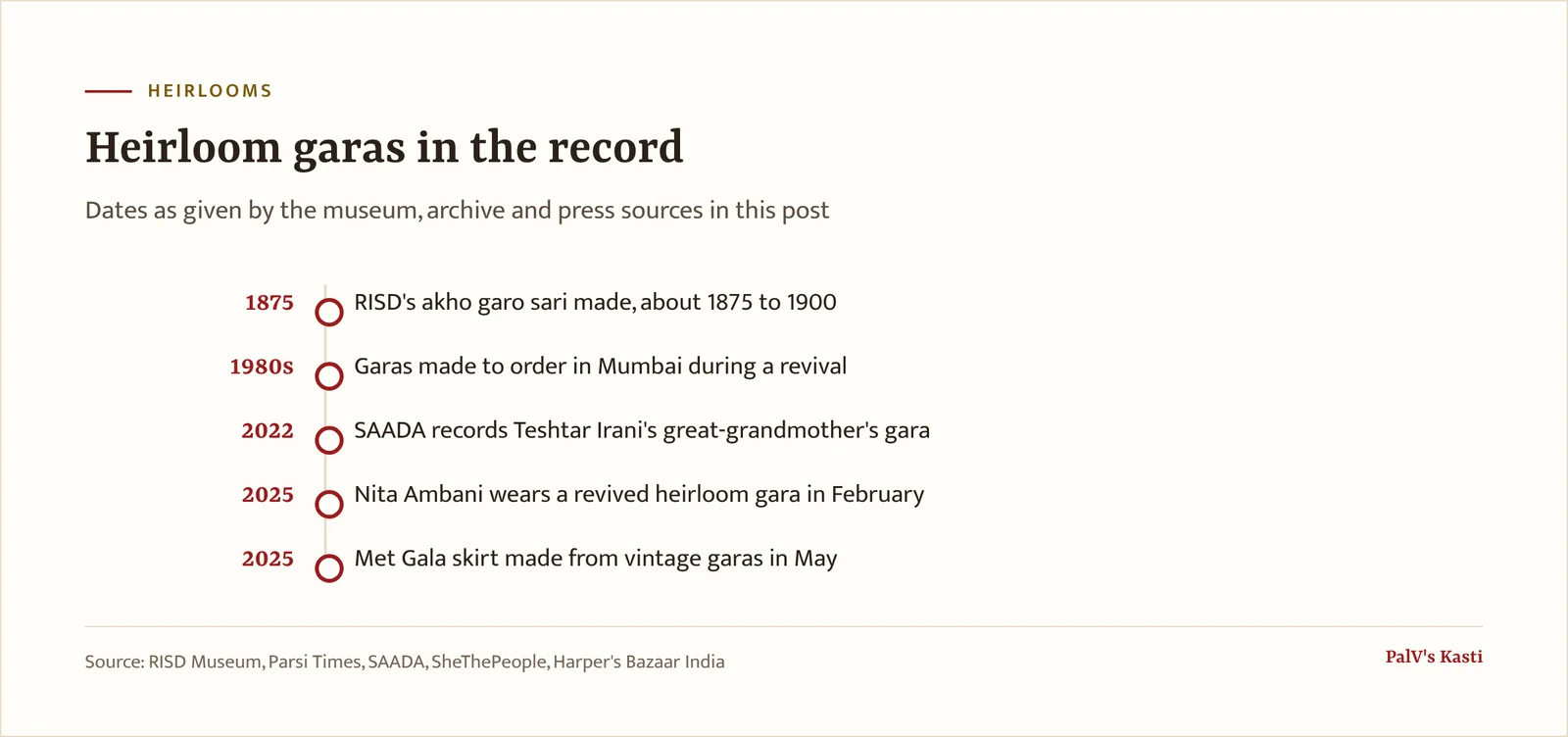
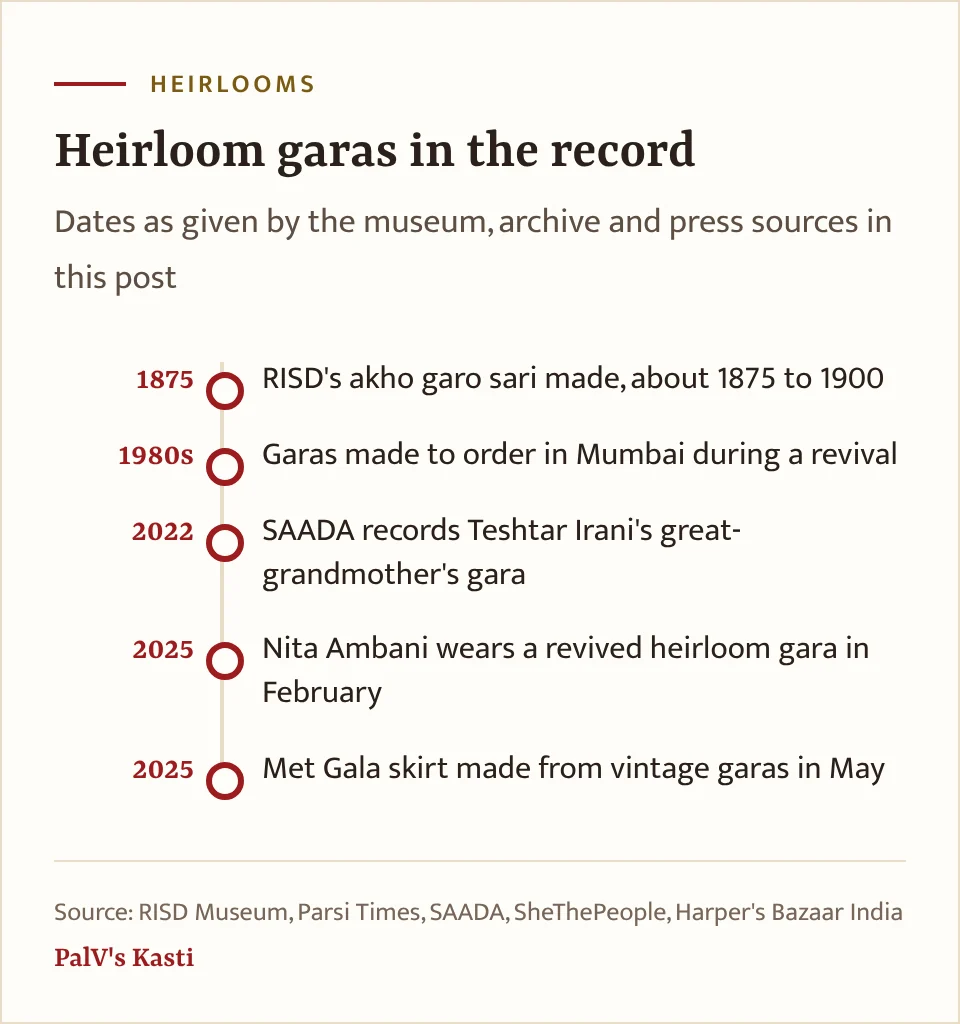
In Parsi families the gara is the sari that gets handed down. The RISD Museum's 2025 essay on the gara calls garas "the most precious of heirlooms" in Parsi families, handed down through generations of women, and the label for the museum's own akho garo sari of about 1875 to 1900 says such garments are "treasured as family heirlooms". Old garas don't last untouched: Parsi Times notes that the all-over embroidery of original garas made the fabric stretch and give way over time. Homegrown reported in 2022 that designer Ashdeen Lilaowala repaired old garas at his studio, an heirloom gara was revived for Nita Ambani in 2025, and vintage garas went into a Met Gala skirt the same year. Here is what the record shows about each path: handing a gara down, repairing it and re-using it.
અસપંદામેદ રોજ
Asfandarmad Roj, Tir Mah · 1396 Y.Z.
Why is the gara treated as a family heirloom?
Two things make it one: what it's worth and what it carries. Homegrown's history of the sari describes three kinds of gara, from border-only to embroidered all over, and says the heaviest, all-over kind is the one saved for weddings and most commonly passed from woman to woman. The same piece calls a gara bought today an investment that starts in a bride's trousseau and goes down from grandmother to mother to daughter. Parsi Times, in September 2023, called it "an investment of sorts", a gift for the younger generation.
Its value isn't only financial. UNESCO Parzor describes the classic embroidery patterns of the gara and kor as "a treasured part of Parsi heritage". The wider craft is covered in our guide to Parsi embroidery. And Homegrown points out that what a family keeps is also the story of who the sari was made for and the occasion it was made for.
Where the gara begins its family life is covered in the gara in a Parsi bride's trousseau.
What do handed-down garas look like in the record?
Four garas that named sources describe as heirlooms:
| Gara | Its family story | Recorded by |
|---|---|---|
| Ashdeen Lilaowala's mother's black gara | Embroidered by his father's grandmother. He has since inherited it | Harper's Bazaar India, 2025; Cabana magazine |
| Teshtar Irani's great-grandmother's gara | Dated 3 April 2022, Flushing, New York. In her oral history she chose it as an object for a time capsule | South Asian American Digital Archive |
| The century-old gara at the 2025 Met Gala | One of the vintage garas fashioned into Natasha Poonawalla's skirt | Harper's Bazaar India, May 2025 |
| Nita Ambani's deep blue gara | Described by Manish Malhotra as an heirloom, revived by Zenobia S. Davar | SheThePeople, February 2025 |
Of the four, the Lilaowala gara has the clearest family line. He has written that his mother's black gara was his earliest memory of the craft, embroidered by his father's grandmother, and he told Cabana magazine it is "a family heirloom that I have now inherited". One sari, from his great-grandmother's needle to his own keeping. The Irani gara shows the same pull in the diaspora: the South Asian American Digital Archive holds the record through its Archival Creators Fellowship Program, under Sharmeen Mehri's oral-history project with Zoroastrian South Asians.
Why do old garas need repair?
The embroidery itself strains the cloth. Parsi Times says the all-over embroidery of early garas made the fabric "stretch and give way, from time to time".
Borders were often separate pieces to begin with. The Victoria and Albert Museum's record for a black silk gauze sari made in China between 1900 and 1950 for the Parsi community notes that the edging on such pieces was often applied separately, with yards of satin ribbon embroidered by Chinese artisans for the purpose. Parsi Times adds that the community always had skilled artisans who could "restore, transfer and repair" these heirlooms.
Homegrown stresses that looking after a gara matters "right down to the way you fold it". Our guide to caring for and storing a Parsi gara saree covers that.
Who has restored old garas recently?
Two named specialists appear in our sources. Homegrown reported in September 2022 that Ashdeen Lilaowala repaired old garas in his studio, both for sustainability and so that they would survive for future generations. We haven't found a 2025 or 2026 report that confirms he still takes on repairs, so ask his studio directly. Old textiles also reach him another way. People now bring their old textiles to his studio, he told Open magazine in February 2025, and "some of these are at least 200 years old". The magazine says he hopes to show that archive in a museum some day.
The other named restorer in our sources is Zenobia S. Davar. SheThePeople reported on 21 February 2025 that Manish Malhotra described Nita Ambani's deep blue gara as an heirloom piece "carefully revived by saree expert Zenobia S. Davar".
We haven't found a published, named method for restoring a gara, so we don't give one here. If you hand an old gara to a specialist, ask exactly what they plan to change before work begins.
Can an old gara be made into something new?
It can, and one recent case made headlines: the 2025 Met Gala. Harper's Bazaar India reported on 6 May 2025 that Natasha Poonawalla's Manish Malhotra look had a sculpted fishtail skirt made from vintage Parsi gara saris, one of them a century-old heirloom. Ashdeen Lilaowala, writing in the same magazine in June 2025, described the ensemble as crafted from two vintage Parsi gara saris.
Our advice is to think hard before you cut. In our view, a repaired gara can still be draped by the next woman in the family, and a cut one can't. If what you want is the look in a new form, gara embroidery is being made fresh today, and our piece on Parsi gara work today covers who is doing that work.
What if your family has no gara to hand down?
Then you can start the line. Parsi Times recalls that in the 1980s revival, community members who were "not bequeathed this heirloom" could have garas made in Mumbai, at a price. Homegrown calls buying a gara today an investment that a bride's trousseau then carries down the generations. For what to look for in the sari itself, see our guide to the Parsi gara saree.
Frequently asked questions
Why are Parsi garas passed down in families?
Garas are treated as heirlooms because of their value and their history. The RISD Museum calls them the most precious of heirlooms in Parsi families, passed down across generations of women. Homegrown notes that the heaviest, all-over embroidered garas, kept for weddings, are the ones most commonly handed from woman to woman.
How old can an heirloom gara be?
Surviving garas can be well over a century old. The RISD Museum's akho garo sari dates to about 1875 to 1900. Harper's Bazaar India reported that Natasha Poonawalla's 2025 Met Gala skirt used vintage gara saris, including a century-old heirloom. Designer Ashdeen Lilaowala says some old textiles brought to him are at least 200 years old.
Can an old or damaged gara be restored?
Yes, specialists have repaired them. Homegrown reported in 2022 that designer Ashdeen Lilaowala repaired old garas at his studio, and SheThePeople reported in 2025 that Manish Malhotra described Nita Ambani's heirloom gara as revived by Zenobia S. Davar. Parsi Times notes that the community has always had artisans able to restore, transfer and repair these saris.
Can I turn my grandmother's gara into another outfit?
You can, but it's permanent. At the 2025 Met Gala, Natasha Poonawalla wore a Manish Malhotra skirt fashioned from vintage Parsi gara saris, one of them a century-old heirloom. Our view: once cut, a gara can no longer be draped as a sari, so we'd choose repair where the cloth can still be saved.