PalV's Kasti

On this page
The gara is the sari that writers on Parsi dress place in a bride's trousseau. Homegrown's history of the Parsi gara calls buying one today an investment, one that starts in a bride's trousseau and then passes from grandmother to mother to daughter. Parsi Times reports that even non-Parsi brides marrying into the community insist on a gara for their trousseau. Museum records tie individual garas to weddings too: the RISD Museum's akho garo sari, made in about 1875 to 1900, was, in its label's words, likely worn by a wealthy Parsee woman, "possibly for her wedding". The older written record of Parsi marriage customs, J.J. Modi's, describes formal gifts of clothes in the run-up to a wedding, though it doesn't name the gara.
અસપંદામેદ રોજ
Asfandarmad Roj, Tir Mah · 1396 Y.Z.
Is a gara part of a Parsi bride's trousseau?
Yes, on the evidence we could check. Ava Gilder, writing for Homegrown in September 2022, describes the gara as an investment that starts in a bride's trousseau and passes from grandmother to mother to daughter. Parsi Times, in a September 2023 feature by Veera Shroff Sanjana, calls the gara "an investment of sorts – a gift for the younger generation", and notes that non-Parsi girls marrying into the community insist on one as part of their trousseau.
Neither source gives a figure for how many brides carry a gara. So read "part of the trousseau" as a custom, not a count.
If you're new to the sari itself, our guide to the Parsi gara saree explains what a gara is and why it costs what it does.
What do Parsi marriage customs say about gifts of clothes?
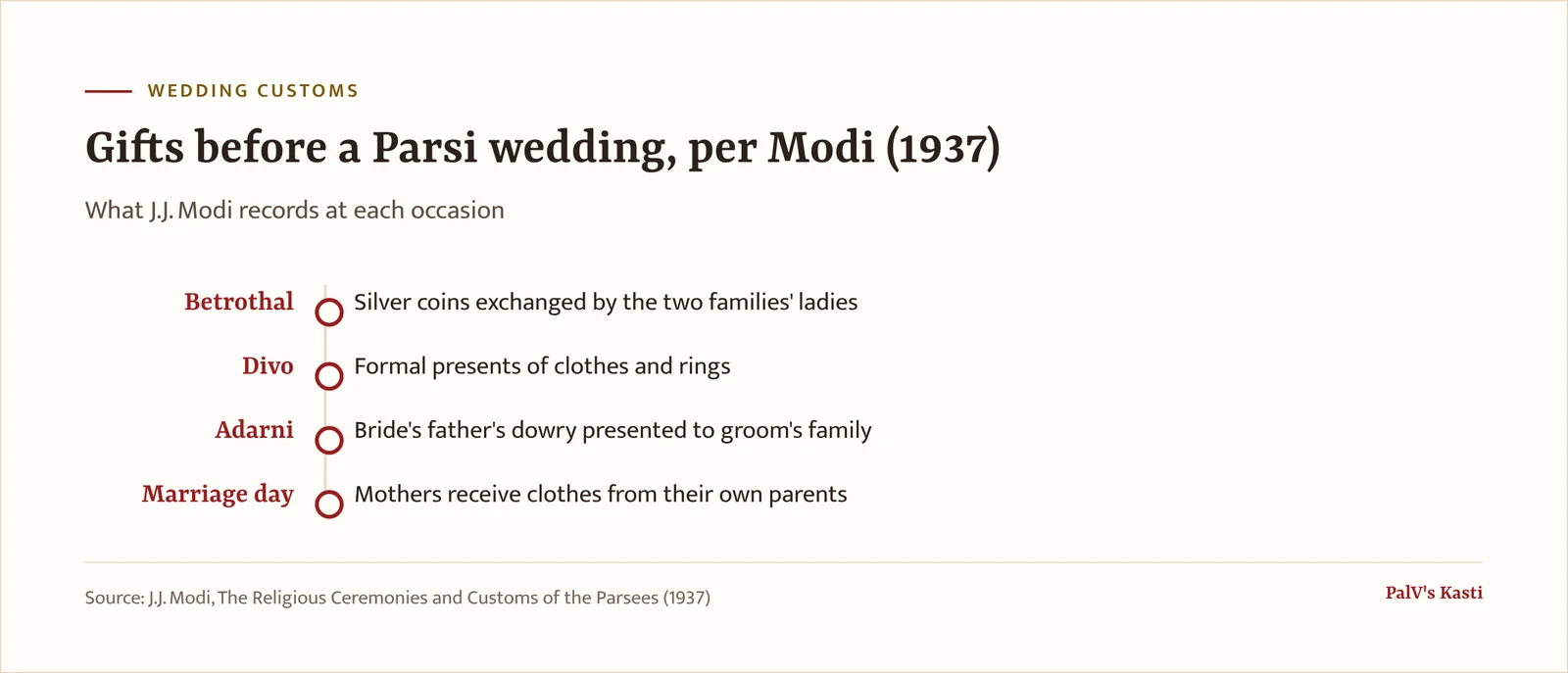
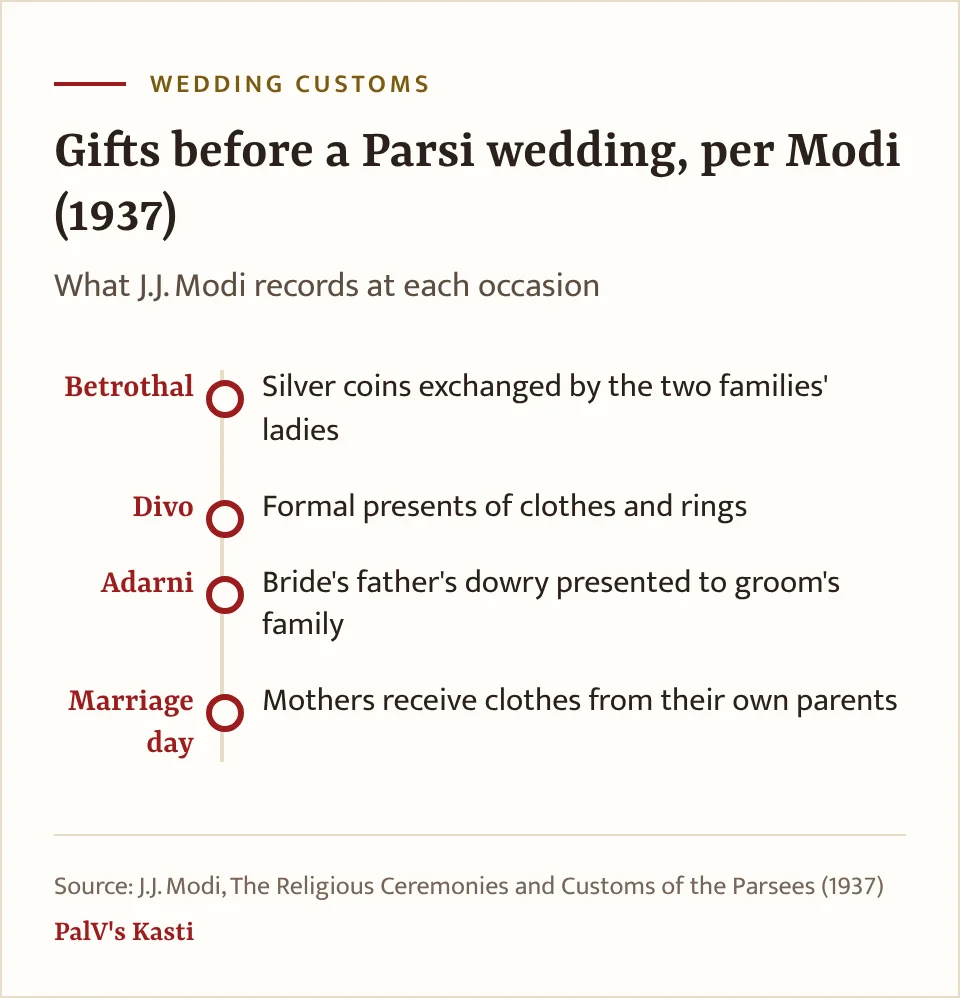
They record clothes as formal wedding gifts, without naming the gara. J.J. Modi's The Religious Ceremonies and Customs of the Parsees (2nd edition, 1937, hosted on avesta.org) walks through the occasions from the betrothal to the wedding day:
| Occasion | What Modi records |
|---|---|
| Betrothal (Adravvun, older name Nam padvun) | The ladies of the two families make each other presents of silver coins, which Modi calls "the only important part of the ceremony" |
| Divo (the lighting of a lamp) | Formal presents of clothes and rings are made, which is why Modi ranks it above the betrothal |
| Adarni | The dowry given by the bride's father is presented to the bridegroom's family |
| Marriage day | The mothers of the bride and groom expect presents of clothes from their own parents |
The Encyclopaedia Iranica entry on the betrothal, by Maneck Fardoonji Kanga (1983), places clothing earlier. It says the essential part of the betrothal is a two-way exchange of jewellery, silver coins and "new sets of clothing". So the two sources differ on the stage at which clothes change hands. Both record clothes changing hands before the wedding day. Neither says which saris were given, and neither mentions the gara by name.
Practice varies between families and Agiaries; your family priest's guidance comes first.
What colour was a bridal gara?
Red, where the record is specific. The Textile Research Centre in Leiden notes that black and violet were common ground colours for Parsi saris, while wedding-related garas came in brilliant red or orange-red. It adds that red silk saris with white Chinese embroidery were worn by Parsi brides during the wedding festival, though "not apparently for the actual wedding ceremony itself".
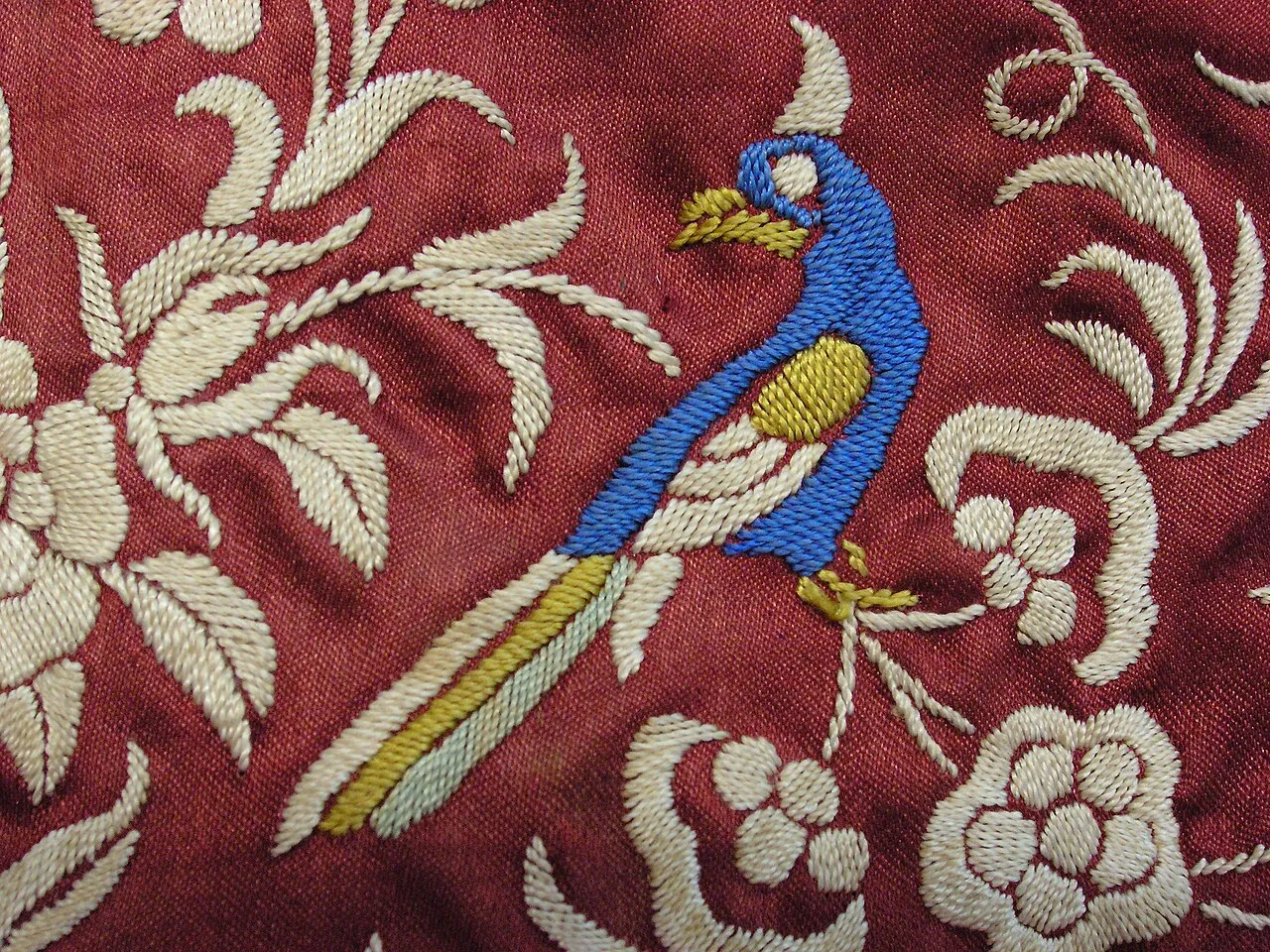
For what is worn at the ceremony itself, see when to wear a Parsi gara and Parsi wedding and Navjote attire.
What happens to a trousseau gara after the wedding?
Homegrown describes the gara passing from the bride's trousseau to the generations after her, grandmother to mother to daughter. How families hand garas down, and how old ones are repaired, is the subject of our piece on the Parsi gara as a family heirloom.
Can a bride still have a hand-embroidered gara made?
Yes, but she needs time. Homegrown's 2022 piece says a hand-embroidered gara can take up to six months to make, depending on the detail, so a trousseau gara is best ordered early. Our piece on how Parsi embroidery is done explains the work involved.
The craft is being taught. The Parzor Foundation's own textiles page says it trains craftspeople to revive Parsi embroidery in contemporary adaptations, and that since 2003 it has run workshops in Ahmedabad, Mumbai, Navsari and Delhi. Our piece on reviving gara embroidery covers who is doing that work, and Parsi embroidery covers the wider craft.
Frequently asked questions
Is a gara part of a Parsi bride's trousseau?
Yes. Homegrown describes the gara as an investment that begins in a bride's trousseau and passes from grandmother to mother to daughter. Parsi Times reports that even non-Parsi brides marrying into the community insist on a gara for their trousseau. No source we checked gives a figure for how many brides carry one.
What colour is a bridal gara?
Red or orange-red, where the record is specific. The Textile Research Centre in Leiden notes that wedding-related garas came in brilliant red or orange-red, while black and violet were common ground colours. It adds that red silk saris with white Chinese embroidery were worn by Parsi brides during the wedding festivities.
What clothes are exchanged around a Parsi wedding?
J.J. Modi records formal presents of clothes and rings at the Divo, and notes that on the marriage occasion the mothers of the bride and groom expect presents of clothes from their own parents. The Encyclopaedia Iranica places an exchange of new sets of clothing at the betrothal. Neither source names the gara.
Do museum records link garas to weddings?
Some do. The RISD Museum holds an akho garo sari, an embroidered silk made in about 1875 to 1900, whose label says a wealthy Parsee woman probably wore it, possibly for her wedding. The Textile Research Centre in Leiden also writes of wedding-related garas made in brilliant red or orange-red.
How long does a hand-embroidered trousseau gara take to make?
Homegrown's 2022 history of the gara says a hand-embroidered gara can take up to six months, depending on how detailed the work is. That is why a gara meant for a bride's trousseau is best ordered well ahead of the wedding rather than in the final weeks before it.