PalV's Kasti

On this page
- What is the traditional Parsi wedding dress for a groom?
- What does a Parsi bride wear?
- Is the head covered at a Parsi wedding?
- What does a child wear for the Navjote?
- What should guests wear to a Parsi wedding?
- Are clothes given as gifts at a Parsi wedding?
- How has Parsi wedding attire changed over time?
- Frequently asked questions
The traditional Parsi wedding dress for the groom is the jama-pichhori, a loose robe that J.J. Modi described in 1922 as "always white in colour". By the end of the 1940s the knee-length dagli had become the men's ceremonial coat, according to Parsi Times writer Dara M Khodaiji. For the bride, the record splits in two: museums tie the gara, the embroidered Parsi sari, to the wedding celebrations, while Singapore's National Heritage Board says bride and groom traditionally both wear white for the ceremony. Women guests often wear the gara too, and Mumbai's CSMVS museum says it "is worn on special occasions as well as at marriages". At a Navjote, the child is dressed by the priest in the white sadra and kusti. And today? "Today anything goes for Parsi weddings," Khodaiji wrote in 2016.
શહેરેવર રોજ
Shehrevar Roj, Tir Mah · 1396 Y.Z.
What is the traditional Parsi wedding dress for a groom?
The older dress is the jama-pichhori. Modi's The Religious Ceremonies and Customs of the Parsees (1922) says the bridegroom puts on "the usual ceremonial dress", the jama-pichhori, a loose flowing dress full of folds and curls that "is always white in colour". His earlier account of the marriage ceremony (1921) says the same, and Singapore's National Heritage Board also records the groom traditionally dressing in white. Modi adds three more details of the groom's appearance:
- He holds a shawl in his hand, a shawl being "considered in India a symbol of respect and greatness".
- He has a mark of kunkun, a red pigment, on his forehead. The groom's is "always long and vertical".
- A garland of flowers hangs round his neck. Modi's 1921 account gives the bride one as well.
The coat came later. Khodaiji writes in Parsi Times that men wore the jamo-pichori on formal or ceremonial occasions "upto mid-twenties", without saying whether he means their age or the decade. He traces a shorter coat, the duglo or dugla, that was worn up to the 1950s even for weddings and navjotes, and dates the dagli in its present, nearly knee-length form to the end of the 1940s. In the 1930s, he adds, some men wore a loose silk surcoat called the sayo over ceremonial dress, "but this fashion did not last long". Dr Ramiyar P. Karanjia, the scholar-priest, still lists the dagli with the pagdi or pheta first among the traditional clothes of Zoroastrian men.
| Garment | What the source says | Source |
|---|---|---|
| --- | --- | --- |
| Jama-pichhori | Loose, flowing, always white, the groom's ceremonial dress in 1922 | Modi |
| Duglo or dugla | Coat worn to weddings and navjotes up to the 1950s | Khodaiji |
| Dagli | Nearly knee-length ceremonial coat, popular by the end of the 1940s | Khodaiji |
| Sayo | Loose silk surcoat of the 1930s that soon fell out of use | Khodaiji |
| Pagree or pheta | By 2016, worn at weddings only by close relatives | Khodaiji |
The coat has its own page: the dagli. For headwear, see the Parsi paghdi and the Parsi pheta.
Practice varies between families and Agiaries; your family priest's guidance comes first.
What does a Parsi bride wear?
Two kinds of record, and they don't quite meet. For the ceremony itself, Singapore's National Heritage Board says that traditionally both bride and groom dress in white, because white is a symbol of purity in Zoroastrianism. Modi's 1921 account describes the bride's sari as a loose garment full of folds, without naming a colour. Museum and university sources, meanwhile, tie brides to the gara in more than one colour:
- *Red silk with white embroidery.* The Textile Research Centre (TRC) in Leiden says red silk saris with white Chinese embroidery were worn by Parsi brides during their wedding festival, and adds that they apparently weren't worn for the ceremony itself. It also notes that "wedding related gharas were in brilliant red or orange-red".
- *White-thread garas.* Aurora Turkenburg's 2022 Leiden University thesis on gara embroidery points to "distinct white thread gara in marriage ceremonies".
- *A gara possibly made for a wedding.* The RISD Museum's akho garo sari, made between about 1875 and 1900, carries a label suggesting a wealthy Parsee woman wore it, "possibly for her wedding".
One smaller detail comes from Modi: the kunkun mark on a bride's forehead "is always round", unlike the groom's long one.
So the sources point to the gara for the festivities and to white for the ceremony. We couldn't open a source that describes what Parsi brides in India wear at the ceremony today, so we haven't guessed. For the sari itself, see our guide to the Parsi gara saree, and for how it fits into a bride's wardrobe, the gara in a Parsi bride's trousseau. The ceremony itself is covered in our guide to the Parsi wedding.
Practice varies between families and Agiaries; your family priest's guidance comes first.
Is the head covered at a Parsi wedding?
For Zoroastrians taking part, yes. James R. Russell writes in Encyclopaedia Iranica that Parsi women leave their faces uncovered, but that on solemn occasions above all the sari is customarily drawn over the head. He doesn't name particular ceremonies. Dr Ramiyar P. Karanjia says the head should be covered at least during prayers, while taking part in rituals and when visiting a fire temple, with a matha-bana (a white cotton cloth) or scarf for women and a topi, pagdi or pheta for men. The reason the head is covered at all is explained in why Zoroastrians cover their heads.
Practice varies between families and Agiaries; your family priest's guidance comes first.
What does a child wear for the Navjote?
The child's Navjote dress is set by the ritual, centred on the white sadra and kusti the priest puts on, and our guide on what to wear to a Navjote walks through it step by step, along with what parents and guests wear.
What should guests wear to a Parsi wedding?
No source we read sets a dress code for guests. What they record is custom:
- *Women.* Khodaiji describes women guests "in their fineries", in garas, antique gold and silver kors, lamés and brocades. Turkenburg writes that female attendees of the three-day wedding "often wear gara as well". CSMVS says the gara is worn at marriages.
- *Men.* Khodaiji: "Men sport pagrees or phentas only if they are close relatives." In 2016, he writes, men came in anything from suits and shirt-sleeves to jeans, t-shirts or pathani dress.
- *Heads.* Zoroastrian guests cover their heads during the prayers, as above. We found no source on what non-Parsi guests are expected to wear, so ask the hosts.
Khodaiji also gives his own preference. For women, "nothing beats a sari with kor!", and for men, the dugli is the best. More occasions for the gara, from weddings to Navroz, are in when to wear a Parsi gara.
Are clothes given as gifts at a Parsi wedding?
They were in Modi's time. He writes that "The marriage occasion is one, when the mothers of the bride and the bridegroom, expect presents of clothes from their own parents". If those parents had died, it fell to a brother to give the sister a suit or suits of clothes. The presents made at the wedding itself, he adds, were mostly shawls, rings or cash.
How has Parsi wedding attire changed over time?
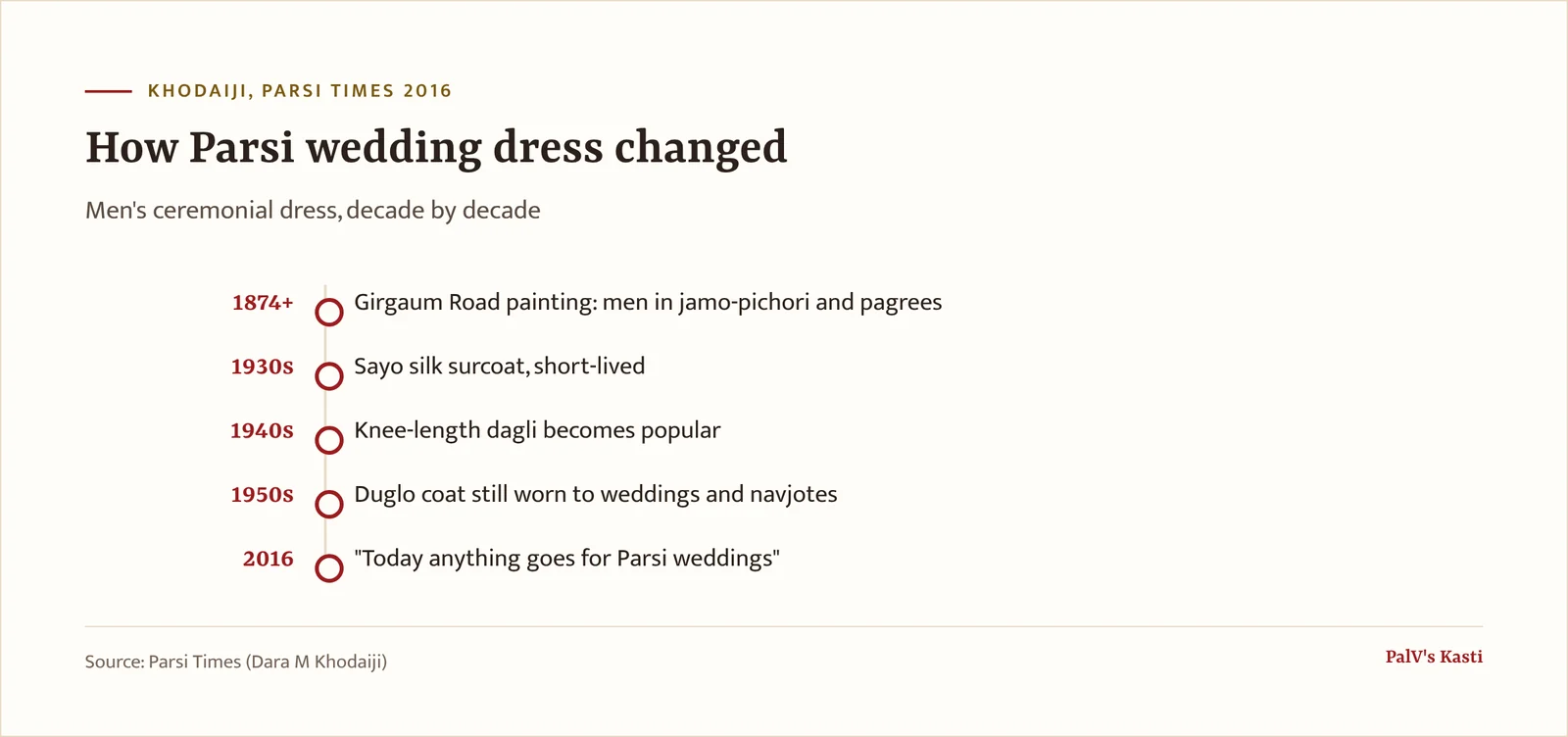
Khodaiji's 2016 Parsi Times article traces most of the change:

| Period | What Khodaiji describes |
|---|---|
| --- | --- |
| "Girgaum Road" painting, after 1874 | Men in jamo-pichori, red ijar and pagrees, women in saris with kors and white matha-banu head scarves |
| Edwardian fashion | Blouses with "long, or three fourth sleeves and high neck", sadras worn shorter, often of net or lace |
| 1930s | The sayo surcoat over ceremonial dress, short-lived |
| End of the 1940s | The knee-length dagli becomes popular |
| Up to the 1950s | The duglo coat still worn to weddings and navjotes |
| About sixty years before 2016 | The baug "filled with men in duglis or duglas, and pagrees or phentas" |
| 2016 | "Today anything goes for Parsi weddings" |
For the wider story of Parsi dress, see how Parsi dress changed over time and our hub on Parsi traditional dress.
Frequently asked questions
What does a Parsi groom wear at his wedding?
Traditionally the jama-pichhori, a loose robe full of folds, which J.J. Modi described in 1922 as always white. Modi says the groom also holds a shawl and wears a red kunkun mark and a flower garland. Parsi Times writer Dara M Khodaiji says the knee-length dagli became the ceremonial coat by the end of the 1940s.
What colour sari does a Parsi bride wear?
Singapore's National Heritage Board says Parsi brides and grooms traditionally wear white for the ceremony. For the festivities, the Textile Research Centre in Leiden records red silk saris with white Chinese embroidery, and a Leiden University thesis points to white-thread garas at marriage ceremonies. Your family priest's guidance comes first.
What should I wear to a Parsi wedding as a guest?
No source we read sets a fixed dress code. Parsi Times writer Dara M Khodaiji describes women guests in garas, kors and brocades and men in anything from suits to pathani dress, with pagrees or phetas only for close relatives. A Leiden University thesis says women attendees often wear the gara.
Do Parsi men cover their heads at weddings?
Zoroastrian men cover their heads during prayers and rituals, says Dr Ramiyar P. Karanjia, with a topi, pagdi or pheta. The formal pagree or pheta is rarer. Dara M Khodaiji wrote in Parsi Times in 2016 that men wear them only if they are close relatives, while sixty years earlier the baug was full of them.
Is the dagli worn at Navjotes as well as weddings?
Khodaiji describes the dagli as ceremonial attire, popular from the end of the 1940s. He says its predecessor, the duglo or dugla coat, was worn to both weddings and navjotes up to the 1950s. Our page on the dagli covers the coat itself, its cut and when it is worn.