PalV's Kasti
On this page
Parsi dress changed in three stages that the written record lets us follow. First, after settling in Gujarat, Parsis took up local clothing. The Kisseh-i Sanjan, finished in 1600, says the ruler Jadi Rana asked that their women dress like his women, and in 1884 Dosabhai Framji Karaka wrote that the men's angrakha and turban and the women's sari closely resembled the dress of Gujarat's Hindus. Second, English fashion moved in during 19th-century Bombay. By 1884 most Parsi men wore coat and trousers, and women had swapped the choli for an English-style bodice. Third, by the early 20th century the paghdi was "largely discontinued" except at ceremonies, while white ceremonial dress held on.
અસપંદામેદ રોજ
Asfandarmad Roj, Tir Mah · 1396 Y.Z.
Did Parsis dress differently in Iran?
Yes, according to Karaka. He opened his chapter on costume by saying that the dress of India's Parsis differed from what their ancestors had worn in Persia, and from what Zoroastrians living in Persia wore in his own day. He didn't describe the Persian dress itself, and neither do the other sources we use here. For what Iranians wore on their heads through history, see our page on headgear in ancient Persia.
Karaka also had a theory about why the change came so easily. Citing the Greek historians, he wrote that the ancient Persians stood out for "imitating foreign manners and customs", and that their descendants kept the habit. Treat that as Karaka's own view, written in 1884.
Why did the Parsis adopt Gujarati dress?
The earliest account is the Kisseh-i Sanjan. Its author, Bahman Kaikobad Sanjana, was a priest living at Navsari, and he finished the poem in 1600. In Shahpurshah Hodivala's 1920 translation, Jadi Rana first asks what the refugees believe and then sets them these conditions:
| Condition | In Hodivala's translation |
|---|---|
| Language | Give up "the tongue of Iran" and adopt the speech of Hind |
| Women's dress | "They should wear garments like those of our females" |
| Arms | Put off all arms and stop wearing them anywhere |
| Marriage | Tie the marriage knot "at evening time" |
Only the women's dress is named in the Kisseh. Karaka went further. He wrote that the community took up its costume "in accordance with their agreement with the Hindu princes", and he tied the men's angrakha and turban to that agreement as well as the women's sari. A few pages later he struck a different note: in Gujarat, he said, the Parsis "willingly adopted" the language, dress and customs of the country. So the sources disagree on how much was required and how much was chosen. We report both and don't pick one.
UNESCO Parzor puts it briefly: once they had left Iran, the Zoroastrians of Pars "came to adopt Indian costumes, including the sari".
What were Parsis wearing in the mid-1800s?
Victoria and Albert Museum (V&A) records give us dated garments from this period. The dates are the museum's own estimates, so read them as "about".
| Approximate date | Object | What it shows |
|---|---|---|
| About 1855, Surat | Child's jhabla of red satin, embroidered in silk at the sleeves, neck and hem | The loose children's shirt Karaka later described |
| About 1870, Bombay | Short-sleeved white muslin Sadra, shown at the London International Exhibition of 1872 as worn by Parsi men of Bombay | The sacred undershirt, recorded as men's wear |
| About 1872, western India | Turban of printed, glazed cotton in the "Khoka" style, registered as "Worn by Parsees" | The men's outdoor head-dress of the time |
| About 1870, western India | White cotton turban, registered in 1872 as "Worn by Parsee priests" | Priests already set apart by white |
| About 1872, Bombay | Wrap jacket with ties, made of English printed cotton and labelled as worn by Parsee women | English cloth was already in Parsi wardrobes |
Some children's pieces from Gujarat were made by Chinese embroiderers. The V&A holds one: a late 19th-century girl's jubla worked with a Chinese floral pattern. That trade story belongs on our page about the Chinese roots of Parsi embroidery.
How did English fashion change Parsi dress in the 19th century?
Karaka's 1884 chapter reads like a report from the middle of the change. Here is what he saw moving:
- Men's coats. Most Parsi men had adopted "a somewhat modified form of the English dress", meaning coat and trousers. They kept the turban, though Karaka found it "cumbrous" and of little use against the sun.
- The angrakha. Its sleeves had been twice the length of the arm, so they creased above the wrist. The "growing fashion" was to cut them to fit.
- Young men. The fashionable young were inclined "to go still further", and he couldn't say what the next generation would wear.
- Women's blouses. The short-sleeved silk kanchri or choli had been "almost entirely superseded" by a bodice cut more after the English fashion.
- Head coverings. Fifty years earlier, women would never have shown the hair above the forehead. By 1884 girls wore the mathabana set well back, and older women were following them.
- Shoes and jewellery. Boots and shoes were taking over from slippers, and the nose-ring had gone within a generation.
- Children. Among the well-to-do, light trousers for children had "been recently introduced".
He called the Parsi way of life "half-European and half-Hindu". The community had once taken to Gujarati ways, he wrote, and was now taking to European ones just as completely.
What changed in the early 20th century?
The paghdi faded from daily use. When the V&A registered a Parsi paghdi of varnished printed cotton in 1913, the entry said this head-dress, worn by Parsi men "for many generations", was "now largely discontinued", though still the general rule on ceremonial occasions. Its story continues on our Parsi paghdi page.
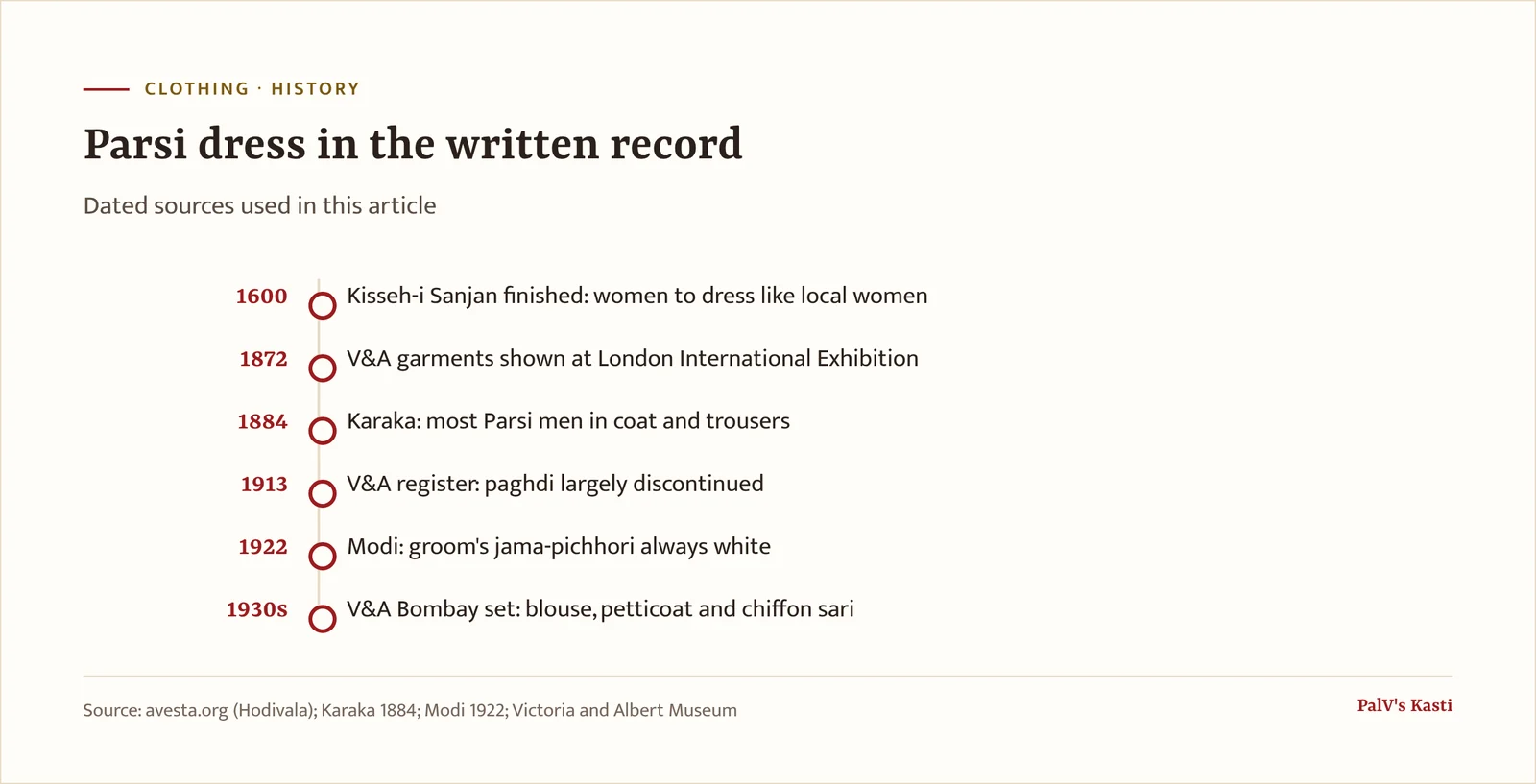
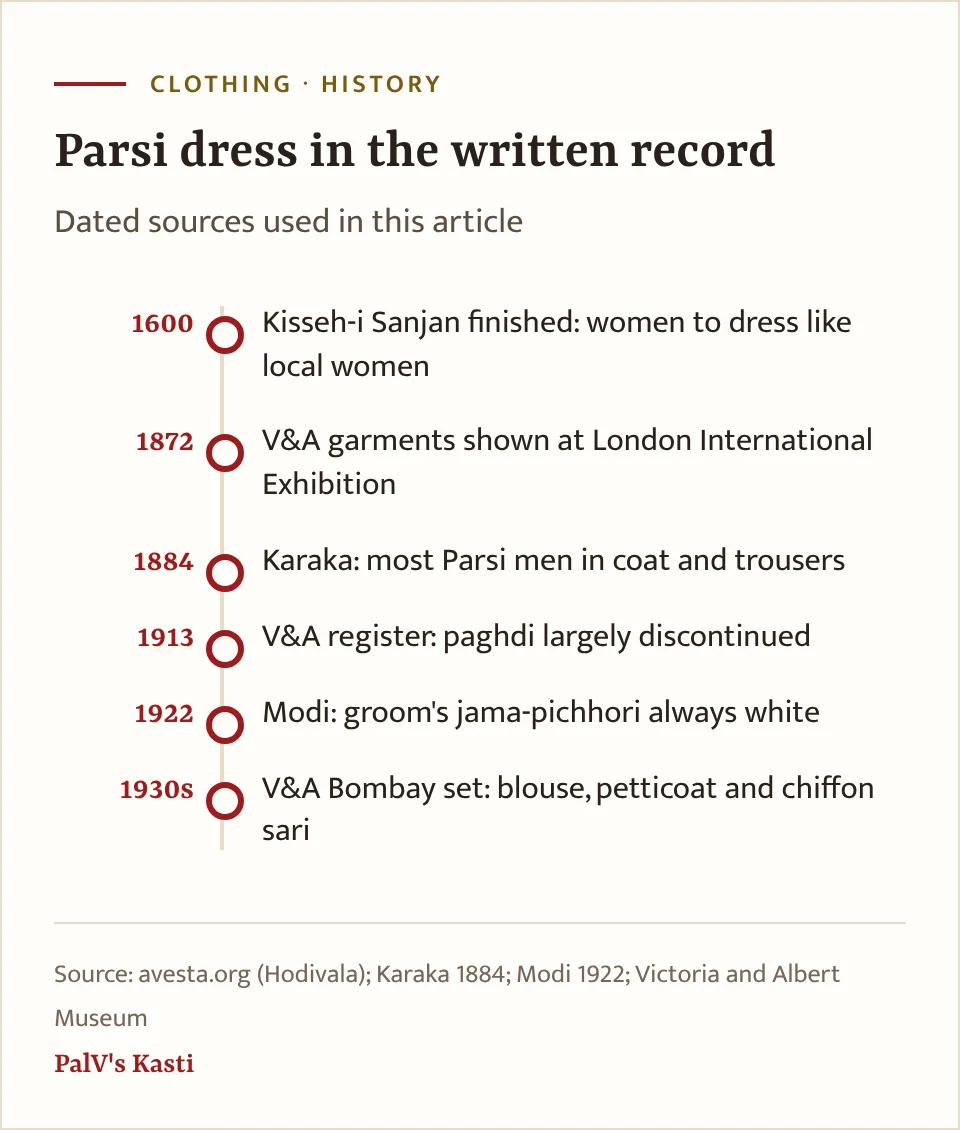
J.J. Modi recorded a smaller change in 1922. The community's chief leaders, he wrote, had carried shawls over their shoulders "fifty years ago". In his day only the head priests still carried them, as the insignia of their office.
Women's dress kept moving towards the blouse and petticoat. An ensemble from about the 1930s in the V&A's Feroza Jamsheed Marker collection, made in Bombay for the Parsee community, pairs a purple silk blouse and an ankle-length petticoat "to be worn under the sari" with a purple chiffon sari whose embroidered border "may be European". The rest of that story is in how Parsi women shaped the modern sari.
Embroidered pieces carried on too. The same collection holds red silk girls' jublas from Bombay dated about 1920 and about 1950, and a pink silk embroidered topi made in China for the Parsee community around 1950.
Which parts of Parsi dress did not change?
Two threads run through the sources from 1884 to the present.
The Navjote.">Sadra and Kusti stayed. In 1884 Karaka listed a long muslin Sadra and the Kusti as the first layer of a Parsi man's home dress, and wrote that women, like men, wore a shirt next to the skin with the Kusti tied round the waist over it. Today the Pluralism Project at Harvard University describes the sudreh as a white muslin undershirt "to be worn each day", kept on with the kushti throughout life. For what the garment means, read our page on the Parsi Sadra meaning. If you need a new one, you can order a Sadra from us.
White for priests and ceremonies stayed. Karaka recorded in 1884 that Shenshai priests wore the laymen's costume made entirely of white cotton, turban included, and that the jama and pichhori were kept for weddings, funerals and a few state occasions. Modi, in 1922, called the white jama-pichhori the priests' "full sacerdotal dress". He also wrote that the bridegroom wore the jama-pichhori, "always white in colour", and that everyone who walked with a funeral procession was "clothed in full white dress". The dagli, a Parsi man's ceremonial coat, has its own page: Parsi Dugli (Dagli). For how all these garments fit together, see our guide to Parsi traditional dress.
Practice varies between families and Agiaries; your family priest's guidance comes first.
Frequently asked questions
Why do Parsi women wear the sari?
The Kisseh-i Sanjan, finished in 1600, records that the ruler Jadi Rana asked the Zoroastrian refugees to dress their women like local women. Karaka's 1884 History of the Parsis ties the Parsi sari to that agreement, and UNESCO Parzor notes that the community adopted Indian costume, including the sari, after leaving Iran.
When did Parsi men start wearing Western clothes?
The change was well under way by the 1880s. Dosabhai Framji Karaka wrote in 1884 that most Parsi men had adopted a modified English dress of coat and trousers. They still wore the turban with it, and the white jama and pichhori were kept for weddings, funerals and some state occasions.
What did Parsi men wear in the 19th century?
Karaka's 1884 account lists a muslin Sadra and Kusti, a sleeved waistcoat, loose cotton trousers, slippers and a China silk skull-cap at home. Outdoors, men added the angrakha, a loose beltless coat with very long sleeves, and a dark turban. The white jama and pichhori were kept for weddings and funerals.
When did Parsis stop wearing the paghdi every day?
By the early 20th century. The Victoria and Albert Museum's 1913 register entry for a Parsi paghdi says the head-dress, worn by Parsi men for many generations, was by then largely discontinued, though still the general rule on ceremonial occasions. Karaka had already called the turban cumbrous back in 1884.
Did the Kisseh-i Sanjan require Parsi men to change their dress?
Not in so many words. In Hodivala's translation, the only clothing condition Jadi Rana sets concerns women's dress, alongside conditions on language, arms and evening weddings. Karaka's 1884 history extends the agreement to the men's angrakha and turban, but that is his reading, not the wording of the Kisseh.