PalV's Kasti
On this page
- When did Parsi women begin wearing the sari?
- How was the Parsi way of wearing the sari different?
- Did Parsi women wear a blouse and petticoat with the sari?
- How did European fashion change the Parsi blouse?
- How did the Parsi style reach women outside the community?
- Did Parsi women create the modern nivi sari?
- Where do the gara and a girl's first sari fit in?
- Frequently asked questions
Parsi women shaped the modern sari mostly by example. In 19th-century Bombay they wore the sari with a blouse and a petticoat underneath and the pallu over the right shoulder. In 1864, on her way to her husband's posting in Ahmedabad, Jnanadanandini Devi of the Tagore family stayed at a Parsi house in Bombay, saw this style, moved the pallu to the left shoulder and later taught her version in Calcutta. Some scholars credit that adaptation as the start of today's nivi drape, which needs a blouse, a petticoat and a sari at least six yards long. Others trace the nivi to the Dravidas or to Andhra Pradesh. The V&A in London holds a Bombay set from about the 1930s, made for the Parsee community, that shows all three pieces together.
શહેરેવર રોજ
Shehrevar Roj, Tir Mah · 1396 Y.Z.
When did Parsi women begin wearing the sari?
After the community settled in India. The Victoria and Albert Museum (V&A) notes that the Parsis came from present-day Iran and "settled first in Gujarat", keeping their own culture and beliefs, "although Parsi women adopted the sari there". The Parzor Foundation, in its exhibition on Parsi embroidery, says Parsi women took up the sari when they migrated from Iran to Sanjan.
The community's own settlement story points the same way. John R. Hinnells, writing in Encyclopaedia Iranica, notes that the Qesse-ye Sanjan says it was written down in 1600 from oral tradition, and that among the ruler's conditions was that "the women should adopt the local dress". He also warns that the text must be used "with due caution" as history.
The sari wasn't the only option. The Textile Research Centre in Leiden notes that Parsi girls tended to wear a loose tunic (jubla), wide trousers and a round cap. Married women, it says, might wear that same outfit or the sari, a garment associated with Hindu women.
How was the Parsi way of wearing the sari different?
Mainly in the shoulder, the pleats and the length:
- Right shoulder. India's Department of Posts wrote in its June 2019 stamp note that Parsi women "have always" brought the palla over the right shoulder, not the left. The Impart Encyclopedia of Art says the same of Parsi women in Bombay at the time Jnanadanandini Devi saw them.
- Pleats on the right, a long pallu. Parzor says Parsi women wore their pleats on the right to keep the sari distinct, and let the pallav reach almost to the feet.
- Over the head. Dosabhai Framji Karaka, in his 1884 History of the Parsis, described the sari folded round the waist with the rest thrown over the head, falling on the right arm. James R. Russell, in Encyclopaedia Iranica, notes that among Zoroastrians the sari is traditionally worn over the head, "especially on solemn occasions".
The full Parsi drape, step by step, is in our guide on how to drape a sari Parsi style.
Practice varies between families and Agiaries; your family priest's guidance comes first.
Did Parsi women wear a blouse and petticoat with the sari?
Yes, and those are the pieces Jnanadanandini Devi carried to Bengal. Ghulam Murshid's entry on her in Banglapedia says that at the Parsi house in Bombay she saw the women wearing saris "along with bodices, petticoats, blouses and shoes". Impart describes Parsi women in Bombay wearing the sari with a blouse and petticoat at a time when, in Bengal, saris "were traditionally worn without a blouse or a petticoat".
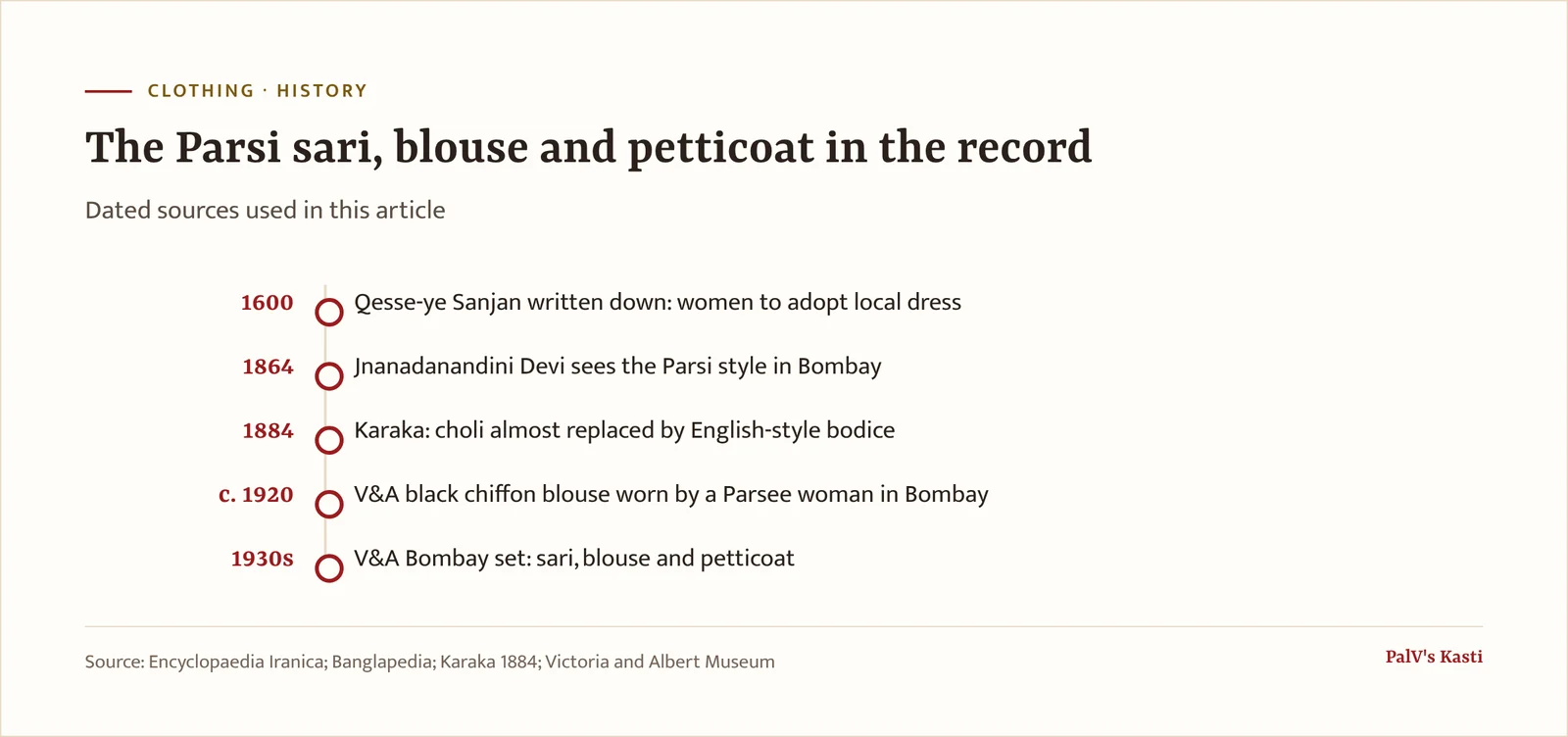
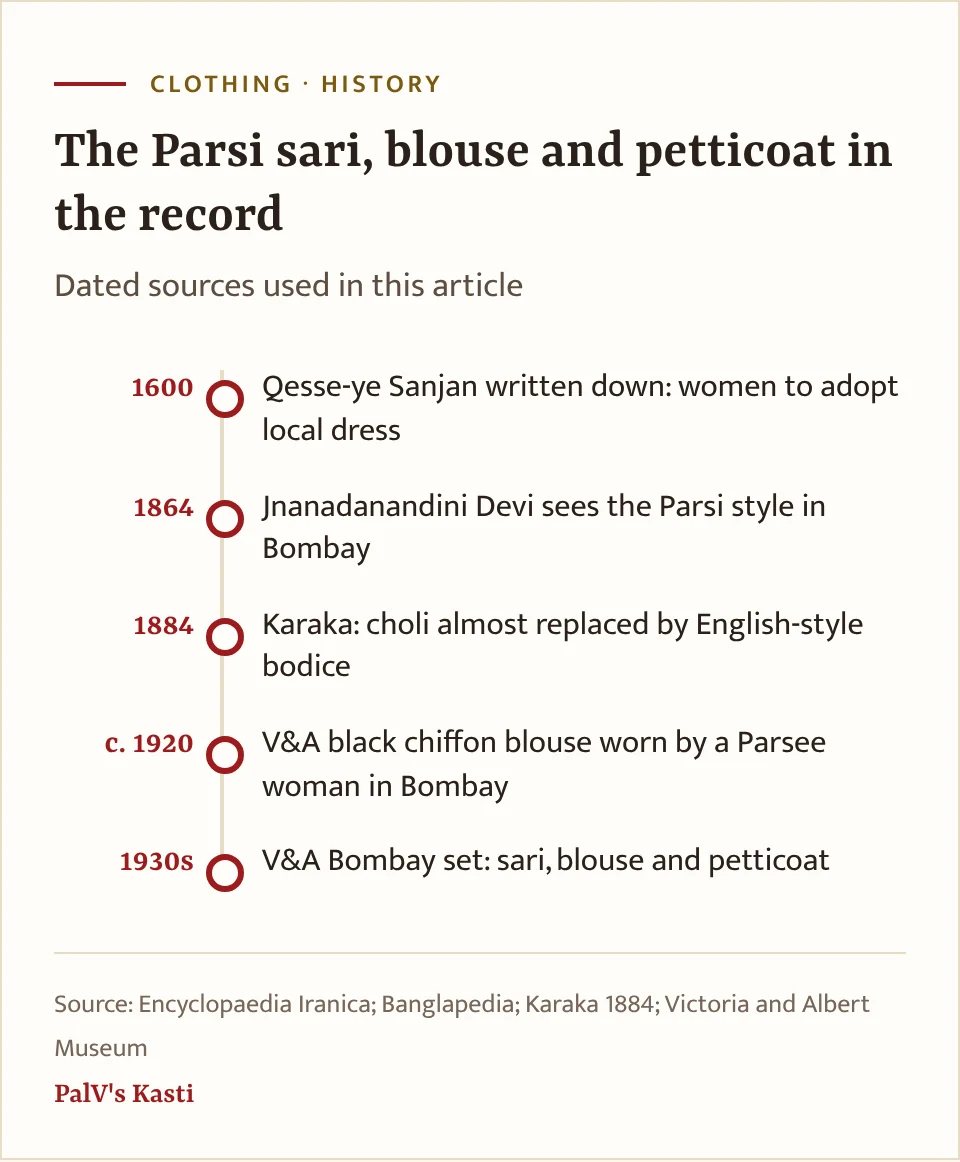
Karaka shows the blouse was itself changing. By 1884, he wrote, the short-sleeved silk choli once worn under the sari had been "almost entirely superseded" by a bodice cut more after the English fashion.
Museum objects show what these garments looked like a few decades later. All four pieces below belong to the V&A's Feroza Jamsheed Marker collection of Parsi clothing:
| V&A number | Object | Date and place | What the V&A records |
|---|---|---|---|
| IS.26-2004 | Sari | About the 1930s, Bombay | Purple chiffon, made for the Parsee community, with an embroidered border that "may be European (Viennese?)" |
| IS.27:1-2004 | Blouse (choli) | About the 1930s, Bombay | Purple silk, made to go with the sari and the petticoat |
| IS.27:2-2004 | Petticoat | About the 1930s, Bombay | Ankle-length purple silk, "to be worn under the sari" |
| IS.18-2004 | Blouse | About 1920, made in Hyderabad | Black chiffon with net lining and embroidered flowers, "Worn by a Parsee woman in Bombay" |
How did European fashion change the Parsi blouse?
Through cut and fabric. Dara M Khodaiji, writing in Parsi Times on 8 November 2016, says Edwardian fashion gave Parsi blouses long or three-fourth sleeves and a high neck, and that Navjote.">Sadras were worn shorter and often made of net or lace. Later, he writes, the sleeves shortened and then disappeared altogether.
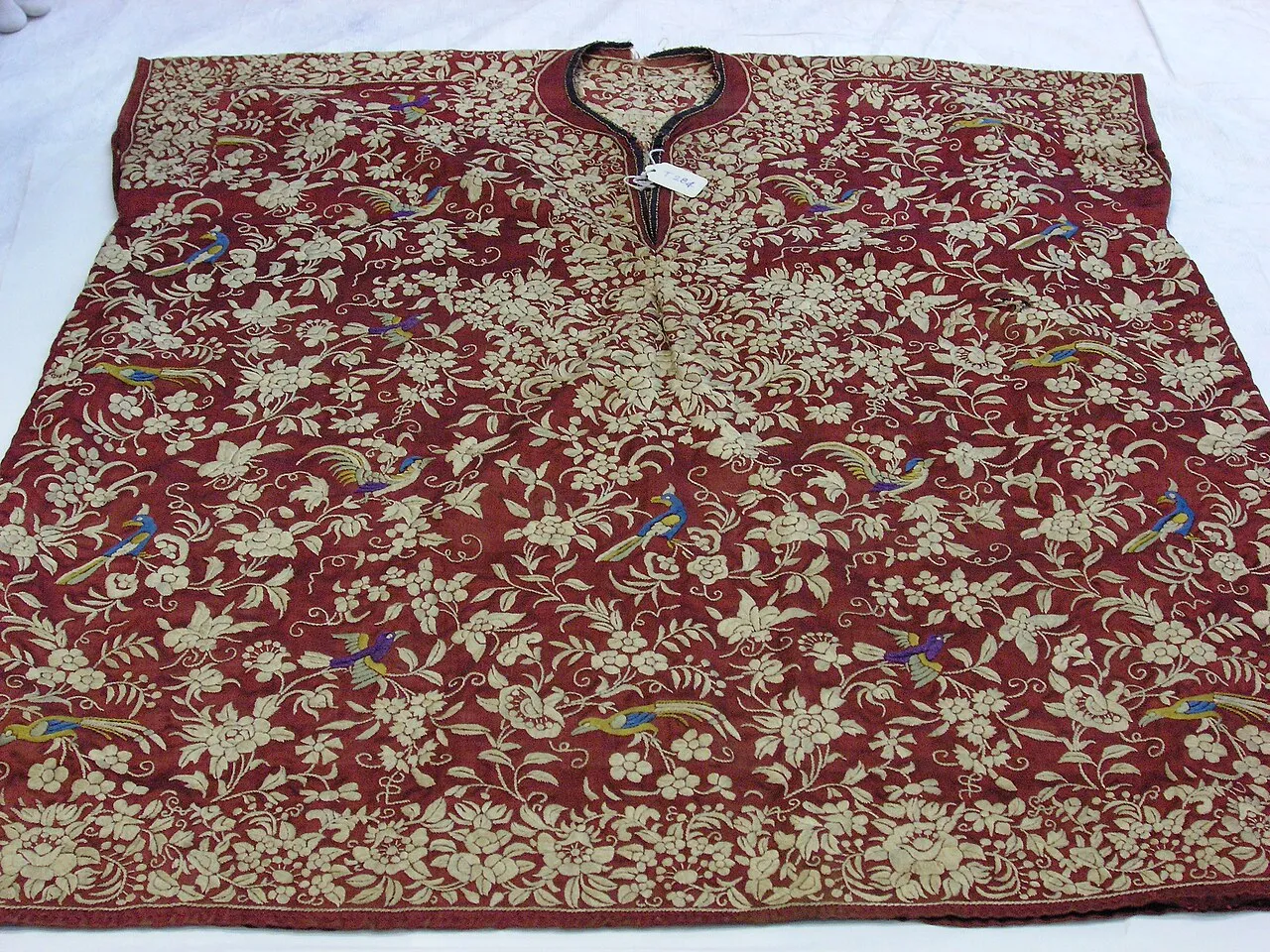
Lace reached even the sacred shirt. Parzor's exhibition shows Lady Bachubai Vakil wearing her sacred Sadra in lace, which it calls a European influence on the community's mixed style. The V&A's 1930s sari, with its possibly Viennese border, points the same way. For what the Sadra itself means, see our page on the Parsi Sadra meaning. How the rest of the Parsi wardrobe changed is in how Parsi dress changed over time.
How did the Parsi style reach women outside the community?
Every source we read tells it through Jnanadanandini Devi. The Department of Posts says she "improvised upon the sari worn by Parsi women" during a tour of Gujarat, draping the pallu over the left shoulder. Impart adds that she made the switch so her right arm stayed free, and that Calcutta called her style the "Bombay Dastur". The Daily Star, in a 4 July 2022 profile by Aashnai Syeda, says the blouse and petticoat came to Bengal "after the influence of Parsi women". Her full story is in how the Parsi drape reached Bengal.
Did Parsi women create the modern nivi sari?
That claim is contested, so here are the positions as their authors state them:
- Credit to Jnanadanandini Devi's Parsi-inspired drape. Impart notes that "other scholars" credit Jnanadanandini Devi with inventing the contemporary nivi drape. A March 2025 PTI report on Animesh Mukherjee's Hindi book about the Tagore family says her style became "the default way of draping a saree across India".
- Other origins. Impart also notes theories that attribute the nivi to the Dravidas, comparing it with the South Indian veshti, and others that place its origin in Andhra Pradesh.
We don't take a side on who invented the nivi. What the sources we read agree on is narrower, and we're confident of it: the sari with blouse and petticoat that Parsi women wore in Bombay was the model Jnanadanandini Devi adapted. Impart describes the nivi today as needing a blouse, a petticoat and a sari of at least six yards.
Where do the gara and a girl's first sari fit in?
Both have their own pages. The Department of Posts calls the traditional embroidered Parsi sari the Gara; read what a Parsi gara saree is. A Parsi girl's first sari is covered in sari perawanu, a Parsi girl's first sari. For the full list of Parsi garments, start with our hub on Parsi traditional dress.
Frequently asked questions
Did Parsi women introduce the sari blouse to India?
No source we read says Parsi women invented the blouse. Banglapedia and Impart record that Parsi women in Bombay already wore the sari with a blouse and petticoat when Jnanadanandini Devi visited in the 1860s, and that she adapted the style for Bengali women. The Daily Star credits the blouse and petticoat in Bengal to Parsi influence.
What is the difference between the Parsi drape and the nivi drape?
The shoulder. Parsi women bring the pallu over the right shoulder, according to India's Department of Posts. The nivi takes it over the left. Impart says Jnanadanandini Devi made exactly that switch from the Parsi style she saw in Bombay, so her right arm stayed free. Both are worn with a blouse and petticoat.
When did Parsi women start wearing saris?
After settling in India. The V&A says Parsi women adopted the sari in Gujarat, where the community first settled, and the Parzor Foundation says they took it up after migrating from Iran to Sanjan. Encyclopaedia Iranica notes that the Qesse-ye Sanjan has the local ruler asking the women to adopt local dress.
Where can I see historic Parsi blouses and petticoats?
The Victoria and Albert Museum in London holds the Feroza Jamsheed Marker collection of Parsi clothing. It includes a purple chiffon sari, a matching silk blouse and an ankle-length petticoat made in Bombay around the 1930s, plus a black chiffon blouse made in Hyderabad around 1920 and worn by a Parsee woman in Bombay.
Was the Parsi sari influenced by European fashion?
Yes, in its blouses and trims. Dara M Khodaiji wrote in Parsi Times that Edwardian fashion gave Parsi blouses long or three-fourth sleeves and high necks, and that Sadras became shorter, often in net or lace. Parzor shows a Sadra in lace as a European influence, and a 1930s V&A sari has a possibly Viennese border.