PalV's Kasti
On this page
- What makes the Parsi saree drape different from other drapes?
- How do you drape a sari in the Parsi style, step by step?
- How is the Parsi drape different from the Seedha Palla?
- Why does the Parsi pallu go over the right shoulder?
- Did Parsi women always wear the sari?
- Is the Parsi sari draped over the head?
- Is there a special way to drape a saree Parsi style on Navroz?
- How does the Parsi drape connect to a girl's first sari and to Bengal?
- Frequently asked questions
The Parsi saree drape is a Gujarati-style way of wearing the sari in which the pallu goes from the back, over the right shoulder, to the front. Most other city drapes take it over the left. Border&Fall's documentary project The Sari Series films it in five moves: knot the sari at the right waist, take the pallu anticlockwise and lay it over the right shoulder, tuck at the left waist, pleat the rest into the centre front, then carry the pallu's edge anticlockwise and tuck it at the right waist. Border&Fall calls it a slight variation of the Gujarati Seedha Palla. The difference is that the pallu is thrown much lower, so it falls close to the lower border.
શહેરેવર રોજ
Shehrevar Roj, Tir Mah · 1396 Y.Z.
What makes the Parsi saree drape different from other drapes?
The shoulder comes first. India's Department of Posts, in its 12 June 2019 press note for the stamp set "Indian Fashion: Sari in Myriad Forms", says Parsi women wear the Gujarati sari with a few style changes, and that they have always worn the palla on the right shoulder, never the left. The RISD Museum's label for a Parsi gara made around 1875 to 1900 agrees: the sari is wrapped round the waist in the traditional Gujarati manner, and the pallu end comes from the back over the right shoulder.
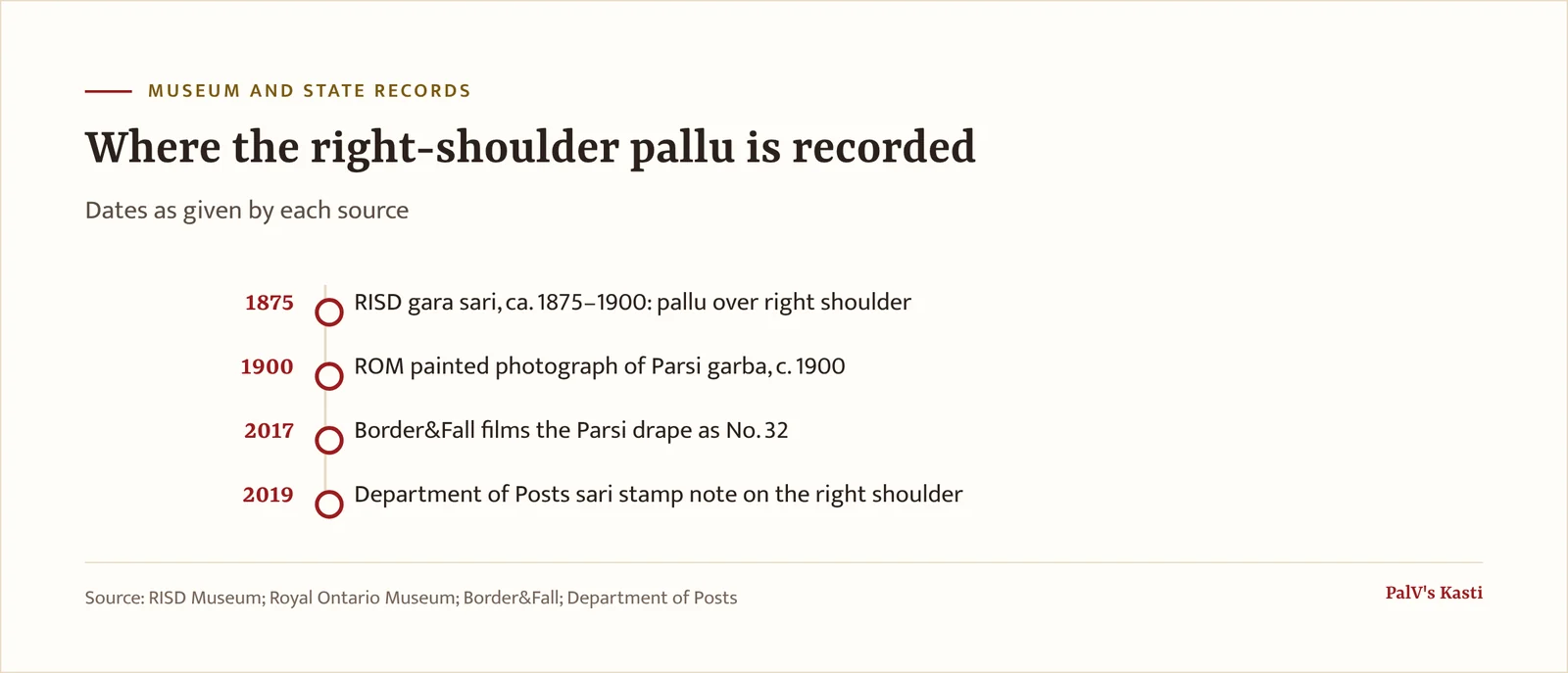
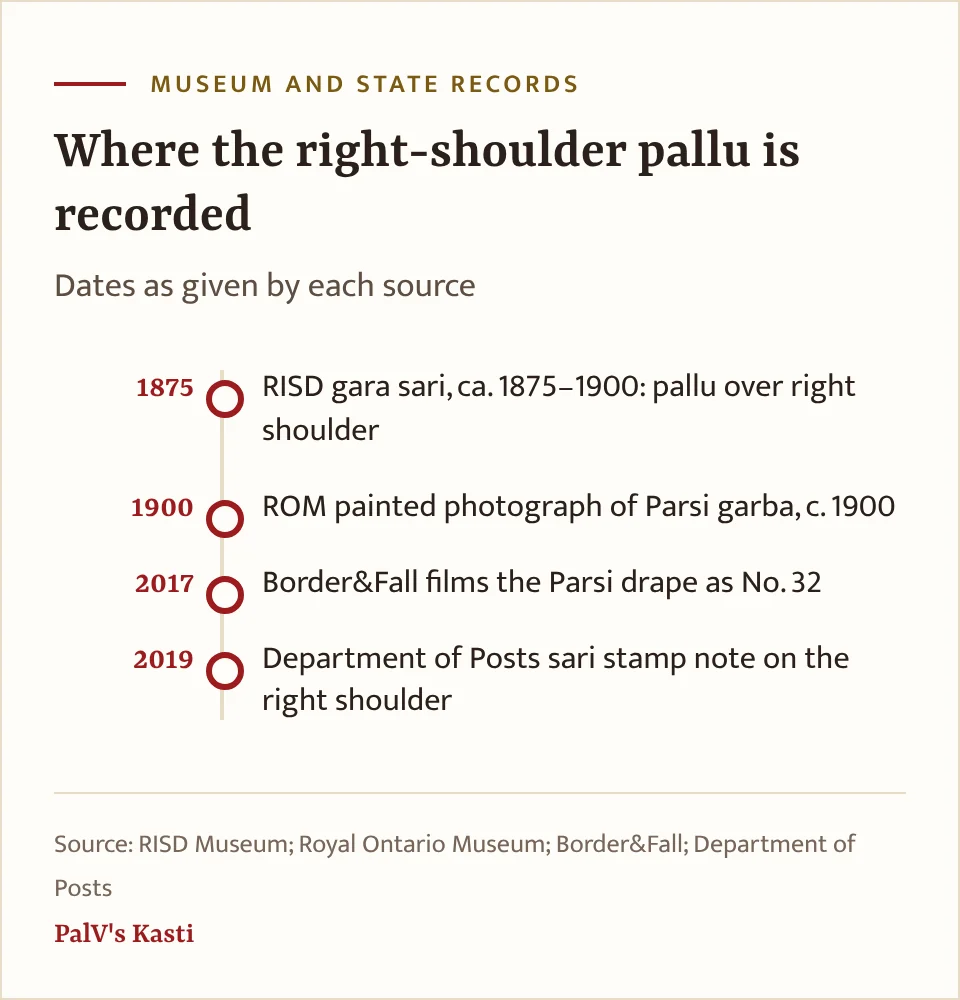
The Royal Ontario Museum goes back further. Its record for a painted photograph of Parsi women and girls dancing the garba, dated about 1900, says this back-to-front pallu over one shoulder was common among Parsis since at least the 19th century.
Length and pleats are the second difference. The Parzor Foundation's online exhibition on Parsi embroidery says Parsi women kept the sari distinct by wearing "their pleats on the right" and letting the "pallav" reach almost to the feet. Border&Fall's film tucks the pleats at the centre front instead, and marks the drape out by the low-thrown pallu. So the two sources disagree on where the pleats sit. We follow Border&Fall's steps below, because theirs is the only complete step-by-step version we could open and check.
How do you drape a sari in the Parsi style, step by step?
This method is Border&Fall's, from The Sari Series: An Anthology of Drape (2017). The project describes itself as non-profit cultural documentation, and its team included Malika Verma Kashyap and Rta Kapur Chishti. Their film shows the drape on a Parsi gara in crepe silk by Ashdeen, 5.5 metres (6 yards) long, worn with a blouse by Theory.
- Knot. Double-knot the sari at your right waist, with the inner end in front.
- Pallu. Carry the pallu anticlockwise round your body and lay it over your right shoulder, going from back to front.
- Adjust. Settle the fall of the drape, then tuck it in at your left waist.
- Pleat. Pleat the length that's left and tuck the pleats in at the centre front of your waist.
- Finish. Bring the edge of the pallu round anticlockwise and tuck it in at your right waist.
Border&Fall's notes stop there. They say nothing about a brooch or pin, a petticoat or a blouse cut, so we haven't added any.
How is the Parsi drape different from the Seedha Palla?
Border&Fall films the Gujarati Seedha Palla as drape No. 31 and the Parsi drape as No. 32. Side by side, what changes is the order of work.
| Step | No. 31 Seedha Palla | No. 32 Parsi Drape |
|---|---|---|
| 1 | Double-knot at right waist, inner end in front | Double-knot at right waist, inner end in front |
| 2 | Make about 12 pleats with the outer end, tuck at centre front | Take pallu anticlockwise, back to front over right shoulder |
| 3 | Bring pallu anticlockwise and pleat its end | Adjust the drape, tuck at left waist |
| 4 | Drape back to front over right shoulder | Pleat the remaining length, tuck at centre front |
| 5 | Take pallu edge once round the body anticlockwise, tuck at right waist | Take pallu edge anticlockwise, tuck at right waist |
| Sari in the film | Banarasi silk by Rajesh Pratap Singh | Parsi gara in crepe silk by Ashdeen |
In the Seedha Palla the pleats come first and the pallu goes up last. The Parsi drape puts the pallu on the shoulder before any pleating. Border&Fall describes the Seedha Palla as the contemporary drape that urban women adopted from the late 19th century.
Why does the Parsi pallu go over the right shoulder?
We found no source that documents a single origin for the right-shoulder pallu. Three give reasons in their own words. The Parzor Foundation links the right-side pleats and the long pallav to keeping the Parsi sari distinct. The Express Tribune, in a 23 June 2013 feature on the gara, advised wearing it Parsi style, pallu over the right shoulder, to show off the embroidery. Quartz, reporting on Border&Fall's project, wrote that the Parsi drape shows off the gara's handwork by letting the pallu flow freely over the right shoulder.
The embroidery is a subject of its own. Our guide to the Parsi gara saree explains what a gara is.
Did Parsi women always wear the sari?
No. The V&A's record for a Parsi sari (T.24-1967) notes that the Parsis originate in present-day Iran, settled first in Gujarat, and that Parsi women adopted the sari there. The Parzor Foundation says the same: Parsi women took up the sari when they migrated from Iran to Sanjan. The rest of the wardrobe is in our guide to Parsi traditional dress, and how Parsi women later changed the sari for everyone is told in how Parsi women shaped the modern sari.
Is the Parsi sari draped over the head?
On solemn occasions, traditionally, yes. James R. Russell, writing in Encyclopaedia Iranica, notes that among Zoroastrians the sari "is traditionally draped over the head", above all on solemn occasions. The Express Tribune's 2013 feature describes an "old" style of drawing the pallu over the head that left only the left ear showing. For why the head is covered at all, see why Zoroastrians cover their heads.
Practice varies between families and Agiaries; your family priest's guidance comes first.
Is there a special way to drape a saree Parsi style on Navroz?
No separate Navroz drape appears in any source we could check. The documented Parsi drape is the one above. What the sources record is the sari itself: Aurora Turkenburg's 2022 Leiden University MA thesis on gara embroidery notes that on Navroz, Parsi women wear gara saris under a dress code. For weddings, the Department of Posts' 2019 note says Parsi brides wear a white ornate gara that is usually a family heirloom; our page on Parsi wedding attire covers the rest. Other occasions are in when to wear a Parsi gara.
How does the Parsi drape connect to a girl's first sari and to Bengal?
Both stories have their own pages. The Department of Posts' 2019 note says the gara is worn after the Sari Perawani, the sari-wearing ceremony. That rite is explained in sari perawanu, a Parsi girl's first sari. The same note says Jnanadanandini Devi of the Tagore family created her own style with the pallu over the left shoulder, "as opposed to the Parsi style". How that happened is told in how the Parsi sari drape reached Bengal.
Frequently asked questions
What is a Parsi saree called?
The embroidered Parsi sari is called a gara. The Department of Posts' 2019 sari stamp note says the traditional Parsi sari of embroidered fabric is called a Gara, and the RISD Museum's label says Parsi women wear gara saris in the Gujarati manner, with the pallu brought from the back over the right shoulder.
Which shoulder does the pallu go over in the Parsi drape?
The right shoulder, from back to front. Border&Fall's Sari Series film of the Parsi drape takes the pallu anticlockwise and lays it over the right shoulder. The Department of Posts' 2019 press note adds that Parsi women have always worn the palla on the right shoulder rather than the left one.
How long should the sari be for the Parsi drape?
Border&Fall's film of the Parsi drape uses a sari 5.5 metres, or 6 yards, long: a Parsi gara in crepe silk by Ashdeen. Its notes give no other length. If your sari is a different length, practise the five steps once beforehand and check where the pallu falls in front.
Is the Parsi drape the same as the Gujarati Seedha Palla?
Close, but not the same. Border&Fall calls the Parsi drape a slight variation of its No. 31 Seedha Palla from Gujarat. Both lay the pallu over the right shoulder from back to front. In the Parsi version the pallu is thrown lower, nearer the lower border, and the pleats are made after the pallu is placed.
Is there a separate Parsi saree drape for Navroz?
We found no source describing a separate Navroz drape, so the documented Parsi drape applies. A 2022 Leiden University thesis on gara embroidery records that on Navroz, Parsi women wear gara saris as part of a dress code. Our guide to when to wear a Parsi gara covers the other occasions in the year.
Did Parsi women always wear the sari?
No. The V&A notes that the Parsis originate in present-day Iran and that Parsi women adopted the sari after the community settled in Gujarat. The Parzor Foundation says they took it up after migrating from Iran to Sanjan, and kept it distinct with pleats on the right and a pallav reaching almost to the feet.