PalV's Kasti
On this page
Aiwisruthrem Geh is the evening watch of the Zoroastrian day. The sacred-texts.com edition of the Khorda Avesta and Mary Boyce both place it from sunset until midnight, when Ushahin Geh takes over. The Bundahishn instead starts it when the stars appear. Boyce, writing in Encyclopaedia Iranica, calls it the fourth watch of the twenty-four hours and says it “is believed to be under their protection”, meaning the Fravashis. Its prayer, the Aiwisruthrem Gah, names the Geh in its first paragraph and turns to “the Ashavan Fravashis” in its second. L.H. Mills, who translated the same prayer for the Sacred Books of the East, notes that it is “recited every day at the hour of Aiwisrûthrima”.
શહેરેવર રોજ
Shehrevar Roj, Tir Mah · 1396 Y.Z.
When does Aiwisruthrem Geh begin and end?
As printed in the Khorda Avesta edition, Aiwisruthrem Geh runs from sunset to midnight. The sacred-texts.com edition of James Darmesteter’s translation (Sacred Books of the East, American edition, 1898) heads the prayer “Aiwisruthrem Gah - (sunset to midnight)”. Boyce gives the same span in her Encyclopaedia Iranica article on the Fravashis.
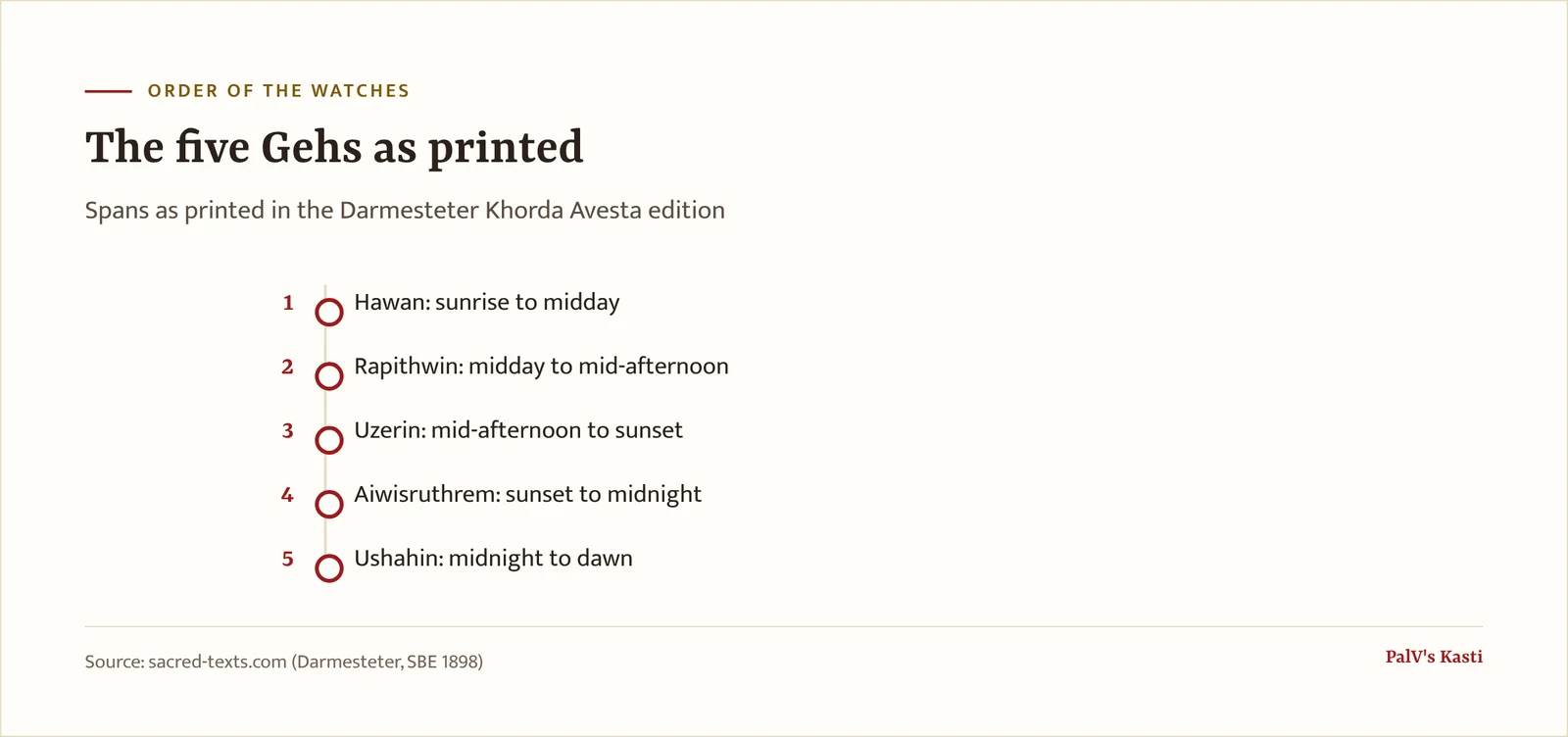
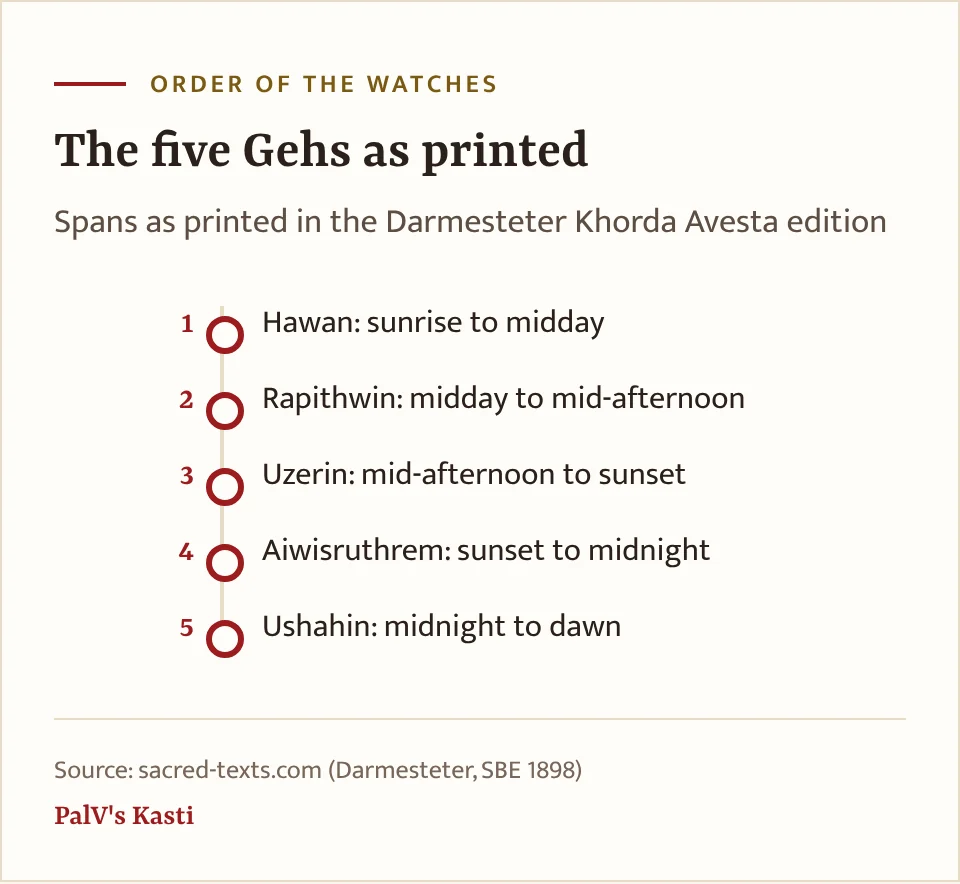
The same edition prints a span for each of the five Gehs. The order below follows the opening chapter of the Yasna, which names the five watches one after another in sections 3 to 7.
| Order | Geh | Span as printed in the Darmesteter edition |
|---|---|---|
| 1 | Hawan | sunrise to midday |
| 2 | Rapithwin | midday to mid-afternoon |
| 3 | Uzerin | mid-afternoon to sunset |
| 4 | Aiwisruthrem | sunset to midnight |
| 5 | Ushahin | midnight to dawn |
Aiwisruthrem is tied to the sun, not to an hour on the watch, so its start moves with sunset through the year and from place to place. The Bundahishn, in E.W. West’s translation, starts it “when the appearance of the stars has come into the sky”. Ervad Ramiyar Karanjia’s site agrees that “traditionally” the Geh began once it was fully dark and stars could be seen. For India, the same page ends Aiwisruthrem at midnight “or 12:38 am (IST)”, because Indian Standard Time is followed rather than local time.
How a printed start time is worked out is explained in our guide to how Geh start times are calculated from sunrise and sunset. The watch that follows has its own article: Ushahin Geh, the night watch from midnight to dawn.
Practice varies between families and Agiaries; your family priest's guidance comes first.
Why is the evening watch linked with the Fravashis?
The evening watch belongs to the Fravashis. Boyce states it plainly: the fourth watch, “from sunset to midnight, is believed to be under their protection”.
The scriptures make the same link in three places, in two translators’ words:
- The Aiwisruthrem Gah opens its second paragraph with “the Ashavan Fravashis” and “the women with their troops of heroes” (Darmesteter).
- Sirozah 1 carries a short line for each Geh. The line for this watch names “the Fravashis of the faithful”, and beside them “the females that bring forth flocks of males” (Darmesteter, avesta.org).
- Yasna 1.6, in Mills’s translation, joins Aiwisruthrem with “the fravashis of the saints” and with those “of the women who have many sons”.
Notice the pairing. Each version sets the Fravashis beside women and their many sons or heroes. The full list of companions named for each watch is in our article on the Yazatas of the five Gehs.
What does the Aiwisruthrem Gah prayer contain?
The Aiwisruthrem Gah runs to 13 numbered paragraphs in the Darmesteter edition on sacred-texts.com. A few landmarks:
- Paragraph 1 names Aiwisruthrem “that furthers life”, with Fradat-vispam-hujyaiti and Zarathushtrotema.
- Paragraph 2 turns to the Ashavan Fravashis and the women with their troops of heroes, then the Yairya Hushitay, Ama, Verethraghna and Uparatat.
- Paragraph 7 reads like a roll-call of a whole society: the Athravan, the warrior and the cattle farmer, then homes, villages, provinces and countries, each with its lord.
- Paragraph 9 worships the Ashavan woman, “predominating in good thoughts”.
- Paragraphs 12 and 13 close with Ahura Mazda “who is highest in Asha” and a wish for “worship and adoration and strength and force for the Ashavan Fravashis”.
The two Sacred Books of the East translators handle the opening name differently. Mills’s version of the Gah reads “for Aiwisrûthrima, and Aibigaya”, leaving the second word untranslated. In his Yasna he adds a footnote to that word: “Or, ‘who furthers life.’” Darmesteter puts “that furthers life” straight into the line.
Where this prayer sits among the day’s other prayers is covered in our guide to the Geh prayers, and what each Geh name means is in Geh names explained.
Where else is Aiwisruthrem named in the liturgy?
Aiwisruthrem appears at the very start of the Yasna. In Yasna 1 the reciter announces the Yasna to each watch of the day in turn, and section 6 reads, in the avesta.org edition of Mills’s translation, “I announce (and) carry out (this Yasna) for Aiwisruthrem (and) Aibigaya”.
The watches come in a fixed sequence there: Hawan in section 3, Rapithwin in 4, Uzerin in 5, Aiwisruthrem in 6 and Ushahin in 7. All five are addressed together again in section 20. Mills’s separate translation of the Gah also sacrifices to Aiwisrûthrima and Aibigaya as “the holy lord(s) of the ritual order”.
Has there always been a prayer at sunset?
On Mary Boyce’s reading, sunset is one of the oldest prayer times. In her Encyclopaedia Iranica article “Gāh”, she writes that before Zoroaster the Iranians marked the day with prayers “at sunrise, noon, and sunset, with the night devotionally a blank”, and that Zoroaster “required his followers to pray also at midnight and dawn”. She also notes that gāh is the word used for the five divisions, “for which no Avestan term is recorded”. Her article cites her 1992 book Zoroastrianism: Its Antiquity and Constant Vigour for this argument.
The five-watch day has one seasonal exception: from Avan Mah to the Gatha days, Havan Geh is recited in the Rapithwin slot, as explained in Second Havan (Biji Havan) Geh. For the full picture, start from our guide to the five Gehs, their names, timings and meaning.
Frequently asked questions
What time does Aiwisruthrem Geh start?
The sacred-texts.com Khorda Avesta edition prints the span as “sunset to midnight”, and Mary Boyce gives the same span in Encyclopaedia Iranica. The Bundahishn, in West’s translation, starts it when the stars appear, and Karanjia’s site calls that the traditional practice. Sunset changes through the year, so check local timings with your family priest.
Which Gah prayer is recited after sunset?
The Aiwisruthrem Gah is the Gah prayer for the evening watch, which the Khorda Avesta edition prints as sunset to midnight. L.H. Mills, in his Sacred Books of the East translation, notes that it is “recited every day at the hour of Aiwisrûthrima”. At midnight, Ushahin Geh begins and its own Gah prayer takes over.
Which divinities belong to Aiwisruthrem Geh?
The Fravashis are the main figures of the evening watch. Mary Boyce writes that the watch from sunset to midnight is believed to be under their protection. The Aiwisruthrem Gah also names Fradat-vispam-hujyaiti and Zarathushtrotema in its first paragraph, and Yasna 1.6 joins the watch with the Fravashis of the saints.
What Geh comes after Aiwisruthrem?
Ushahin Geh comes after Aiwisruthrem. The Darmesteter edition on sacred-texts.com prints the Ushahin span as “midnight to dawn”, which follows directly from Aiwisruthrem’s “sunset to midnight”. Yasna 1 keeps the same order in Mills’s translation, addressing Aiwisruthrem in section 6 and Ushahin in section 7.
Is Aiwisruthrem the same as Aiwisrûthrima?
Yes. They are two spellings of the same Geh name. Darmesteter’s Khorda Avesta writes “Aiwisruthrem”. L.H. Mills’s translation of the Gah, as printed on sacred-texts.com, writes “Aiwisrûthrima”, while the avesta.org digital edition of his Yasna uses the simpler “Aiwisruthrem”.