PalV's Kasti
On this page
- Which Geh boundaries move and which stay fixed?
- How do you work out the Geh times for a given day?
- Why does Havan Geh end at 12:38 pm in India and not at 12 noon?
- Does Aiwisruthrem Geh begin at sunset or when the stars appear?
- How is the start of a new Geh marked in the fire temple?
- Frequently asked questions
Geh timings rest on two moving points and three fixed ones. Sunrise and sunset change every day, so Havan Geh starts at that day's sunrise, and Uziran Geh ends (and Aiwisruthrem begins) at that day's sunset. Noon, 3 pm and midnight are fixed points of local time. For India, Ervad Ramiyar Karanjia's site reads them on Indian Standard Time as 12:38 pm, 3:38 pm and 12:38 am, and Noshir H. Dadrawala gives the same figures for Western India in Parsi Times (29 April 2023).
So the one thing you need to look up is the sunrise and sunset for your city on that day. Older texts mark the evening and pre-dawn boundaries by the stars rather than the sun, and we set out both readings below, with their sources.
શહેરેવર રોજ
Shehrevar Roj, Tir Mah · 1396 Y.Z.
Which Geh boundaries move and which stay fixed?
Two of the five boundaries follow the sun and three follow the clock. Karanjia's article "5 Gehs – An Understanding" gives the spans below, and adds "(whatever the time)" after sunrise and sunset to show those two are taken from the actual day. Dadrawala's list matches it point for point, and he frames it as applying "Assuming one is in Western India".

| Geh | Begins | Ends | What moves |
|---|---|---|---|
| Havan | Sunrise | 12:00 noon local time (12:38 pm IST) | Start moves with sunrise |
| Rapithwan | 12:00 noon local time (12:38 pm IST) | 3:00 pm local time (3:38 pm IST) | Nothing: both ends are clock times |
| Uziran | 3:00 pm local time (3:38 pm IST) | Sunset | End moves with sunset |
| Aiwisruthrem | Sunset | Midnight local time (12:38 am IST) | Start moves with sunset |
| Ushahin | Midnight local time (12:38 am IST) | Sunrise | End moves with sunrise |
The IST figures in brackets are the ones Karanjia gives for India and Dadrawala gives for Western India. They aren't worked out for any other place.
The avesta.org digital edition of the Khordeh Avesta heads the five Gah prayers with the same spans in plain words: sunrise to midday, midday to mid-afternoon, mid-afternoon to sunset, sunset to midnight, and midnight to dawn. FEZANA's prayer curriculum for grades 6 to 8 points teachers to Karanjia's page for its explanation of the five Gehs. For the names and meaning of each, see our guide to the five Gehs; the morning watch has its own page, Hawan Geh.
How do you work out the Geh times for a given day?
Following Karanjia's and Dadrawala's spans, it takes three steps.
- Look up the day's sunrise and sunset for where you are. Dadrawala suggests a daily newspaper or a phone app. Havan begins at sunrise. Uziran ends, and Aiwisruthrem begins, at sunset. Ushahin runs until the next sunrise.
- Mark the three fixed points. On local time they're 12:00 noon, 3:00 pm and 12:00 midnight. On Indian Standard Time, both sources give them as 12:38 pm, 3:38 pm and 12:38 am.
- Check the Mah. From the start of Avan Mah to Vahishtoisht Gatha, the noon slot is kept as the second (biji) Havan instead of Rapithwan, according to both Karanjia and Dadrawala. The clock times don't change. The dates are in when Rapithwin begins and ends and Second Havan (Biji Havan).
To find which Roj and Mah a date falls on, use our Parsi calendar.
Practice varies between families and Agiaries; your family priest's guidance comes first.
Why does Havan Geh end at 12:38 pm in India and not at 12 noon?
Because the noon in question is local noon, and India's clocks are set for a different longitude. Karanjia's site explains that in India the Indian Standard Time "is taken into consideration and not the local time", so Havan Geh ends at 12:38 pm. Dadrawala writes that priests in Mumbai and Gujarat keep Mumbai time for ceremonies, and that the gap between IST and Bombay Time is "thirty-eight minutes and fifty seconds". He adds that most people round it off to forty minutes.
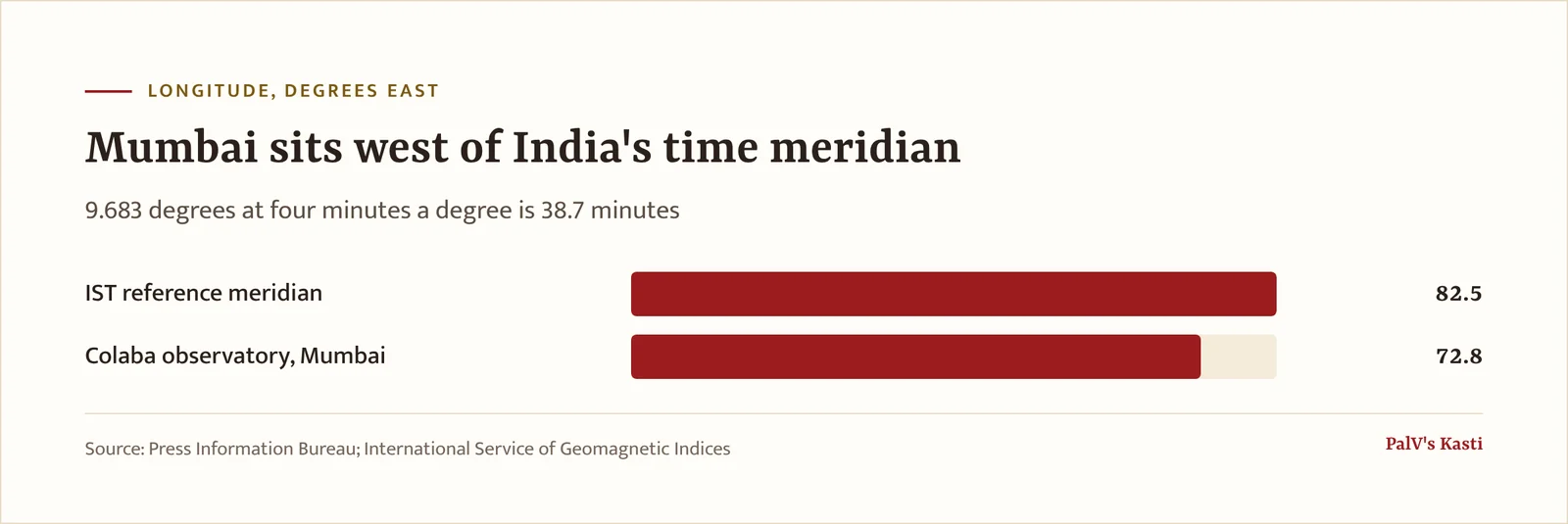

You can check the 38 minutes yourself. A Press Information Bureau release of 30 December 2016 states that IST is five hours and thirty minutes ahead of UTC. The earth turns 360 degrees in 24 hours, which is 15 degrees an hour, or four minutes of clock time per degree of longitude. Five and a half hours at 15 degrees an hour puts IST's reference line at 82.5°E, the meridian Dadrawala also names. The Colaba observatory in Mumbai is listed by the International Service of Geomagnetic Indices at 72.817°E.
That's 9.683 degrees west of the IST line. Multiply by four and you get 38.7 minutes. Mumbai's mean (average) local noon therefore falls at about 12:38 or 12:39 on an IST clock, which matches the figure both writers give.
One caveat. That's mean noon. The sun's actual noon drifts around it through the year, and Encyclopaedia Britannica describes the equation of time as a correction "never exceeding 16 minutes" between apparent and mean solar time. None of our sources says whether 12:38 pm is meant as mean noon or the sun's actual noon on a given day.
Karanjia gives 12:38 pm for India as a whole, and Dadrawala frames it for Western India, where, he writes, Parsis keep Bombay Time "for all liturgical purposes". Neither discusses cities further east, where the same arithmetic gives a different figure. If you live far from Mumbai, ask your family priest which figure your Agiary follows.
Practice varies between families and Agiaries; your family priest's guidance comes first.
Does Aiwisruthrem Geh begin at sunset or when the stars appear?
The modern rule and the older texts use different markers for the evening and pre-dawn boundaries.
- Sunrise and sunset. Karanjia's and Dadrawala's spans put both boundaries at sunrise and sunset, and so do the avesta.org Khordeh Avesta headings.
- The stars. The Bundahishn, in E. W. West's translation (Sacred Books of the East, volume 5, chapter 25, section 9), starts Aiwisruthrem "when the appearance of the stars has come into the sky" and runs it to midnight. Ushahin then lasts "from midnight until the stars become imperceptible".
- Modi's 1922 account. Describing the Boi ceremony, Jivanji Jamshedji Modi says Havan begins "when the stars begin to cease to appear" and Uziran runs from 3 pm "to the time when the stars begin to appear".
Both modern writers record the older practice too. Karanjia's site, right after giving sunset as the start of Aiwisruthrem, adds: "Traditionally the Aiwisruthrem geh started after it was completely dark". Dadrawala says the same, that it traditionally begins only once it is fully dark and the stars can be seen. No source we opened puts a number of minutes on the gap between sunset and the first stars, so we don't either.
Practice varies between families and Agiaries; your family priest's guidance comes first.
How is the start of a new Geh marked in the fire temple?
By the Boi, the feeding of the sacred fire. Modi, who spells it Bui, says the ceremony takes place "at the commencement of each of the five Gahs". A 2018 answer on Karanjia's site agrees: the Boi, performed "in the fire temple", marks the beginning of each Geh. So in an Agiary or Atash Behram, the boundary times worked out above are the times the Boi is offered.
Which rituals belong to which Geh is covered in ceremonies by Geh. For questions about a prayer that runs across a boundary, see what to do when the Geh changes, and for the order in which you say the Geh prayer itself, where the Geh prayer fits in daily prayers. The prayers are gathered on our Geh prayers page.
Practice varies between families and Agiaries; your family priest's guidance comes first.
Frequently asked questions
What time does Havan Geh end in India?
Havan Geh ends at 12:00 noon local time, which Ervad Ramiyar Karanjia's site gives as 12:38 pm on Indian Standard Time. The gap exists because IST is set on the 82.5°E meridian while Mumbai lies about 9.7 degrees further west. Each degree equals four minutes of clock time, so Mumbai's mean local noon arrives at roughly 12:38 IST.
Does Uziran Geh start at 3 pm or 3:38 pm?
Both describe the same moment. Karanjia's site and Noshir Dadrawala give Uziran Geh as starting at 3:00 pm local time, or 3:38 pm on Indian Standard Time. Uziran then runs until that day's sunset, so its end moves through the year while its start stays fixed on the clock. Rapithwan, or the second Havan, comes before it.
Does Aiwisruthrem Geh start at sunset?
In the modern reckoning given by Karanjia's site and Dadrawala, yes. Older sources mark it by the stars. The Bundahishn, in E. W. West's translation, starts it when the stars appear, and Modi's 1922 account ends Uziran at the same point. Both modern writers note that traditionally Aiwisruthrem began only once it was fully dark.
Is midnight for Ushahin Geh 12:00 or 12:38 am?
Karanjia's site and Dadrawala both give the start of Ushahin Geh as 12:00 midnight local time, or 12:38 am on Indian Standard Time. It's the same moment read on two different clocks. Ushahin then runs until sunrise in the modern reckoning, or until the stars fade from the sky in the Bundahishn's wording.
Do Geh timings change with the season?
Yes. Sunrise and sunset move every day, so the start of Havan, the end of Uziran and the start of Aiwisruthrem all shift with them. The noon, 3 pm and midnight boundaries stay on the clock. From the start of Avan Mah to Vahishtoisht Gatha, the noon slot is kept as the second Havan instead of Rapithwan.