PalV's Kasti
On this page
- Which Geh prayer do I recite after the Geh changes?
- Which other prayers change when the day Gehs end at sunset?
- How long should I wait after the Geh changes before praying?
- Can I pray just after midnight, when Ushahin begins?
- Should I do a fresh Kusti when the Geh changes?
- What happens in the fire temple when the Geh changes?
- Frequently asked questions
When the Geh changes, the prayers change with it. The full Geh prayer you recite after the Sarosh Baj becomes the new Geh's prayer, the short Geh named inside the Fravarane changes too, and at sunset the daytime Khorshed and Meher Nyash give way to the Sarosh Yasht. Er. Dr. Ramiyar Karanjia lists the turn of each Geh among the times a Kusti is done, and in an Atash Behram or Atash Adaran the priest performs the Boi for the sacred fire after the turn of every Geh. We found no priestly or institutional source that sets a waiting period after a daytime change, so ask your family priest what your Agiary follows. For Ushahin, Karanjia asks that the obligatory prayers be said at least an hour after that Geh begins.
શહેરેવર રોજ
Shehrevar Roj, Tir Mah · 1396 Y.Z.
Which Geh prayer do I recite after the Geh changes?
You recite the prayer of the Geh in which you are praying. Karanjia's question-and-answer page on prayers sets out the order: the Kasti, then the Sarosh Baj, and then whichever of the five larger Geh prayers fits the time of prayer. Jivanji Jamshedji Modi's 1922 account of a priest's daily prayers, The Religious Ceremonies and Customs of the Parsees, names "the Gah according to the time of the day" in the same place in the sequence, straight after the Srosh Baj. Where the Geh prayer sits in the rest of your daily prayers is covered in our article on Geh prayers.
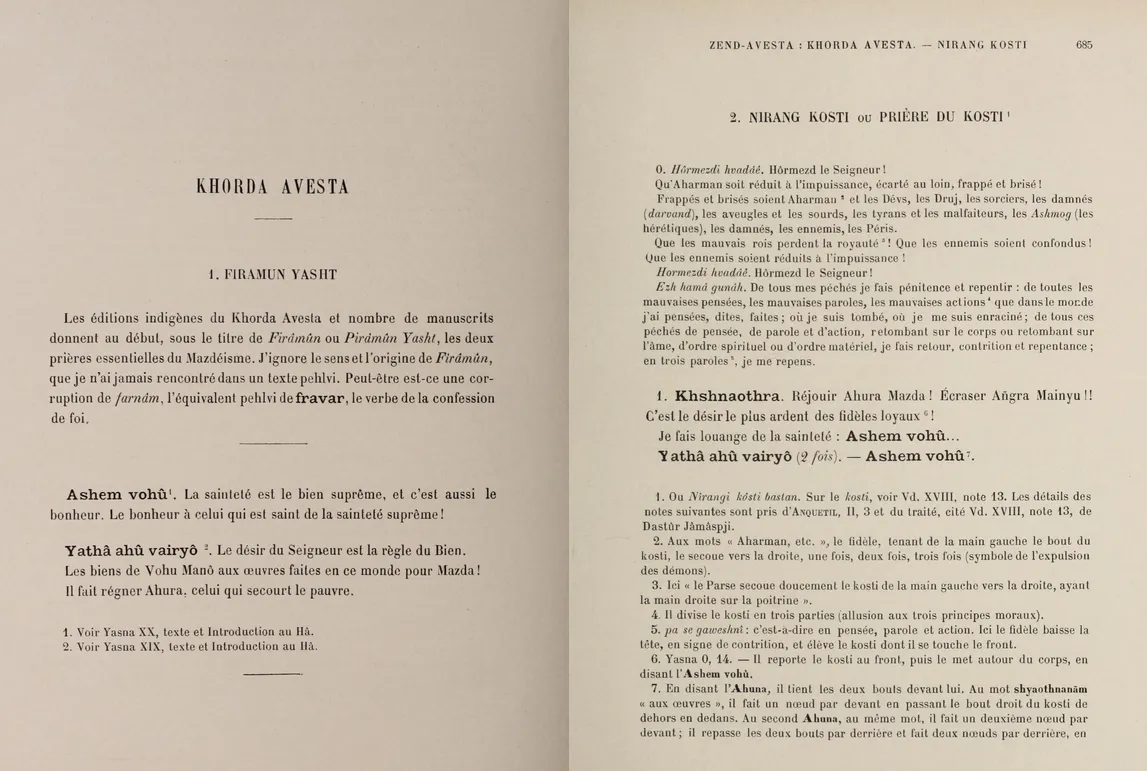
The short Geh changes as well. Karanjia notes that every Zoroastrian prayer has a Fravarane paragraph in which "the relevant 'short geh is recited'", and the avesta.org Khordeh Avesta marks that spot in the Fravarane with "(Here recite the appropriate Gah dedication)". So a Yasht or Nyash started after the change carries the new Geh's name in its Fravarane.
From the beginning of Avan Mah to the fifth Gatha day, Karanjia writes, Havan Geh is recited instead of Rapithwin in all prayers. For that period, see Second Havan (Biji Havan), and for the morning watch itself, Hawan Geh. All five Gehs are set out together in our guide to the five Gehs.
Practice varies between families and Agiaries; your family priest's guidance comes first.
Which other prayers change when the day Gehs end at sunset?
The prayers that follow the Geh prayer depend on whether it is day or night. Karanjia gives the obligatory (Farajyat) prayers for each Geh as below.
| Geh | After the Kasti, Sarosh Baj and the Geh prayer |
|---|---|
| Havan, Rapithwin (or second Havan) and Uziran | Khorshed Nyash, Meher Nyash, Doa Vispa Humata, Doa Nam Setayashne, Char Disha no Namaskar, 101 names of God, Doa Tandarosti |
| Aiwisruthrem | Sarosh Yasht Vadi with Nirang, Doa Nam Setayashne, Diva or Cherag no Namaskar, 101 names of God, Doa Tandarosti |
| Ushahin | Sarosh Yasht Hadokht with Nirang, Doa Nam Setayashne, Diva or Cherag no Namaskar, 101 names of God, Doa Tandarosti |
Modi records the same day-and-night split for a priest's obligatory prayers. The Khurshid and Meher Nyayishes are said in the first three Gahs, and in the two night Gahs they "are replaced by Sraosh Yasht (Yaçna LVII) and Sraosh Hadokht".
Karanjia also ties the Khorshed and Meher Nyash to the sun. He writes that they are recited only in the three day Gehs of Havan, Rapithwin and Uziran, and that they have to be recited in sunlight. So once sunset has passed, his scheme has no place for them until the next Havan Geh.
Practice varies between families and Agiaries; your family priest's guidance comes first.
How long should I wait after the Geh changes before praying?
We found no priestly or institutional source that sets a waiting period after a daytime change. Ask your family priest what your Agiary follows.
The evening and night turns have firmer guidance.
- Aiwisruthrem. Karanjia gives sunset as the start of Aiwisruthrem but adds that traditionally it "started after it was completely dark". The Bundahishn, in E.W. West's translation, likewise starts the Aiwisruthrem period when the stars have appeared in the sky.
- Ushahin. Karanjia writes that Farajyat prayers said in Ushahin must come "at least an hour after the geh starts". His page on the five Gehs gives the reason: in the first hour of Ushahin "evil forces are most powerful", while the later part of the Geh is the best time for prayer.
Clock times for Geh boundaries change through the year with sunrise and sunset, and any fixed time you see applies only to the place its author names. For how each start time is worked out, see how Geh start times are calculated from sunrise and sunset.
Practice varies between families and Agiaries; your family priest's guidance comes first.
Can I pray just after midnight, when Ushahin begins?
Karanjia doesn't forbid Ushahin prayers, but he advises against the first hour of the Geh, when "evil forces are most powerful", and names the later part of Ushahin as the best time for prayer. If the Farajyat prayers are done in Ushahin, he writes, they should begin at least an hour after the Geh starts. Writing in Parsi Times on 1 November 2025, Noshir H. Dadrawala also describes the hours after midnight as traditionally believed to be the peak time of dark forces.
Practice varies between families and Agiaries; your family priest's guidance comes first.
Should I do a fresh Kusti when the Geh changes?
Karanjia includes the turn of the Geh among the regular times for the Kusti, alongside the morning, after a bath and before going to bed. His prayers page also starts every set of Geh prayers with the Kasti.
Priests do the same in the fire temple. Modi writes that the priest who tends an Atash Behram "performs the Kusti-padyab at the commencement of each new Gah" before reciting his prayers and feeding the fire. For the full list of times the Kusti is retied through the day, see Geh times for doing Kusti.
Practice varies between families and Agiaries; your family priest's guidance comes first.
What happens in the fire temple when the Geh changes?
The sacred fire is fed. Karanjia explains that for an Atash Behram and an Atash Adaran the Boi is done five times daily, "after the turn of every Gah", while a Dadgah fire needs the Boi at least once a day. Modi likewise writes that the Bui (Boi) is performed at the commencement of each of the five Gahs. In the Boi, Karanjia writes, the priest recites the Atash Nyash, feeds the fire with dried wood and sandalwood, and rings the bells at the words dushmata, duzukhta and duzvarshta.
People in the hall often ask whether they must stand when the bells ring. Karanjia's answer is no. He writes that there is "no religious requirement to stand" while the Boi bells ring, since they are meant to drive away evil and not to honour a divine being. For the rituals tied to particular Gehs, see ceremonies by Geh.
Practice varies between families and Agiaries; your family priest's guidance comes first.
Frequently asked questions
Which Geh prayer should I recite if the Geh has just changed?
Recite the prayer of the Geh you are now in. Er. Dr. Ramiyar Karanjia sets the order as the Kasti, the Sarosh Baj and then the larger Geh prayer that fits the time of prayer. The short Geh inside the Fravarane paragraph also changes, so any Yasht or Nyash you begin carries the new Geh's name.
How many minutes should I wait after the Geh changes?
We found no priestly or institutional source that fixes a waiting period after a daytime Geh change, so ask your family priest what your Agiary follows. The night Gehs have firmer guidance. Karanjia writes that Aiwisruthrem traditionally began once it was completely dark, and that obligatory prayers in Ushahin should begin at least an hour after it starts.
Can I recite Khorshed and Meher Nyash after sunset?
Not in Karanjia's scheme. He writes that the Khorshed and Meher Nyash are recited only during the three day Gehs of Havan, Rapithwin and Uziran, and that they have to be recited in sunlight. Modi's 1922 account agrees that at night these two Nyaish are replaced by the Sarosh Yasht and the Sarosh Hadokht.
Do I need to do Kusti again at the change of Geh?
Karanjia lists the turn of each Geh among the regular times for doing the Kusti, and every set of Geh prayers he gives begins with it. Modi records that the priest tending an Atash Behram performs the Kusti-padyab at the start of each new Gah, before his prayers and the feeding of the fire.
Do I have to stand when the Boi bells ring in the Agiary?
No, according to Er. Dr. Ramiyar Karanjia, who writes that there is no religious requirement to stand while the bells ring during the Boi. The bells are struck at the words dushmata, duzukhta and duzvarshta to drive away evil, not to show respect to a divine being. Your family's custom may differ.
Is it all right to pray right after midnight?
Er. Dr. Ramiyar Karanjia advises against praying in the first hour of Ushahin Geh, when he says evil forces are most powerful, and names the later part of the Geh as the best time for prayer. Obligatory prayers said in Ushahin should begin at least an hour after it starts. Ask your family priest what your family follows.