PalV's Kasti
On this page
The Kusti is retied on waking and again at the start of each Geh, and also at times set by daily life: after using the toilet, after a bath, before prayers and before going to the fire temple. Encyclopaedia Iranica's entry on the Kusti, by Jamsheed K. Choksy and Firoze M. P. Kotwal, says it is untied and retied "upon awakening each day" and at the beginning of the other watches, or gāh, of the day. Er. Dr. Ramiyar Karanjia lists "the turn of each geh" among the regular Kusti times. The Geh also decides which way you face, because the Kusti is done towards the sun: east in the morning, west in the late afternoon, and towards a lamp or other light after dark. The clock time of a Geh change isn't fixed. Two of the five boundaries move every day with sunrise and sunset.
શહેરેવર રોજ
Shehrevar Roj, Tir Mah · 1396 Y.Z.
When in the day is the Kusti untied and retied?
Three sources give lists of Kusti occasions. They overlap but aren't identical, so we set them side by side.
| Source | Occasions named |
|---|---|
| Encyclopaedia Iranica, "Kustīg" (Choksy and Kotwal, 2014) | On waking each day; at the beginning of each of the other Gehs; before religious acts such as worship at a fire temple; after sexual intercourse, urination and defecation |
| Er. Dr. Ramiyar Karanjia, QA about Navjot, Sadra and Kasti | In the morning; at the turn of each Geh; after a bath; before going to bed; after coming home from outside; after the toilet; after visiting a Dakhma or cemetery; before going to a fire temple; before daily prayers; before attending rituals |
| J. J. Modi, The Religious Ceremonies and Customs of the Parsees (1922) | Immediately after leaving bed; every time after answering a call of nature; before saying prayers; at the time of bathing; before meals |
Karanjia sorts his list by purpose. The Kusti done in the morning, at the turn of each Geh, after a bath and before bed "inspires and energises us", he writes. The Kusti after coming in from outside, after the toilet and before the fire temple, prayers or rituals is "for the purpose of cleansing".
Modi adds an observation from his own time. A Parsi of the 1920s, he says, sometimes skipped the Kusti on waking and before meals, but generally did it after the toilet, before prayers and at bathing. Only Modi names meals, and only Karanjia names bedtime.
Practice varies between families and Agiaries; your family priest's guidance comes first.
Why is the Kusti retied when the Geh changes?
Two reasons come out of the sources. First, the change of Geh is itself listed as a Kusti time, by Iranica and by Karanjia. Second, every set of Geh prayers opens with the Kusti. Karanjia writes that prayers "always start with the Kasti ritual", with the Srosh Baj next, after which the larger Geh prayer for that time of day is recited.
Priests kept the same rule in the fire temple. Modi, writing in 1922, describes the priest who tends the fire in an Atash Behram as performing the Kusti-padyab at the start of each new Gah, before he recites his obligatory prayers.
Where the Kusti sits in the full order of daily prayers is covered in where the Geh prayer fits in daily prayers, and what those prayers say in translation is in the Gah prayers in English.
Practice varies between families and Agiaries; your family priest's guidance comes first.
How do I know when the Geh has turned?
Two of the five boundaries follow the sun, so their clock time changes through the year and from town to town. Havan begins at sunrise and Aiwisruthrem at sunset, whatever the time. The other three boundaries are fixed by the clock, and for India two named sources give the same figures in Indian Standard Time.
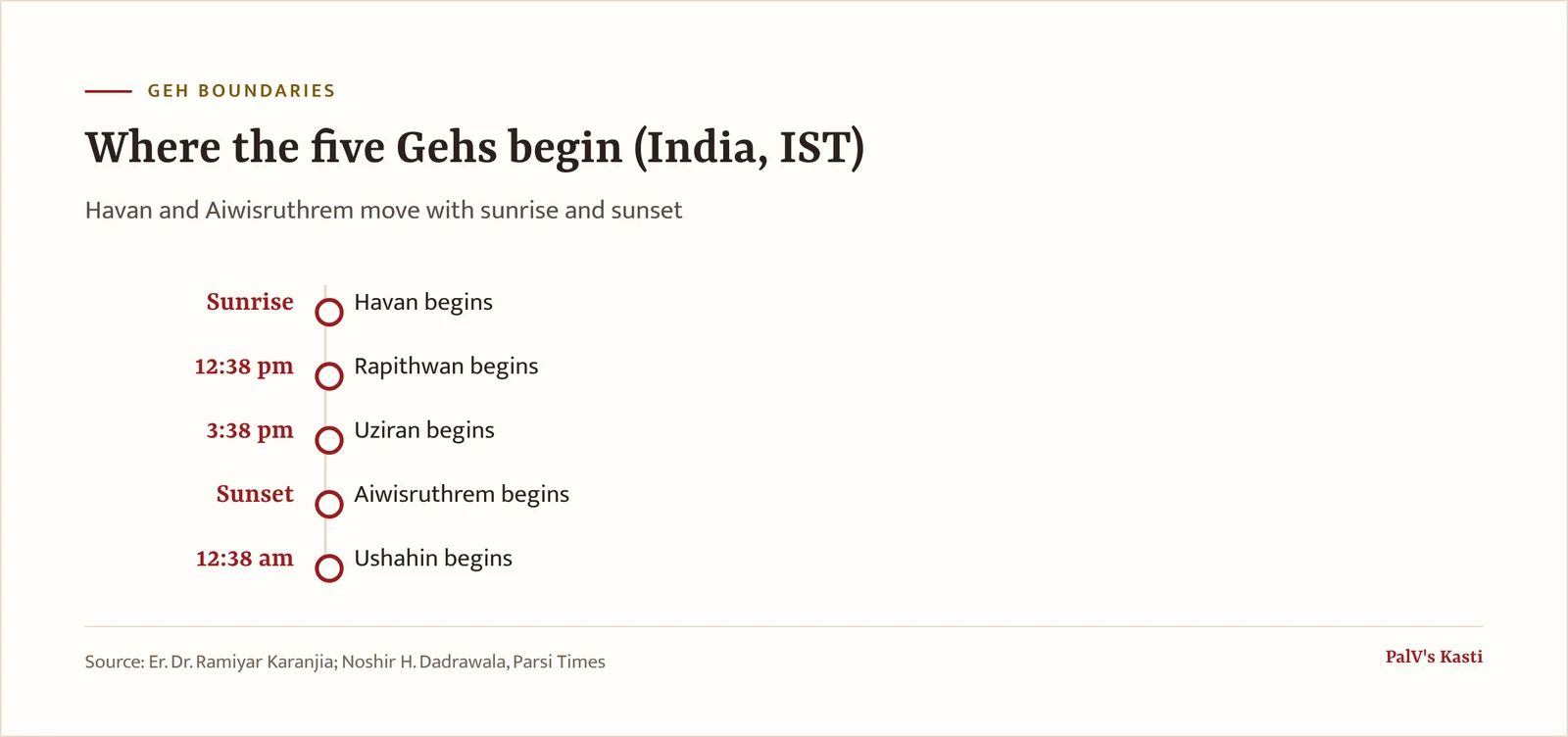

| Geh | Begins |
|---|---|
| Havan | Sunrise (changes daily) |
| Rapithwan | 12:00 noon, given for India as 12:38 pm IST |
| Uziran | 3:00 pm, given for India as 3:38 pm IST |
| Aiwisruthrem | Sunset (changes daily) |
| Ushahin | Midnight, given for India as 12:38 am IST |
The IST figures are Er. Dr. Ramiyar Karanjia's, in his article on the five Gehs. He explains the 38 minutes by saying that Indian Standard Time, not local time, is the clock being used. Noshir H. Dadrawala gives the same IST figures in a Parsi Times answer of 29 April 2023. Outside India, ask your priest which clock your community follows. For the sunrise and sunset boundaries, use the times for your own town on that day.
The full method is in our guide to how Geh start times are calculated from sunrise and sunset, and the five periods themselves are introduced in the five Gehs.
Which direction should I face for the Kusti in each Geh?
The Kusti is done facing the sun, or a light once the sun has set, so the direction moves with the Geh. Karanjia gives the reason: Zoroastrians "are enjoined to face the sun while doing the Kasti", which is why the direction differs from one Geh to the next. An older account says the same. The Kusti procedure of Dastur Jamaspji Minochiharji Jamasp-Asa-na, recorded by E. W. West in the Sacred Books of the East, has the person face the sun in daytime, and at night a lamp or the moon. Modi cites the Dadistan-i Dini for the custom of turning towards light at the Kusti, which he says goes back to "times immemorial".
| Geh | Karanjia | Modi, 1922 | Iranica |
|---|---|---|---|
| Havan (morning) | East | Face the sun; indoors when the sun isn't visible, east up to 12 noon | East, from dawn to midday |
| Rapithwan (noon) | South or west | Face the sun; indoors when the sun isn't visible, west from 12 noon | West, from midday |
| Uziran (late afternoon) | West | Face the sun; indoors when the sun isn't visible, west until nightfall | West, until sunset |
| Aiwisruthrem and Ushahin (night) | Any direction except north, towards a fire, diva or electric lamp | A lamp or the moon, or the stars if there is neither | An oil lamp, fire, the moon or the stars |
The noon Geh is where the sources part. Karanjia says you can face either south or west in Rapithwan, and notes that priests from Udvada prefer south while priests from Navsari face west. West's record of Dastur Jamaspji's account also gives south at midday, "even when the sun is northerly". Iranica gives west from midday until sunset. Modi's general rule is to face the sun, with west from noon for someone indoors who can't see it.
On one point the priestly sources agree: don't face north. Karanjia writes that in Avestan texts the north is the side where Angra Mainyu, the evil spirit, resides, and that Zoroastrians don't face north for prayers or rituals. Noshir H. Dadrawala, writing in Parsi Times in 2018, says Zoroastrians are "precluded from praying facing the North".
Practice varies between families and Agiaries; your family priest's guidance comes first.
Which way do I face for the Kusti after sunset?
After sunset you face a light rather than the sun. Karanjia says to face a fire, diva or electric lamp, in any direction except north. Modi names a lamp or the moon, or the stars when there's neither. Iranica lists an oil lamp, fire, the moon or the stars.
With no light at all, two sources point south. Iranica says facing south is regarded as an appropriate qebla, and Dastur Jamaspji's account in West's translation says that when there is no light the person should face the south. Karanjia also lists bedtime as a Kusti time, so the night Kusti isn't only for those who pray in Aiwisruthrem or Ushahin.
Practice varies between families and Agiaries; your family priest's guidance comes first.
For questions about praying across a boundary, such as a Geh that turns while you're mid-prayer, see what to do when the Geh changes.
Frequently asked questions
How many times a day is the Kusti retied?
No single number is fixed, because the occasions depend on your day. Encyclopaedia Iranica names waking and the start of each Geh, plus times such as after the toilet and before visiting a fire temple. Er. Dr. Ramiyar Karanjia adds after a bath and before bed. Modi's 1922 list of five occasions includes before meals.
Should I retie my Kusti when the Geh changes?
Yes, according to both Encyclopaedia Iranica and Er. Dr. Ramiyar Karanjia. Iranica says the Kusti is retied at the beginning of each watch, or Geh, of the day, and Karanjia lists the turn of each Geh among the regular Kusti times. Modi records that priests tending an Atash Behram did the Kusti-padyab at each new Gah.
What time does each Geh start in India?
Havan starts at sunrise and Aiwisruthrem at sunset, so both move daily. Er. Dr. Ramiyar Karanjia and Noshir H. Dadrawala give the clock-fixed boundaries for India in IST: Rapithwan at 12:38 pm, Uziran at 3:38 pm and Ushahin at 12:38 am. Check sunrise and sunset for your own town.
Which direction do I face for the Kusti at noon?
The sources differ for the Rapithwan Geh. Karanjia says south or west, noting that Udvada priests prefer south and Navsari priests west. Dastur Jamaspji's account in West's translation gives south at midday. Encyclopaedia Iranica gives west from midday, and Modi says to face the sun, or west from noon when indoors.
Do I need to do the Kusti before every Geh prayer?
Er. Dr. Ramiyar Karanjia writes that prayers always start with the Kusti, followed by the Srosh Baj and then the larger Geh prayer for that time. Modi's 1922 list and Encyclopaedia Iranica also name the Kusti before prayers or other religious acts. So each time you sit down to pray a Geh, the Kusti comes first.