PalV's Kasti
On this page
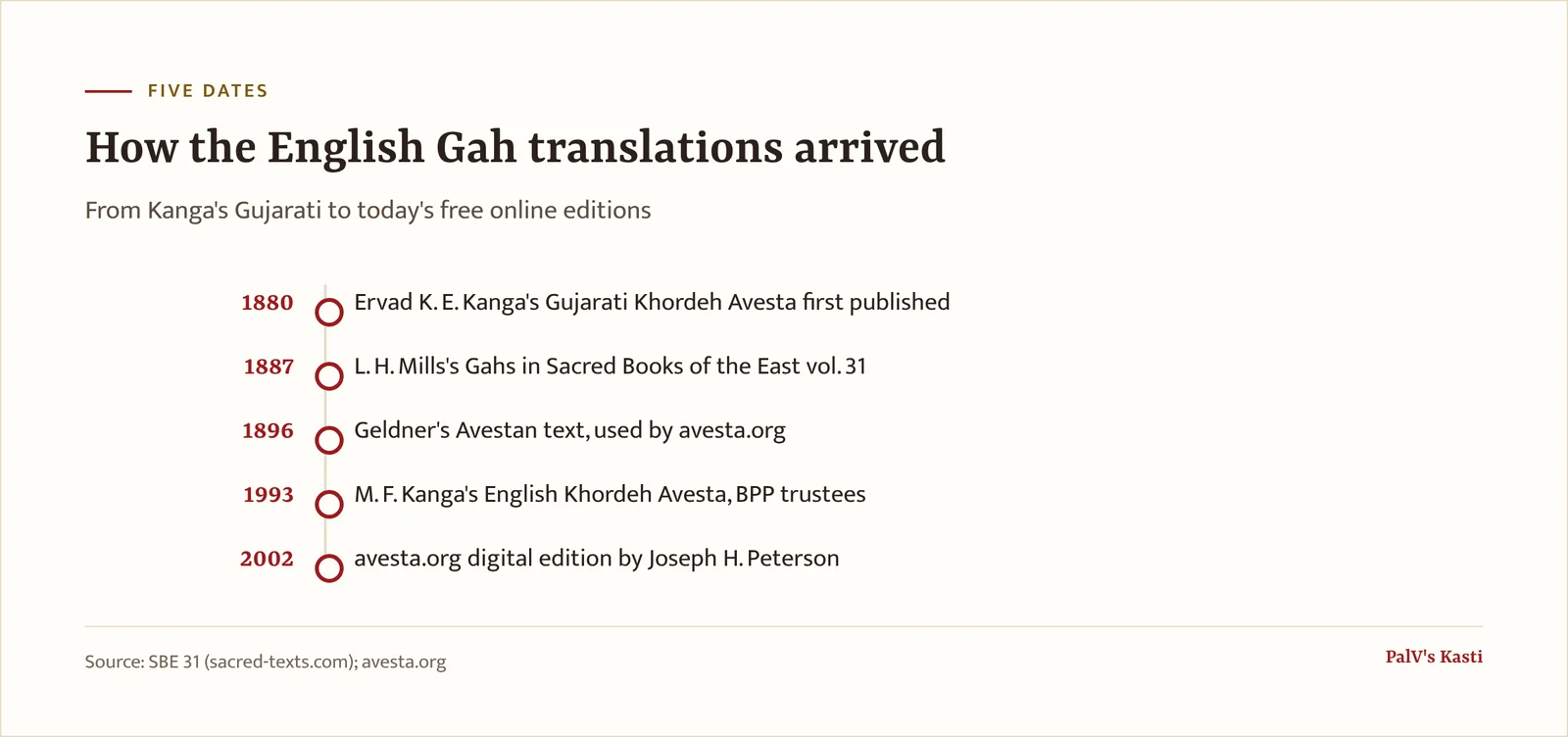
Three English translations of all five Gah prayers can be read free online. L. H. Mills translated them in 1887, in volume 31 of the Sacred Books of the East, and that text is on sacred-texts.com. The avesta.org digital edition prints the Avestan of each Gah with an English translation credited to James Darmesteter. And Prof. Ervad Maneck Furdoonji Kanga's English Khordeh Avesta, made from Ervad Kavasji Edulji Kanga's Gujarati Khordeh Avesta, was published by the trustees of the Bombay Parsi Punchayet in 1993 and is now on avesta.org too. The three don't word the same lines alike, as the side-by-side table below shows, and that changes how the prayer reads in English.
શહેરેવર રોજ
Shehrevar Roj, Tir Mah · 1396 Y.Z.
Which English translations of the Gah prayers exist?
These are the three we opened and checked, with what each one gives you.

| Translation | Year | Made from | Where to read it | What you get |
|---|---|---|---|---|
| L. H. Mills, The Zend-Avesta Part III (Sacred Books of the East, vol. 31), Oxford University Press | 1887 | The texts of Westergaard, which Mills says he followed "as to extent of matter" | sacred-texts.com | English only, with scholarly footnotes |
| avesta.org Khorda Avesta, digital edition by Joseph H. Peterson | 2002 edition | Karl F. Geldner's 1896 Avestan text, with the English credited to Darmesteter (Sacred Books of the East, American Edition, 1898) | avesta.org | Avestan in Roman letters and English for all five Gahs |
| Prof. Ervad Maneck Furdoonji Kanga, Khordeh Avesta in English | 1993, corrected 2014 | Ervad Kavasji Edulji Kanga's Gujarati Khordeh-Avesta-Bā-Māyeni, first published in 1880 | avesta.org (PDF) | Avestan in Roman letters, English keyed to it word by word, and explanatory notes |
The avesta.org page credits its English to Darmesteter, but it isn't Mills's wording. Mills's Havan Gah has "I confess myself a Mazda-worshipper", the avesta.org Hawan Gah has "I profess myself a Mazda-worshipper", and Kanga gives "I profess myself (to be) a worshipper of Ahura Mazda". Treat them as three separate renderings.
What does Mills's 1887 translation say?
Mills's is the scholar's text. His Havan Gah opens with the profession of faith, "I confess myself a Mazda-worshipper, of Zarathustra's order", and he uses "we sacrifice to" for the worship of each being, as in "we sacrifice to Sâvanghi and Vîsya".
His footnotes explain some of the companion beings. In the Aiwisruthrem Gah he glosses Aibigaya as "Or, 'that furthers life.'", Frâdat-vîspãm-hugyâiti as "The genius presiding over all that furthers happiness", and Zarathustrôtema as "The genius presiding over the highest office in a province". For each of the other four Gahs he adds a note that it is recited every day at the hour of its Geh.
One thing will puzzle a first-time reader. Mills doesn't reprint the passages that repeat from the Havan Gah. His later Gahs carry bare cross-references instead, such as "(See Gâh I, 3, 4.)" in the Aiwisruthrem Gah and "(See Gâh I, 9, 10.)" in the Ushahin Gah. To read those Gahs in full, you turn back to Gâh I.
What does the avesta.org translation say?
The avesta.org edition is the one to open if you want the Avestan and the English on one screen. Every Gah begins "Propitiation to Ahura Mazda. Ashem Vohu...(3)." Where Mills writes "we sacrifice to", this version prefers "we worship", and its dedications run "for worship, adoration, propitiation and praise". Its Rapithwin Gah, for example, names "Fradat-Fshu and Zangtuma, Ashavan, the master(s) of Asha".
It also translates the closing Ahmai raeshca, which begins "To him splendor and khwarenah; to him health of body".
What does Kanga's English Khordeh Avesta say?
This is the English form of a prayer book that, its 1993 foreword says, has stayed a standard work in the Parsi community for more than a century. The same foreword explains that the Bombay Parsi Punchayet trustees asked Prof. Ervad Maneck Furdoonji Kanga to render Ervad Kavasji Edulji Kanga's Gujarati Khordeh-Avesta-Bā-Māyeni into English. M. F. Kanga died in October 1988, before it was printed, and Ervad Ratanshah Rustomji Motafram, then head-master of the M. F. Cama Athornan Institute, proof-read it.
It reads differently from both scholarly versions, because it uses the names Parsis say aloud: Meher Yazata for Mithra, Ardibehesht, Khordād and Amardād. Its most useful habit is a sentence in each Gah that says what the time of day is for.
- Havan: the time when the work of Savanghi, "business of gaining profit", and of Visya, "lord of the clans", goes on.
- Rapithwan: the time of "giving rest or relief to beasts".
- Uzirin: the time when "it is time to rest men from the work".
- Ushahen: the time "propitious to ask for one's wishes to be fulfilled".
The Uzirin Gah also gets a full explanation of the priestly offices it names. The Ātarvakhsha, for instance, is the priest "whose function is to keep the fire burning". And the footnotes often set its reading beside those of Spiegel, Harlez, Mills and Darmesteter.
Like Mills, Kanga saves space on the repeated passages, with a note in each later Gah pointing back to the Havan Gāh for paragraphs 3 and 4. At the end of each Gah, the closing prayers (Ahmāi raeshcha, Hazanghrem, Jasa me avanghe Mazda, Kerfeh Mozd) are named there without a translation.
How do the three translations render the same lines?
Setting one passage side by side shows the difference better than any description. Here are the Mithra line from the Havan Gah and the waters line from the Uziran Gah.
| Line | Mills, 1887 | avesta.org | Kanga, 1993 |
|---|---|---|---|
| Mithra in the Havan Gah | "of the myriad eyes, the Yazad of the spoken name" | "ten thousand eyes, a Yazata who is invoked by name" | "ten thousand eyes (and) of the spoken name" |
| The waters in the Uziran Gah | "that lofty Ahura, Apãm-napât" | "the lofty Ahura Apam Napat, and the waters made by Mazda" | Opens with "the (very source of) water", and later translates the name as "the Navel of the Waters" |
Mills and Kanga both keep "the spoken name", while avesta.org turns it into a Yazata "invoked by name". When the epithet comes back in the next verse, Kanga renders it "of the renowned name". With the waters, Mills and avesta.org keep the Avestan name Apam Napat, while Kanga explains it in English. Who Mithra, Apam Napat and the other beings are is explained in the Yazatas of the five Gehs, and what each Geh's own name means is in Geh names explained.
Which English translation should you read?
Our view, based on what each one contains: if you pray from a Gujarati Kanga Khordeh Avesta, read M. F. Kanga's English, because it follows that book and numbers every Avestan word against its English. If you want the Avestan and a plain English side by side on a phone, use the avesta.org page. Read Mills when you want notes on the obscure names, and keep his cross-references to Gâh I in mind.
For what each of the five texts is and how a Gah prayer is laid out, see the five Gah prayers in the Khordeh Avesta. For the Gehs themselves and their timings, which move with sunrise and sunset, start with the five Gehs, and for when the Kusti is retied through the day, see Geh times for doing Kusti.
Practice varies between families and Agiaries; your family priest's guidance comes first.
Frequently asked questions
Is there an English translation of the Havan Gah?
Yes. Three can be read free online: L. H. Mills's 1887 translation in Sacred Books of the East volume 31 on sacred-texts.com, the avesta.org edition with Avestan and English credited to Darmesteter, and Prof. Ervad Maneck Furdoonji Kanga's English Khordeh Avesta, first published in 1993 and now hosted on avesta.org.
Who translated the Gah prayers into English?
L. H. Mills translated all five Gahs in 1887 for the Sacred Books of the East. The avesta.org digital edition, by Joseph H. Peterson, credits its English to James Darmesteter. Prof. Ervad Maneck Furdoonji Kanga rendered Ervad Kavasji Edulji Kanga's Gujarati Khordeh Avesta into English, published by the Bombay Parsi Punchayet trustees in 1993.
Which English Gah translation follows Kanga's Khordeh Avesta?
Prof. Ervad Maneck Furdoonji Kanga's English Khordeh Avesta does. It was made from Ervad Kavasji Edulji Kanga's Gujarati Khordeh-Avesta-Bā-Māyeni, first published in 1880. It uses familiar Parsi forms such as Meher Yazata and Ardibehesht, and says what each time of day is for, such as rest for beasts at Rapithwan.
Why do the English translations of the Gahs read so differently?
They were made from different starting points for different readers. Mills followed Westergaard's texts for a scholarly series and writes "we sacrifice to". The avesta.org version prefers "we worship". Kanga's English follows a Gujarati prayer book, uses Parsi names and explains each Gah's time, so Mithra becomes Meher Yazata.
Where can I read the Gah prayers in Avestan and English together?
Two free editions print both. The avesta.org Khorda Avesta page gives all five Gahs, Havan to Ushahin, with Avestan in Roman letters from Geldner's 1896 edition and an English translation. Prof. Ervad Maneck Furdoonji Kanga's English Khordeh Avesta, also on avesta.org, numbers each Avestan word against its English. Mills gives English only.