PalV's Kasti

On this page
The Khordeh Avesta, the Zoroastrian book of daily prayer, holds two kinds of Gah prayer for each of the five Gehs of the day. The first is a short dedication of a few lines that is never said on its own. It's slotted into other prayers, such as the Srosh Baj and the Fravarane paragraph of the Nyaishes and Yashts, according to the Geh you're in. The second is a longer prayer that carries the Geh's name: Havan Gah, Rapithwin Gah, Uziran Gah, Aiwisruthrem Gah and Ushahin Gah. All five long texts open and close with the same passages. The middle is where they part ways. Havan Gah honours Mithra and Raman Khwastra, Rapithwin Gah the five Gathas, Uziran Gah Apam Napat, the waters and the priestly offices, Aiwisruthrem Gah the Fravashis and the offices of society, and Ushahin Gah the dawn and Sraosha.
We quote the prayer text from one edition only: the Khordeh Avesta on avesta.org, which prints Karl F. Geldner's 1896 Avestan text with James Darmesteter's English translation. For the teaching around the prayers we rely on Ervad Ramiyar Karanjia's published writing and on FEZANA's lesson plan for grades 6 to 8.
શહેરેવર રોજ
Shehrevar Roj, Tir Mah · 1396 Y.Z.
What is the short Gah dedication?
The short Gah dedication is a formula of a few lines addressed to the Geh in which you're praying. The avesta.org edition prints the five dedications together and adds a plain note: "These five dedications are not recited independently." Depending on the time of day, it says, one of the five is recited where other prayers indicate.
You can see this inside the Srosh Baj. After its opening lines, the same edition places the instruction "(Here recite the appropriate Gah dedication.)" Karanjia's site describes the same thing as a short three-line prayer said within the Fravarane in every Nyaish and Yasht, and his page on the five Gehs repeats that a short invocation to the Geh is recited in the Fravarane paragraph of every prayer.
Here is the Havan dedication in the avesta.org edition, the opening Avestan line first and then the English:
hâvanêe ashaone ashahe rathwe ýasnâica vahmâica xshnaothrâica frasastayaêca
"To Hawan, Ashavan, the master of Asha, for worship, adoration, propitiation and praise. To Savanghi and Visya, Ashavan, the master(s) of Asha, for worship, adoration, propitiation and praise."
The other four follow the same pattern. Each names its Geh, then a pair of companion beings.
| Geh | Companion pair named in the dedication (avesta.org spelling) |
|---|---|
| Havan | Savanghi and Visya |
| Rapithwin | Fradat-Fshu and Zangtuma |
| Uziran | Fradat-Vira and Dakhyuma |
| Aiwisruthrem | Fradat-vispam-hujyaiti and Zarathushtrotema |
| Ushahin | Berejya and Nmanya |
Spellings differ between editions. Karanjia's site writes Sāvanghi, Frādat-fshu and Frādat-vira, so don't be thrown if your Khordeh Avesta looks different. Who these companions are, and what each one guards, is the subject of our article on the Yazatas of the five Gehs.
What is the full Gah prayer for each Geh?
The full Gah prayer is a separate text, one for each Geh, recited in that Geh. Karanjia's site counts five special prayers in the Khordeh Avesta, one for each Geh. FEZANA's lesson plan lists "the five Gāhs" among the book's contents and describes them as prayers dedicated to the five watches of the day, praising the five beings in charge of those periods.
Karanjia's site places the full Gah after the Srosh Baj. His 2018 column says the larger Geh prayers come after the Sarosh Baj, before you begin any other prayer. The full sequence, Kusti included, is set out in where the Geh prayer fits in daily prayers.
| Gah prayer | Period in the avesta.org heading | Other spellings you'll meet |
|---|---|---|
| Havan Gah | Sunrise to midday | Hawan, Hāvan |
| Rapithwin Gah | Midday to mid-afternoon | Rapithwan |
| Uziran Gah | Mid-afternoon to sunset | Uzerin, Uzirin |
| Aiwisruthrem Gah | Sunset to midnight | Aiwisruthrima |
| Ushahin Gah | Midnight to dawn | Ushahen |
Three of these boundaries are sunrise, sunset and dawn, so the Geh you're in shifts with the season and with where you live. Karanjia's site gives 12:00 noon and 3:00 pm for the two daytime changes, and notes that in India, which keeps Indian Standard Time rather than local time, they fall at 12:38 pm and 3:38 pm. For today's timings, check our Parsi calendar. The seasonal rule about the noon Geh is covered on our main page on the five Gehs.
How is a full Gah prayer put together?
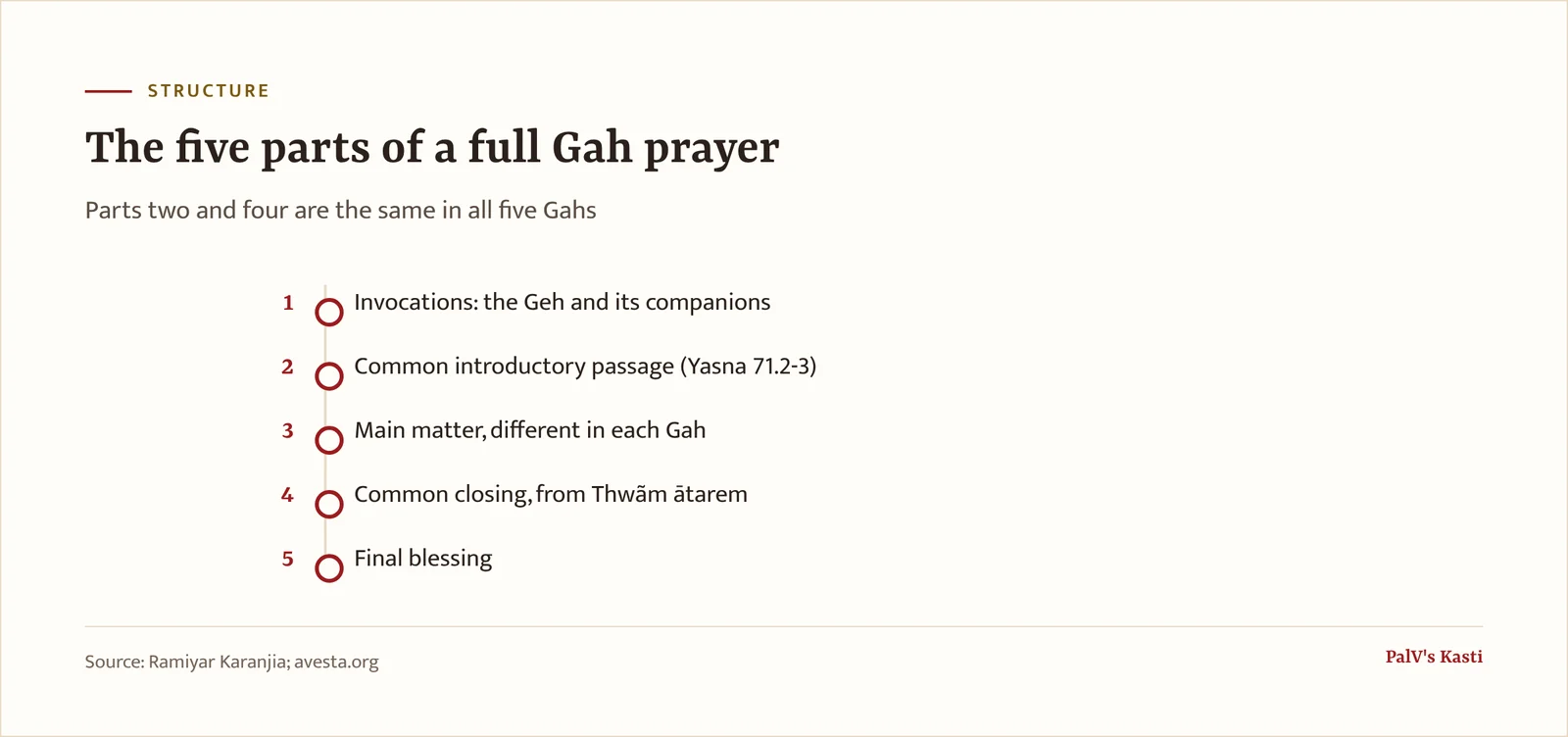
Karanjia's site divides the larger Geh prayer into five parts: invocations, an introductory extollation common to all five, the main matter, a concluding extollation that's also common, and a final blessing. The avesta.org texts bear this out.

The opening
Every one of the five begins with the same line: "Propitiation to Ahura Mazda. Ashem Vohu...(3)." Then comes "I profess myself a Mazda-worshipper, a follower of Zarathushtra", followed by the dedication to the Geh and its companion pair. The next paragraph is the invocation proper, where the Geh's presiding beings are named. In Havan Gah that's Mithra "of wide pastures, with a thousand ears, ten thousand eyes" and Raman Khwastra.
The shared middle frame
According to Karanjia's site, the common introductory passage runs from the words Ahurem mazdam to ratufritim yazamaide, and these two paragraphs come from Yasna 71.2-3. In the avesta.org edition they stand as paragraphs 3 and 4 of each Gah, opening "We worship Ahura Mazda, Ashavan, the master of Asha" and going on to the Fravashi of Zarathushtra, the Amesha Spentas and "the good, powerful, holy Fravashis".
The concluding passage
The common closing begins with the words Thwãm ātarem, an address to Fire, according to Karanjia's site. The avesta.org English renders it "We worship you, O Atar, son of Ahura Mazda", and the paragraph goes on to the Baresman, Apam Napat, Nairyosangha and the Fravashis of the Ashavan.
The final blessing
In the avesta.org edition, Hawan Gah ends on a run of short prayers: Yatha Ahu Vairyo twice, the blessing that begins "To him splendor and khwarenah", "A thousand remedies, ten thousand remedies" three times and "Come to my help, O Mazda" three times. The text finishes on Ashem Vohu. Ushahin Gah closes with the same run.
How do the five Gah texts differ from one another?
They differ in the main matter, the part between the shared frames. Here's whom each one addresses in the avesta.org edition, with Karanjia's summary of the main matter alongside.

- Havan Gah worships the Airyema-ishyo prayer, then Mithra of wide pastures and Raman Khwastra. Karanjia's list for its main matter also includes Khordad, Amardad and the Yasna Haptanghaiti.
- Rapithwin Gah opens with Asha Vahishta and Atar, the son of Ahura Mazda, then worships each of the five Gathas by name, from the Ahunawad to the Wahishtoisht. Karanjia sums it up as the five Gathas, Manthra Spenta and the Amesha Spentas.
- Uziran Gah is addressed to "the lofty Ahura Apam Napat" and the waters. It names eight priestly offices, from the Zaotar to the Sraoshavarez, and then "the stars and the Moon and the Sun". Karanjia's site lists "8 Priestly offices, Luminaries".
- Aiwisruthrem Gah turns first to the Fravashis of the Ashavans. Later it names the Athravan, the warrior and the cattle farmer, then homes, villages, provinces and countries with their lords, and "the youth of good thought, good words, good deeds".
- Ushahin Gah is addressed to Sraosha, with Rashnu and Arshtad. Its main paragraph worships Ushah, the dawn, then Ahura Mazda, Vohu Mano, Asha Vahishta, Khshathra Vairya and Spenta Armaiti, which Karanjia's site sums up as the first five Ameshaspands. There's more on this watch in our post on Ushahin Geh.
Karanjia's site also pairs each Geh with an associated divinity: Meher Yazad for Havan, Ardibahesht for Rapithwan, Berez Yazad for Uziran, the Asho Farohars for Aiwisruthrem and Sarosh Yazad for Ushahen.
If you'd like to read the five texts in English before you learn them, our guide to the Gah prayers in English compares the published translations. For the rituals that are tied to particular Gehs, see which ceremonies belong to which Geh, and for the wider set of prayers said through the day, our page on Geh prayers.
Practice varies between families and Agiaries; your family priest's guidance comes first.
Frequently asked questions
What is a Gah prayer?
A Gah prayer is a prayer for one of the five Gehs, the divisions of the Zoroastrian day. The Khordeh Avesta has two kinds for each Geh: a short dedication that's inserted into other prayers, such as the Srosh Baj and the Fravarane, and a longer prayer named after the Geh itself, such as Havan Gah or Ushahin Gah.
How many Gah prayers are in the Khordeh Avesta?
There are five full Gah prayers, one each for Havan, Rapithwin, Uziran, Aiwisruthrem and Ushahin. Each Geh also has its own short dedication, so the book holds five dedications as well. The avesta.org edition prints the dedications together and notes that they aren't recited independently, only where another prayer calls for them.
Is the Gah dedication the same as the Gah prayer?
No. The dedication is a short formula naming the Geh and its two companion beings, recited inside another prayer where the text indicates. The full Gah prayer is a separate, longer text with its own opening, invocations, main matter and closing blessing. Karanjia's site says it's recited after the Srosh Baj, before any other prayer.
Are the five Gah prayers the same text?
They share a frame but not a body. In the avesta.org edition all five open with "Propitiation to Ahura Mazda. Ashem Vohu" and share the paragraphs that worship Ahura Mazda and the Fravashis, and the address to Atar. The middle differs: Havan honours Mithra, Rapithwin the five Gathas, and Ushahin the dawn and Sraosha.
Which Gah prayer is recited at night?
Two Gehs fall at night. The avesta.org edition heads Aiwisruthrem Gah "sunset to midnight" and Ushahin Gah "midnight to dawn". Aiwisruthrem Gah turns early to the Fravashis of the Ashavans, while Ushahin Gah is addressed to Sraosha, with Rashnu and Arshtad, and worships the dawn. Exact times move with sunset and sunrise.