PalV's Kasti
On this page
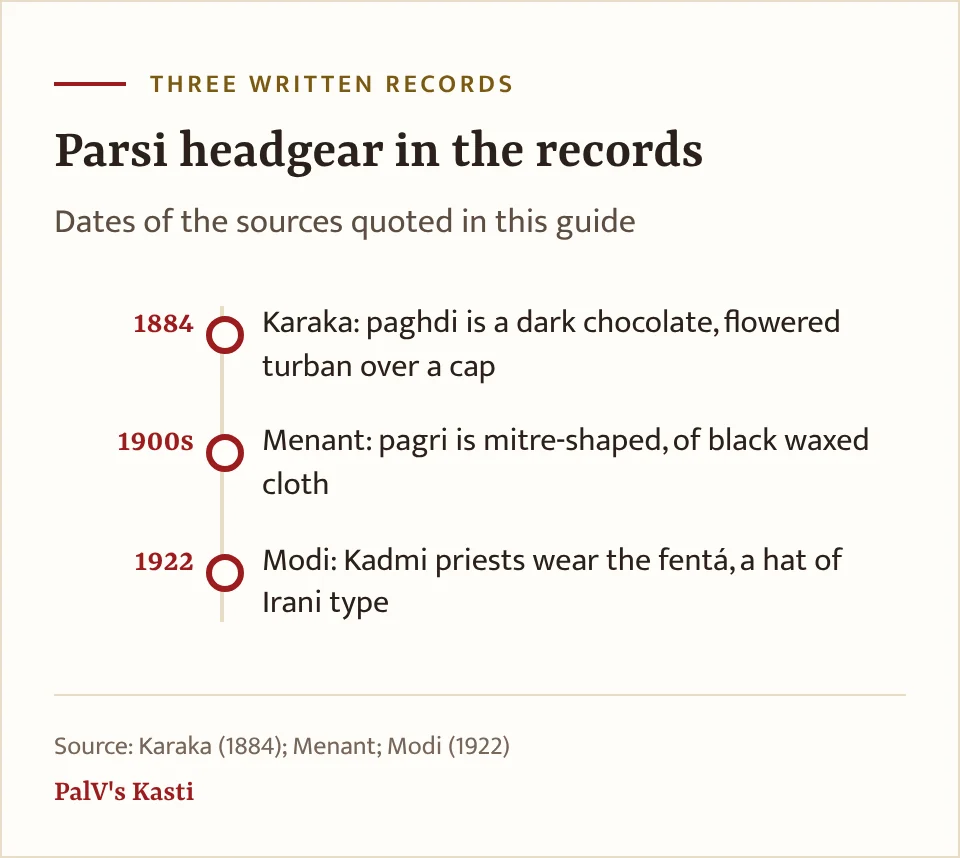
The Parsi pheta turns up in the records as the fentá and the fetah, and both are hats, not turbans. J.J. Modi wrote in 1922 that priests of the Kadmi sect "put on the fentá, which is a hat of an Irani type", while Shahanshahi priests wore white turbans. Singapore's Indian Heritage Centre describes "the Parsi fetah" as "a black hard hat". The paghdi is recorded separately, as an outdoor turban worn over a cap: dark chocolate and flowered in 1884, and mitre-shaped, of black waxed cloth or brown silk, in the early 1900s. The one occasion our sources record for the fentá is a Kadmi priest officiating at a ceremony in a fire temple. Neither record says whether fentá and fetah are the same headdress, and neither compares it with the paghdi, so we set each one out on its own below.
શહેરેવર રોજ
Shehrevar Roj, Tir Mah · 1396 Y.Z.
What is a Parsi pheta?
Two records describe a Parsi hat under names close to pheta, and each says something different. Modi (1922) called the fentá "a hat of an Irani type". The Indian Heritage Centre in Singapore, cataloguing a Dawoodi Bohra hat in its collection, set it against "the Parsi fetah, a black hard hat".
The spellings vary. Modi writes fentá. The Indian Heritage Centre writes fetah, and the only place it uses the word pheta is for the Bohra hat, which it calls "the traditional fetah or pheta". We use pheta in this guide as the everyday spelling. Neither source refers to the other, so we haven't merged them.
How is the pheta different from the paghdi?
No source we found compares the two directly. Modi records the fentá as a Kadmi priest's hat "of an Irani type", the Indian Heritage Centre records "the Parsi fetah" as "a black hard hat", and the paghdi is recorded as an outdoor turban worn over a cap. The table sets out what each record says, without blending them.

| Modi's fentá (1922) | Indian Heritage Centre's "Parsi fetah" | Paghdi (pagri) | |
|---|---|---|---|
| How it is described | "A hat of an Irani type" | "A black hard hat" | A turban (Karaka, 1884); shaped like a bishop's mitre (Menant) |
| Colour | Not given | Black | Generally dark chocolate, flowered (Karaka); mostly black, sometimes brown (Menant) |
| Recorded wearers | Kadmi priests | Not given | Parsi men going out |
| Origin given | Nothing beyond "of an Irani type" | Not given | Gujarat |
On origins, Modi gives nothing for the fentá beyond "of an Irani type". For the paghdi, Dosabhai Framji Karaka wrote in 1884 that the Parsis adopted their Indian costume under their agreement with the Hindu princes who received them, which is why the men's coat and turban look so much like the dress of the Hindus of Gujarat. Delphine Menant traced Bombay Parsi dress to the Banias of Surat. The full story is in our guide to the Parsi paghdi.
Who wore the Parsi pheta?
In our sources, the fentá belongs to the priests of the Kadmi sect. Modi's footnote is direct: "The priests of the Shahanshahi sect put on white turbans, those of the Kadmi sect put on the fentá".
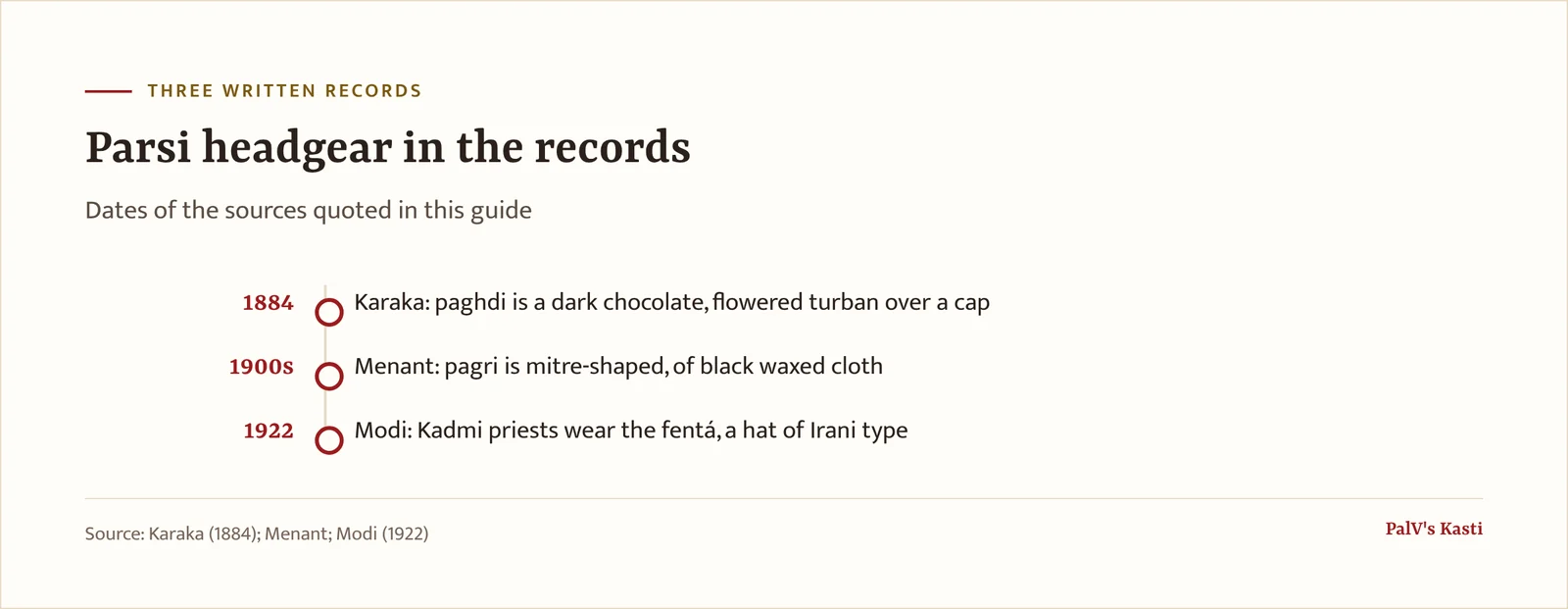
Karaka (1884) backs up the Shenshai half of that. He wrote that Shehenshai priests dressed like laymen, except that everything was white cotton, "including the turban". He also wrote that the two sects observe all Parsi festivals "in exactly the same manner, only on different dates", and that Kadmi lay dress didn't differ from Shehenshai dress. Only "a few priests" of the Kadmi sect wore "a peculiar garb of their own", copied from their late high priest Mulla Firoz, which he said looked much like "the dress of an Armenian or a Turk". Karaka doesn't describe a hat. Neither source links this garb to the fentá.
When is the pheta worn?
The occasion our sources record is ritual. Modi's footnote sits beside his illustration of the Bui ceremony in the sanctum of a fire temple, and he notes, "In this illustration it is a Kadmi priest who officiates". So a Kadmi priest performing a ceremony wore the fentá in Modi's day.
We haven't found a source we can cite on how the pheta is worn at Parsi weddings or Navjotes today, so we've left that out rather than guess. For what is worn at those events, see our guide to Parsi wedding and Navjote attire.
Practice varies between families and Agiaries; your family priest's guidance comes first.
Is the Parsi fetah the same as the Bohra fetah?
No. The Indian Heritage Centre describes the Bohra fetah as a flat-topped hat worn by men of the Dawoodi Bohra community. The piece in its collection is ring-shaped, made to sit on top of a cloth cap, and worked in gold thread. The museum states that the Bohra fetah differs from the Parsi fetah in its gold thread, its shape, its design and its construction.
For why Zoroastrians cover their heads at all, see our guide to Zoroastrian head covering. The everyday cap has its own page on the Parsi topi (cap), and if you're here for what's worn under all of this, start with the Parsi Sadra meaning.
Frequently asked questions
What is a Parsi pheta?
The records we found use other spellings. J.J. Modi wrote in 1922 that Kadmi priests wore the fentá, "a hat of an Irani type". Singapore's Indian Heritage Centre describes "the Parsi fetah" as "a black hard hat", unlike the Dawoodi Bohra fetah. Neither source says whether the two names describe the same headdress.
Is a pheta the same as a paghdi?
No source we found compares them directly. J.J. Modi (1922) records the fentá as a Kadmi priest's hat of an Irani type, and the Indian Heritage Centre records the Parsi fetah as a black hard hat. Dosabhai Framji Karaka (1884) and Delphine Menant describe the paghdi as an outdoor turban worn over a cap.
Who wore the fentá?
Priests of the Kadmi sect, according to J.J. Modi, who wrote in 1922 that Shahanshahi priests wore white turbans while Kadmi priests wore the fentá. Dosabhai Framji Karaka (1884) noted that a few Kadmi priests wore a distinctive garb copied from their late high priest Mulla Firoz, but he did not describe a hat.
What colour is a Parsi pheta?
Singapore's Indian Heritage Centre describes "the Parsi fetah" as "a black hard hat" when comparing it with a Dawoodi Bohra fetah in its collection. J.J. Modi's 1922 note on the Kadmi priests' fentá gives no colour. We found no other colour description in a museum record or historical source, so we haven't listed any.
What is the difference between Kadmi and Shenshai?
They are the two groups of Parsis that Dosabhai Framji Karaka described in 1884. Karaka spells the second group Shehenshai. He wrote that both observe all the festivals in exactly the same manner, only on different dates. For headgear, J.J. Modi recorded in 1922 that Shahanshahi (Shenshai) priests wore white turbans and Kadmi priests wore the fentá.