PalV's Kasti
On this page
Making a Kusti (also spelt Kushti or Kasti) is a religious act as well as a craft. In J.J. Modi's 1922 account, weaving the sacred cord is "the privilege of the women of the priestly class", while cutting and consecrating it is "the privilege of a priest". The Parzor Foundation records that a weaver covers her head and begins with a prayer, and that a woman in menses does not weave but folds the warp and sets it aside. When the cord is nearly finished, a priest recites the Srosh Baj and a nirang (liturgical formula) and cuts it. Shernaz Cama's essay for Parzor adds that this has become rare, and that many weavers now cut the cord themselves after reciting the nirang.
શહેરેવર રોજ
Shehrevar Roj, Tir Mah · 1396 Y.Z.
Who may weave a Kusti?
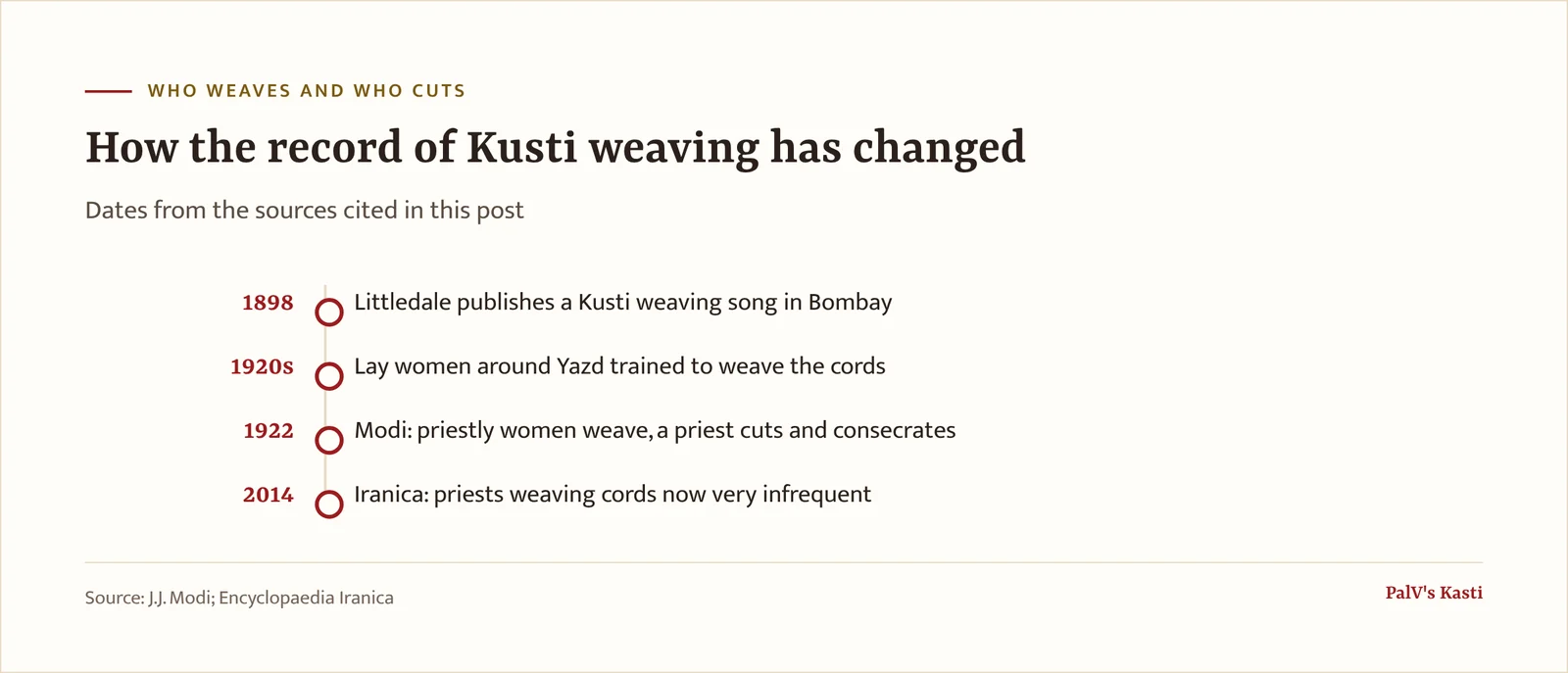
The sources agree on the tradition and also record how it has changed. Modi, describing Parsi practice in 1922, gives the weaving to the women of the priestly class and the cutting and consecration to a priest. Encyclopaedia Iranica, in its 2014 entry "Kustīg" by Jamsheed K. Choksy and Firoze M. Kotwal, says that in Iran and India the cords have traditionally been woven by women from āthornān (priestly) families. Priests sometimes wove them too, which Iranica calls "a practice now very infrequent".
Lay women weave as well. Iranica records that during the 1920s, behdin (lay) Zoroastrian women in and around Yazd were trained to weave the cords. In India, Parzor's arts and crafts page says that earlier a priest or his wife wove the kustis, and that as the boundaries between the priestly class and the laity diminished, women of the laity started weaving too. Parzor's "Keepers of Tradition" story goes further and says Parsi women today make up all the weavers of the Kusti. We have not found a published ruling from a priestly body on lay weavers, so we report what each source records and take no side. For today's weavers, see who weaves Kustis.
What does a weaver do before she starts?
She covers her head and prays. Parzor's "Spinning the Kusti" story on Google Arts & Culture says Zoroastrian women begin by covering their heads with a mathabanu, a white muslin scarf, out of respect for the sacred craft. Some then do their kusti prayers. Others begin with the Yatha Ahu Vairyo (Ahuna Vairya). Shernaz Cama's essay "Sacred Armour" for Parzor puts it more simply: "Most women start the process with a little prayer."
Cama also offers a reason for the custom. Wool, she writes, is absorbent and "collects the good vibrations produced by prayers". That is her interpretation, and we quote it as hers.
Practice varies between families and Agiaries; your family priest's guidance comes first.
What purity rules apply while a Kusti is being made?
Purity starts with the material. Modi writes that the Kusti is made of lamb's wool, and that the lamb "is considered to be an emblem of innocence and purity". Cama draws a distinction: in Zoroastrian tradition hair is nasu, or defiled matter, whereas wool is pure because its structure is different. Encyclopaedia Iranica is broader on materials. It describes threads of lamb's or, less often, goat's wool, and adds, citing the Nērangestān, that cotton can be used as well.
The weaver's own state matters too. Cama records that a weaver in menses stops work and will generally fold the warp and put it aside. The loom wasn't left idle. Parzor's arts and crafts page explains that torans, the beaded door hangings of Parsi homes, are made on the same loom, and were traditionally woven when a woman was considered "impure" and could not touch the sacred thread. Parzor's "Keepers of Tradition" story says the same. All three accounts come from Parzor's documentation. We did not find a second, independent written source for this practice, so read it as Parzor's record.
Care continues after weaving. Parzor's "Weaving the Kusti" story describes dhupvanu, in which sulphur sprinkled on heated coal bleaches the new Kusti. A brass or copper vessel is set on the Kusti, wrapped in white muslin, and left "in a part of the house where it is not touched".
Practice varies between families and Agiaries; your family priest's guidance comes first.
How is a new Kusti cut and consecrated?
Modi gives the fullest description, and the steps below follow his account of Parsi practice in 1922. Cama's essay for Parzor describes the same sequence of prayers.

- When the weaving is almost finished, with about a foot of the threads still unwoven, the whole cord is taken off the loom and handed to a priest.
- The priest first performs the padyab kusti.
- He recites the Srosh Baj as far as the word "Ashahe".
- He recites the nirang, the formula that cuts and consecrates the thread, and then the Ashem Vohu and the Yatha Ahu Vairyo.
- While reciting the Yatha Ahu Vairyo, he cuts the Kusti into two parts as he says the word "shyaothnanam".
- He then says a short Pazand formula in baj (a suppressed tone) and finishes the baj.
- The priest returns the cord. The weaver turns the hollow Kusti inside out with a needle, finishes the remaining threads by hand and forms three tassels at each end. The Kusti is washed before it is worn.
Modi adds that weavers usually had the cord cut and consecrated by the male priests of their own families, and paid a small fee when they had to go to another priest. The mechanics of turning and finishing the cord are covered in our guide to Kusti weaving.
How has consecration changed since Modi's time?
Cama's essay records the same rite and what has happened to it since. The table sets the two accounts side by side.
| Point | Modi (1922) | Cama, for Parzor |
|---|---|---|
| Who cuts the cord | A priest, usually a male priest of the weaver's own family | A priest, traditionally, with a special knife usually made of ivory and kept only for this purpose |
| Prayers | Padyab kusti, Srosh Baj to "Ashahe", the nirang, Ashem Vohu and Yatha Ahu Vairyo | Srosh Baj to "ashahe", the nirang, Ashem Vohu and Yatha Ahu Vairyo |
| Payment | A small fee if a priest from outside the family is used | Weavers who sent the cord to a priest paid him a small fee |
| Practice now | The priest's role is described as the norm | Women "rarely send the kusti to the priest for cutting"; weavers cut it themselves after reciting the nirang |
Untying and retying the Kusti once it is worn is a separate ritual. Iranica describes it as untying and retying with specific prayers after the padyab ablution. We don't cover it here; our Parsi Kusti guide is the place to start.
Practice varies between families and Agiaries; your family priest's guidance comes first.
Are there songs or other customs while weaving?
Yes. Encyclopaedia Iranica describes making the cords as a joyful activity, with the women singing, laughing and sharing as they work. Its bibliography lists a book on exactly this: H. Littledale's Weaving Song of Parsee Girls, a Gujarati text with an English verse translation published in Bombay in 1898. For that book and later records of the craft, see books and films on Kusti weaving. If you want to try the craft yourself, start with learning to weave a Kusti.
Frequently asked questions
Who is allowed to weave a Kusti?
J.J. Modi wrote in 1922 that weaving the Kusti was the privilege of women of the priestly class. Encyclopaedia Iranica records the same tradition in Iran and India, and notes that lay women around Yazd were trained to weave in the 1920s. The Parzor Foundation reports that lay Parsi women in India now weave kustis too.
Can a woman weave a Kusti during her period?
According to the Parzor Foundation's documentation, no. Shernaz Cama records that women in menses do not weave, and generally fold the warp and set it aside. Parzor also notes that women traditionally wove beaded torans on the same loom during that time, because they were not permitted to handle the sacred thread.
Does a priest have to consecrate a new Kusti?
In the practice J.J. Modi described in 1922, the nearly finished Kusti was handed to a priest, who cut and consecrated it before the weaver finished it. Shernaz Cama's essay for Parzor records that this has become rare, and that weavers now usually cut the cord themselves after reciting the nirang for cutting and consecrating the thread.
What prayer is said before weaving a Kusti?
The Parzor Foundation records that weavers cover their heads with a white muslin mathabanu and start with a prayer. Some do their kusti prayers, while others recite the Yatha Ahu Vairyo. Practice differs between weavers and households, so your family priest is the right person to ask about your own family's custom.
What is the nirang in Kusti making?
The nirang is the liturgical formula a priest recites for cutting and consecrating a new Kusti. In J.J. Modi's 1922 account, the priest recites the Srosh Baj up to the word "Ashahe", then the nirang, then the Ashem Vohu and Yatha Ahu Vairyo, cutting the cord at the word "shyaothnanam".
Why is a Kusti made of wool?
J.J. Modi wrote that the Kusti is made of lamb's wool, the lamb being an emblem of innocence and purity. Shernaz Cama, writing for Parzor, adds that hair counts as defiled matter while wool is pure. Encyclopaedia Iranica notes that goat's wool is used less often, and that cotton can also be used.