PalV's Kasti
On this page
- What is Threads of Continuity: The Zoroastrian Craft of Kusti Weaving?
- Where did the research come from?
- Is there a book called 'Thread Bare'?
- Which 'Threads of Continuity' is which?
- What older written records describe Kusti weaving?
- Are there films or photographs of Kusti weaving?
- Where can you read or see each record?
- Frequently asked questions
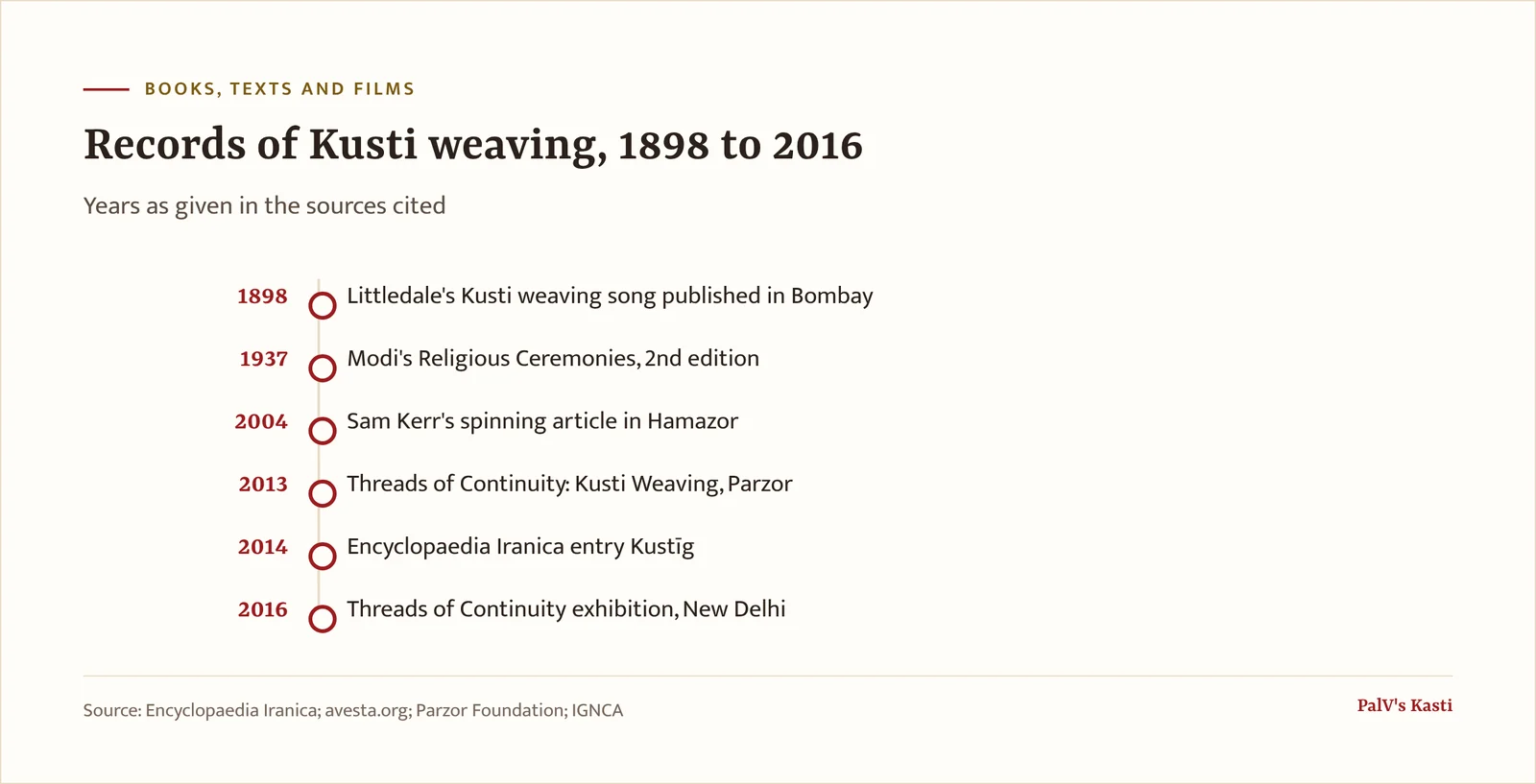
The book on Kusti weaving is Threads of Continuity: The Zoroastrian Craft of Kusti Weaving, by Ashdeen Lilaowala with Shernaz Cama, published by the Parzor Foundation in Delhi in 2013. Parzor says it was the first time the craft had been studied and documented in a publication. Older written records exist too. J.J. Modi's The Religious Ceremonies and Customs of the Parsees describes the spinning and the jantar loom, and Encyclopaedia Iranica cites an 1898 Bombay text of the song Parsi girls sang while weaving. For pictures and film, the best record we found is Parzor's own: step-by-step photo stories on Google Arts & Culture, and three films of its 2016 Threads of Continuity exhibition in New Delhi, where Kusti weaving was demonstrated.
શહેરેવર રોજ
Shehrevar Roj, Tir Mah · 1396 Y.Z.
What is Threads of Continuity: The Zoroastrian Craft of Kusti Weaving?
It is the Parzor Foundation's book on the craft, credited to Ashdeen Lilaowala with Shernaz Cama. Cama's own essay "Sacred Armour" lists it in its references as published by Parzor, Delhi, in 2013.
Parzor's publications page says the book explains the weaving process, the looms and tools used and how they have changed, and the symbolism of the Navjote.">Sudreh and Kusti, along with the related ceremonies. When we checked that page on 16 November 2026, it was listed at ₹1,200.
Where did the research come from?
From fieldwork in Navsari. Parzor's "Weaving the Kusti" story says Ashdeen Lilaowala, Parzor's first researcher and at the time a student at the National Institute of Design in Ahmedabad, carried out the first textile study of Kusti weaving in Navsari, and that this research became Threads of Continuity. Parzor's crafts page adds that Kusti weaving, rooted in oral tradition, was documented for the first time in a Parzor publication. In a 2023 Outlook Traveller profile by Samai Singh, Lilaowala is described as an NID Ahmedabad graduate whose study of Kusti weaving "was published as a book".
Is there a book called 'Thread Bare'?
We could not find one. Parzor's publications list doesn't carry that title, and neither do the other records in this post. If you are looking for the book on Kusti weaving, the title to ask for is Threads of Continuity: The Zoroastrian Craft of Kusti Weaving.
Which 'Threads of Continuity' is which?
Parzor uses the name for two books and an exhibition, so check the subtitle before you order.
| Title | What it is | Who | Where it is recorded |
|---|---|---|---|
| Threads of Continuity: The Zoroastrian Craft of Kusti Weaving | Book on Kusti weaving, the looms and the tools | Ashdeen Lilaowala with Shernaz Cama | Parzor publications page |
| Threads of Continuity: Zoroastrian Life & Culture | Book on Zoroastrian philosophy and culture, from Central Asia to Gujarat and the Deccan | Dr Shernaz Cama | Parzor publications page |
| Threads of Continuity (exhibition) | Exhibition on Parsi culture at IGNCA, Janpath, New Delhi, 22 March to 29 May 2016 | IGNCA with the Ministry of Minority Affairs and Parzor | IGNCA events page |
The Life & Culture volume was listed at ₹2,500 on the same Parzor page on 16 November 2026.
What older written records describe Kusti weaving?
Three stand out, and two of them are free to read online.
Modi's account. J.J. Modi's The Religious Ceremonies and Customs of the Parsees (2nd edition, Bombay, 1937) describes the Kusti in its chapter on initiation ceremonies. It records that lamb's wool was combed and spun on a hand-spindle called the châtri, that the thread was woven on a hand-loom called the jantar, and that the twisted thread went round the loom 72 times. avesta.org hosts a free edition edited by Joseph H. Peterson under a CC-BY-NC licence.
The weaving song. Encyclopaedia Iranica's 2014 entry "Kustīg", by Jamsheed K. Choksy and Firoze M. Kotwal, says the women who make the cords sing, laugh and share religious and lay stories as they work. For that it cites H. Littledale's Weaving Song of Parsee Girls, a Gujarati text with an English verse translation published in Bombay in 1898.
The Iranica entry itself. The entry is a short record in its own right. It says the Parsis of Navsari became well known for supplying Kustis to Zoroastrians in India, Great Britain and the United States, and that Mrs Najamai M. Kotwal taught Parsi girls to weave them for almost three decades.
A shorter piece, Sam Kerr's "The ancient art of spinning a yarn", appeared in Hamazor, the journal of the World Zoroastrian Organization, in Fall 2004. It looks at hand-spinning among Zarathushtis, carried on "mainly for the weaving of their sacred thread".
Are there films or photographs of Kusti weaving?
Yes, though not a stand-alone documentary that we could verify. What we did find is Parzor's visual record.
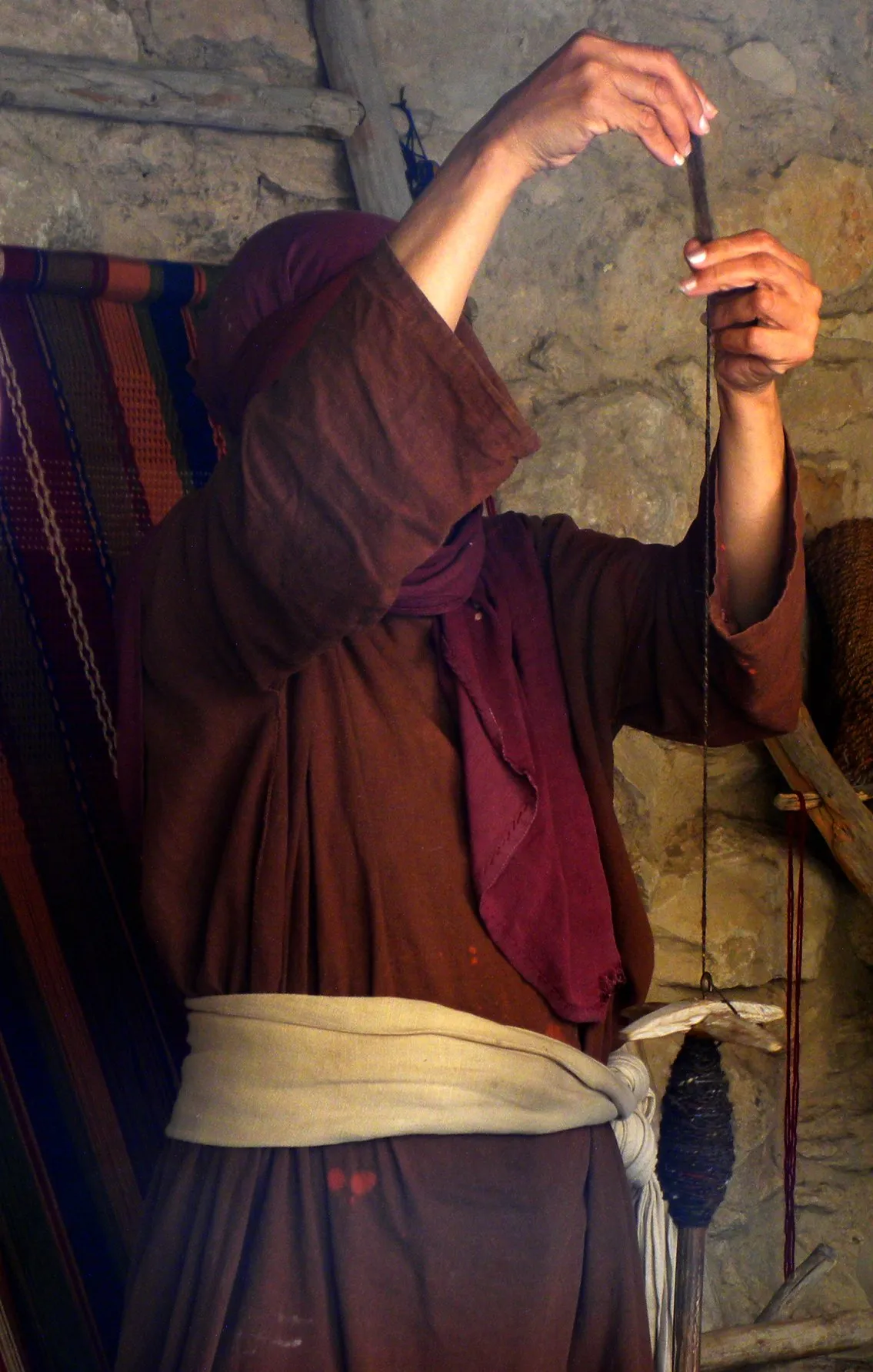
- Weaving the Kusti (Google Arts & Culture, Parzor Foundation) follows the warping and the weaving, with photographs dated between 2001 and 2015. Its credits thank the craftswomen of Navsari, naming Navaz and Erna Bamji and the late Katy Sorabji, and list Jonas Spinoy, Dushyant Mehta, Hemant Mehta and Rustom Havewala for photography.
- Spinning the Kusti (same platform) shows the spindles and loom parts one at a time, among them the chaaterdo, the jantar, the kateli beater, the tan khuta, the khangu and the veesoon. Our guide to the Kusti loom and tools explains what each one does.
- Parzor Films lists three films titled "Threads of Continuity Exhibition, New Delhi, 2016", Episodes 1 to 3. The listing has no description, so we can't tell you which episode shows the loom.
- At that exhibition, IGNCA's event page scheduled Kusti weaving demonstrations on 14 and 15 April 2016, and a Parzor Film Festival screening on 16 April 2016.
The prayers and purity rules that go with the craft are covered in our post on Kusti making rituals.
Where can you read or see each record?
| Record | Type | Year | Where to find it |
|---|---|---|---|
| Threads of Continuity: The Zoroastrian Craft of Kusti Weaving | Book | 2013 | Parzor Foundation |
| The Religious Ceremonies and Customs of the Parsees (J.J. Modi) | Book, 2nd edition | 1937 | Free PDF on avesta.org |
| Weaving Song of Parsee Girls (H. Littledale) | Gujarati text with English verse translation | 1898 | Cited in Encyclopaedia Iranica |
| Kustīg (Choksy and Kotwal) | Encyclopaedia entry | 2014 | Encyclopaedia Iranica online |
| The ancient art of spinning a yarn (Sam Kerr) | Journal article, Hamazor | 2004 | avesta.org |
| Spinning the Kusti; Weaving the Kusti | Photo stories | Photos 2001 to 2015 | Google Arts & Culture |
| Threads of Continuity Exhibition, Episodes 1 to 3 | Films | 2016 | Parzor Films |
For the full making process in one place, start with our guide to Kusti weaving, and for what the Kusti means and how it is worn, see Parsi Kusti. For the people who keep the craft going today, see Kusti weavers. Kusti weaving is also our own family's work: we have woven by hand on the jantar in Ahmedabad for more than 35 years. If you only need a Kusti to wear, you can buy a Parsi Kusti online from us.

Frequently asked questions
Who wrote the book on Kusti weaving?
Ashdeen Lilaowala wrote Threads of Continuity: The Zoroastrian Craft of Kusti Weaving with Shernaz Cama, director of UNESCO Parzor. The Parzor Foundation published it in Delhi in 2013. It grew out of the textile study of Kusti weaving that Lilaowala carried out in Navsari for Parzor while he was a student at NID Ahmedabad.
Where can I buy Threads of Continuity on Kusti weaving?
The Parzor Foundation sells it. On 16 November 2026 its publications page listed Threads of Continuity: Zoroastrian Craft of Kusti Weaving at ₹1,200. Check the subtitle before you pay, because Parzor also sells Shernaz Cama's Threads of Continuity: Zoroastrian Life & Culture, a different book listed at ₹2,500.
Is there a documentary film on Kusti weaving?
We couldn't verify a stand-alone documentary with a named maker and year. Parzor Films lists three episodes filmed at its Threads of Continuity exhibition in New Delhi in 2016, where IGNCA scheduled Kusti weaving demonstrations on 14 and 15 April. Parzor's Google Arts & Culture photo stories show the warping and weaving step by step.
Where can I see photographs of a Kusti being woven?
The Parzor Foundation's "Weaving the Kusti" and "Spinning the Kusti" stories on Google Arts & Culture are free to view. They carry photographs dated between 2001 and 2015 of Navsari weavers, including Navaz Bamji at her jantar, with captions naming each tool and each stage, from spinning through warping to finishing.
Is there an old written description of how a Kusti is woven?
Yes. J.J. Modi's The Religious Ceremonies and Customs of the Parsees (2nd edition, Bombay, 1937) describes lamb's wool spun on a châtri spindle and woven on a jantar loom, with the twisted thread passed round it 72 times. A free edition edited by Joseph H. Peterson is available on avesta.org.
What is the Parsi Kusti weaving song?
Encyclopaedia Iranica's entry "Kustīg" cites H. Littledale's Weaving Song of Parsee Girls, a Gujarati text with an English verse translation published in Bombay in 1898. Iranica cites it when it describes making the cords as a joyful activity in which women sing, laugh and share religious and lay stories.