PalV's Kasti
On this page
A jhabla is a loose, square-cut tunic and an ijar is a pair of loose trousers, and together they were the embroidered dress of young Parsi children in the 19th century. The Victoria and Albert Museum (V&A) records that young girls wore the jubla, as it spells it, with loose trousers and "a round embroidered cap". Women could also wear an ijar under their gara saris, according to a record from Singapore's Indian Heritage Centre. Both garments were embroidered in silk, like the gara. The museum pieces show satin stitch, tiny knots and hooked-needle chain stitch, and some carry silver thread and sequins. Museum examples are dated from about 1850 to about 1950.
શહેરેવર રોજ
Shehrevar Roj, Tir Mah · 1396 Y.Z.
What is a jhabla?
A jhabla is a tunic. The Parzor Foundation, which documents Parsi heritage under the UNESCO Parzor project, captions one "A Jhabla or Tunic worn particularly by children". The V&A adds that tunics in this style were worn by Parsi children, and the Penn Museum describes one of its jhablas as a silk tunic for a Parsi child or woman.
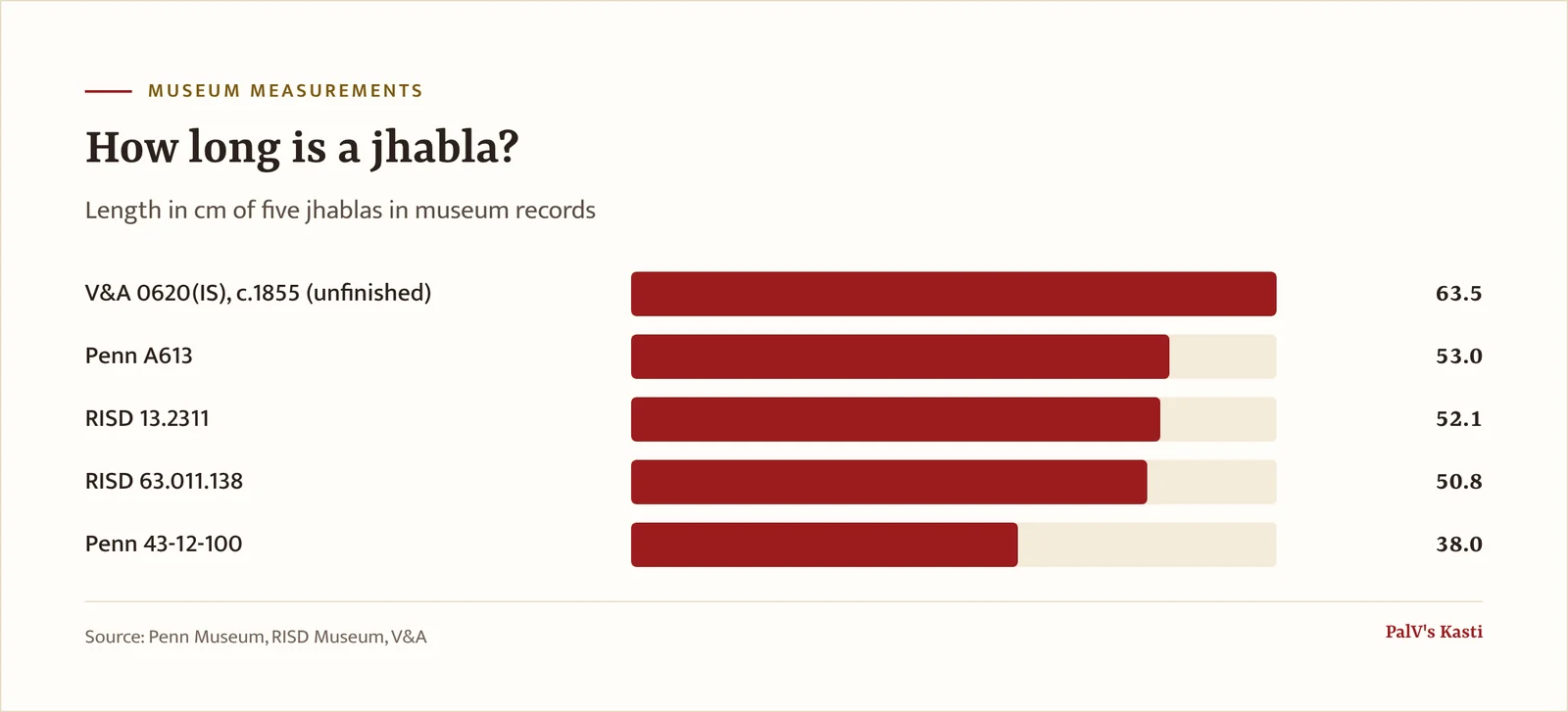

The shape is simple. A pink silk example made in China for the Parsee community in Bombay around 1950 is catalogued by the V&A as a "Pink silk blouse of square cut". Five collection records give these measurements:
| Museum and number | Date | Length |
|---|---|---|
| Penn Museum A613 | Mid to late 19th century | 53 cm (42 cm wide) |
| Penn Museum 43-12-100 | Late 19th century | 38 cm (37 cm wide) |
| RISD Museum 13.2311 | About 1875 to 1910 | 52.1 cm |
| RISD Museum 63.011.138 | About 1875 to 1925 | 50.8 cm (50.8 cm wide) |
| V&A 0620(IS), an unfinished piece | About 1855 | 63.5 cm (61 cm wide) |
You'll see the name spelt several ways: jhabla, jubla (V&A and the Textile Research Centre in Leiden) and jabhla (Parzor).
What is an ijar?
An ijar is a pair of loose trousers or pyjamas. The record for a late 19th-century ijar cloth held by Singapore's Indian Heritage Centre, published on Roots.gov.sg, calls ijar loose trousers or pyjamas that are "a basic element of traditional Parsi clothing". The Textile Research Centre (TRC) in Leiden spells it ijor and calls them wide trousers.
The embroidery sat at the ankles. The same record says each ijar had an embroidered border along the bottom of both legs, matched to the gara or jhabla and often in pastel colours. A V&A child's ensemble from Gujarat, about 1874, has purple satin trousers with red cuffs embroidered with flowers, 64 cm long and 46 cm at the waist. A V&A pair from Surat, about 1855, is a drawstring pyjama with appliqué at the ankles in silver-wrapped thread and sequins.
Embroidered trousers carried on into the 20th century. The V&A holds a pair of red silk trousers from Bombay, catalogued as "legha" and "Made for the Parsee community", embroidered with green, white and yellow cockerels.
Who wore jhablas and ijars?
Children first. TRC Leiden says girls usually wore three pieces, a loose jubla, wide ijor trousers and a round cap, and any of them could carry embroidery. The V&A's 1874 ensemble is exactly that set: a cap, tunic and trousers for a Parsi child.
Women sometimes wore them too. The Indian Heritage Centre record says ijar were most often worn with a jhabla by young Parsi boys and girls, but could also be worn by women under their gara saris. The Penn Museum catalogues its red jhabla as made for a Parsi child or woman.
How were jhablas and ijars embroidered?
With the same stitches and threads as gara saris. The records show four main methods:
- Satin stitch. A V&A child's tunic from Gujarat, about 1867, is worked in twisted silk satin stitch in white, yellow and green, with two peacocks on the front and two on the back. RISD's two jhablas are silk satin-stitch embroidery.
- Knots. Penn's dark blue tunic is worked entirely in knots (seed stitches, khako in Gujarati) in floss silk.
- Chain stitch with a hooked needle. Penn's red jhabla is tie-dyed and embroidered in mochi bharat, a chain stitch done with a small hooked needle called an aari.
- Metal thread and sequins. A V&A jhabla from Surat, about 1855, carries appliqué in silver-wrapped thread with silver-coloured sequins around the arms and hem. Parzor notes that Deccani zari work began appearing on Parsi jhablas and on children's prayer caps, or topis.
Some layouts repeat. The Penn Museum calls two peacocks flanking a pendant neckline a common composition for a Parsi jhabla. Parzor says the rooster is "a favored element on children's clothing", and writes that the Divine Fungus motif gives protection to children when embroidered on their jhablas. For what these motifs show and mean, see gara embroidery designs and motifs. For a stitch-by-stitch account, read how Parsi embroidery is done.
Were jhablas made in China or in India?
Both, and often in two stages. Several jhablas were embroidered flat and tailored later. The V&A's 1867 tunic is catalogued as complete but untailored, not sewn along the sides and with the collar not cut out. One of four Parsi children's jublas bought at the Great Exhibition of 1851 is catalogued as an "Uncut piece for Parsi girl's blouse". The Indian Heritage Centre's ijar cloth is likewise unstitched, with its border already embroidered.
The RISD Museum's label explains the route. The first such garments were made from other embroidered textiles brought back from China, and Chinese workshops later produced uncut embroidered panels that could be tailored back home. RISD records its two jhablas as made in China by unknown Chinese makers. The Indian Heritage Centre's ijar cloth even carries a Chinese export stamp.
Other pieces were made in Gujarat. The V&A notes of its Gujarat tunic: "Probably embroidered by a Chinese embroiderer". The Penn Museum places its red jhabla "most likely in Surat, Gujarat". And Parzor records that, having watched travelling Chinese sellers, the pherias, at work, "Parsi women created their own Garas, Jabhlas and Kors". The China connection itself is covered in our guide to the Parsi gara saree, and the longer story in our history of Parsi garas.
Where can you see old jhablas and ijars today?
In museum collections, including the V&A, the Penn Museum and the RISD Museum, with one ijar cloth held by the Indian Heritage Centre in Singapore. A search of the V&A's collection for "jhabla" on 16 November 2026 returned seven Surat jhablas dated about 1855. Two V&A records from Surat, a jhabla and a pyjama, cite the same India Museum slip book entry, 4023, which reads "Child's Frock and Trousers / Surat / Figured Crimson Silk Heavily Emb'd with Silver". So the two were entered together in the India Museum's slip book.
| Where | What | Date |
|---|---|---|
| V&A | Jubla bought at the Great Exhibition, 800-1852 | About 1850 |
| V&A | Child's cap, tunic and trousers, 1426&A to B-1874 | About 1874 |
| V&A | Red silk trousers with cockerels, IS.11-2004 | 20th century |
| Penn Museum | Red tie-dyed jhabla, A613, bought from F. P. Bhumgara & Company in 1904 | Mid to late 19th century |
| RISD Museum, Providence | Jhablas 13.2311 and 63.011.138 | About 1875 to 1925 |
| Indian Heritage Centre, Singapore | Parsi ijar cloth, 2015-00046 | Late 19th century |
Both RISD jhablas were shown in the exhibition "The Flower, The Labor, and The Sea", which ran from 27 September 2025 to 28 June 2026 and has now closed. For garas held abroad, see the global gara. The embroidered sari border is covered in kor, the embroidered sari border, the gara's place in a wedding in the gara in a Parsi bride's trousseau, and the wider family of Parsi embroidery in Parsi embroidery.
Frequently asked questions
What is a Parsi jhabla?
A jhabla is a loose, square-cut embroidered silk tunic worn mainly by Parsi children, especially young girls. The V&A records it was worn with loose trousers and a round embroidered cap. Museum examples date from about 1850 to 1950, and five we checked measure 38 to 63.5 cm long.
What is the difference between a jhabla and an ijar?
The jhabla is the tunic, worn on the upper body. The ijar is a pair of loose trousers or pyjamas worn below it, with an embroidered border at the bottom of both legs. Museum records show both were embroidered in matching silk, often to go with a gara.
Did adult Parsi women wear jhablas and ijars?
Sometimes. A record from Singapore's Indian Heritage Centre says ijar could be worn by women under their gara saris, though young boys and girls wore them most often. The Penn Museum catalogues one red silk jhabla, probably from Surat, as made for a Parsi child or woman.
Why do Parsi jhablas show roosters and peacocks?
The Parzor Foundation links the rooster's morning crow with "the slaying of the demon of darkness" and says such associations made it a favoured motif on children's clothing. The Penn Museum describes two peacocks flanking a pendant neckline as a common Parsi jhabla composition. Parzor also links the Divine Fungus motif to protecting children.
How do you spell jhabla and ijar?
Spellings vary by source. The V&A and TRC Leiden write jubla, and Parzor writes jabhla, for the tunic. TRC Leiden writes ijor for the trousers, while the Indian Heritage Centre and Parzor use ijar. The V&A also catalogues one 20th-century pair of Parsi trousers as legha.