PalV's Kasti
On this page
Parsis observe Dae Mah, the tenth month of the Zoroastrian calendar, mainly through Jashans of thanksgiving to Dadar Ahura Mazda. Writing in 1922, the scholar Jivanji Jamshedji Modi recorded that the month "is sacred to Ahura Mazda himself" and that its 1st, 8th, 15th and 23rd days are "the sacred Jashan days". Families and institutions arrange these Jashans at home, at the office or at an Agiary. The month also holds Zarthost no Diso, the anniversary of Zarathushtra's passing, on Khorshed Roj, the 11th day, and Modi placed the Maidhyarem Gahambar from the 16th to the 20th day. Older Iranian customs, set down by al-Biruni around A.D. 1000, add a picture of kings stepping off the throne on the month's first day.
If you want the background first, our guide to what Dae Mah is explains the month and its dedication to the Creator. This page is about what people actually do in it.
શહેરેવર રોજ
Shehrevar Roj, Tir Mah · 1396 Y.Z.
Which days of Dae Mah are kept as Jashan days?
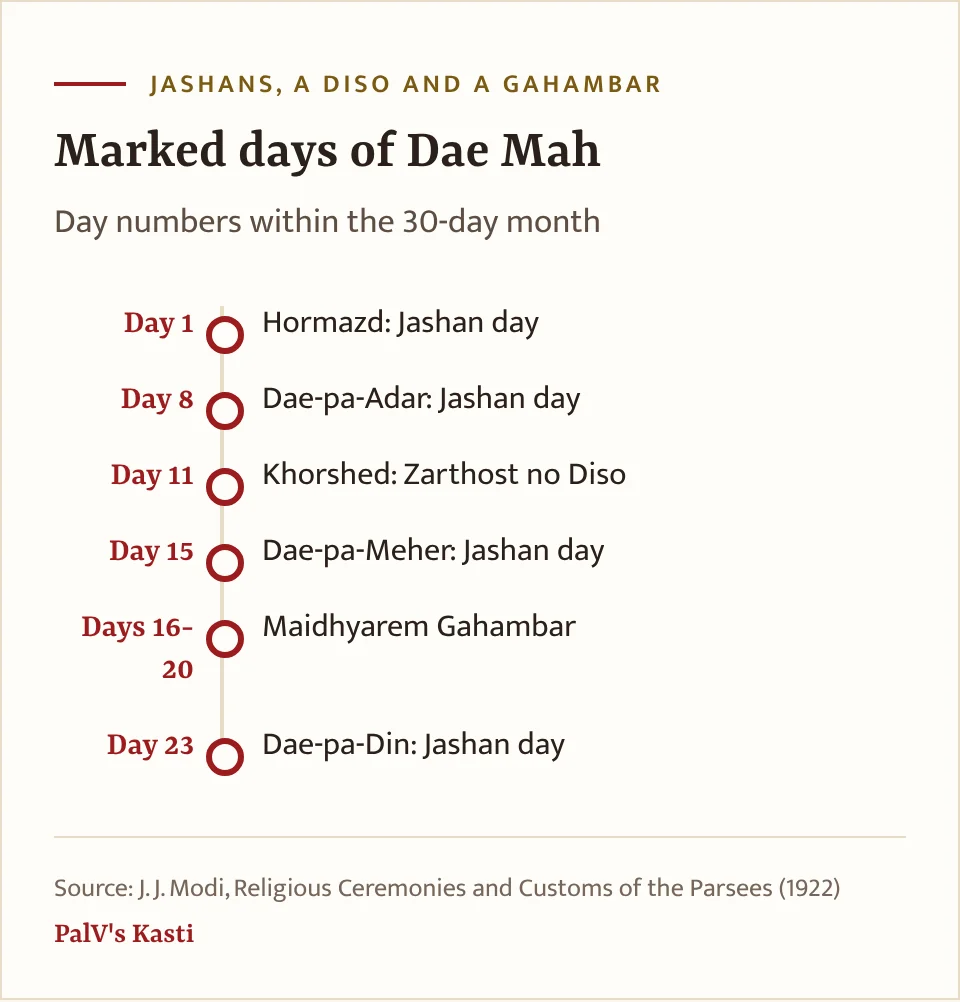
Four days. Modi lists the 1st, 8th, 15th and 23rd of Dae, the days named Hormazd, Dae-pa-Adar, Dae-pa-Meher and Dae-pa-Din, as "the sacred Jashan days" of Dae Dadar. Noshir H. Dadrawala, writing in Parsi Times in May 2023, names the same four days and calls a Jashan on each of them "most meritorious". Mary Boyce, in the Encyclopaedia Iranica, counts the same thing from the other side: there were "four festivals for Ahura Mazdā" in the month Dadvah.
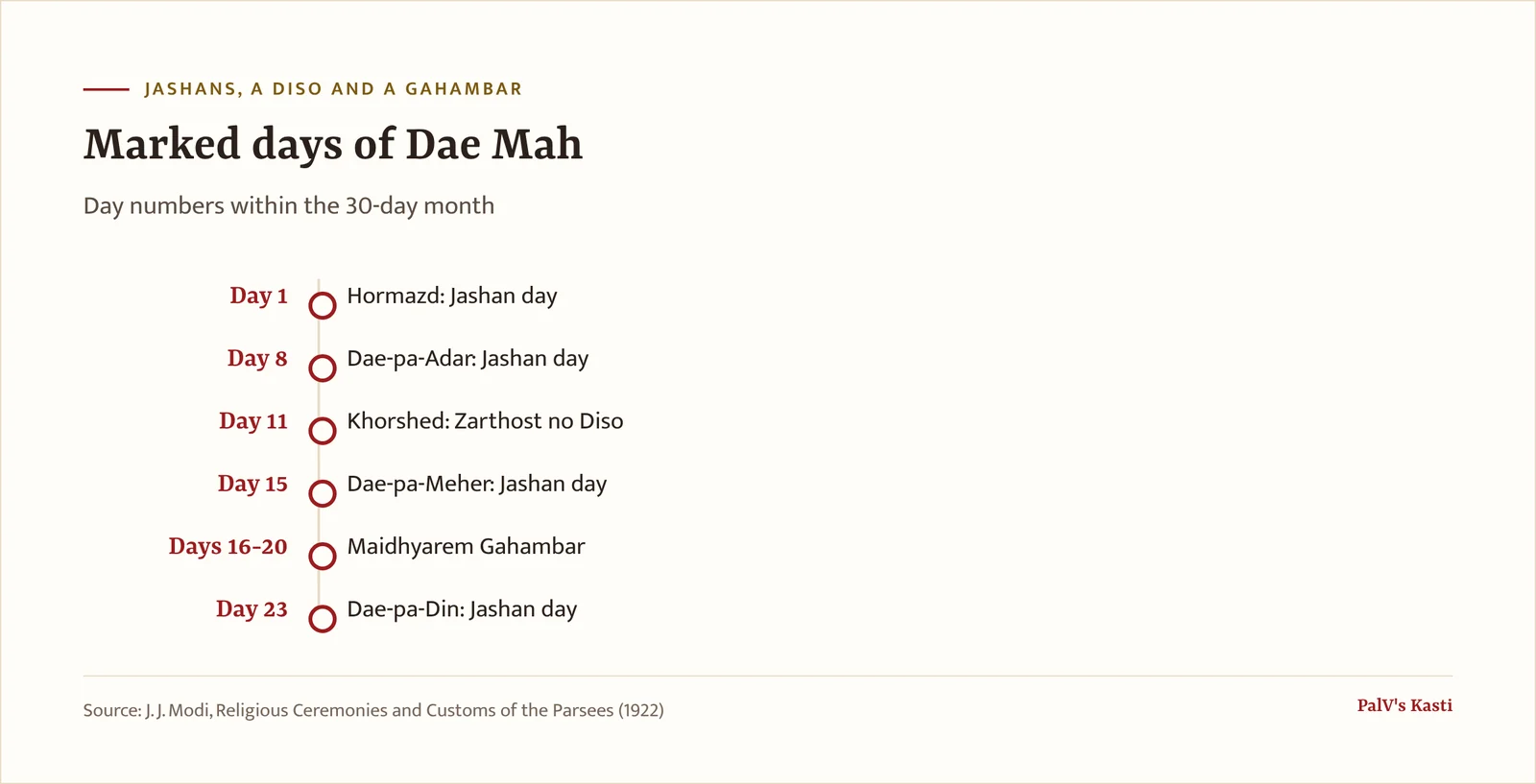
| Day of Dae Mah | Roj name | Why it is a Jashan day |
|---|---|---|
| 1st | Hormazd | The month is sacred to Ahura Mazda, and this day bears his name |
| 8th | Dae-pa-Adar | A day named for the Creator |
| 15th | Dae-pa-Meher | A day named for the Creator |
| 23rd | Dae-pa-Din | A day named for the Creator |
Why four? A day becomes a feast when its name matches the month's, and the Creator's name sits on four days of every month. Al-Biruni gave that reason for Dae a thousand years ago: the 8th, 15th and 23rd are feast-days "on account of the identity of the names", that is, because day and month share a name. Our guide to Dae Mah sets out the rule, and the Dae days of every month covers the three Creator days in full.
Practice varies between families and Agiaries; your family priest's guidance comes first.
Where do Parsis hold a Dae Mah Jashan?
At home, at the office or at a fire temple. Dadrawala, in the same 2023 Parsi Times column, describes gratitude in this month being offered through Jashans held at home, at the office, or at an Atash Behram or Agiary.
Institutions keep the custom as well. Parsi Times reported that the Central Bank of India held its 39th annual Dae Mah Jashan at Cama Baug Agiary in Mumbai on 7 June 2019, conducted by Vada Dasturji Er. Keki Ravji. For why a Jashan suits this particular month, read Jashans in Dae Mah.
Practice varies between families and Agiaries; your family priest's guidance comes first.
Why was a Dae Mah Jashan held in June?
Because the Parsi calendar has drifted. Boyce describes Dadvah as "a midwinter month", yet that Dae Mah Jashan in Mumbai was held in early June. Modi explains why: Parsis "have ceased to observe intercalation since their imigration to India" (his spelling), so even their Navroz no longer falls on 21 March. To see where the month falls now, use when Dae Mah falls in the Shenshai, Kadmi and Fasli calendars or our Parsi calendar.
Why does Zarthost no Diso fall in Dae Mah?
Parsi tradition places the anniversary of Zarathushtra's death on Khorshed Roj, the 11th day of Dae Mah. J. J. Modi recorded in 1922 that this day "is held to be the anniversary of the death of Zoroaster" and "is observed as a Jashan day". In the list of Baj ceremonies he reproduces from Parsi books of ritual, the Baj for the Prophet's diso is dated "Roz Khorshed mah Deh". The North American Mobeds Council's weekly scripture extract gives the same day, Dae Mah and Khorshed Roj, and so does Dadrawala in his May 2020 Parsi Times column on Zarthost no Diso.
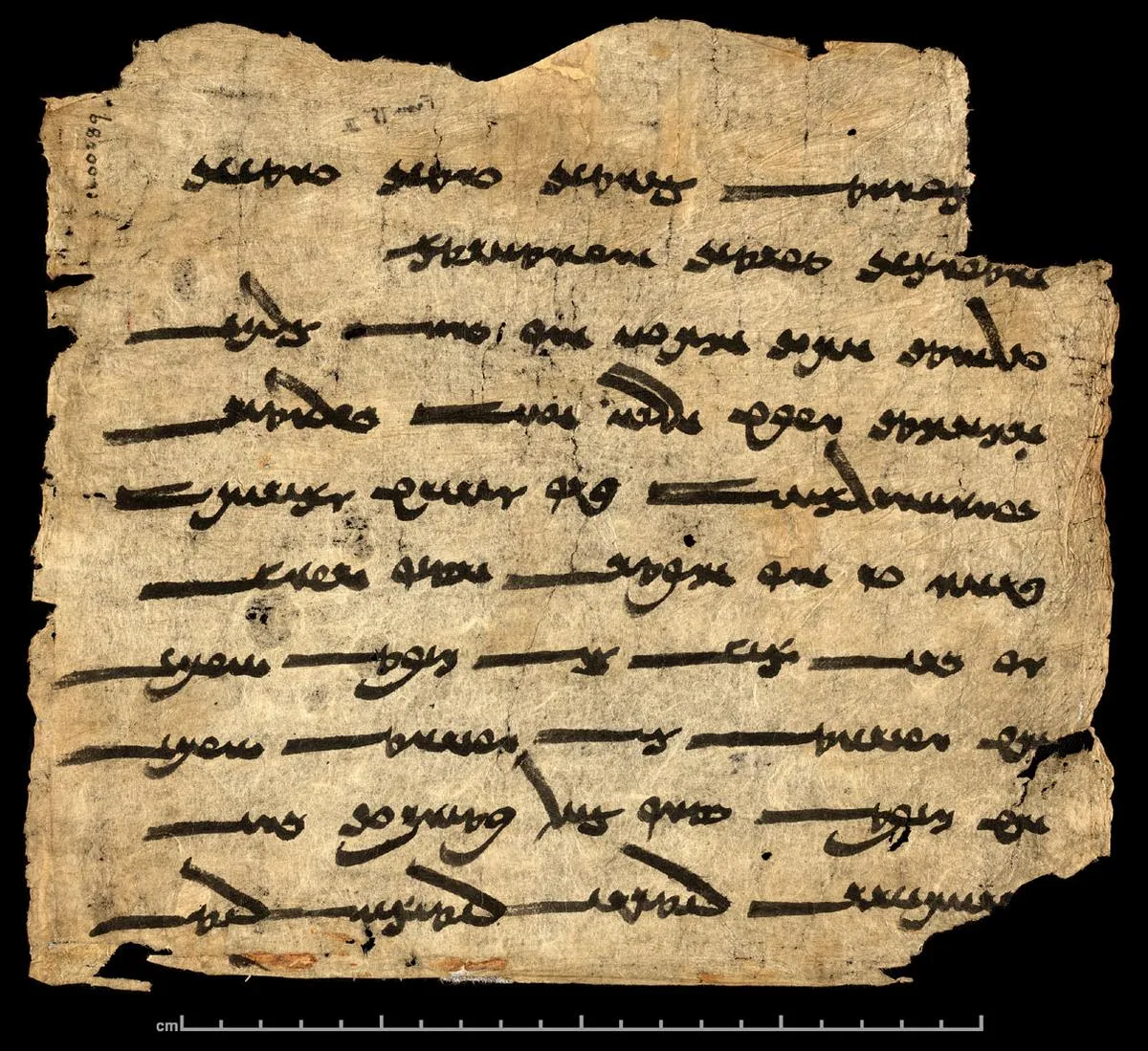
The older texts point elsewhere, and it is fair to say so. The Pahlavi Selections of Zadspram, in E. W. West's translation, has Zartosht pass away "in the month Ardwahisht" on "the day Khur". A. V. Williams Jackson, Professor of Indo-Iranian Languages at Columbia, read that tradition the same way in 1899: the day Khur, "the eleventh day of the second month". The day is the 11th in every account. The month differs. We record both and take no side.
Practice varies between families and Agiaries; your family priest's guidance comes first.
Which Gahambar falls in Dae Mah?
The Maidhyarem Gahambar, the fifth of the six seasonal feasts. The Afrinagan of the Gahambars, in L. H. Mills's translation, names "the fifth Myazda, which is that of the Maidhyairya". Modi glosses Maidhyarem as "the season of Mid-winter", when farm work stops because of the cold, and in his list of Jashan days he gives its dates as "the 16th to the 20th day" of Deh. The Bundahishn, in West's translation, places "the season of Maidyarem" on "the auspicious day Warharan of the month Din", the month it lists between Adar and Vohuman, and calls that day the shortest day. Warharan is the 20th day, the last of Modi's five.
Practice varies between families and Agiaries; your family priest's guidance comes first.
What customs did Iranians keep in Dae Mah in older times?
Several, and al-Biruni recorded a number of them in his Chronology of Ancient Nations. The title page of C. Edward Sachau's 1879 translation dates the work to A.D. 1000. These are customs of old Iran as Biruni knew of them, many already described in the past tense. They are not a description of Parsi practice in India today.

| Day | Name Biruni gives | What he records |
|---|---|---|
| 1st | Khurram-roz | The king came down from the throne, dressed in white, sat on white carpets "in the plain", and let anyone, "high or low", speak to him |
| 1st | Nuwad-roz | Also kept as a feast because 90 days separate it from Nauroz |
| 8th, 15th, 23rd | Creator days | Feast-days, as above. Boyce adds that Biruni noted the Sogdians of his time holding fairs on them |
| 14th | Gosh-roz (Sir-sawa) | People ate garlic, drank wine and cooked vegetables with meat to protect themselves "against the devil" |
| 15th | Dai-ba-Mihr-roz | A human-like figure of paste or clay was set at gateways, a custom abolished by his time because it resembled idolatry |
Dadrawala retells the Khurram-roz custom in his 2023 column. In Biruni's account the king met the dihkans and farmers, ate and drank with them, and told them that on this day he was "like one of you" and "your brother".
Fire marked the month as well. The Bundahishn says that winter arrives "on the auspicious day Adar of the month Din", and that people light a fire everywhere on that day as a sign that winter has come. Maneckji Nusservanji Dhalla summarised the same custom in 1922: people would kindle fires everywhere on the ninth day, Adar, "to mark the advent of winter".
Frequently asked questions
Which are the Jashan days of Dae Mah?
The four Jashan days of Dae Mah are the 1st (Hormazd), 8th (Dae-pa-Adar), 15th (Dae-pa-Meher) and 23rd (Dae-pa-Din). J. J. Modi's 1922 study of Parsi customs names all four as the sacred Jashan days of the month, and Noshir H. Dadrawala, writing in Parsi Times in 2023, calls a Jashan on each of them most meritorious.
Can a Dae Mah Jashan be held at home?
Yes. Noshir H. Dadrawala, writing in Parsi Times in 2023, describes Dae Mah Jashans being performed at home, at the office, or at an Atash Behram or Agiary. Institutions hold them too, for example the Central Bank of India's annual Dae Mah Jashan at Cama Baug Agiary, Mumbai, reported in June 2019.
Is Zarthost no Diso observed in Dae Mah?
Yes. Parsi tradition keeps it on Khorshed Roj, the 11th day of Dae Mah. J. J. Modi recorded this in 1922, and the North American Mobeds Council and Parsi Times give the same day. Older sources differ on the month: West's translation of the Pahlavi Zadspram and A. V. W. Jackson place the death on day Khur of Ardibehesht.
What did Persian kings do on the first day of Dae?
According to al-Biruni, writing around A.D. 1000, the king came down from his throne on Khurram-roz, the first day of Dae. He dressed in white, sat on white carpets in the open plain, heard anyone who wished to speak, and ate with the farmers, telling them he was their brother.
Is Dae Mah still a winter month?
Not in the Parsi calendar of India. Mary Boyce describes Dadvah as a midwinter month, and the Bundahishn places its Gahambar on the shortest day. But J. J. Modi notes that Parsis in India stopped intercalating, so the calendar has drifted. A Dae Mah Jashan in Mumbai was held on 7 June 2019.