PalV's Kasti

On this page
We could not find an official count of Zoroastrianism in the US. The figure most often quoted comes from a FEZANA survey that found 14,405 Zoroastrians in the United States in 2012, up from 10,794 in 2004. Canada does count religion, and its 2021 Census found 7,285 Zoroastrians. Other estimates run higher: in 2022 the Indiana University professor Jamsheed Choksy told the Associated Press that the two countries together had more than 30,000. FEZANA, the Federation of Zoroastrian Associations of North America, is the umbrella body that links the local associations. It was registered in Illinois on 2 June 1987. Today it runs scholarships, a youth wing and an annual general meeting, and the Pluralism Project at Harvard notes that it publishes the quarterly FEZANA Journal.
This page is part of our series on the Zoroastrian diaspora. Below we show where each number comes from and how the community got here.
શહેરેવર રોજ
Shehrevar Roj, Tir Mah · 1396 Y.Z.
How many Zoroastrians live in the USA?
We could not find a government count of Zoroastrians in the United States. So every US figure in circulation is a community estimate, and the estimates do not agree.
The most detailed one is FEZANA's own. Roshan Rivetna compiled "The Zarathushti World, a 2012 Demographic Picture" for the FEZANA Journal (Fall 2013). For the US it rests on a survey of all 50 states, done in 2004 with Noshir Jesung and in 2012 with Zenobia Damania. The result was 10,794 in 2004 and 14,405 in 2012, which the table itself gives as growth of 33.5%.
FEZANA is frank about the limits. Its disclaimer calls the compilation a "magazine survey" rather than a statistically correct census and warns that the data received may be incomplete. So we treat 14,405 as an estimate, not a headcount.
Two other figures are often repeated:
- The Pluralism Project's profile "Two Streams Converge" says that today there are over 15,000. The sentence begins with North America as a whole, then mentions six dar-e-mehrs in the US, so it is not clear whether the figure is for the US alone. The page carries no date.
- Jamsheed Choksy, professor of Central Eurasian Studies at Indiana University, estimated in an Associated Press story of 1 July 2022 that the United States and Canada together are home to more than 30,000 Zoroastrians, which he said is higher than the latest figure for Iran.
| Figure | Area | Year | Who gives it | Type |
|---|---|---|---|---|
| 10,794 | USA | 2004 | FEZANA Journal (Rivetna) | Community survey |
| 14,405 | USA | 2012 | FEZANA Journal (Rivetna) | Community survey |
| Over 15,000 | North America (wording unclear) | Undated | Pluralism Project, Harvard | Estimate |
| 6,442 | Canada | 2012 | FEZANA Journal (Rivetna) | Community survey |
| 7,285 | Canada | 2021 | Statistics Canada | Census |
| More than 30,000 | USA and Canada | 2022 | Jamsheed Choksy, via AP | Scholar's estimate |
Add FEZANA's two 2012 country figures and you get 20,847 for the US and Canada together (our sum). That is well under Choksy's figure ten years later, which shows how loose the numbers are, not which one is right. For the community back home, see our page on the Parsi population in India.
How many Zoroastrians live in Canada?
Canada has an official figure. Statistics Canada table 98-10-0342-01, from the 2021 Census, counts 7,285 people who gave their religion as Zoroastrian. They are concentrated in a few places:


- Ontario: 4,785, of whom 3,895 live in the Toronto metropolitan area.
- British Columbia: 1,675, with 1,535 in metropolitan Vancouver.
- Alberta 415 and Quebec 310. Metropolitan Montréal and Calgary have 275 each.
It is still largely a first-generation community. Of the 7,285, the census puts 5,730 in the first generation (born outside Canada), 1,440 in the second, and only 120 in the third generation or later.
The same table also breaks the count down by Canada's visible-minority categories. Nationally, 3,630 Zoroastrians are classed as South Asian and 2,390 as West Asian. The split changes by city. In Toronto it is 2,435 South Asian against 950 West Asian, while Vancouver has 430 South Asian and 835 West Asian. The census does not ask who is Parsi and who is Iranian, so these categories are not a direct count of either group.
FEZANA's 2012 survey had put Canada at 6,442. The census and the survey are nine years and a whole method apart, so the two should not be read as a trend.
When did Zoroastrians first come to America?
The Pluralism Project dates a Zoroastrian presence in America to the 1860s. It records that in 1865 New York's Evening Post printed a letter against slavery from Dosabhai Faramji Cama. Both the Pluralism Project and a 2023 FEZANA lesson plan say a Parsi went to California in the Gold Rush years, but they name him differently: Cawasji Zaveri in one, Maneckji Framji Javeri (citing Parsi Prakash, in 1866) in the other.
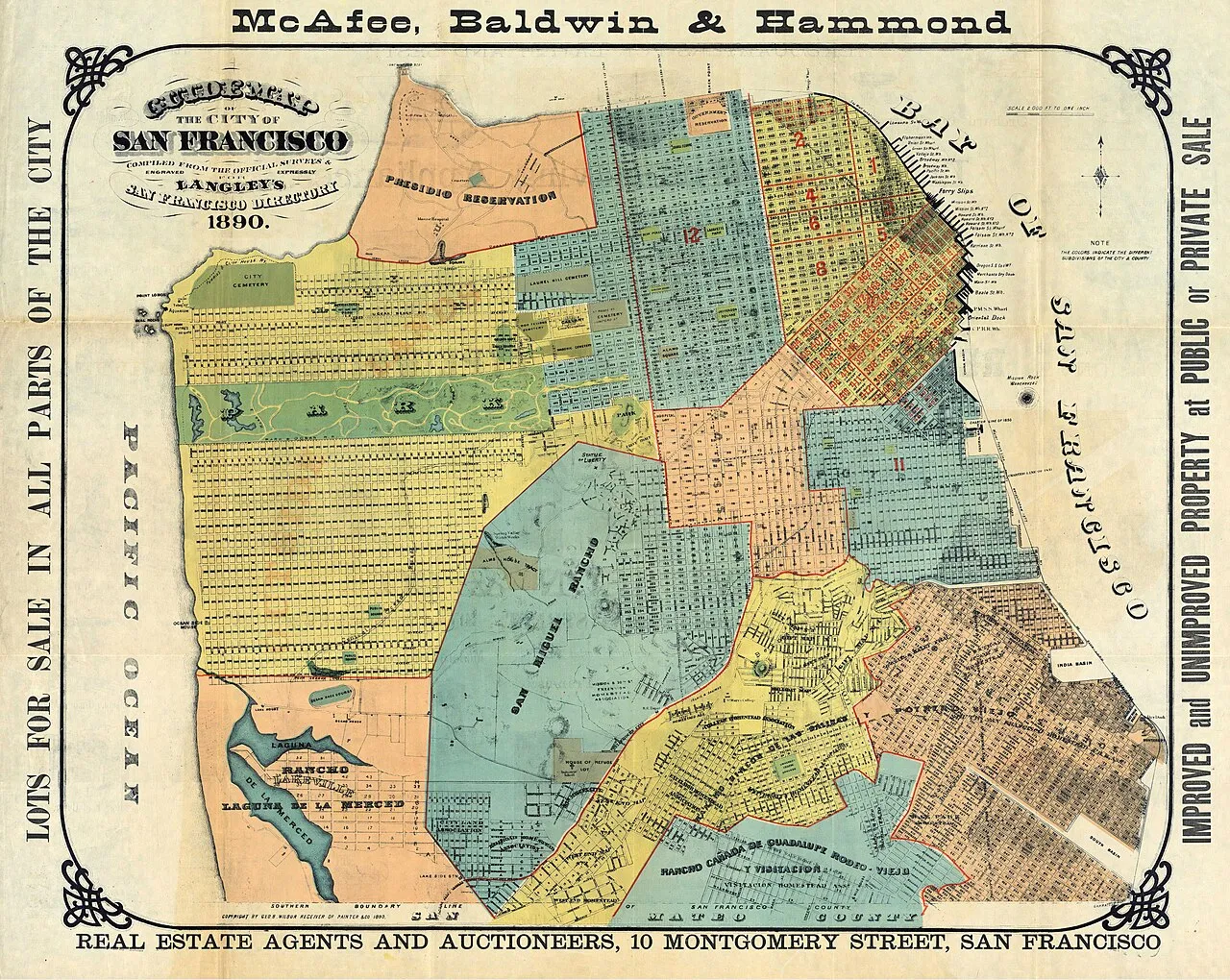
Pestonji Framji Daver, a Parsi, arrived in San Francisco in 1892. FEZANA's lesson plan calls him the first known Zoroastrian to settle permanently in North America. Dr Kersey H. Antia, in an essay published on avesta.org, also calls him the first Parsi to settle in the US, citing the research of Jamshed Pavri of Vancouver. The Pluralism Project lists Daver among the early arrivals without calling him the first. Antia adds that under Pestonji Daver's will, his estate went to the Bombay Parsi Panchayet for cosmopolitan charities after his son's death. The Pluralism Project gives 1926 as the year the first recorded Iranian Zoroastrian, Rostam Kermani, settled in the US.
The students of the 1950s and 1960s
Real numbers came later. Antia, who settled in the US in 1965, writes that "the real migration" happened in the 1950s and 1960s, once restrictions on Asian immigration were lifted. The Pluralism Project agrees that Parsis came then for study and work. Antia says most early settlers were students who found good jobs and stayed. Many married Americans or Canadians, he notes, but in his view a large majority went back home to find a Zoroastrian spouse. Some held their children's navjote in North America, while many more returned home for it, because family ties stayed strong.
Iranian Zoroastrians after 1979
The second stream came from Iran. The Pluralism Project writes that many local communities had doubled in size by the late 1970s as Iranian Zoroastrians joined them. FEZANA's lesson plan says immigration rose steeply after the 1979 Islamic Revolution, with most Iranians settling in California. The two groups are not the same community under one name. The Pluralism Project notes that most Parsis grew up speaking English and Gujarati and most Iranian Zoroastrians Farsi, and that they often follow different religious calendars. Women's experience of this history has its own page, Zoroastrian women in the US.
What is FEZANA and when was it founded?
FEZANA stands for the Federation of Zoroastrian Associations of North America. Its members are local associations. Its own history, adapted from a 1996 FEZANA Journal article by Rohinton Rivetna, gives these steps:
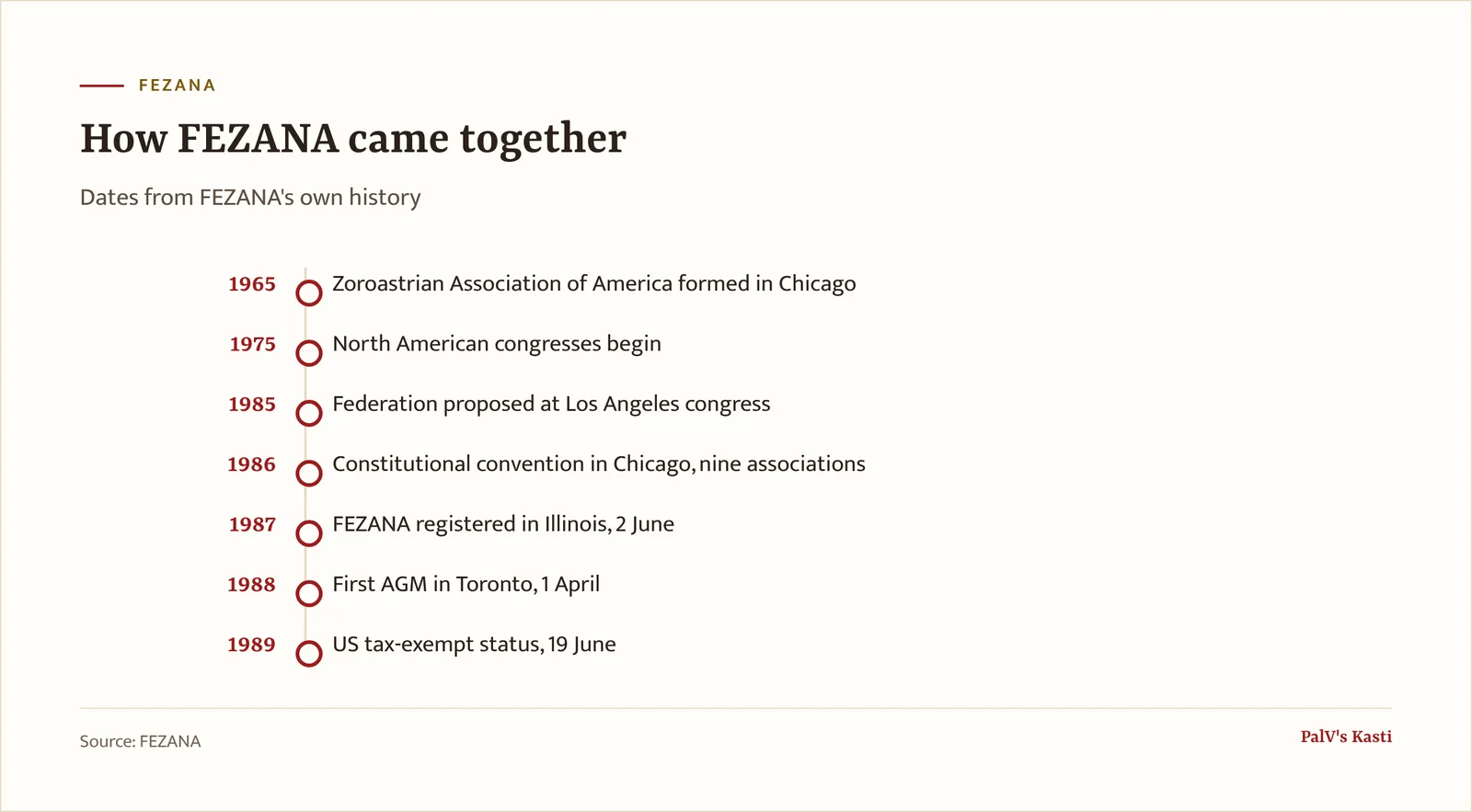
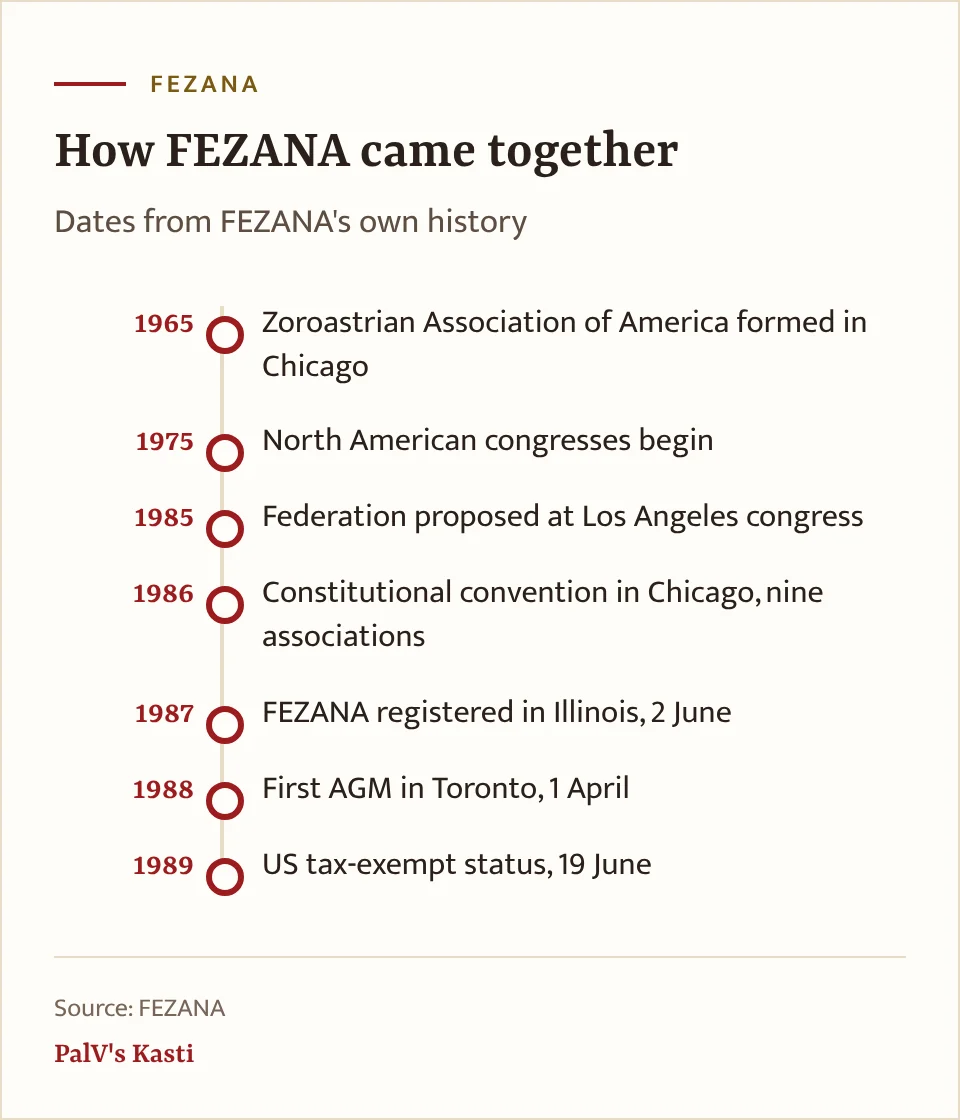
- 1965: Keki Bhote, Jim Modi and others form the Zoroastrian Association of America, which works mainly around Chicago for three or four years. The Pluralism Project dates its founding to 23 May 1965, by thirty Chicago-area Zoroastrians.
- From 1975: North American congresses meet in different cities, and the idea of a continental body is discussed there.
- 1985: at the Fifth North American Congress in Los Angeles, Homi Minocher Homji of Toronto presents a proposal for a federation.
- May 1986: representatives of nine associations meet in Chicago for a constitutional convention. Firdosh Mehta, the delegate from Alberta, is credited with adding the "E" to the name.
- 2 June 1987: FEZANA is registered in the State of Illinois.
- 1 April 1988: the first annual general meeting is held in Toronto.
- 19 June 1989: FEZANA receives tax-exempt status in the United States.
One line in FEZANA's charter explains a lot about how it works. After listing its purposes, it says that nothing in them shall be read as weakening "the religious and administrative autonomy" of individual associations or individual Zoroastrians. The clause leaves those decisions with the associations and the individuals themselves.
What does FEZANA do?
Its stated purposes include coordinating the associations, promoting the study and practice of the faith, sharing information, and representing members in wider forums. In practice, these are the parts we could confirm from FEZANA's own pages:
- The FEZANA Journal. A quarterly magazine, according to the Pluralism Project. The 2012 population survey above appeared in it.
- Scholarships. Running since 1998. FEZANA says it gives more than $85,000 a year, for study in the US and Canada, including the performing, creative and culinary arts.
- ZYNA, the youth wing. FEZANA describes it as bringing together Zoroastrian youth aged 15 to 35 across North America, with retreats, talks and service projects.
- The annual general meeting. It moves between member cities. The 38th was in Toronto on 2 to 4 May 2025, hosted by the Zoroastrian Society of Ontario, and the 39th was listed for Los Angeles on 24 to 26 April 2026, hosted by the Zoroastrian Association of California. The 2020 to 2022 meetings were held online because of COVID-19.
FEZANA's About page says it is the coordinating body for 27 associations. Its associations page, which we counted on 16 November 2026, lists 28: 23 in the US and five in Canada. It also lists one virtual association and 13 small groups. We report both numbers as found.
Where do Zoroastrians in the US live?
Without a census, the associations list is the closest thing to a map. California stands out: seven of FEZANA's 23 US member associations are based there, in Westminster, San Jose (two), Mather, Corona, Orange and Santa Ana. That fits FEZANA's note that most Iranian arrivals after 1979 settled in California. Two associations are in Suffern, New York, including the Zoroastrian Association of Greater New York. Texas has two, in Houston and Flower Mound. The rest are spread one to a state: Chicago's association in Burr Ridge, Illinois, plus others in Georgia, Arizona, Florida, Massachusetts, Kansas, Ohio, Maryland, Michigan, Pennsylvania, New Jersey and Washington.
A list of associations is not a list of people. FEZANA's page gives no membership figure for each one, so we can't say which city has the largest community. For how a smaller community organises itself far from India and Iran, see our page on Zoroastrians in Australia.
Frequently asked questions
How many Zoroastrians live in the USA?
We found no official count. FEZANA's 2012 survey of all 50 states found 14,405 Zoroastrians in the United States, up from 10,794 in 2004. FEZANA itself calls this a magazine survey, not a census. The Pluralism Project gives an undated figure of over 15,000, apparently for North America. In 2022 Jamsheed Choksy put the two countries together above 30,000.
How many Zoroastrians are there in Canada?
Canada's 2021 Census counted 7,285 people who gave Zoroastrian as their religion. Ontario had 4,785 of them, including 3,895 in the Toronto metropolitan area, and metropolitan Vancouver had 1,535. Of the national total, 5,730 were first-generation Canadians, born outside the country.
When did Zoroastrians first come to America?
Harvard's Pluralism Project traces a Zoroastrian presence in America to the 1860s. FEZANA names Pestonji Framji Daver, a Parsi who reached San Francisco in 1892, as the first known permanent settler. Larger numbers came in the 1950s and 1960s, when restrictions on Asian immigration were lifted, and Iranian Zoroastrians followed after 1979.
What is FEZANA?
FEZANA is the Federation of Zoroastrian Associations of North America, registered in Illinois on 2 June 1987. It coordinates local Zoroastrian associations in the US and Canada, gives scholarships, runs the youth wing ZYNA and holds an annual general meeting. Its charter protects the religious and administrative autonomy of each member association.
How many Zoroastrian associations are there in North America?
FEZANA's About page says it coordinates 27 associations. Its associations page, counted on 16 November 2026, lists 23 member associations in the US and five in Canada, plus one virtual association and 13 small groups. California has the most US associations, with seven.