 PalV's Kasti
On this page
- Why is identity a harder question for Zoroastrians abroad?
- How do Zoroastrian children learn the religion abroad?
- Do diaspora Zoroastrians still do Navjote and Kusti?
- How does the tie to Iran and India keep identity alive?
- Do Parsis and Iranian Zoroastrians abroad form one community?
- Why do intermarriage and conversion divide diaspora communities?
- Frequently asked questions
Diaspora Zoroastrian identity is held together by a few things families can actually do far from India and Iran. They build local associations and dar-e-mehrs, run religion classes, and send their teenagers to camps and youth trips. Volunteer mobeds perform the Navjote, weddings and funerals. Many families also keep a strong tie to Iran, through prayer in Avestan, stories from the Shahnameh and, for some, travel back. The strain is just as real. In Canada's 2021 Census, 5,730 of the 7,285 Zoroastrians counted were first generation; only 120 were third generation or more. John Hinnells, who studied the diaspora for three decades, named intermarriage and conversion as highly divisive disputes in these communities.
શહેરેવર રોજ
Shehrevar Roj, Tir Mah · 1396 Y.Z.
Why is identity a harder question for Zoroastrians abroad?
Away from India and Iran, the community is largely invisible. Rashna Writer's chapter on Zoroastrian communities outside India and Iran, published by Routledge, says these communities are seen mainly as a religious group and are "almost unknown in the host countries". Her chapter summary closes by naming survival as the open question.

Young people feel that gap at school. In a BBC report from Harrow published on 26 May 2026, Shazneen Munshi recalled classmates asking: "You're a Rastafarian?" She and Freyan Khambatta told the BBC that their faith is still widely misunderstood in London.
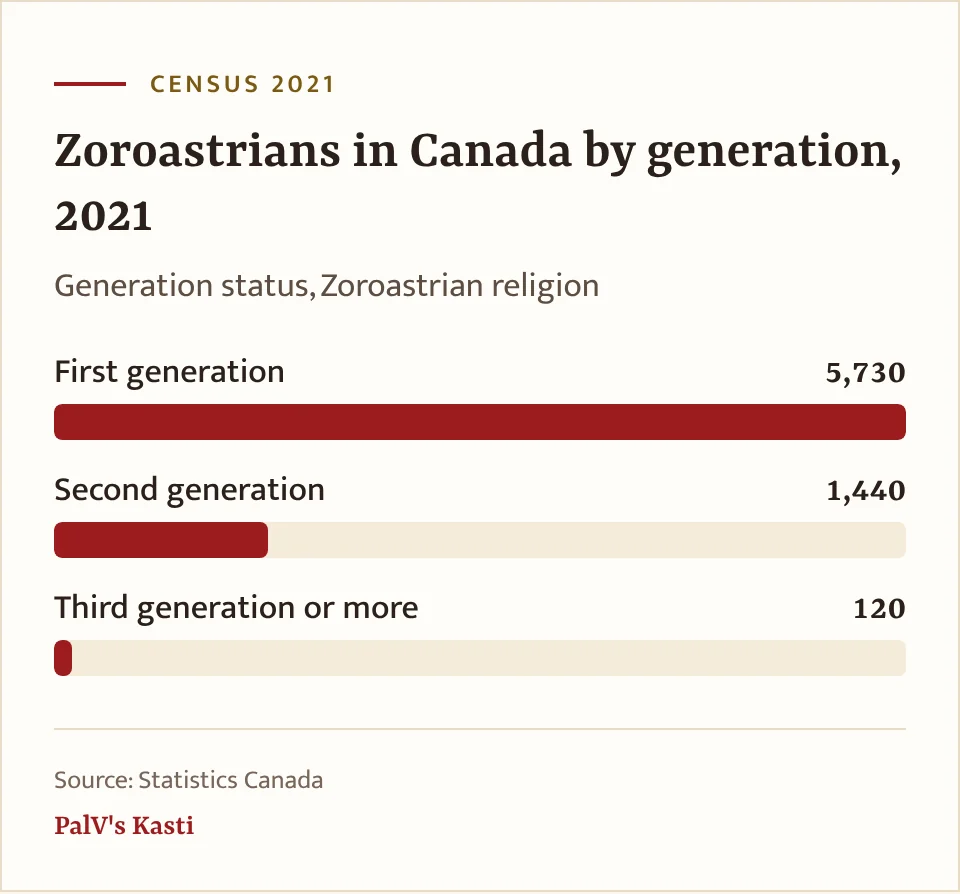
Canada's census shows the generational picture. Statistics Canada's 2021 Census counted 7,285 Zoroastrians in Canada: 5,730 first generation, 1,440 second generation and only 120 third generation or more. By our calculation, about 79% were first generation. In the United States, Paulina Niechciał's 2025 article in the Journal of Persianate Studies names a specific fear: US-born Zoroastrians losing their links to their heritage, and not being recognised by the society around them.
For where these communities are and how they got there, read our guide to the Zoroastrian diaspora. For the population picture back home, see Parsi population in India.
How do Zoroastrian children learn the religion abroad?
Religion classes are one route, and in North America FEZANA, the Federation of Zoroastrian Associations of North America, writes material for them. Its Religious Education Committee publishes a set of lessons called "Zoroastrianism in Diaspora", written for families who, in FEZANA's words, "learn from one another in the diasporas". The identity lessons run from pre-kindergarten to Grades 9–12.
The Grades 6–8 identity lesson shows the approach. Teachers explain that a child may be seen as a student or a friend at school, as a child or sibling at home, and as part of a faith community at the Zoroastrian centre. Students then write down which beliefs, customs, values and community practices they feel most connected to, and why.
Outside the classroom, Harvard's Pluralism Project describes North American youth events "from overnight camps to 'Z-Ski' trips to the Zoroastrian Olympics", and a Zoroastrian scout troop in Toronto. FEZANA's youth wing, ZYNA, brings together Zoroastrians aged 15 to 35. Over Labor Day weekend in 2023, Religion News Service reported, ZYNA took about 20 young adults aged 21 to 35 on a road trip to six dar-e-mehrs, from San Diego to Sacramento. One of them, Shawheen Keyani, 32, told RNS he had once felt that being Zoroastrian made him "sort of like a dodo".
Canada's community has its own history of building these institutions; our page on Parsis in Canada covers it.
Do diaspora Zoroastrians still do Navjote and Kusti?
Yes, and mobeds who live abroad make it possible. The North American Mobeds Council lists "Navjote - Sudreh Pushi" among its services, alongside Jashan, Afringan and Satoom, Gahambars, weddings and funerals. Families find a priest through its "Find a Mobed" directory, and the council says it will give pro-bono religious service to Zoroastrians in North America who are in financial need.
Most of these priests are not paid. Dr Kersey H. Antia, in an undated essay on Parsi settlers in North America, wrote that none of the North American dar-e-mehrs he described had a full-time or even part-time paid priest. Instead, priests who had qualified as navar or martab "in the old country" served as volunteers when needed. He added that some priests' sons, born and raised there, had become navar in India too.
Some rites have not travelled. Almut Hintze of SOAS wrote for the British Academy in June 2016 that "no Yasna ceremonies are performed in the diaspora". Funerals have changed as well. Antia wrote that priests and laity in North America have accepted cremation or burial, and that in Chicago his community arranged with a funeral home to let priests perform the sachkar, the ritual cleaning.
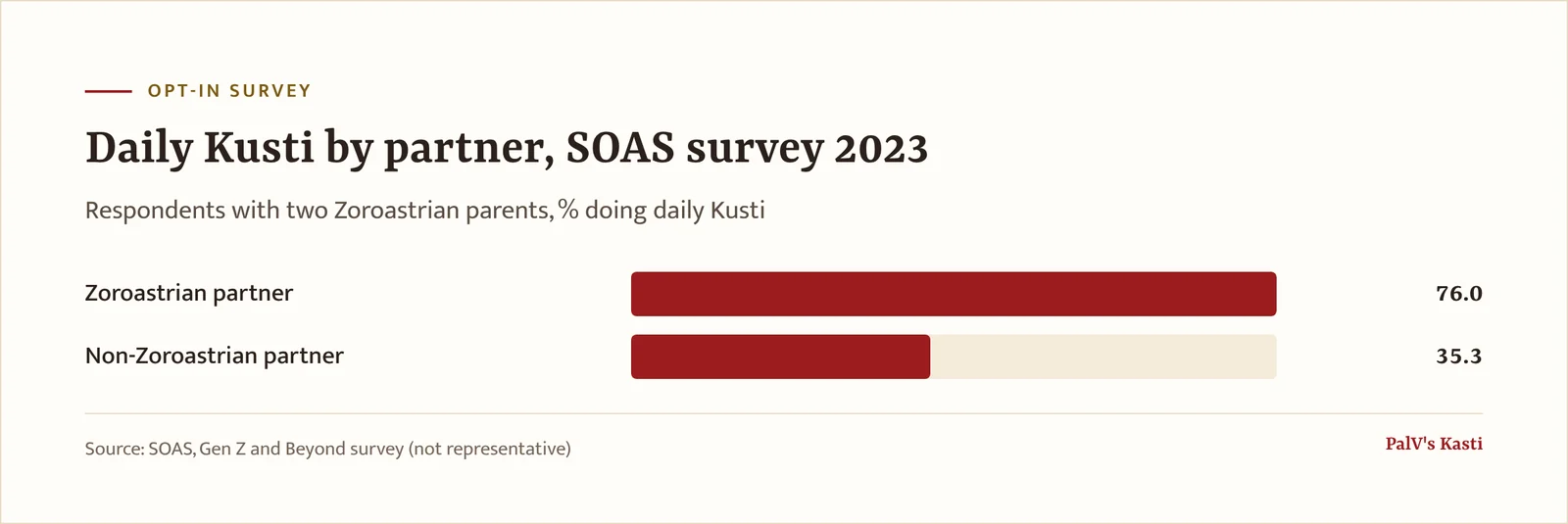
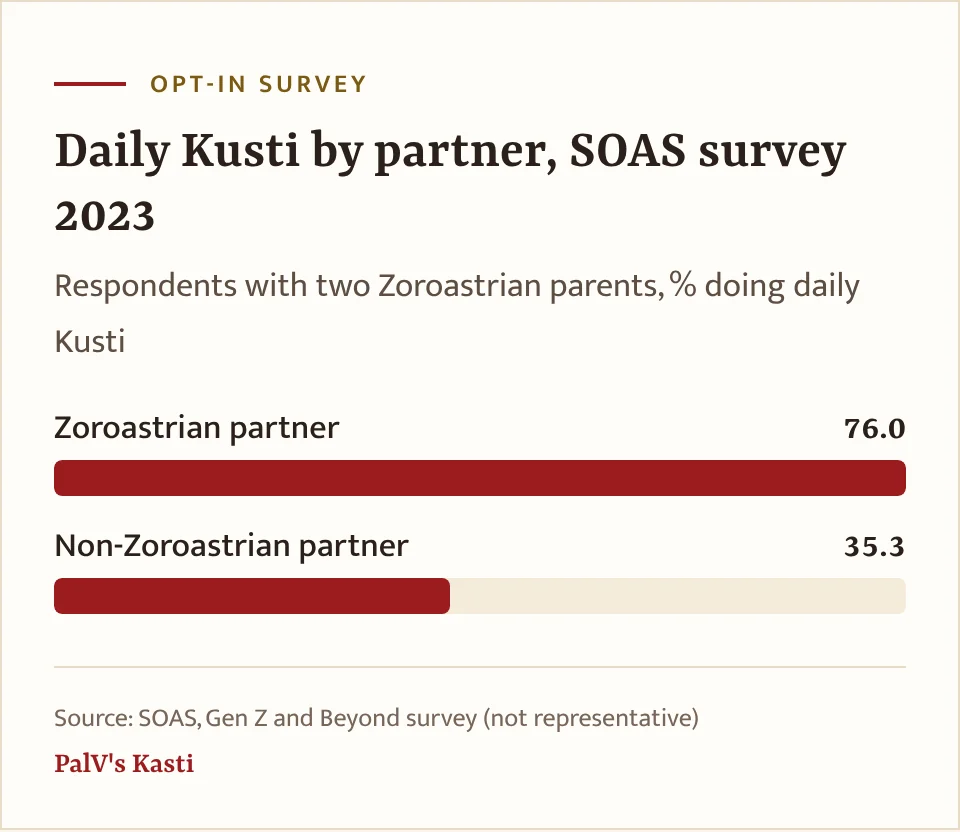
Survey data link daily practice to family life. The SOAS "Gen Z and Beyond" survey of April 2023 had 5,003 respondents. Among those with two Zoroastrian parents, 76.0% of people with a Zoroastrian partner said they did daily Kusti prayers, against 35.3% of people with a non-Zoroastrian partner. The authors stress that the survey was opt-in and is not statistically representative.
Practice varies between families and Agiaries; your family priest's guidance comes first.
How does the tie to Iran and India keep identity alive?
For many Parsis abroad, Iran matters as much as India. Reviewing Hinnells's book The Zoroastrian Diaspora (Oxford University Press) in Times Higher Education in July 2006, Hintze summarised his finding that many American Parsis of the second and third generation see Persia, "rather than India", as their homeland. That tie, Hinnells found, is kept alive by praying in Avestan, by Achaemenid motifs on the walls of homes and prayer rooms, and by stories from the Shahnameh.
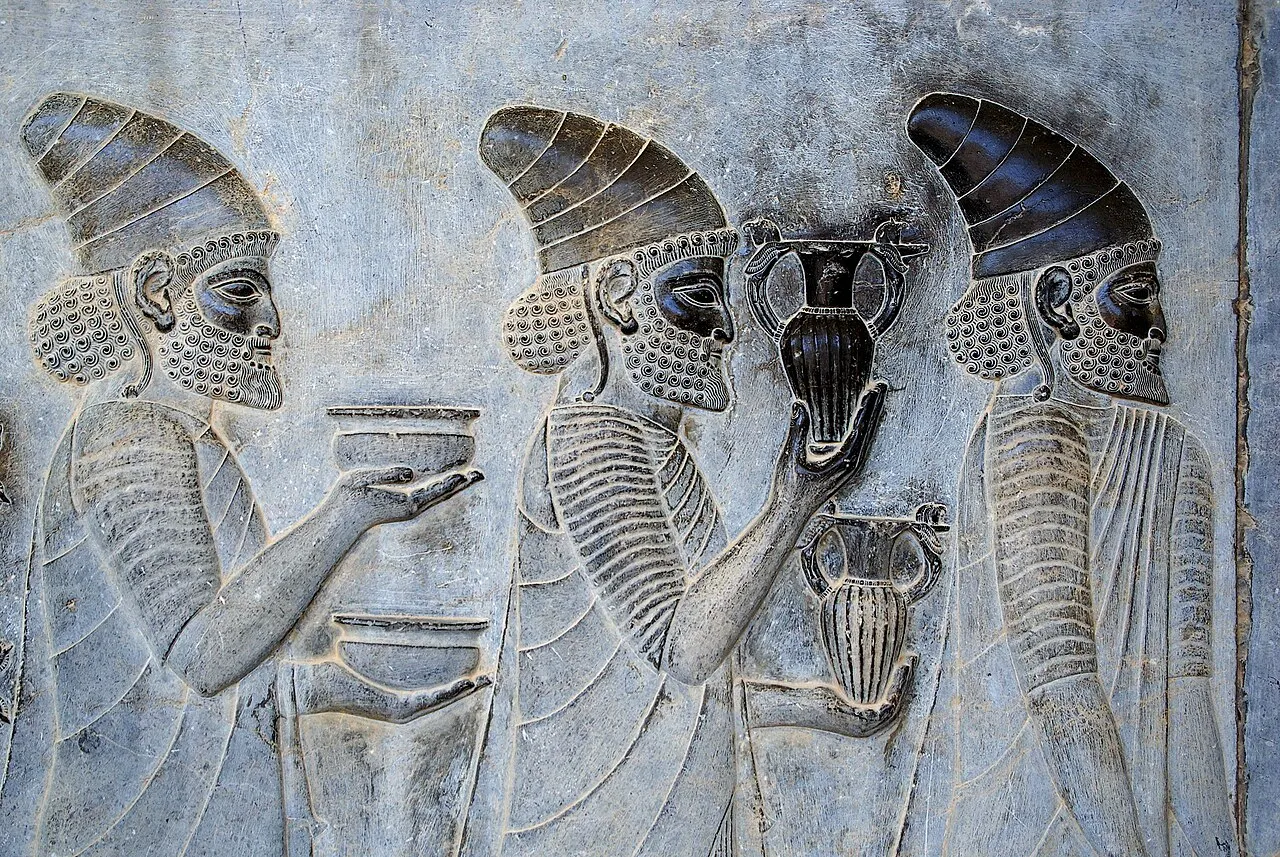
Some families go back. Pheroza Surti Daruwalla's 2019 PhD thesis at the University of Sydney followed a three-week pilgrimage to Iran. She asks whether trips to Iran and India could help diaspora Zoroastrians, especially the second generation in Australia, reconnect with their faith. Her thesis notes that the religion has no formal pilgrimage tradition, so such travel is something families choose for themselves.
The heritage stories cannot be taken for granted. In the SOAS survey, 44.2% of respondents aged 18 to 25 had never heard of the Shahnameh, and 22.1% had never heard of the Qisseh-ye Sanjan. Belonging is also shifting: 76.3% of migrant respondents called the country they live in now "home", while 36.9% named their birthplace.
Do Parsis and Iranian Zoroastrians abroad form one community?
They share buildings, but not always calendars. The Pluralism Project notes that most Parsis speak English and Gujarati, while most Iranian Zoroastrians "claim Farsi as their mother tongue". The two groups observe slightly different rituals and festivals, and often follow different religious calendars. Some associations still keep parallel schedules.
There are moves to bring them together. The Zoroastrian Society of Washington State adopted the Fasli calendar in 1994 to encourage joint observances. One Bay Area Zoroastrian predicted to the Pluralism Project that the Parsi and Iranian labels would disappear and "we will simply be American Zoroastrians". On the ZYNA trip, Keyani told RNS: "We're just all Zoroastrians at the end of the day."
Not every scholar sees the gap closing. Writer's chapter says the religious and cultural differences between the two groups persist. Smaller communities in Europe face the same questions with fewer people; our page on Zoroastrians in Italy looks at one of them.
Why do intermarriage and conversion divide diaspora communities?
Hinnells, in Hintze's summary, calls intermarriage and conversion "key issues of communal, highly divisive, disputes". Marrying within the community, the review notes, is getting harder "in small and dwindling diasporic communities". Intermarriage happens especially among highly educated cosmopolitans. Writer's chapter warns that a rise in marriages outside the community could wear away its distinct identity.
The same review reports a pull in the other direction. East African Zoroastrians who moved to Britain in the 1960s were religiously orthodox, and they helped reassert traditional boundaries in the London community.
Attitudes among the young are recorded in the SOAS survey. Of respondents aged 18 to 25 who were in a relationship, 49.5% had a non-Zoroastrian partner or spouse. 79.6% of 18 to 25-year-olds accepted both intermarried men and intermarried women, and 91.6% of North American respondents of all ages did so. Niechciał's 2025 article adds that the American setting blurs ethnic boundaries and accepts conversion, unlike Iran.
Practice varies between families and Agiaries; your family priest's guidance comes first.
Frequently asked questions
How do Zoroastrian children learn the religion abroad?
Through religion classes and youth activities. In North America, FEZANA's Religious Education Committee publishes "Zoroastrianism in Diaspora" identity lessons from pre-kindergarten to Grades 9–12. Youth camps, ski trips, the Zoroastrian Olympics and ZYNA, FEZANA's youth wing for ages 15 to 35, add friendships and a sense of belonging outside the classroom.
Can a Navjote be performed outside India?
Yes. The North American Mobeds Council lists "Navjote - Sudreh Pushi" among its services, along with Jashan, weddings and funerals, and keeps a "Find a Mobed" directory. Dr Kersey Antia wrote that North American priests mostly serve as unpaid volunteers who had qualified as navar or martab "in the old country". Your family priest's guidance comes first.
What divides Parsis and Iranian Zoroastrians abroad?
Language and calendar, above all. Harvard's Pluralism Project says Parsis mostly speak English and Gujarati and Iranians Farsi, and that the two groups often follow different religious calendars and slightly different rituals. Some associations hold parallel events. The Zoroastrian Society of Washington State adopted the Fasli calendar in 1994 to encourage joint observances.
Do diaspora Zoroastrians accept intermarried families?
Views differ, and John Hinnells described intermarriage as a highly divisive issue in the diaspora. In SOAS's opt-in 2023 survey of 5,003 people, 79.6% of 18 to 25-year-olds accepted both intermarried men and women, rising to 91.6% among North American respondents. The survey is not statistically representative, and families and Agiaries answer the question differently.
Why do diaspora Zoroastrians visit Iran and India?
To reconnect with the places their faith and families come from. Pheroza Surti Daruwalla's 2019 University of Sydney thesis studied a three-week pilgrimage to Iran. It asks whether such trips could help second-generation Australian Zoroastrians reconnect with their religion, which has no formal pilgrimage tradition. John Hinnells found that many American Parsis see Persia as their homeland.


