 PalV's Kasti

On this page
- How does Iran's government view the Zoroastrian revival?
- What does Iran's constitution say about Zoroastrians?
- Can a Muslim convert to Zoroastrianism in Iran?
- Do scholars see the revival as opposition to the state?
- How many Zoroastrians live in Iran?
- What happened at the Cyrus Day gatherings at Pasargadae?
- Frequently asked questions
Iran's government has not, in any source we could find, made a formal statement about the Zoroastrian revival as such. Its position shows up in law instead. The Islamic Republic recognises Zoroastrians as one of three protected minorities and gives them a seat in parliament, but it treats leaving Islam as apostasy and, according to the European Union Agency for Asylum (EUAA), does not recognise conversions from Islam to Zoroastrianism. So the Iran Zoroastrian revival meets two different legal positions. People born Zoroastrian may practise within the limits of the law. Muslim-born Iranians drawn to the faith have no legal route in. For the wider picture of the movement, see our post on the Zoroastrian revival.
શહેરેવર રોજ
Shehrevar Roj, Tir Mah · 1396 Y.Z.
How does Iran's government view the Zoroastrian revival?
The state's view has to be read from three things: the constitution, the way courts treat conversion, and how the authorities have handled public gatherings tied to pre-Islamic heritage. None of the government, judiciary or clerical sources we found uses the phrase "Zoroastrian revival".
The closest thing to a clerical comment comes second-hand. Iran International reported in March 2023 that a cleric in Qom spoke of a "strange tendency" among members of the Bakhtiari tribe to take up Zoroastrianism. We know that quote only through the EUAA's May 2025 report, which cites it, so treat it as one reported remark and not as government policy.
What does Iran's constitution say about Zoroastrians?
Iran's 1979 constitution, as amended in 1989, makes Islam of the Twelver Ja'fari school the official religion under Article 12. Article 13 then names Zoroastrian, Jewish and Christian Iranians as the only recognised religious minorities. They may perform their rites, and follow their own rules in personal affairs and religious education, within the limits of the law.
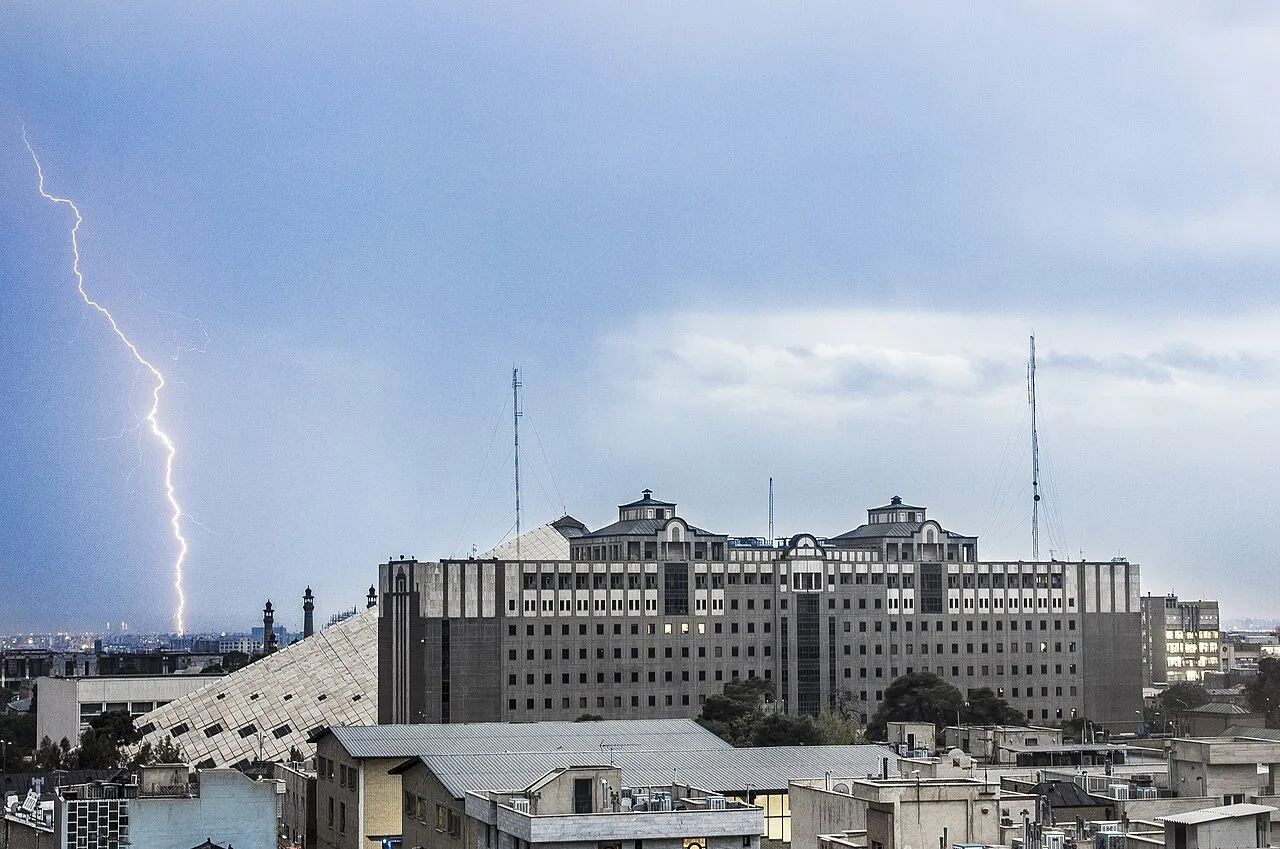
Article 14 asks the government and all Muslims to treat non-Muslims ethically and justly and to respect their human rights. There's a condition attached: the protection covers those who do not conspire or act against Islam or the Islamic Republic.
Article 64 gives Zoroastrians one elected representative in the Majlis, Iran's parliament. The US State Department's 2023 religious freedom report (published 26 June 2024) counts five of the 290 seats as reserved for recognised minorities: two for Armenian Christians, one shared by Assyrian and Chaldean Christians, one for Jews and one for Zoroastrians.
Can a Muslim convert to Zoroastrianism in Iran?
Not legally. The State Department says that under Iranian law, as usually interpreted, Muslim citizens may not change or renounce their religion, and the only conversions the state recognises are those into Islam. Sharia as the government interprets it treats conversion from Islam as apostasy, which it regards as a crime punishable by death.
One detail matters here. Both the State Department and the EUAA note that apostasy is not written into Iran's penal code. The State Department says the code instead tells judges to rely on the constitution and fatwas in apostasy cases, and the EUAA says a conversion "can be seen as apostasy under the Sharia law". The EUAA, citing Iran International, adds that conversions from Islam to Zoroastrianism are not recognised by the state.
Paulina Niechciał, a specialist in Zoroastrianism at Jagiellonian University in Kraków, wrote in a paper published on 9 May 2025, which the EUAA cites, that the ban on apostasy in practice "precludes conversion to Zoroastrianism" and also rules out spreading pro-conversion views in public. She also wrote that conversion "has been illegal, impossible, or risky". The State Department adds that a citizen who is not a registered Christian, Jew or Zoroastrian is treated as Muslim and generally may not express their faith in public.
Zoroastrians themselves don't agree on converts either. According to the EUAA, Zoroastrians hold no single unified view on whether the faith accepts converts. Römer, in the study described below, notes that communities in Iran and India have long kept a strict ethno-religious identity, while debate about admitting converts has grown in recent decades. That debate is set out in our post on converting to Zoroastrianism.
Practice varies between families and Agiaries; your family priest's guidance comes first.
Do scholars see the revival as opposition to the state?
Benedikt Römer, writing in the journal Entangled Religions in June 2024, studied the life stories of two Muslim-born Iranians who took up what he calls Neo-Zoroastrianism. He proposes reading it in two ways at once: as a movement of religious revival and reform, and as a form of resistance to the Shi'ite Islam promoted by the Islamic Republic. Religion Watch, summarising his work in September 2024, reports that contact between ethnic Zoroastrians and Neo-Zoroastrians inside Iran is little and cautious, and that Neo-Zoroastrians can speak openly only outside the country. Our post on Neo-Zoroastrianism covers the movement itself.
In GAMAAN's online survey of June 2020, 7.7% of respondents chose "Zoroastrian". Michael Stausberg, Pooyan Tamimi Arab and Ammar Maleki, writing in the Journal for the Scientific Study of Religion in 2023, put the weighted figure at 8% and called it "Survey Zoroastrianism". They argue that surveys outside state control let people voice identity aspirations tied to nationalism and civilisational heritage. The EUAA, citing the same authors, notes that some Muslims may see such a conversion as opposition to the Islamic Republic rather than a religious step, and that people who identify this way may avoid formal conversion, given the risk of the death penalty, and keep their religion private.
The EUAA also quotes Canada's Immigration and Refugee Board (March 2022), which cited a 2015 study describing a trend among Iranian youth of converting from Islam to Zoroastrianism, with no official figures because of fear of state persecution. How young people elsewhere are shaping the faith is the subject of our post on Zoroastrian youth.
How many Zoroastrians live in Iran?
Nobody has a precise count, and the sources disagree:
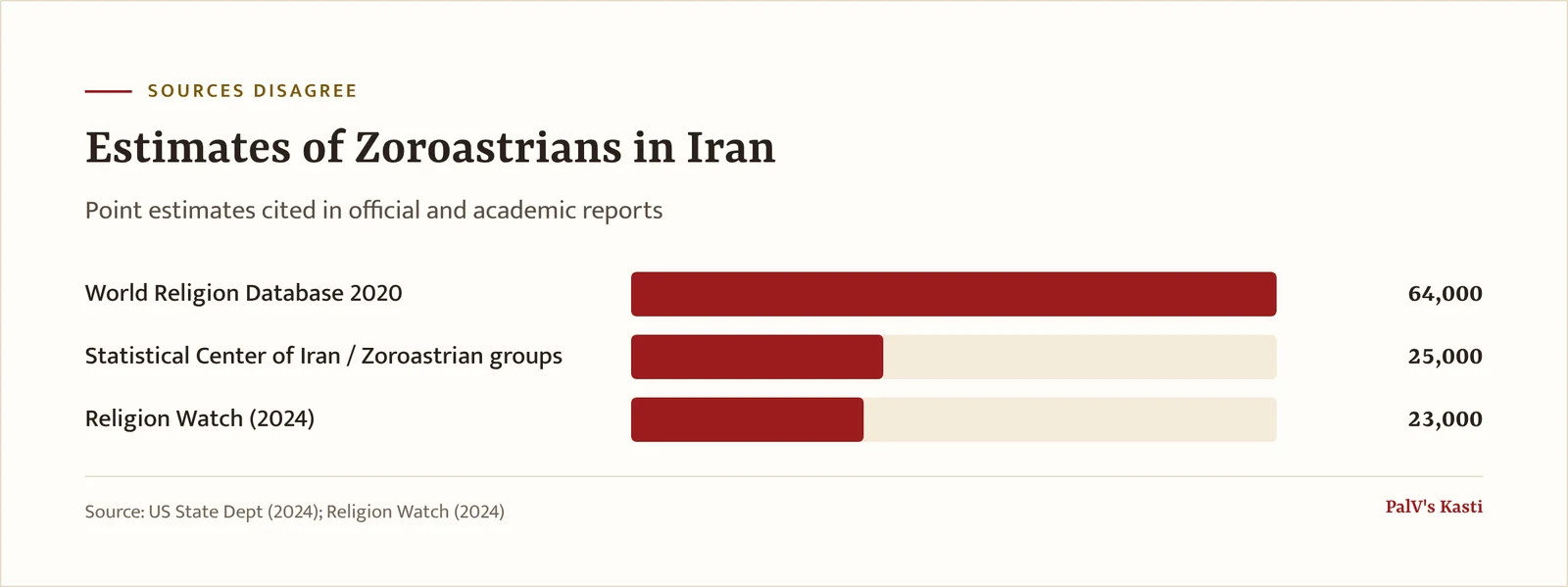
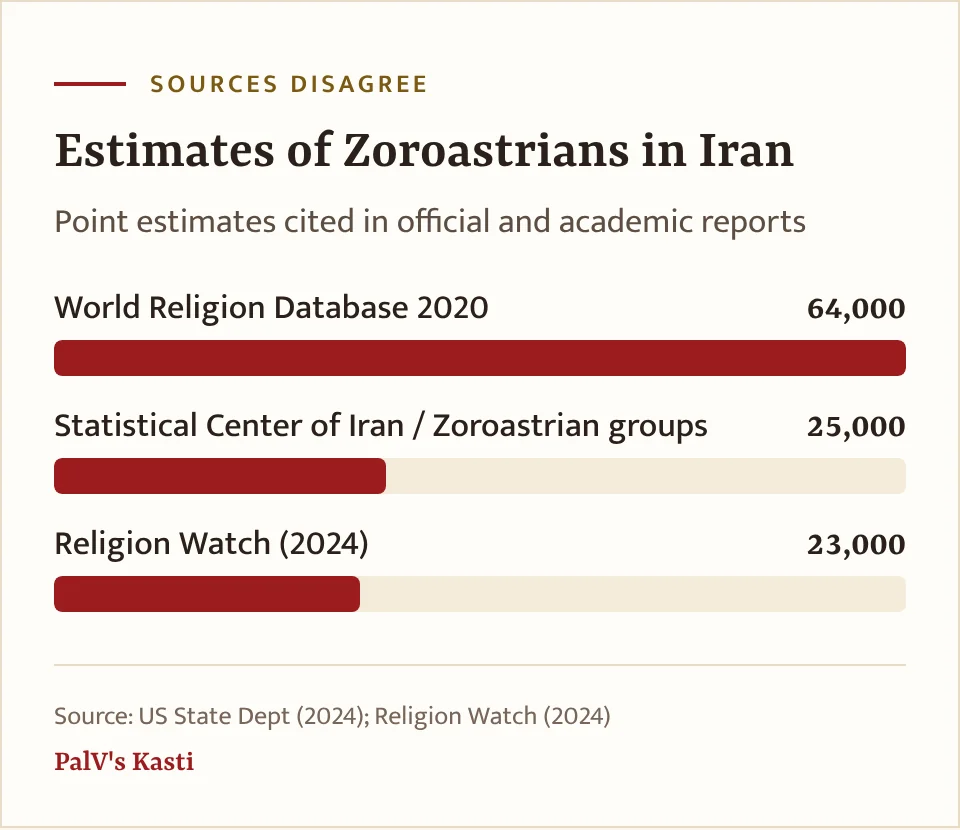
- About 25,000, the figure the US State Department gives from Zoroastrian groups and the government-run Statistical Center of Iran.
- 64,000, the World Religion Database's 2020 estimate, also cited by the State Department.
- 11,000 to 25,000, or up to 50,000, in the estimates the EUAA cites from France 24 and from Stausberg and colleagues. The EUAA says there are no precise figures.
- About 23,000, most of them now in Tehran, according to Religion Watch (September 2024).
Stausberg and colleagues point out that the 8% in the 2020 online survey is many times the number recorded in scholarship. That gap is why they read survey identification as a statement of identity, not a headcount of community members.
What happened at the Cyrus Day gatherings at Pasargadae?
Cyrus Day, 29 October, has no official holiday status. It is the day when people gather at the tomb of Cyrus the Great at Pasargadae in Fars province. The reports describe it as a celebration of a pre-Islamic king. They don't call it a Zoroastrian rite or describe the people there as Zoroastrians. We include it because Stausberg and colleagues tie Zoroastrian self-identification to nationalism and civilisational heritage, the same pre-Islamic past the gathering marks.
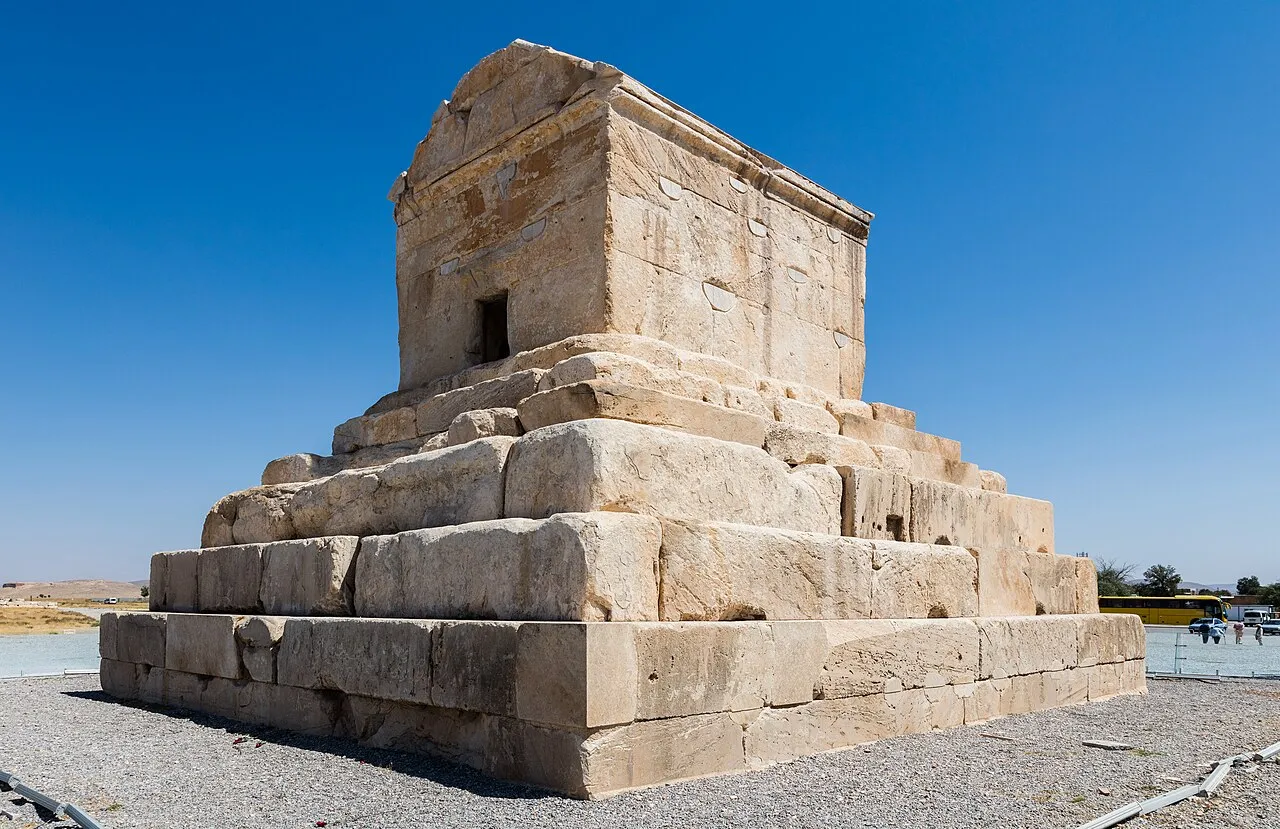
On 31 October 2016, AP, citing the semi-official ISNA news agency, reported that several organisers of the gathering had been detained. Fars province prosecutor Ali Salehi said they were held over "norm-braking and anti-values" slogans chanted at the gathering. AP added that the clerics who came to power in 1979 generally reject celebrations of pre-Islamic icons.
A year later, on 29 October 2017, Radio Farda reported that the judiciary's news agency Mizan said the Intelligence Ministry had "identified and destroyed" plans for an "illegal gathering" at the tomb. Radio Farda also reported that scores of people had been arrested after thousands gathered in 2016, with some later sentenced to prison.
Frequently asked questions
Is Zoroastrianism legal in Iran?
Yes, for those born into it. Article 13 of Iran's constitution names Zoroastrians, Jews and Christians as the only recognised religious minorities, free to perform their rites and follow their own rules in personal and religious matters within the limits of the law. Recognition covers the existing community. It does not extend to Muslim-born Iranians who wish to convert.
Can a Muslim convert to Zoroastrianism in Iran?
Not with legal recognition. The US State Department says Iranian law, as usually interpreted, bars Muslims from changing religion, and the government treats leaving Islam as apostasy. Apostasy isn't in the penal code, so judges are told to rely on the constitution and fatwas. The EUAA reports that the state does not recognise conversions from Islam to Zoroastrianism.
Do Zoroastrians have a seat in Iran's parliament?
Yes, one. Article 64 of the constitution says Zoroastrians and Jews each elect one representative to the Majlis. According to the US State Department, five of the 290 seats are reserved for recognised minorities: two for Armenian Christians, one shared by Assyrian and Chaldean Christians, one for Jews and one for Zoroastrians.
How many Zoroastrians live in Iran?
Estimates differ. The US State Department cites about 25,000, a figure from Zoroastrian groups and the Statistical Center of Iran, and a World Religion Database estimate of 64,000. The EUAA says there are no precise figures and cites estimates of 11,000 to 25,000, with some sources going as high as 50,000.
Why are Cyrus Day gatherings at Pasargadae restricted?
Iranian officials described the gatherings in political terms. In 2016 the Fars prosecutor said organisers were detained over "norm-braking and anti-values" slogans, and in 2017 the judiciary's news agency called a planned gathering illegal. AP noted that Iran's post-1979 clerics generally reject celebrations of pre-Islamic figures. None of these reports calls it a Zoroastrian observance.
This is general information, not legal advice; for a specific case, speak to a lawyer.


