 PalV's Kasti
On this page
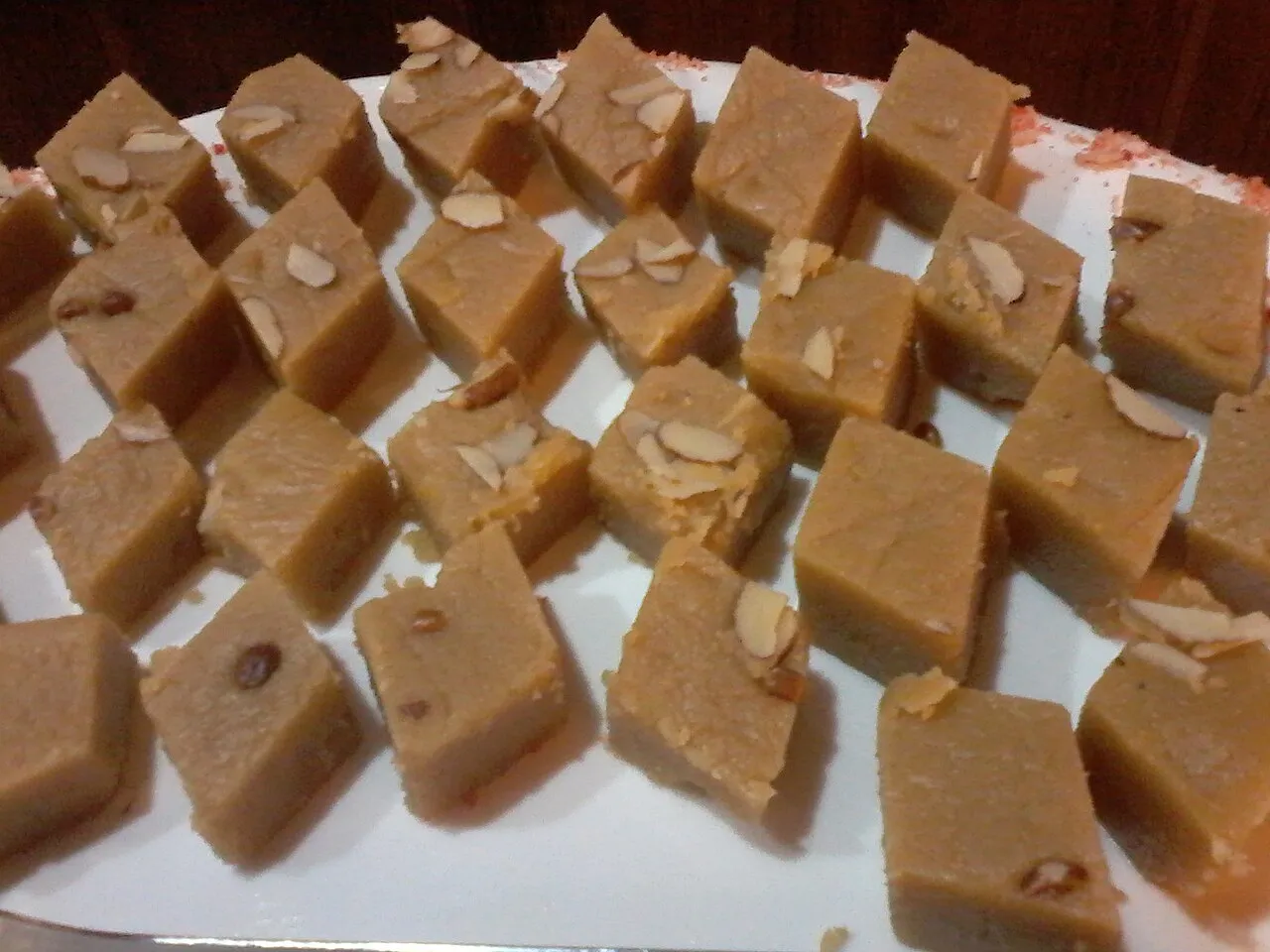
Badam pak is an almond sweet made in Parsi kitchens. To make it, you boil sugar with rose water, take it off the heat and stir in mawa (khoya). Almonds and ghee go in next, and the mixture is cooked on a low flame, stirred all the while, until it leaves the sides of the pan. Cardamom and nutmeg are mixed in at the end, the mass is spread on a greased thali, and it is cut into squares once cool. That order of work comes from Tarla Dalal's published recipe, which is not labelled Parsi. Niloufer Mavalvala's Parsi cookbook calls her version an almond caramel toffee, but its method is behind a paywall. So this page gives you the steps without measurements we cannot stand behind.
શહેરેવર રોજ
Shehrevar Roj, Tir Mah · 1396 Y.Z.
What is badam pak, and where does it sit among Parsi sweets?
FEZANA's community cookbook Eat, Live, Pray (2012) glosses "badam" simply as almonds. In The Route to Parsi Cooking (2024), Niloufer Mavalvala groups badam pak with doodh pak, akhrot no halvo and copra pak as Parsi delicacies carrying both Persian and Indian influences. In the same chapter she places ravo, eeda pak, sua pak and gajar no halvo among the sweets with Persian roots. For the wider picture of which sweet is made for which day, see our guide to Parsi sweets.
Mavalvala gives badam pak a full recipe in an earlier book, The World of Parsi Cooking: Food Across Borders (2019). She titles it "Almond Caramel Toffee (Badaam Pak)" and sets the yield at two and a half kilos. Her headnote compares family recipes to secrets kept close to the heart, and says this one brings back happy childhood memories.
What goes into badam pak?
- Almonds, the sweet's namesake
- Mawa (khoya), the cooked-down milk solids that give the sweet its body
- Sugar, boiled first with rose water
- Ghee, added along with the almonds
- Cardamom and nutmeg, stirred in near the end
Tarla Dalal's published badam pak uses exactly this set: rose water, sugar, mava, almonds, ghee, cardamom and nutmeg. Her page doesn't present it as a Parsi recipe, and it gives no quantities. The versions we saw credited to Parsi cooks online differ from each other, some leaning on mawa and others on milk reduced at home. We couldn't trace any of them to a published original, so we haven't reproduced them.
How is badam pak made, step by step?
The order of work below follows Tarla Dalal's method. Treat it as a guide to what happens in the pan and when, then take your measurements from a family recipe or from Mavalvala's book.
- Boil the sugar with the rose water, then take the pan off the heat.
- Stir the mawa into the hot syrup until smooth.
- Add the almonds and the ghee.
- Return the pan to a low flame and keep stirring with a wooden spoon. The mixture is ready when it comes away from the sides of the pan.
- Stir in the cardamom and nutmeg.
- Spread the mass evenly on a thali greased with ghee.
- Once it has cooled, cut it into squares.
Step four is the one that needs patience. Go by the mass leaving the sides of the pan, not by the clock.
How do you make mawa for badam pak at home?
A note on mawa in FEZANA's Eat, Live, Pray gives two ways. The slow one is to keep full-fat milk at a simmer of about 80°C in an iron karahi or wok for several hours, until the water has gone and only caramelised milk solids are left.
For North America, the same note offers a microwave shortcut. A 250 g tub of ricotta is cooked for three minutes to drive off its water, then mixed with 1 tbsp ghee, 3 tbsp full-fat milk powder and 3 tbsp double cream. That goes back in on high for four to five minutes, with a stir every minute or so, and is kneaded once slightly cooled. The book warns this mawa is very rich. For a lighter one, it says, use the cooked-down ricotta on its own.
When and where do Parsis eat badam pak?
We found no published source that ties badam pak to a particular Parsi occasion, so we won't invent one. What we did find is everyday and seasonal. In 2014 DNA's Meher Mirza wrote about the tiny Parsi Amelioration Committee stall on Grant Road in Mumbai, where, on misty winter mornings, Parsis bought vasanu, eeda pak and badam pak to eat with their breakfast akuri.
It travels too. In 2020 ParsiCuisine.com listed Roshan Rivetna's Parsi Mithai Shop, shipping within the USA and Canada, selling badam pak in half-pound servings packed in gift boxes. For the sweets Meher Mirza describes on a Navroz morning in Saveur, see our pages on Parsi sev and Parsi ravo.
Frequently asked questions
Is badam pak only a Parsi sweet?
No. Niloufer Mavalvala, writing about Parsi desserts in 2024, lists badam pak among the Parsi sweets with both Persian and Indian influences. Tarla Dalal publishes a badam pak with no community label, built on the same almonds, mawa, sugar, ghee, rose water, cardamom and nutmeg, so the sweet is not confined to Parsi cookbooks.
Is badam pak the same as mawa ni boi?
No. Badam pak is an almond sweet set in a tray and cut into squares. Mawa ni boi is a fish-shaped sweet made from khoya, which Saveur and Homegrown both connect with the Parsi New Year. You can read how it is made and why it is shaped like a fish in our page on Mawa ni boi.
Can I make badam pak without shop-bought mawa?
Yes. You can simmer full-fat milk for several hours until only the milk solids remain. FEZANA's cookbook Eat, Live, Pray also gives a microwave shortcut: ricotta cooked until dry, then enriched with ghee, full-fat milk powder and double cream and cooked again on high, stirring every minute or so, until thick.
How do I know when badam pak is cooked?
Watch the edges of the pan rather than the clock. In Tarla Dalal's method the almond and mawa mixture is stirred on a low flame with a wooden spoon until it leaves the sides of the pan. Only then are the cardamom and nutmeg stirred in and the mass spread on a greased thali to set.


