 PalV's Kasti
On this page
Louis Malle's Parsi wedding footage comes from "Bombay", the seventh and last episode of his documentary series Phantom India (L'Inde fantôme), shot in 1968 and listed by the Criterion Channel as a 1969 French production. The wedding is a brief passage, not a full record of the ceremony. About 18 minutes into the episode, the English subtitles have the narrator say, "We attended a wedding of rich Parsi," held by the Mazdean rite, and the commentary then moves on to the community as the film saw it in 1968: its Persian origins, its funeral custom, its place in Indian industry and its attitude to marrying out. No published review or archive note that we could find describes the shots themselves, so this page sets out what the narration says and how the film was made and received.
If you want to know what actually happens at a Parsi wedding, our main guide explains each stage.
અસપંદામેદ રોજ
Asfandarmad Roj, Tir Mah · 1396 Y.Z.
What is Phantom India?
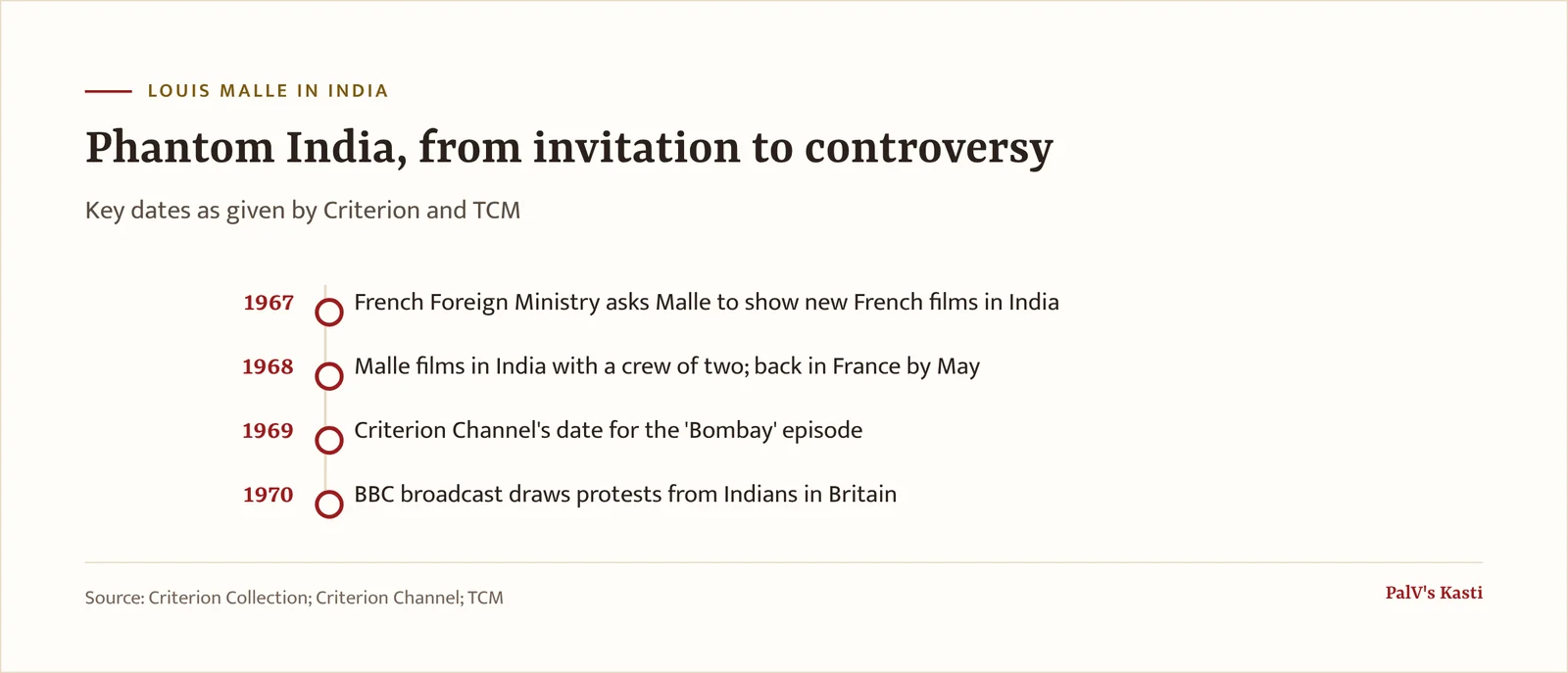
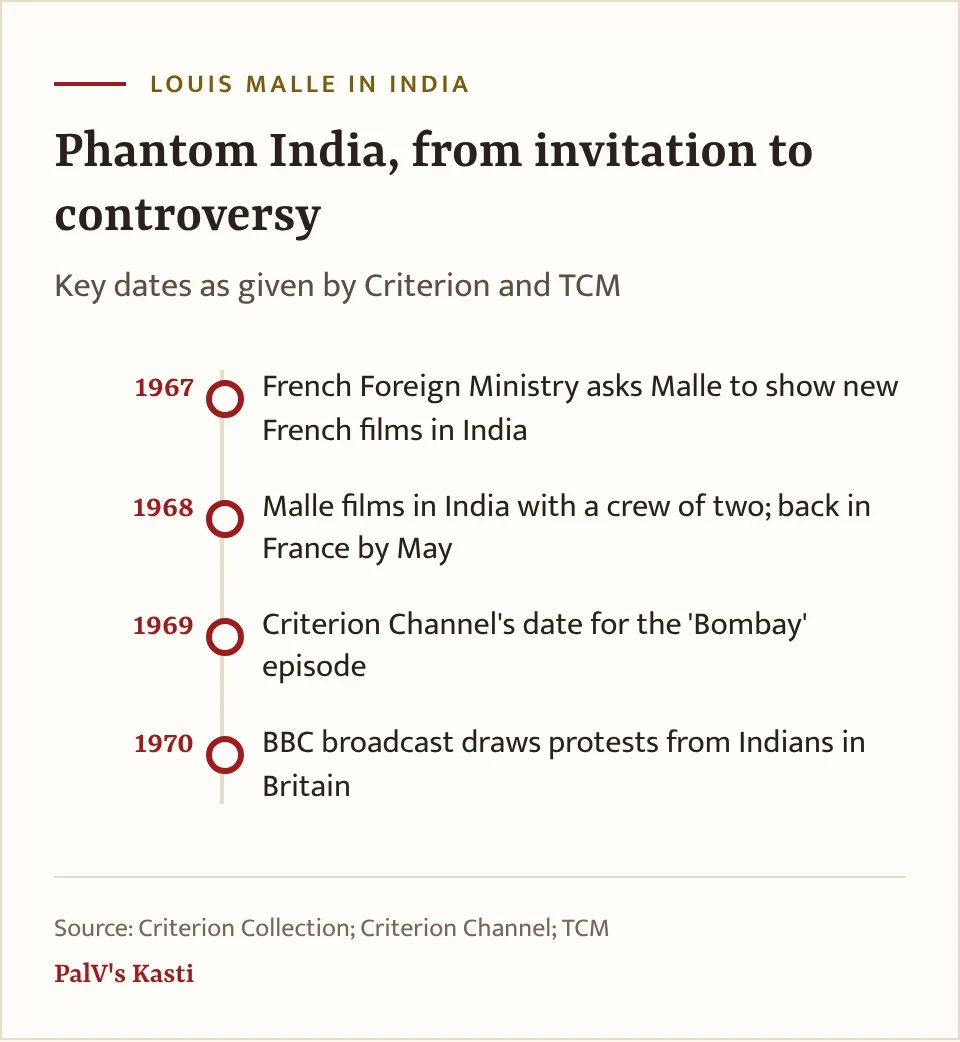
Phantom India is a documentary in seven parts by the French director Louis Malle. The Criterion Collection's essay on Malle's documentaries says that in late 1967 the French Ministry of Foreign Affairs asked him to tour India presenting new French cinema, and that he went back to India in early 1968 with a crew of two: Étienne Becker on a 16mm camera and Jean-Claude Laureux on sound. Sean Axmaker's 2007 article for TCM names the same two men.
The two accounts differ on the size of the shoot. The Criterion essay gives five months of filming and thirty hours of footage, cut down to 363 minutes. TCM gives six months and more than 40 hours of 16mm film, edited into eight films: seven became Phantom India, which was shown on French television, and the eighth was a separate film on Calcutta. The Criterion Channel says Malle called Phantom India the most personal film of his career.
What does the "Bombay" episode say about the Parsi wedding?
We read the English subtitles of episode 7 on pad.ma, the Public Access Digital Media Archive, which lists the episode at 49 minutes 31 seconds with Becker as cinematographer (the Criterion Channel lists it at 52 minutes). The Parsi passage follows a section on India's new industrial fortunes. In the subtitles it runs from about 18:13 to 20:12 (about two minutes, by our reading of the timecodes). In that time the narrator, speaking for the film:
- describes Parsis as the pioneers of Indian capitalism;
- says the crew attended the wedding of a wealthy Parsi family, held according to the Mazdean rite founded by Zarathustra;
- says the community is concentrated in Bombay and came from Persia to escape persecution;
- briefly describes the Parsi custom of the Towers of Silence;
- mentions that the Tata family founded India's first steelworks;
- says Parsis hold firmly to their traditions, and states that a Parsi who marries outside the community is ostracised.
In the subtitles, that is the whole of the commentary on Parsis in this stretch. The wedding is named once and the narration moves on. The narration does not name the families, the venue or the priests, and it does not explain the stages of the Ashirwad. The remarks on the funeral custom and on marrying out are the film's own commentary from 1968, written for a French television audience. They are not a guide to how families or Agiaries approach these questions today. Practice varies between families and Agiaries; your family priest's guidance comes first.
A few minutes later the same episode returns to Parsis briefly, describing a yoga class in Bombay where many of the students were well-off Parsis.
Was the film made in 1968 or 1969?
Both dates are right for different things. According to the Criterion essay, Malle went back to India in early 1968, was home in France by May 1968 after five months of shooting, and then spent a year editing. The Criterion Channel lists the "Bombay" episode as a 1969 film. The wedding footage was therefore shot in 1968, in a film dated 1969.
Why was Phantom India controversial?
The trouble came when the series reached British television. TCM reports that the BBC showed it in 1970, that Britain's Indian community wrote letters of protest, that the Government of India also protested, and that India then expelled the BBC's New Delhi bureau. The Criterion essay describes forceful opposition from Indians in England, who felt the film dwelt on beggars, poverty and unrest and ignored the country's economic progress and middle class. It adds that Malle's name became notorious in India even though the film was never shown there.
Where can you watch Louis Malle's Parsi wedding film?
As of November 2026, the Criterion Channel streams all seven episodes of Phantom India, with "Bombay" listed as episode 7. The pad.ma archive also holds the episode with English subtitles. Look for the Parsi passage at around the 18-minute mark.
For the customs a film like this only glimpses, see our page on unique Parsi wedding customs, and for the prayers themselves, the Parsi wedding Ashirwad.
Frequently asked questions
What is Phantom India?
Phantom India (L'Inde fantôme) is a seven-part documentary by the French director Louis Malle, filmed across India in 1968 with a two-man crew and first shown as a television series. Its last episode, "Bombay", includes a short passage about a Parsi wedding. Malle called it the most personal film of his career, according to the Criterion Channel.
Does Phantom India show a Parsi wedding?
Yes, briefly. In episode 7, "Bombay", the narrator says the crew attended a wealthy Parsi wedding held by the Mazdean rite, then talks about the community's origins, customs and place in Indian industry. The passage lasts about two minutes, and the narration does not name the families or venue or explain the ceremony step by step.
Where can I watch Louis Malle's Phantom India?
As of November 2026, the Criterion Channel streams all seven episodes, with "Bombay" as episode 7. The pad.ma archive, the Public Access Digital Media Archive, also holds that episode with English subtitles. The Parsi wedding passage begins roughly 18 minutes into the episode, after a section on India's industrial fortunes.
Why was Phantom India controversial?
When the BBC broadcast it in 1970, Indians in Britain protested that it dwelt on poverty and unrest. TCM reports that the Government of India protested too and expelled the BBC's New Delhi bureau. The Criterion Collection notes that Malle's name became notorious in India, although the film was never shown there.
Who filmed Phantom India with Louis Malle?
Malle worked with a crew of two. Étienne Becker shot the film on a 16mm camera and Jean-Claude Laureux recorded the sound, according to both the Criterion Collection and TCM. The sources differ on the shoot itself: Criterion gives five months and thirty hours of footage, TCM six months and over 40 hours.


