 PalV's Kasti

On this page
Murghi no palau is the Parsi chicken palau: chicken, potatoes and rice cooked together with spices and yoghurt in one sealed pot. The name says pulao, but the cooking often looks like a biryani. Karachi-born cookbook author Niloufer Mavalvala puts it plainly, writing that Parsis still call their dishes palau while cooking them in a way best described as biryani. What sets the Parsi version apart is less the method than what goes in and around it. Potatoes are expected, fried onions and dry fruit go on top, and a bowl of dal sits alongside. This guide explains the name, the difference from biryani, and gives Mavalvala's own recipe.
શહેરેવર રોજ
Shehrevar Roj, Tir Mah · 1396 Y.Z.
What is murghi no palau?
The name pairs murghi, chicken, with palau, the Parsi form of pulao. Mavalvala's recipe, printed by the Canadian food body Taste Canada from her book The Route to Parsi Cooking: From Pars to India and Beyond, carries the title "Murghi no Palau | Chicken Biryani". She puts both names on the same dish, and that tells you a lot.
The mutton version, gos no palau, is the better-known one. In her column for The Cook's Cook, Mavalvala names gos no palau with masala ni daar as the traditional Parsi wedding pairing, and the chicken palau as the compromise. Palaus with fish or prawns exist too, and in her words vegetable palaus are not commonly made.
Is Parsi palau a pulao or a biryani?
Both words describe rice cooked with meat, and Mavalvala calls the difference between them subtle. Mavalvala traces the name across languages: polow in Persian, pilav in Turkish, pilaf or pilav in Arabic, pulao in Hindi and Urdu. She credits the Mughals with the richer biryani, which added saffron and dairy.
Her working distinction is this. A pilaf cooks raw rice in broth with aromatics, dry fruit, nuts or meat. A biryani uses par-boiled rice with plenty of ghee, milk or yoghurt, meat and saffron. By that test, she says, Parsis keep the word palau but cook something best described as biryani.
There is a twist in her own murghi no palau, though. The rice goes in raw, over yoghurt and par-cooked chicken, and cooks in salted water in the sealed dish. She notes this saves one pot. So her recipe borrows from both sides: pilaf-style raw rice, with the yoghurt and saffron of a biryani in the ingredient list. If you want the dish cooked and sold under the biryani name, our post on Parsi chicken biryani covers it.
What makes a Parsi chicken pulao different from biryani?
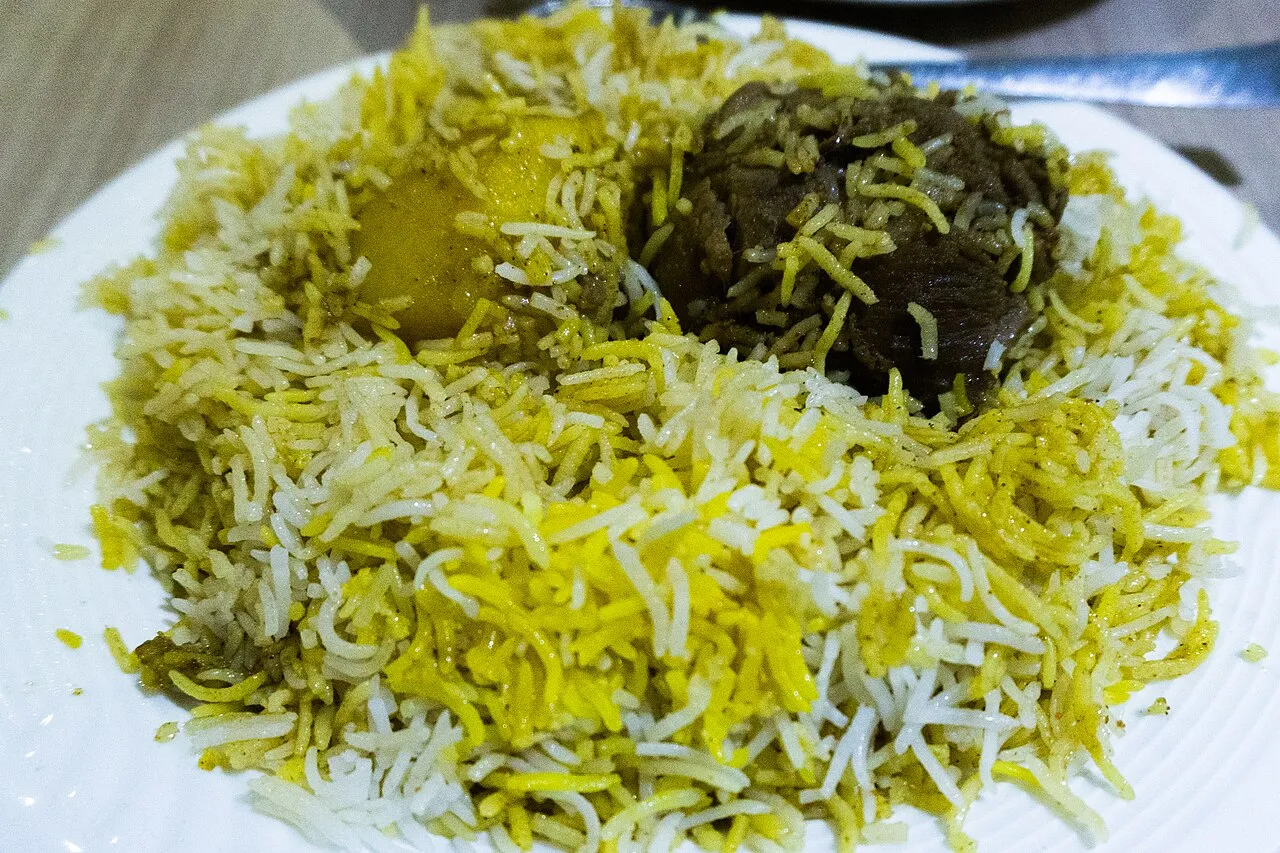
Potatoes, always
Mavalvala calls potatoes in a Parsi palau a deal breaker, and compares this with the Kolkata biryani. Mumbai caterer and food writer Perzen Patel, writing for India Food Network in October 2015, describes two ways Parsi cooks do it. The potatoes are either steamed into the rice, or the finished pulao is topped with deep-fried potato quarters. In Mavalvala's murghi no palau they steam with the chicken before the rice goes in.
Fried dry fruit and onions on top
Patel's main complaint about the biryanis she finds in Mumbai is that everything turns soggy after the dum, with nothing to give texture. Parsi pulaos, she says, are usually finished with fried cashews, almonds and raisins, for crunch. Mavalvala lists dry fruits, nuts, boiled eggs, herbs and crisp fried onions (barista) as the usual garnishes for palau.
Dal on the side
Patel writes that, apart from prawn pulao, most Parsi pulaos come with dhansak dal made without the meat, plus kachumber, and argues that this makes the pulao a full meal in a way biryani isn't for her. She also says the meat's own fat and gravy carry the flavour, so a Parsi pulao needs little added oil. That last point is her view as a cook, and Mavalvala's recipe below uses just a teaspoon of oil.
When do Parsis cook murghi no palau?
Mavalvala introduces her boneless recipe as a quick weekend fix, while admitting she normally insists on bone-in meat for flavour. For weddings, Mavalvala names mutton palau with masala ni daar as the traditional pairing, which we cover in our post on Mutton pulao dal. Chicken, she says, takes its place as a compromise.
Mavalvala describes festive palau cooked over a wood fire in a degchi, the largest pot to hand. The rice and spices go in a few hours before the ceremony, and the pot is sealed with a soft dough of wheat and water and left to steam.
How do you make murghi no palau?
This method follows Niloufer Mavalvala's recipe in The Route to Parsi Cooking: From Pars to India and Beyond, as printed by Taste Canada. The steps below are in our words. The printed recipe does not state how many it serves. It uses boneless chicken thigh and finishes in the oven, with a stovetop option.
Ingredients
- 500 g boneless, skinless chicken thighs, cut into cubes
- 500 g potatoes, peeled and cubed to the same size as the chicken
- 1 tsp oil
- 1 tsp each crushed ginger and crushed garlic
- 1 green chilli, chopped fine
- Ground spices: 2 tsp red chilli, 1 tsp cumin, ¾ tsp coriander, ¾ tsp garam masala, ¼ tsp turmeric, plus 1 tsp salt
- 1 tbsp tomato paste
- 1 cup crushed fried onions
- 1 cup yoghurt, seasoned lightly with salt and sugar
- ⅛ tsp saffron, crushed and soaked in 1 tbsp warm water
- 2 cups rice, washed
- 4 cups boiling water with 1½ tsp salt
- 1 dried bay leaf and 2 green cardamom pods
Method (oven)
- Heat the oven to 200°C (400°F).
- Warm the oil, add the ginger, garlic, chilli, salt and ground spices, and stir for about a minute until fragrant.
- Add the chicken and let it colour on all sides, about five minutes.
- Stir in the tomato paste, fried onions and potatoes. Cover and let everything steam for seven minutes. The potatoes should be nearly cooked by now.
- Tip the mixture into an ovenproof dish. Spread the yoghurt over it, spoon the raw rice on top, and add the bay leaf and cardamom.
- Pour in the boiling salted water. Press a sheet of wet baking paper onto the surface so it touches the water, then seal the dish with five overlapping layers of foil so no steam escapes.
- Set the dish in a hot water bath and bake for 40 minutes. Switch off the oven and leave it inside for 20 minutes more before serving.
Mavalvala lists the soaked saffron in a "Combine" group with the yoghurt and rice, but the printed steps never say when it goes in. We have not guessed.
On the stovetop instead
Use a wide pan. After step 4, add the yoghurt, rice, bay leaf and cardamom straight into the pan and pour in the hot salted water. Boil until the water has nearly gone and the rice shows on top. Push wet baking paper down onto the rice, cover tightly, and cook on low for 30 minutes. Turn off the heat and rest it for 10 minutes.
Her tips
- Rinse the rice until the water is clear, up to ten times if needed. That is what gives khullo dano, every grain separate.
- Salt the rice and the chicken separately.
- Cut chicken and potatoes to a similar size so they finish together.
What do you serve with murghi no palau?
For a meat palau, the usual partner is dal. Patel names dhansak dal without meat, with kachumber on the side. At weddings, Mavalvala's pairing for mutton palau is masala ni daar. Seafood palaus are the exception. Mavalvala serves prawn or fish palau with dahi nu raitu, and Patel says prawn pulao goes well with a simple raita. Since murghi no palau is a meat palau, dal and kachumber are the safe choice.
Frequently asked questions
Is Parsi palau the same as biryani?
Not quite. Cookbook author Niloufer Mavalvala says Parsis keep calling the dish palau but cook it in a way best described as biryani. The Parsi version is marked by potatoes in every palau, a topping of fried dry fruit and onions, and dal served alongside. Her own murghi no palau cooks raw rice in the pot, a pilaf habit.
Why are there potatoes in Parsi pulao?
Potatoes are simply expected in a Parsi palau. Niloufer Mavalvala calls them a deal breaker and compares the habit with Kolkata biryani. Perzen Patel says they are either steamed into the rice with the meat or fried in quarters and piled on top, and admits that at weddings she usually eats just the potatoes and dal.
What is served with murghi no palau?
Dal is the usual partner for a Parsi meat palau. Perzen Patel serves pulao with dhansak dal made without meat and a side of kachumber. For weddings, Niloufer Mavalvala pairs mutton palau with masala ni daar. Seafood palaus are the exception: both writers serve prawn palau with a plain yoghurt raita instead.
What does khullo dano mean?
Khullo dano is the phrase Niloufer Mavalvala uses for rice in which every grain stays separate. In her murghi no palau recipe she gets it by washing the rice until the water runs clear, as many as ten times, to remove surface starch before the raw rice goes into the pot with the chicken.
Can murghi no palau be made with boneless chicken?
Yes. Niloufer Mavalvala's printed recipe uses 500 g of skinless, boneless chicken thigh, although she says she usually prefers bone-in meat for a richer flavour. She offers the boneless version as a quick weekend dish, cooked in the oven in a sealed dish, and says a wide pan on the stovetop works just as well.


