 PalV's Kasti

On this page
- Do Parsis bury their dead?
- What does Zoroastrian tradition say about burial?
- What is an aramgah, and why did Iran's Zoroastrians move to burial?
- Where are Parsi cemeteries in India and Pakistan?
- How do Zoroastrians bury their dead?
- Can a non-Parsi spouse be buried in a Parsi cemetery?
- Is Doongerwadi a cemetery or a smashan bhumi?
- Frequently asked questions
The traditional Parsi practice is not burial. It is dokhmenashini, placing the body in a dakhma or Tower of Silence, and J.J. Modi, writing in 1922, records that burial appears to have been prohibited in the old books of the Parsees. But where there was no dakhma, Parsis and other Zoroastrians have buried their dead for well over a century, in walled cemeteries usually called an aramgah, a "place of rest". Delhi, Bangalore and Rawalpindi all have one. In Iran, the Zoroastrian community of Tehran replaced its dakhma with an aramgah in 1937. Whether burial is acceptable is still argued over, and this page sets out what each side has said.
અસપંદામેદ રોજ
Asfandarmad Roj, Tir Mah · 1396 Y.Z.
Do Parsis bury their dead?
Some do, mostly where there is no Tower of Silence nearby. Mary Boyce, writing on the disposal of the dead in the Encyclopaedia Iranica (1993), notes that small, scattered Zoroastrian communities "had of necessity buried their dead". She also records that some Parsi reformers argued for burial in place of exposure, with more success away from Bombay than in it.
The same point came up in court. In Jamsheed Kanga & Anr v Parsi Panchayat Funds & Ors (Bombay High Court, Appeal 256 of 2010, decided 11 March 2011), the appellants argued that in parts of India without Towers of Silence, Zoroastrian bodies are either cremated or buried. Counsel for the Bombay Parsi Punchayet trustees replied that such alternatives "are accepted as a matter of necessity". The judges recorded both submissions and said plainly that their decision did not adopt either view. They were only interpreting the trust deed.
This page is about burial. For exposure, see our guide to the Tower of Silence, and for the other main alternative, our guide to Parsi cremation.
What does Zoroastrian tradition say about burial?
J.J. Modi, in The Religious Ceremonies and Customs of the Parsees (1922), quotes a description of the Towers of Silence explaining that earth, fire and water are held sacred, and that to keep them from contact with decaying flesh the religion directs that the dead are not to be buried, burnt, or put into rivers or the sea. In his own words, burial "seems to have been prohibited" in the old Parsi books. He adds that the Vendidad (VII, 48) treats ground where a body has been buried as unfit to live on for at least 50 years, and that Herodotus mentions the old Persian ban on burial.
Kersey H. Antia takes a similar line in his "Commentary on Disposal of the Dead" (FEZANA Journal, Winter 2005), written about the options open to Zoroastrians in North America. He calls dokhmenashini the only method that pollutes no element, and says burial harms the earth and can harm nearby water. In his view, where local law rules out exposure, cremation is the next alternative. If burial is the only option, because no crematorium is available, he advises lining the grave with cement-concrete blocks on every side, as is done in Iran.
Practice varies between families and Agiaries; your family priest's guidance comes first.
What is an aramgah, and why did Iran's Zoroastrians move to burial?
Aramgah (also spelt aaramgah) is the name used for a Zoroastrian cemetery. Boyce translates it as "place of rest", and the Bangalore community's own history calls its burial ground the Aaramgah.
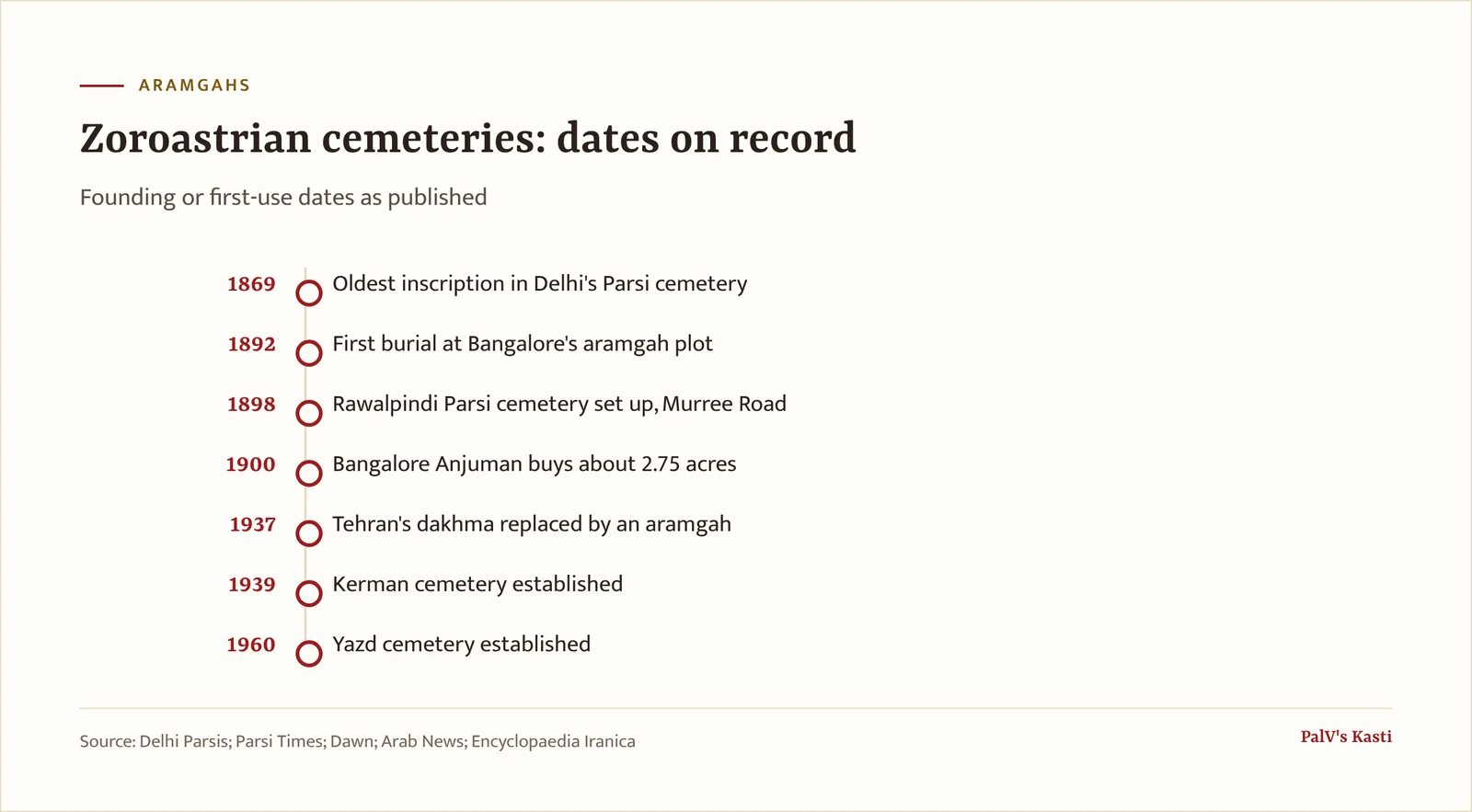
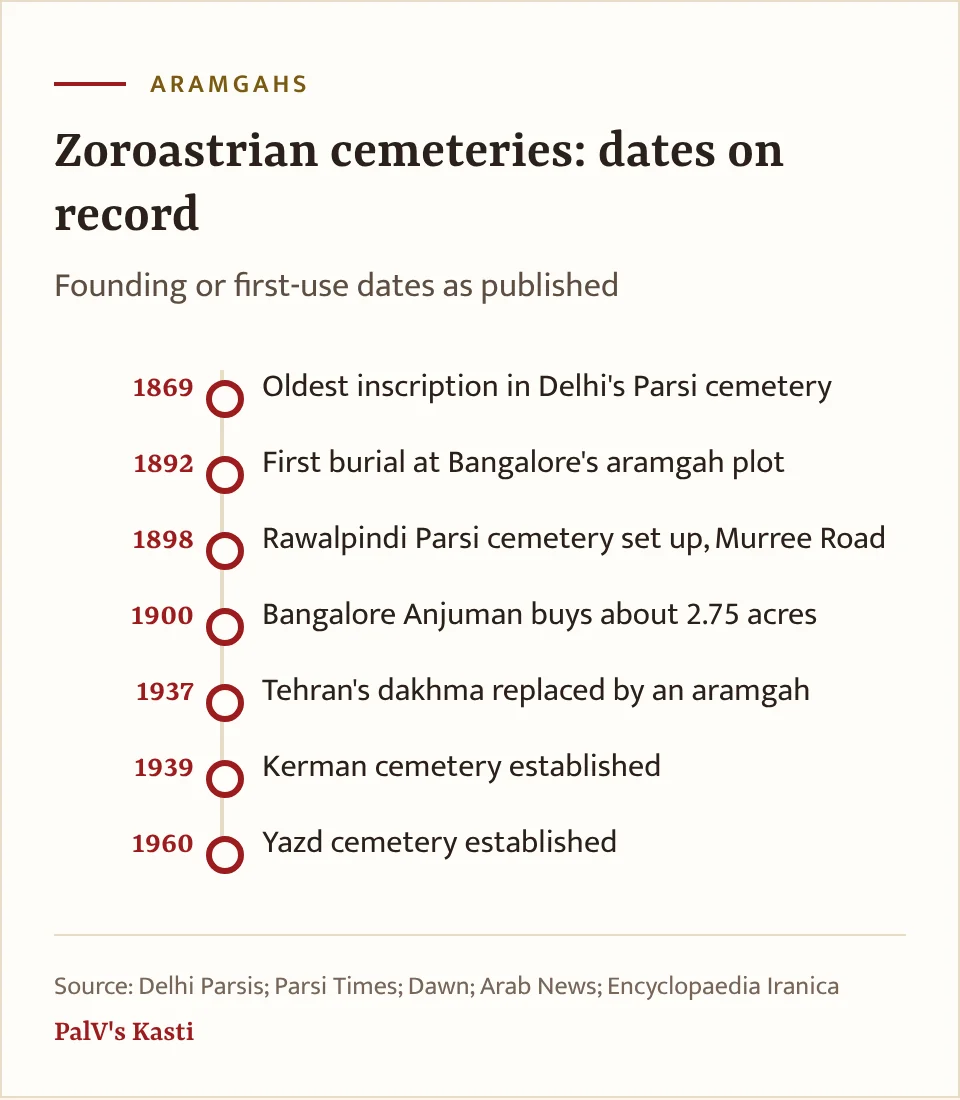
According to Boyce, reform ideas took hold among Iran's Zoroastrians in the 1930s. The Tehran dakhma gave way to an aramgah in 1937, and Kerman and Yazd followed with cemeteries in 1939 and 1960. She describes cement-lined graves and says a coffin is not always used. These dates come from Boyce's article alone.
Where are Parsi cemeteries in India and Pakistan?
We could not find any published list or count of Parsi cemeteries in India. These are the ones with a reliable record.
Delhi
Delhi's Parsi cemetery is near Khan Market, as Scroll reported in September 2014. The Delhi Parsis community website says the old cemetery carries an inscription dated 1869, which it calls the earliest physical evidence of Parsis in the region, and that the Delhi Parsi Anjuman was set up in 1925.
Bangalore
Parsi Times (1 February 2025) traces the Bangalore aramgah to 1892, when a Parsi who had moved to the city died and there was no Parsi burial ground. With help from the Dewan of Mysore, a plot was found and he was buried with full Zoroastrian rites on 1 April 1892. The community's Parsi Anjuman bought about 2.75 acres around that plot in 1900, and a prayer hall was built at the aramgah after a donation in April 1926.
Nagpur
The Times of India (14 August 2025) describes Nagpur's Parsi cemetery in the Seminary Hills area, looked after by a caretaker. The same report says that with no dakhma in the city, Nagpur's community now chooses cremation.
Rawalpindi
Across the border, Rawalpindi's Parsi cemetery sits behind the Jewellers Market on Murree Road. Dawn (7 October 2024) and Arab News (21 July 2026) both date it to January 1898. Dawn counts more than 100 graves and mentions a prayer hall where the final rites are performed. Arab News describes its custodian, Isphanyar Bhandara, as a Parsi member of Pakistan's National Assembly. It notes that Pakistan inherited two historic dakhmas at Partition, both in Karachi, and quotes Bhandara saying the Parsis of Rawalpindi and Lahore "chose burial six feet under".
How do Zoroastrians bury their dead?
Published detail is thin. The two clearest descriptions are Boyce's account of Iran, where graves are lined with cement and later cemented over, and Antia's advice to enclose the grave in cement-concrete blocks. Antia says the cement is meant to reduce pollution of land and water. Cemeteries such as Rawalpindi's and Bangalore's have a prayer hall on the grounds for the funeral prayers, and the Bangalore account says its first burial was done with full Zoroastrian rites. We found no source that sets out a separate burial liturgy, so ask the priest who will lead the funeral.
Practice varies between families and Agiaries; your family priest's guidance comes first.
Can a non-Parsi spouse be buried in a Parsi cemetery?
In Delhi the question was put to the community in 2014, when the trustees of the Delhi Parsi Anjuman proposed letting the non-Parsi husbands and wives of members be buried in the community cemetery. Scroll reported that the trustees were backing away from it ahead of a members' vote. Anjuman president Yezad Kapadia said it was not the right thing to do, that members did not seem to want the change, and that with limited space they would rather keep the ground for the community's own people. The same report said the Federation of Parsi Zoroastrian Anjumans of India had asked Delhi to reject the change. Speaking for the other side in the same report, Vispy Wadia, speaking as a trustee of the Association for the Revival of Zoroastrianism in Mumbai, said the community's population was in decline and that it needed to be more inclusive to survive.
Is Doongerwadi a cemetery or a smashan bhumi?
Doongerwadi, the Tower of Silence estate at Malabar Hill in Mumbai, is a site for dokhmenashini, and the Free Press Journal notes that past suggestions to add a crematorium there were rejected by the high priests and orthodox members. In March 2025 the Bombay Parsi Punchayet added a Marathi name to its gate that called it a "smashanbhoomi", a word usually used for a cremation ground. The same paper reported on 10 March 2025 that orthodox members objected, fearing a crematorium was planned. The management said the word was a literal translation of "cemetery", and BPP chairman Viraf Mehta then confirmed it had been removed from the board.
A proposal to add a burial ground beside a dakhma has been opposed before. In January 2017, Parsi Times reported an uproar over a proposal to build an aramgah inside the Navsari Doongerwadi. Four high priests (Vada Dasturjis), namely Dr Firoze Kotwal, Dr Jamasp Asa, Khurshed Dastoor and Cyrus Noshirwan Dastur, wrote to the Navsari Anjuman asking it not to go ahead because the plan went against the religion. We could not find a published report of what was decided.
Frequently asked questions
Do Parsis bury their dead?
Traditionally they do not. The customary rite is dokhmenashini at a Tower of Silence, and J.J. Modi's 1922 book describes burial as prohibited in the old Parsi books. But where no dakhma exists, Parsis have buried their dead in community cemeteries in Delhi, Bangalore and Rawalpindi. Mary Boyce calls this burial out of necessity. Ask your family priest.
What is a Parsi kabristan or aramgah?
Aramgah is the name used for a Zoroastrian cemetery. Mary Boyce translates it as "place of rest" and records that Tehran's dakhma was replaced by an aramgah in 1937. In India, the Bangalore community's own history calls its burial ground the Aaramgah, and the Parsi cemeteries in Bangalore and Rawalpindi have prayer halls on the grounds.
Is there a Parsi cemetery in Delhi?
Yes. Delhi's Parsi cemetery is near Khan Market and is in the care of the Delhi Parsi Anjuman, founded in 1925. The Delhi Parsis website says the old cemetery has an inscription dated 1869. In 2014 its president called a proposal to bury members' non-Parsi spouses there not the right step, citing community feeling and space.
Is there a Parsi cemetery in Nagpur?
Yes. The Times of India reported in August 2025 that Nagpur's Parsi cemetery is in the Seminary Hills area and is tended by a caretaker. The same report said that, because the city has no dakhma, the Nagpur Parsi community now opts for cremation. We could not find a reliable founding date for the cemetery.
Is Doongerwadi a smashan bhumi?
No. Doongerwadi in Mumbai is the estate of the Towers of Silence, used for dokhmenashini, and past suggestions to add a crematorium were rejected. A March 2025 signboard calling it a "smashanbhoomi" upset orthodox members. The Free Press Journal reported that the Bombay Parsi Punchayet removed the word, after its management explained it was meant as a translation of "cemetery".


