 PalV's Kasti
On this page
- Do Parsis live longer than other Indians?
- Why do Parsis live long? What the research does and does not say
- How old is the Parsi population compared with India?
- What did the 1985 Bombay survey find about age-related disorders?
- How common is high blood pressure among Parsis?
- Do Parsis get more breast cancer?
- Are Parsis genetically different, and what is genetic research adding?
- What are the gaps in Parsi longevity research?
- Frequently asked questions
Parsis in Mumbai live well beyond the Indian average. A 2011 study in the journal Demographic Research put Mumbai Parsi life expectancy at birth at 73.5 years for men and 77.7 years for women, against an Indian average of 64. What the research does not yet give is a proven reason. The published papers we read describe the pattern without explaining it. They do, however, measure the illnesses that come with an older community in detail: Parkinson's disease, essential tremor, stroke, high blood pressure and a cancer pattern unlike that of other Mumbaikars. Most of those figures come from a single door-to-door survey of 14,010 Parsis living in Bombay's housing colonies in 1985.
This page sets out what that research found, who did it and where it stops. It is general information drawn from published studies, not medical advice.
અસપંદામેદ રોજ
Asfandarmad Roj, Tir Mah · 1396 Y.Z.
Do Parsis live longer than other Indians?
On the figures available, yes. Zubin Shroff and Marcia Castro, writing in Demographic Research in 2011 about the Parsis of Mumbai, found life expectancy at birth of 73.5 years for men and 77.7 years for women. They compared this with an Indian average of 64 years (a UNICEF figure for 2009) and called it similar to most developed countries.
A 2015 review by Ranjita Pandey and Neena Yadav in the Bulletin of Mathematics and Statistics Research gives a longer view. It puts Parsi life expectancy at nearly 70 years in 1972 to 1977 and estimates it at about 80 years by the end of the twentieth century. The same review records infant deaths falling from about 29 per 1,000 live births in 1972 to about 25 in 1977. The two papers cover different periods, so their numbers don't match exactly, but both show Parsis living longer than Indians as a whole.
Why do Parsis live long? What the research does and does not say
None of the peer-reviewed papers we opened tests why Parsis live long. They offer context, not proof.
- Money and medical care. Nadir Bharucha and Thomas Kuruvilla of Bombay Hospital, in a 2003 BMC Public Health paper on blood pressure, describe the community as relatively affluent with ready access to medical care. Their paper does not link this to lifespan.
- Habits and customs. Researchers at the Mumbai Cancer Registry, writing in 2001, said the different Parsi cancer pattern was believed to come from differences in habits, customs and economic status. That explanation was about cancer, not lifespan.
- Genes. In 2020 the company Avesthagen announced a study of Parsi mitochondrial DNA which, it said, showed "a presence of longevity as a trait". Parsi Times carried the announcement on 20 June 2020. The study was released on bioRxiv, a preprint server whose own site says articles are not peer-reviewed before they are posted.
Births matter too. Shroff and Castro point to research from 1948 that tied the community's changing age structure to a steady fall in both the birth rate and the death rate. In their own 2001 data, Mumbai Parsis had a fertility rate of 0.89 children per woman, and fewer than 13% of the community was under 15.
How old is the Parsi population compared with India?
Much older. The 2003 BMC Public Health paper prints the age profile from a 1985 community survey beside India's 1981 census and the United States in 1980. Among Parsis, 20.5% were aged 65 or over and 7.4% were under 10. For India the figures were 3.8% and 26.7%. For the United States they were 11.3% and 14.6%. The authors call the Parsi profile closer to that of developed countries than to the young Indian population.
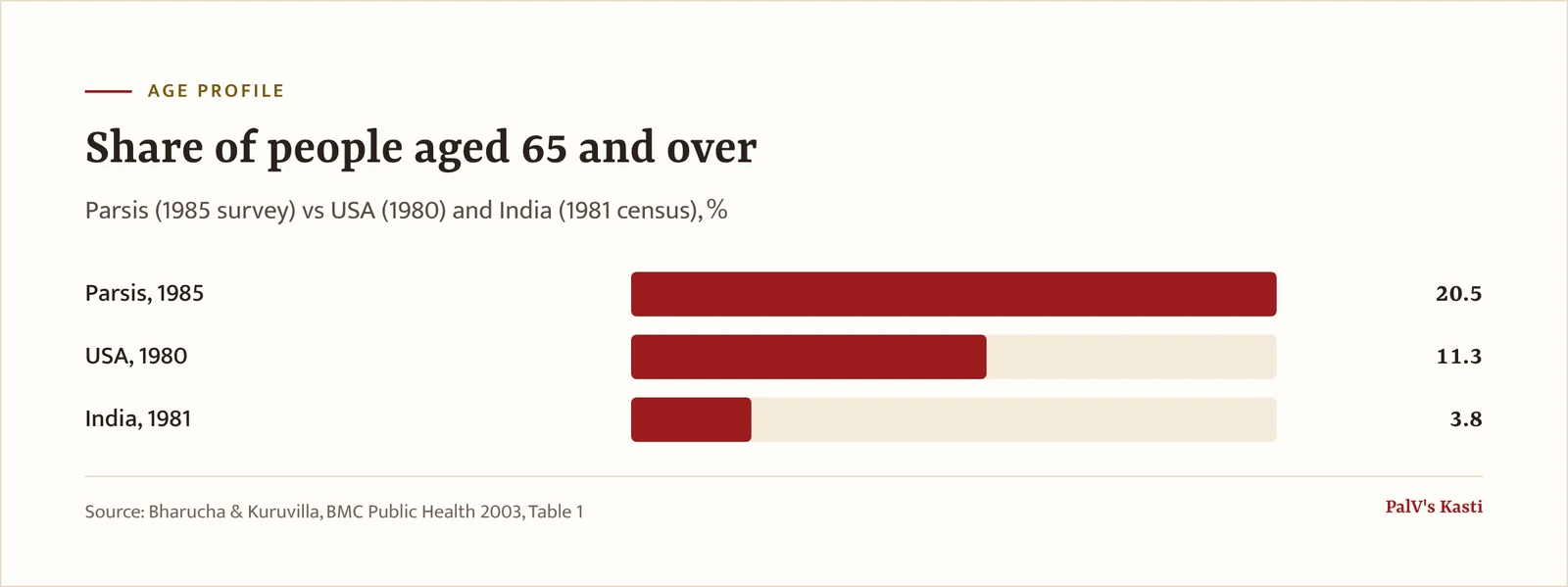
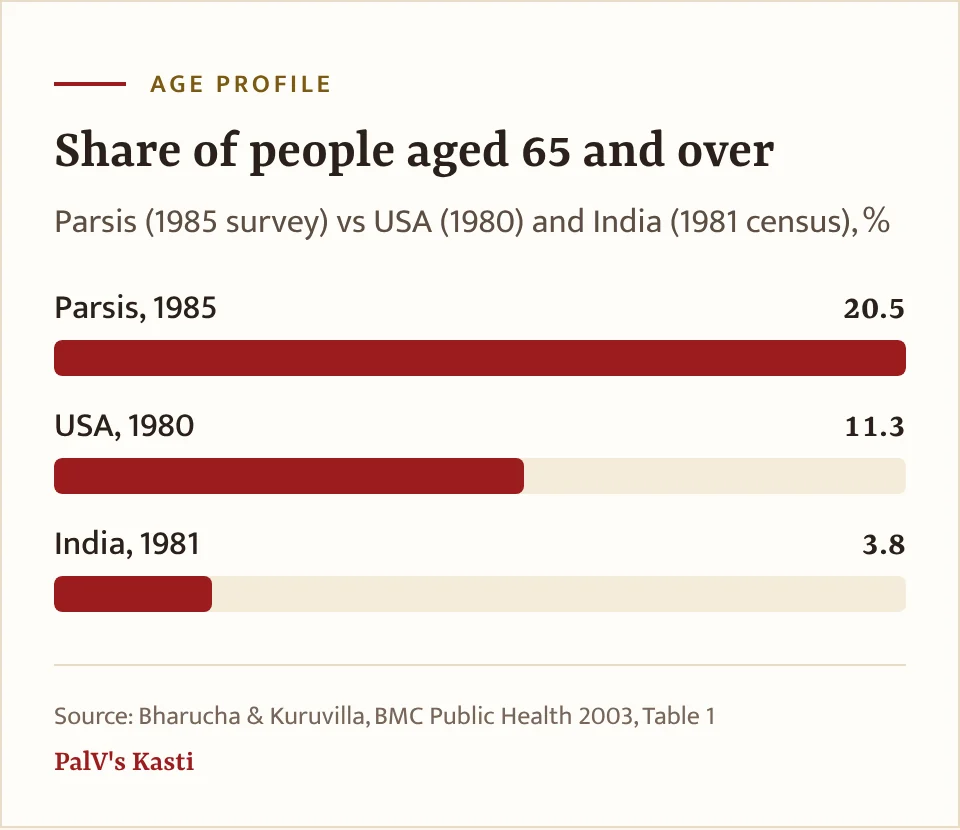
The trend continued. Shroff and Castro found nearly a quarter of Mumbai's Parsis over 65 in 2001. Pandey and Yadav give the 2001 share aged 65 and above as 24.2%, higher than Sweden (17.4%) or Japan (16.1%) around the same time.
What did the 1985 Bombay survey find about age-related disorders?
The largest body of evidence comes from the Neuroepidemiology Department of Bombay Hospital, from a team that included Nadir E. Bharucha, Eddie P. Bharucha and Bruce S. Schoenberg. After a pilot in one colony of 851 people (published in 1987), the team screened 14,010 Parsis living in Bombay's colonies door to door. High school graduates, social workers and medical students put a screening questionnaire to each household, and neurologists then examined everyone who screened positive. About one-third of Bombay's Parsis lived in such colonies, according to the 2003 BMC Public Health paper. The results came out in separate papers between 1988 and 1991.
| Disorder | People found | Rate per 100,000 | Paper |
|---|---|---|---|
| Peripheral neuropathy | 334 | 2,384 | Neurology, 1991 |
| Essential tremor | 233 (104 men, 129 women) | 1,663.1 | Archives of Neurology, 1988 |
| Stroke | 118 (57 men, 61 women) | 842.3 | Stroke, 1988 |
| Parkinson's disease | 46 (25 men, 21 women) | 328.3 (see note below) | Archives of Neurology, 1988 |
Parkinson's disease among Parsis
The survey found 46 Parsis with Parkinson's disease, and the rate rose steadily with age. The published abstract prints the rate as "328.3 cases per 1000 population". Dividing 46 by 14,010 gives about 328 per 100,000 (our calculation), so per 100,000 is the reading that fits the counts. A 2005 review of Parkinson's disease in India, in the Journal of the Indian Medical Association, notes that Indian prevalence figures vary widely between studies and that the rate is high among the urban Parsi community of Mumbai. Neither paper sets out a cause.
Essential tremor, stroke and nerve damage
Essential tremor affected 233 people, about 1.7% of those screened (our calculation), and its authors describe their paper as the first community-based survey of the condition in Asia. Stroke affected 118 people, 114 of them with the ischaemic type. The 2003 BMC Public Health paper names high blood pressure as the most important risk factor for stroke in this community. Peripheral neuropathy was the most common disorder of all. Compression was its most common type, and diabetes was the commonest cause among the rest.
How common is high blood pressure among Parsis?
Common, and often missed. For their 2003 study, Bharucha and Kuruvilla chose one in four Parsi adults aged 20 and over in the Bombay colonies, and 2,415 of the 2,879 selected took part. A doctor measured each person's blood pressure. They found high blood pressure in 36.4%, and 48.5% of those people did not know they had it. Among those who did know, only 13.6% had it well controlled. In hypertensives aged 60 and over, 73% had isolated systolic hypertension, where the upper reading is 140 or more and the lower one stays under 90. The authors called for regular screening and education in the community.
Age explains part of this. The same paper adjusted its figures to the age profile of India's 1981 census. On that basis, Parsi prevalence would be 24.7% in men and 24.6% in women, lower than the 30% and 33% reported for urban north India.
Do Parsis get more breast cancer?
The Mumbai Cancer Registry of the Indian Cancer Society, in operation since 1964, compared Parsis with the rest of Greater Mumbai in a 2001 paper by B.B. Yeole and colleagues. Overall, Parsi age-adjusted cancer rates were lower. The mix was very different, though. Parsi rates were higher for cancers of the female breast and endometrium, and for lymphomas and leukaemias. Cancers of the mouth, pharynx, larynx, oesophagus and cervix, which are frequent among non-Parsis, were seen less often among Parsis.
Avesthagen's 2020 announcement also reported no association with lung cancer in the Parsi genomes it studied, which the company connected with the community's non-smoking customs. That finding comes from the same preprint mentioned above.
Are Parsis genetically different, and what is genetic research adding?
A 2017 study in Genome Biology, with Gyaneshwer Chaubey as first author and CSIR's Centre for Cellular and Molecular Biology in Hyderabad among the partners, found present-day Parsis genetically closest to Iranian and Caucasus populations rather than to their South Asian neighbours. It dated their mixing with Indian populations to roughly 1,200 years ago. The authors also found enriched homozygosity, which they say reflects the community's recent isolation and inbreeding.
The Avestagenome Project, run by Avesthagen, has collected a bio-bank of blood samples and health records from over 4,500 community members since 2008, according to its 2020 announcement. Its mitochondrial study reported 420 variants, with signals for longevity and for Parkinson's disease and colon and prostate cancers. We cover the project itself in our post on the Avestagenome Project. For the faith's own teaching on caring for the body, see Health in Zoroastrianism.
What are the gaps in Parsi longevity research?
Three gaps stand out. Most disorder figures still come from the 1985 survey, so they describe Parsis of Bombay's colonies four decades ago. We could not find a published community figure for Alzheimer's disease or dementia. And the only claim of a genetic basis for Parsi longevity that we found comes from a company announcement of an unreviewed preprint. Until newer peer-reviewed work appears, the measured facts are a long life expectancy and an older community with the illnesses of age, while the reasons stay open.
Frequently asked questions
Do Parsis live longer than other Indians?
Yes, on published figures. A 2011 Demographic Research study found Mumbai Parsi life expectancy at birth of 73.5 years for men and 77.7 for women, against an Indian average of 64. A 2015 review estimated Parsi life expectancy at about 80 years by the end of the twentieth century. Neither study proves why.
Why is Parkinson's disease common among Parsis?
Nobody has shown why. A 1985 door-to-door survey of 14,010 Bombay Parsis found 46 cases, about 328 per 100,000, and a 2005 Indian review called the rate high among Mumbai's urban Parsis. A 2020 genetic preprint from Avesthagen reported an association, but it had not been peer reviewed.
Are Parsis genetically different from other Indians?
Partly. A 2017 Genome Biology study found Parsis genetically closest to Iranian and Caucasus populations, with mixing with Indian populations about 1,200 years ago. It also found enriched homozygosity, which the authors linked to recent isolation and inbreeding. That mixing means Parsis also carry South Asian ancestry.
Do Parsis get more breast cancer?
According to a 2001 Mumbai Cancer Registry study, Parsi rates were higher than other Mumbaikars' for female breast cancer, endometrial cancer, lymphomas and leukaemias. Overall Parsi cancer rates were lower, and mouth, throat, oesophageal and cervical cancers were less common. Its authors said the contrast was believed to reflect habits, customs and economic status.
What is the Avestagenome Project?
It is a genetic research project run by Avesthagen, which says it has gathered blood samples and health data from over 4,500 Parsis since 2008. In 2020 it announced a mitochondrial DNA study reporting 420 variants and signals for longevity and some diseases, released as a preprint before peer review.


