PalV's Kasti
On this page
The Parsi Dharamsala in Secunderabad began in 1889, when the Chenai family gave a private property so that Zoroastrians visiting the twin cities would have somewhere to stay. Two records agree on that year and on how the complex grew: a large hall in 1893, a second hall in 1919 and a pavilion in 1929. One is the local Parsi Zoroastrian Anjuman's own website, the other a Deccan Chronicle feature from April 2025. The old residential quarters were pulled down in 2006 and replaced by a modern block with air-conditioned rooms, the Anjuman says. Deccan Chronicle reported in April 2025 that it still gives travellers food and rooms and hosts weddings and Navjotes.
You will see it written as Parsi Dharamsala, Parsi Dharamshala or Parsi dharmshala, and the family name as Chenai or Chinoy. The Anjuman's own pages use both spellings for this dharamsala.
શહેરેવર રોજ
Shehrevar Roj, Tir Mah · 1396 Y.Z.
Who founded the Parsi Dharamsala in Secunderabad?
The two records name the donors slightly differently, so we give both. The Parsi Zoroastrian Anjuman of Secunderabad and Hyderabad credits the founding to the late Khan Bahadur Edulji S. Chenai, saying he gave his personal property in 1889 for Zoroastrians coming to the twin cities for work and for pleasure.
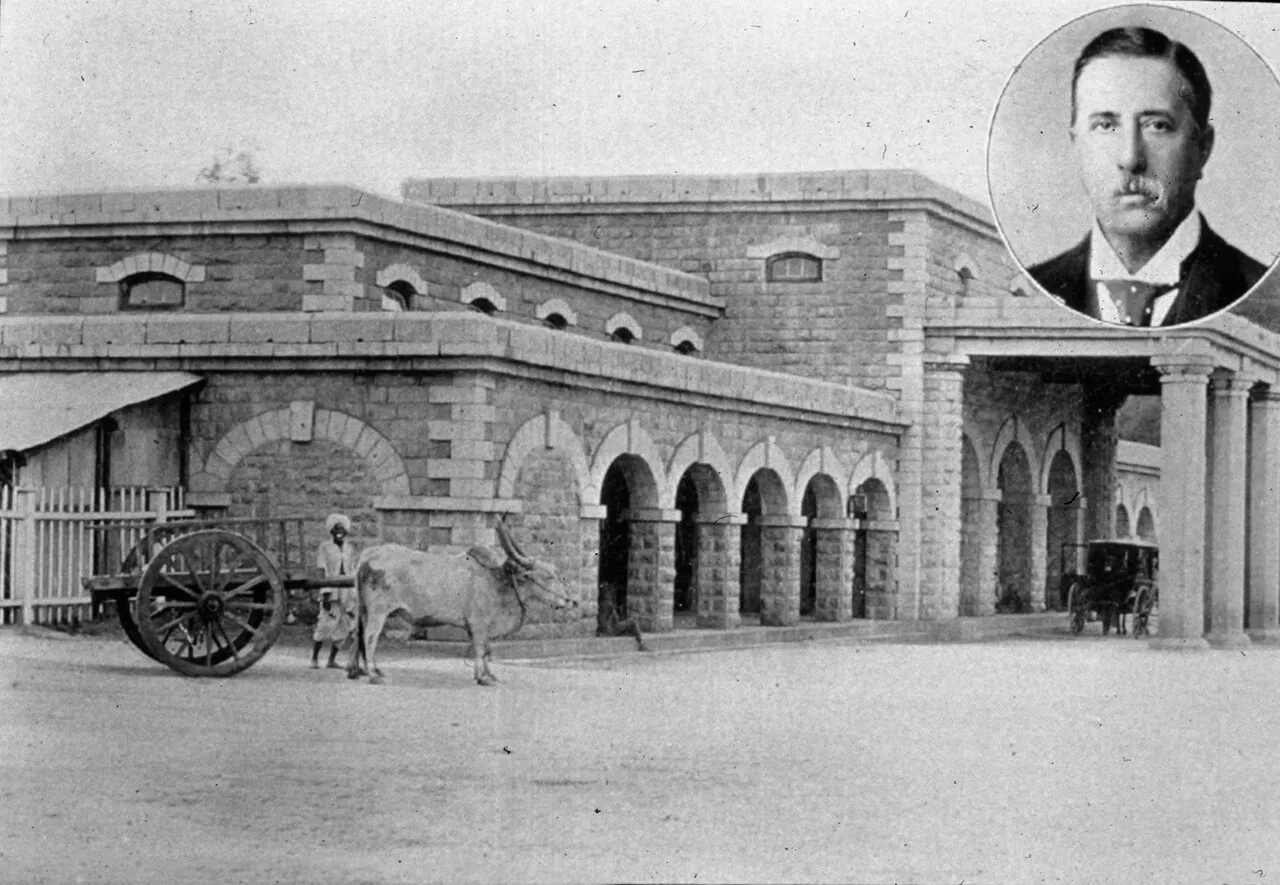
Deccan Chronicle's April 2025 report, written by Kakoli Mukherjee, names a couple: Khan Bahadur Seth Edulji Sohrabji Chenai and Bai Pirojbai Edulji Chenai. It says the two of them donated the property in 1889 as a resting place for travellers, and it gives the official name as the Bai Pirojbai Edulji Chenai Parsi Dharamshala. Her name also appears on the Anjuman's directory listing, as the Bai Pirojbai Chinoy Parsi Dharamshala.
The same benefactor's name is on another Secunderabad landmark. The Anjuman's Dar-e-Meher at Secunderabad, which carries the name of Khan Bahadur Seth Edulji Sohrabji Chenai, dates from 8 August 1920, according to the Anjuman. For how gifts like these were usually held and run, see our page on Parsi charitable trusts.
How did the dharamsala grow between 1889 and 1929?
Both the Anjuman and Deccan Chronicle list the same three additions in forty years:
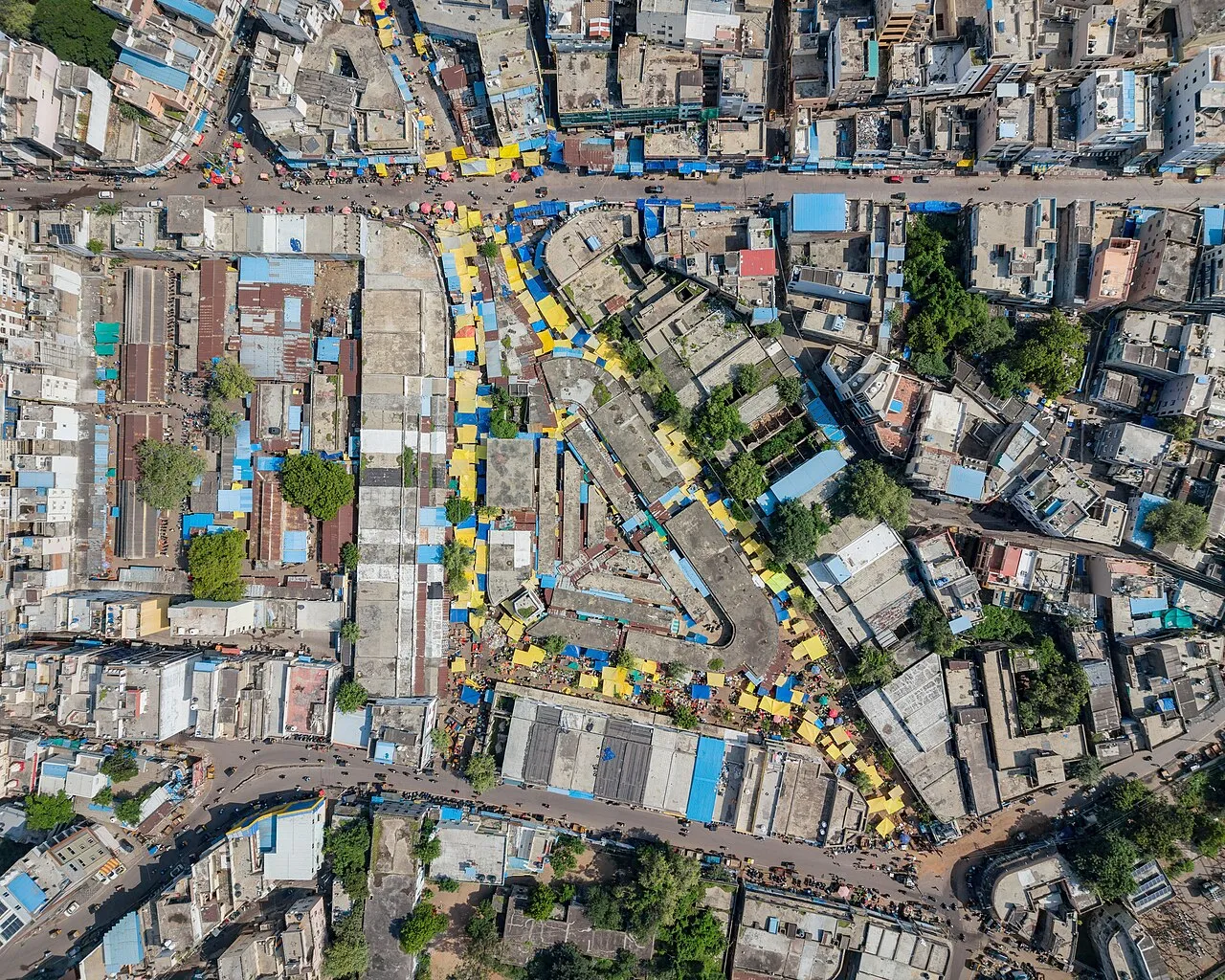
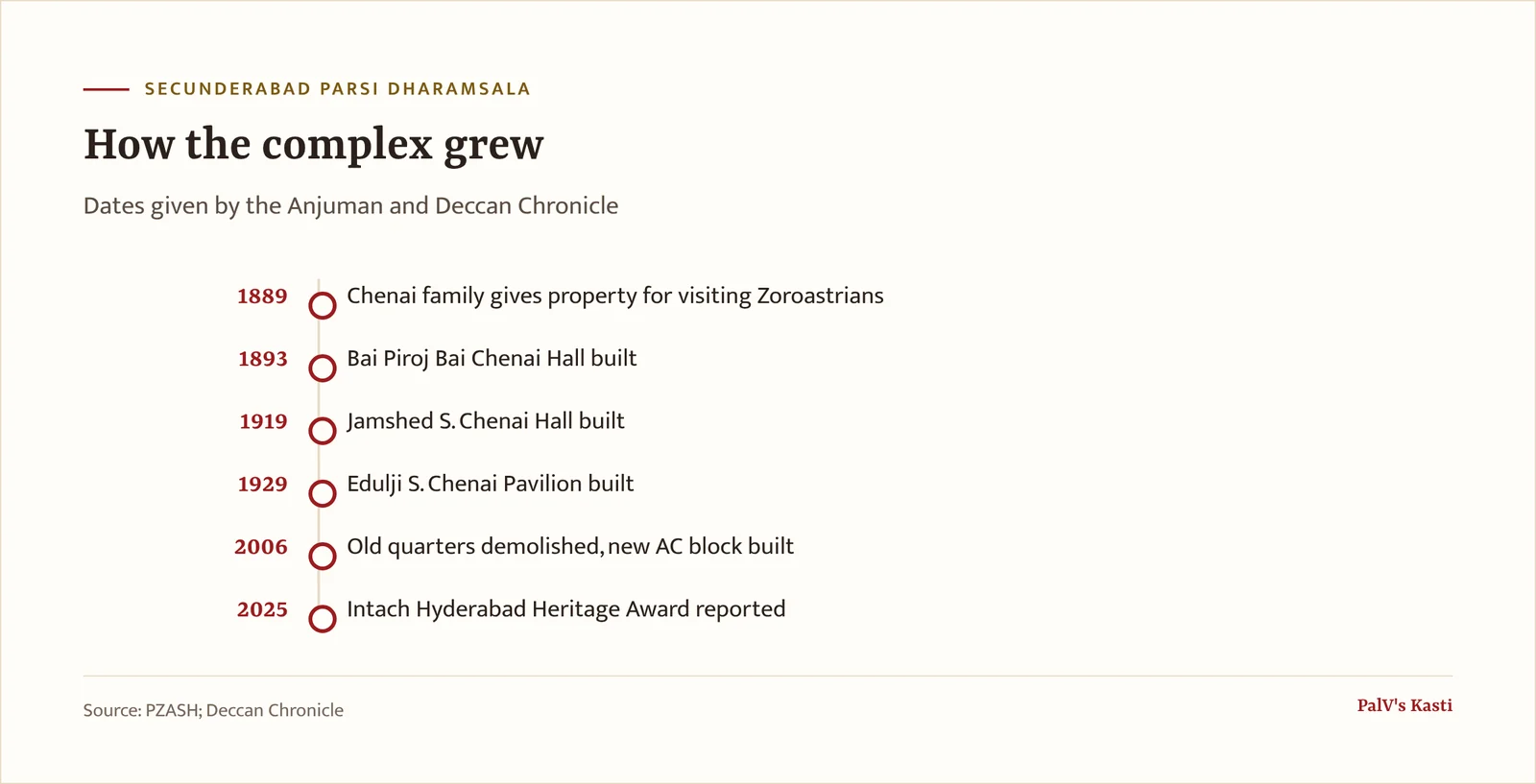

- 1893: the Bai Piroj Bai Chenai Hall, which the Anjuman calls the large hall
- 1919: the Jamshed S. Chenai Hall, a smaller hall
- 1929: the Edulji S. Chenai Pavilion
Neither source says who paid for the 1919 and 1929 buildings, or how Jamshed S. Chenai was related to the founders. We have left that out rather than guess.
What changed in 2006, and what survives from the old building?
The Anjuman says the old residential quarters had fallen into disrepair and were demolished in 2006. A modern building went up in their place, with air-conditioned rooms for co-religionists visiting Secunderabad.
Deccan Chronicle's 2025 feature describes what is still original in the complex: high ceilings, a sloping dining-hall roof laid with terracotta tiles, ceiling fans hung on very long rods, and a carved "American tin ceiling" with metal columns in the pavilion. The same report lists later changes. The dining-hall chandeliers were bought later, the old Shahabad tile floors gave way to Kota stone, modern fittings were added, and portraits of the founders and other eminent Parsis of the city were redone digitally.
The paper also reported that the complex received the Intach Hyderabad Heritage Award in 2025. We have not been able to open INTACH's own notice of it.
Can visitors stay at the Parsi Dharamsala today?
Yes, on the evidence we have. Deccan Chronicle reported in April 2025 that the trustees, whom it named as Sohrab Chinoy, Darius Chenai and Jamshed Chinoy, provide food and accommodation to travellers at nominal rates. The Anjuman's page describes the dharamsala as being for Zoroastrians visiting Secunderabad. Neither source publishes room rates or booking rules.
The Anjuman's directory, last updated in March 2018, gives the address as 131A Prenderghast Road, opposite Paradise Hotel, Secunderabad 500 003, and the phone number as (040) 27842565. Check both with the Anjuman before you travel, since the listing is several years old.
What else happens there?
The Anjuman lists public meetings, Navjotes, marriages and Gahambars among the events held in its halls, and its welfare page says Gahambars are held there from time to time, with a simple dinner that a majority of community members come to eat.
For dharamshalas in other cities, start with our guide to Parsi dharamshalas. The history of another rest house is in our post on the Ajmer Parsi Dharamshala.
Frequently asked questions
Who founded the Parsi Dharamsala in Secunderabad?
The Parsi Zoroastrian Anjuman of Secunderabad and Hyderabad credits the late Khan Bahadur Edulji S. Chenai, who gave his own property in 1889. Deccan Chronicle, reporting in April 2025, names him together with Bai Pirojbai Edulji Chenai and says the couple donated the property that year as a resting place for travellers.
Where is the Parsi Dharamsala in Secunderabad?
The Anjuman's directory, last updated in March 2018, lists the Bai Pirojbai Chinoy Parsi Dharamshala at 131A Prenderghast Road, opposite Paradise Hotel, Secunderabad 500 003, with the phone number (040) 27842565. Because that listing is several years old, confirm the address and number with the Anjuman before you set out.
Can visitors stay at the Secunderabad Parsi Dharamsala?
The Anjuman describes it as a dharamsala for Zoroastrians coming to the twin cities for work or pleasure, with air-conditioned rooms in the building that replaced the old quarters in 2006. Deccan Chronicle reported in April 2025 that it gives travellers food and rooms at nominal rates. Neither source publishes a tariff, so ask the trustees directly.
What halls does the Secunderabad dharamsala have?
According to the Anjuman, the complex has the large Bai Piroj Bai Chenai Hall from 1893, the smaller Jamshed S. Chenai Hall from 1919 and the Edulji S. Chenai Pavilion from 1929. Deccan Chronicle gives the same three names and years. The Anjuman says public meetings, Navjotes, marriages and Gahambars are held in the complex.
Did the Secunderabad Parsi Dharamshala win a heritage award?
Deccan Chronicle reported in April 2025 that the complex had received the Intach Hyderabad Heritage Award that year. We could not open INTACH's own announcement or a second press report, so the exact date of the award is not given here. The newspaper is the only record we have read for it.