 PalV's Kasti
On this page
Tata Chemicals was established at Mithapur in 1939, when the Tatas took over the Okha Salt Works on the Okhamandal coast of Saurashtra. That salt works had been started in 1927 by Kapilram Vakil, an England-educated chemical engineer, with the backing of the Maharaja of Baroda. Vakil wanted to go further and make soda ash, and Tata accounts say he turned to JRD Tata for help. According to the company's timeline, its first chemical unit, a bromine plant, came up in 1942, and a 2004 Tata Group article dates the start of soda ash production to 1944. The Tata Chemicals history that follows draws on the company's own records and on Business Today.
અસપંદામેદ રોજ
Asfandarmad Roj, Tir Mah · 1396 Y.Z.
What was the Okha Salt Works before Tata Chemicals?
The Okha Salt Works was a salt-making venture in Okhamandal, Saurashtra, set up in 1927 by Kapilram Vakil. A 2019 Tata heritage article describes the area as dry and rugged, on the western tip of India. Tata Chemicals' own timeline calls him a British-educated chemical engineer, and Business Today, reviewing a book on the company's history in 2015, described him as India's pioneering "salt man" and perhaps one of the country's first chemical engineers.
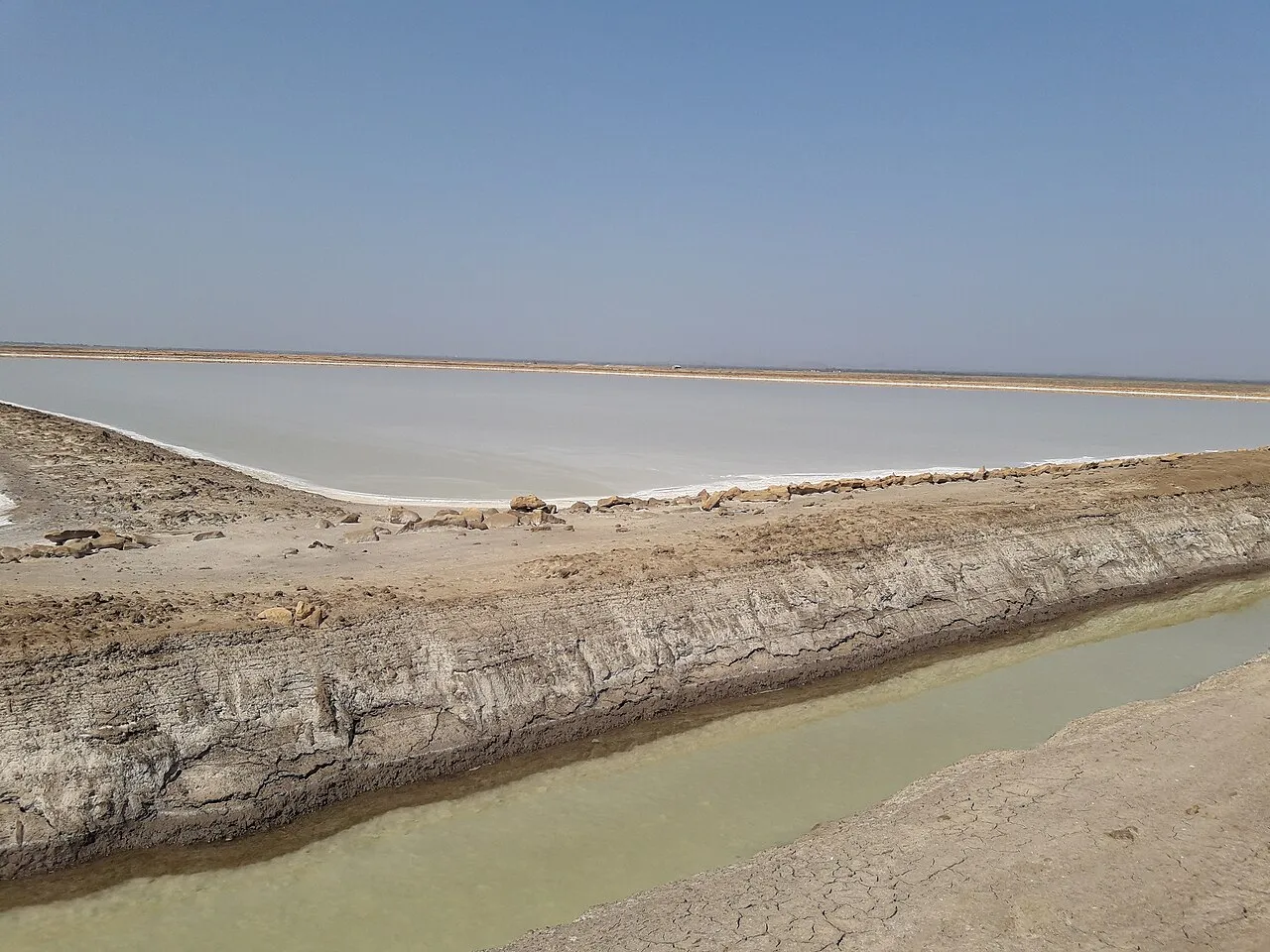
Okha then lay in the territory of the princely state of Baroda. According to a 2004 Tata Group article, Vakil took his plan to the ruler, Maharaja Sayajirao Gaekwad, who approved it, and V. T. Krishnamachari, the Diwan of Baroda, laid the salt works' foundation stone. Business Today places Vakil's salt works in what is now Mithapur.
Why did Kapilram Vakil turn to JRD Tata?
Two Tata Group accounts give slightly different reasons.
The 2004 article says that a decade after starting the salt works, Vakil wanted to expand into soda ash and did not have the money to do it. The Tatas agreed to take over the company. A 2019 Tata heritage piece puts it more starkly: faced with what it calls an alien government that encouraged foreign imports, the salt works collapsed, and Vakil appealed to JRD to rescue it. That piece adds that the Maharaja of Baroda supported the appeal, arguing that a group which had pioneered steel and electric power could also start an inorganic chemicals industry for India.
Soda ash was the prize. The same 2019 article says India's self-reliance in making glass, ceramics and textiles depended on producing it.
When was Tata Chemicals founded?
Every source agrees on the year, 1939, and Business Today notes that the company turned 75 in 2014. The exact day is less settled, because Tata's own documents name three different dates:
- 1 January 1939: the day Tata Chemicals was "launched", according to the 2019 Tata heritage article.
- 23 January 1939: the day JRD Tata inaugurated the company after taking over Vakil's Okhamandal Salt Works, according to Tata Chemicals' 75th-anniversary press release of 2014.
- 14 June 1939: the day the Tata Chemicals foundation stone was laid, according to the company's online timeline.
We have not found an independent record that settles which of these counts as the founding date, so we give all three and let the year stand.
How did the Mithapur plant get through its first hard years?
Slowly. The company's timeline lists a bromine plant as the first unit of the new works in 1942. In 1943 an auxiliary power plant was commissioned, and the works began making caustic soda and liquid chlorine, with zinc chloride, hydrochloric acid and bleaching powder alongside. Soda ash, the product the whole venture was built for, followed in 1944, at a capacity of 80 tonnes a day according to the 2004 Tata article.
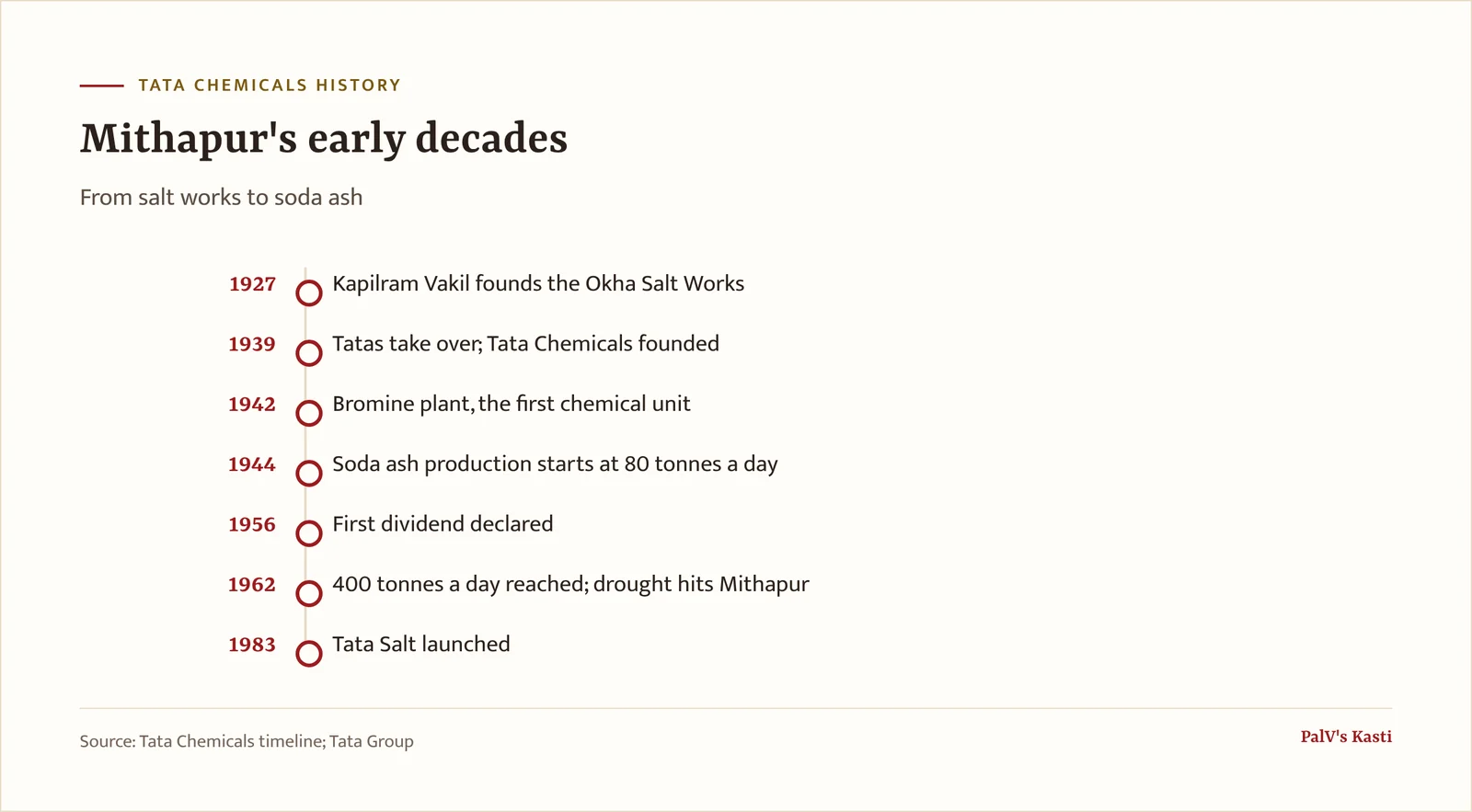
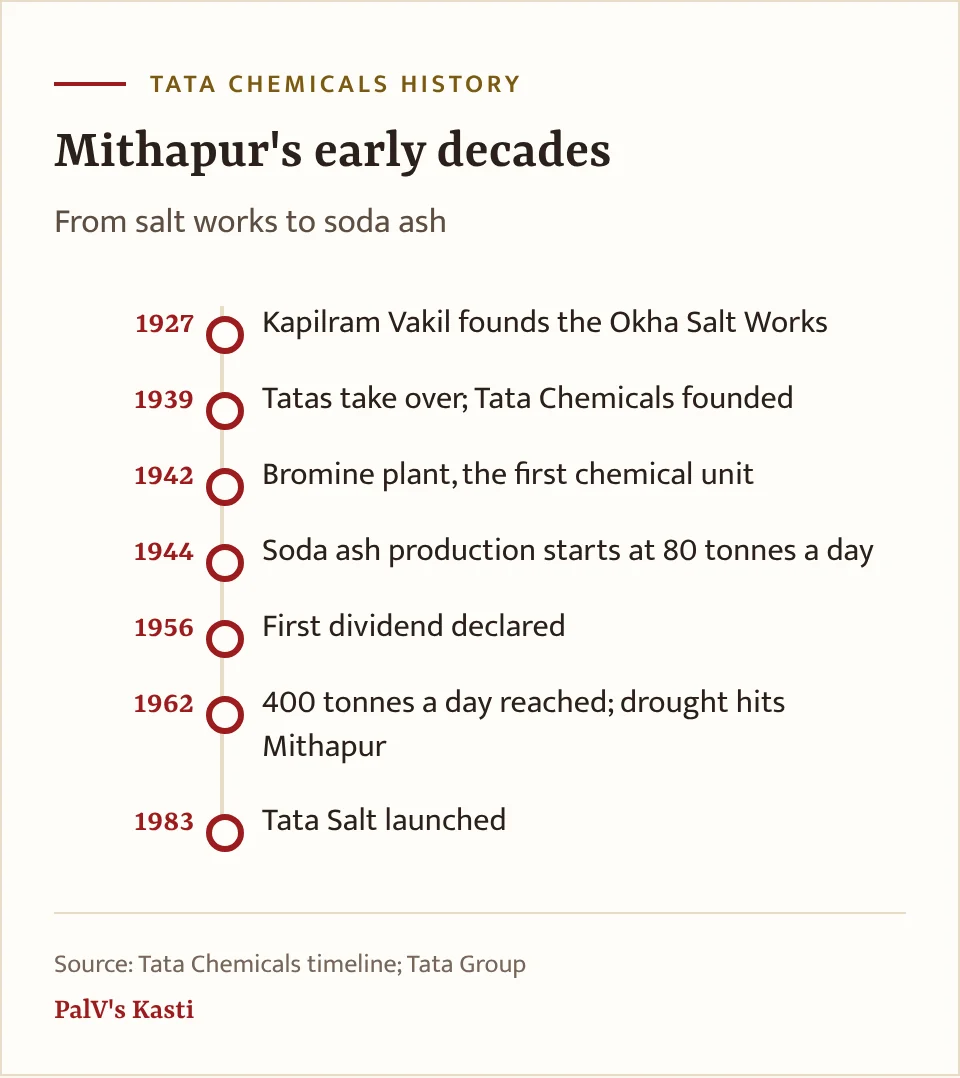
The 2019 heritage article lists three obstacles: the Second World War, the lack of Indian know-how in soda ash manufacture, and a drought in 1962. That drought was met by recycling fresh water and using seawater, and the plant survived. JRD Tata's own verdict, as the Tata Group quotes it, was blunt. Of all the companies he had been involved with, he said, none had faced "so many difficulties compounded with bad luck" as Tata Chemicals.
One name keeps coming up in these accounts. Darbari Seth joined as a young chemical engineer. The 2004 article says that when the British firm ICI, the only company in the subcontinent with the technology, scoffed at the project, Seth took it personally and set out to build India's best soda ash plant.
Tata Chemicals declared its first dividend in 1956, its timeline says. A 1957-58 expansion programme followed, and the 2004 article dates the 400-tonnes-a-day mark to 1962. The company's timeline records a "four hundred tonne tower" set up in 1964 to commemorate the milestone.
How did Tata Chemicals grow beyond Mithapur?
From the 1980s onwards the company moved into consumer goods, new plants and other countries. Its timeline gives these dates:
- 1980: Tata Chemicals Society for Rural Development (TCSRD) set up.
- 1983: Tata Salt launched, described by the company as India's first iodised, vacuum-evaporated, branded salt.
- 1994: the Babrala plant commissioned, which the company says took 36 months.
- 2006: Brunner Mond acquired, with assets in the UK and Kenya.
- 2008: General Chemical Industrial Products of the US acquired, which the timeline says made Tata Chemicals the world's second-largest soda ash maker. Business Today wrote that this buyout lifted it into the global league.
- 2010: British Salt acquired (the company's 2014 press release gives 2011 for this deal).
- 2020: the consumer business demerged.
Tata Salt also links the modern company to its start. The company's 2014 press release says the idea for its iodised salt grew out of seawater processing at the Mithapur plant, on the coast where Vakil began in 1927. For where Tata Chemicals sits among the other companies founded by the family, see our Tata Group history.
Frequently asked questions
When was Tata Chemicals founded?
Tata Chemicals was founded in 1939 at Mithapur, on the Okhamandal coast of Saurashtra in present-day Gujarat. Tata's own records give three dates that year: a launch on 1 January, an inauguration by JRD Tata on 23 January, and the laying of the foundation stone on 14 June. The company marked its 75th anniversary in 2014.
Who was Kapilram Vakil?
Kapilram Vakil was an England-educated chemical engineer who founded the Okha Salt Works in 1927 with the approval of Maharaja Sayajirao Gaekwad of Baroda. A 2004 Tata Group article says that when he wanted to expand into soda ash and lacked the money, he approached the Tatas. The Tatas took the works over in 1939 as Tata Chemicals.
Why was Tata Chemicals set up at Mithapur?
Tata Chemicals grew out of an existing salt works. Kapilram Vakil's Okha Salt Works already stood in Okhamandal, in what was then Baroda territory, when the Tatas took it over in 1939. Vakil wanted to add a soda ash plant there, and a Tata heritage article links soda ash to India's self-reliance in glass, ceramics and textiles.
When did Tata Chemicals start producing soda ash?
According to a 2004 Tata Group article, the Mithapur soda ash plant began production in 1944 with a capacity of 80 tonnes a day. Capacity reached 400 tonnes a day in 1962. Before soda ash, the works had already produced bromine from 1942, and caustic soda and liquid chlorine from 1943, according to the company's timeline.
When was Tata Salt launched?
Tata Salt was launched in 1983, according to Tata Chemicals' timeline and its 2014 anniversary press release. The company's timeline describes it as India's first iodised, vacuum-evaporated, branded salt, and the 2014 press release says the idea grew out of seawater processing at the Mithapur plant, where the business began. Tata Chemicals demerged its consumer business in 2020.


