 PalV's Kasti
On this page
- What did ancient Persians eat, according to Herodotus?
- What do the Persepolis tablets say about everyday food?
- What was served at the Persian king's table?
- What did Zoroastrians eat in Sasanian Iran?
- What did the early Parsis eat after reaching Gujarat?
- Which ancient Persian traces survive in Parsi cuisine today?
- Frequently asked questions
Ancient Persians ate bread, barley, meat, wine and a long list of fruit and nuts, and the old texts linger on sweets. Herodotus, writing in Greek, said the Persians served few main courses but many desserts, and roasted whole animals for birthdays. Clay tablets from Persepolis record barley handed out as rations. A Sasanian-era text praises almond and walnut pastries and a quince-and-apple jelly. What the first Parsis ate after they reached Gujarat is a harder question, because no record of their meals survives. What we can trace is the Persian layer that Parsi cooks such as Niloufer Mavalvala still point to: nuts, dried fruit and a love of sweet things.
શહેરેવર રોજ
Shehrevar Roj, Tir Mah · 1396 Y.Z.
What did ancient Persians eat, according to Herodotus?
The oldest detailed description comes from the Greek historian Herodotus, in Book 1 of his Histories. He wrote that the day a Persian valued most was his own birthday, and on that day he laid out a bigger meal than usual. Rich households roasted an ox, a horse, a camel or a donkey whole in an oven. Poorer families roasted smaller animals instead.
He also noticed how a Persian meal was built. There were only a few main dishes, then a long run of sweets and small treats brought out one after another. According to Herodotus, the Persians joked that Greeks got up from dinner still hungry, since so little sweet food followed their main course. He adds that Persians were very fond of wine.
Herodotus also passes on a speech, put in the mouth of a Lydian adviser named Sandanis, that paints the Persians before their conquests as a plain people on stony land who drank water, had no figs and ate what they had rather than what they liked. Herodotus adds that until they defeated Lydia, the Persians lived without luxury or comfort. So his picture is of a diet that grew richer with conquest, though it is still one Greek outsider's view.
What do the Persepolis tablets say about everyday food?
The Persepolis Fortification Tablets are clay records, written mostly in Elamite in the middle of Darius I's reign, that log payments made in goods by the Achaemenid administration. Counts and dates differ by source. The ancient-history site Livius gives 20,000 to 25,000 tablets written between 506 and 497 BCE, while the University of Southern California's West Semitic Research Project estimates 15,000 to 30,000, written around 509 to 494 BCE. One entry quoted by Livius notes that a man called Barîk-'El received 130 litres of barley as his rations in the month that falls in November or December 501 BCE. Livius describes the ration as a kind of payment for service, so grain worked as both food and wages.
What was served at the Persian king's table?
The royal kitchen was another world. FEZANA's 2012 cookbook Eat, Live, Pray collects the Greek accounts in a section by K. E. Eduljee. He quotes Xenophon saying the king's bakers and cooks kept every bread and pastry ever invented in use and still went on inventing new ones, and did the same with meat dishes. He also quotes a list from the Macedonian writer Polyaenus of ingredients for the king's dinner: sweet grape jelly, turnips and radishes candied with salt, salted capers, pistachio (terebinth) oil, Ethiopian cumin and saffron from Media.
The same book carries the story of the Parthians, the second Persian dynasty. Farishta Murzban Dinshaw writes there that Roman soldiers knew a hard, cracker-like "Parthian bread", and that Pliny the Elder claimed it would keep for centuries. She also names asafoetida, the hing of an Indian kitchen, as one of the spices that moved across the Parthian empire.
What did Zoroastrians eat in Sasanian Iran?
The Sasanians ruled Iran from 224 to 651 CE, and FEZANA's book calls theirs the last of the three great Persian empires. Middle Persian books from this period and just after it describe food in Zoroastrian writers' own words.
King Khosrow and his page
In a Sasanian text known in English as King Husrav and His Boy (translated by J. M. Unvala, Paris, 1921), the king tests a young noble with questions about the finest things in life. Eduljee summarises the answers in FEZANA's book. The best dish is the organ meat of a two-month-old lamb raised on its mother's milk and cow's milk, marinated with herbs, cooked in beef broth and finished with whey. The best summer pastries are almond and walnut pastries and buns, all fried in walnut butter. And the boy says no pastry can beat a clear jelly pressed from apple and quince juice.
The Bundahishn's kitchen garden
The Bundahishn, a Zoroastrian book on creation, sorts plants by how people use them (we read it in E. W. West's 1897 translation). Coriander shoots, water-cress and leeks, eaten alongside bread, are its "salad". Wheat, barley and the pulses are "corn". It names fruits that are eaten whole, like the fig, apple, quince, grape, mulberry and pear, those eaten only for the outside, like the date and peach, and those eaten only for the inside, like the walnut, almond, pomegranate and pistachio. Elsewhere it says the first man and woman lived first on water, then plants, then milk, and then meat.
Food also marked who you were. The historian Touraj Daryaee, in a 2012 article in the journal Iranian Studies, shows how late antique Zoroastrian texts set the Iranian diet against the foods of Arabs and Indians, and used dietary law to draw lines of purity.
What did the early Parsis eat after reaching Gujarat?
Here we have to be honest: nobody wrote it down. Encyclopaedia Iranica notes that the date of the migration to India is debated, with proposals running from 716 to 936 CE. The only account, the Qissa-i Sanjan, says it was written in 1600 from oral tradition, and Iranica advises using it with caution. In S. H. Hodivala's English translation, the priest's explanation of the faith to the local ruler covers fire, water, the cow, the sun and moon, and the sacred girdle, but there is no dish and no food rule in it. The famous story of sugar stirred into a bowl of milk is described in FEZANA's cookbook as folklore, and we could not find it in Hodivala's text of the Qissa.
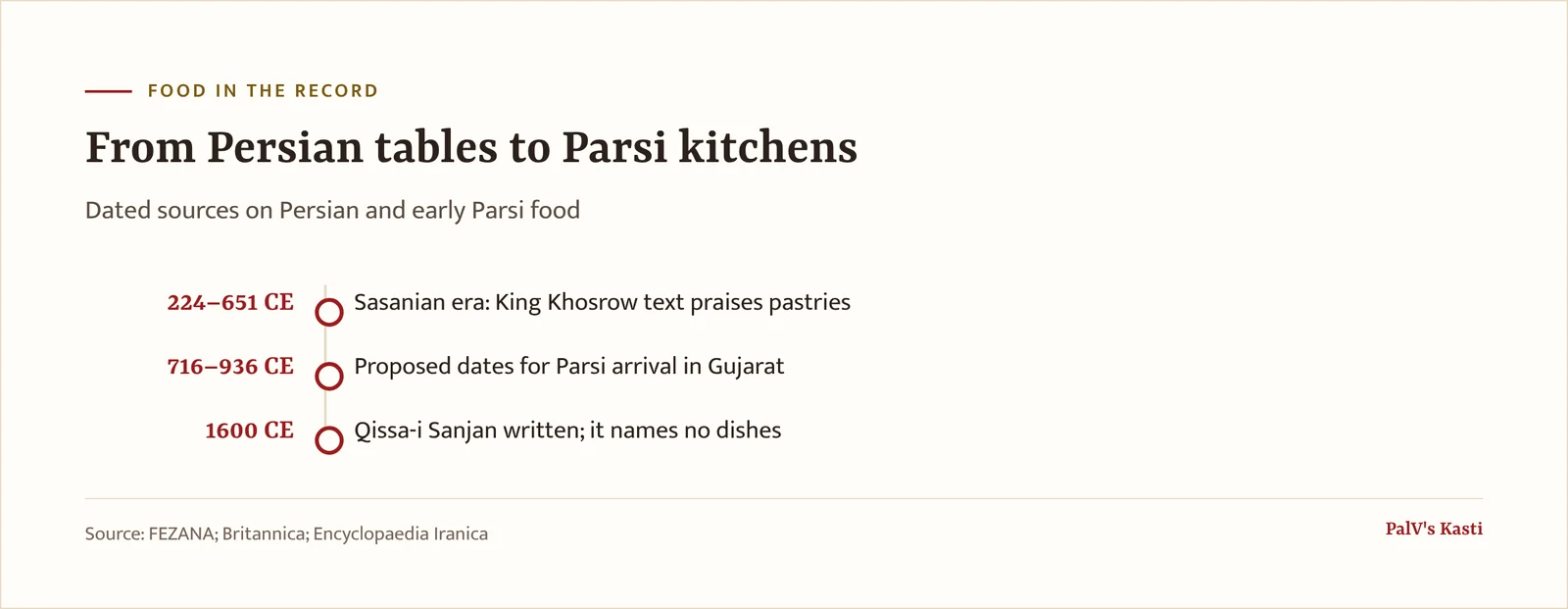

FEZANA's book also says the first 300 years after the arrival are not recorded in detail. So any menu you read for "the first Parsis" in Sanjan is a guess.
Which ancient Persian traces survive in Parsi cuisine today?
Cookbook author Niloufer Mavalvala puts it simply on The Cook's Cook: the Persian half of Parsi cooking shows in dishes of dried fruit, nuts and sweetness, and the Indian half in ginger, garlic, chillies and spice. In her "Roots" note in FEZANA's book she adds that in ancient Persia berries sweetened food, nuts thickened stews and fruit was dried for the winter. She notes that almonds, pistachios, raisins and rosewater go into many Parsi sweets, and FEZANA's book gives chicken cooked with apricots, jardalu ma marghi, as an example of the Persian-Gujarati mix.
Dhansak is one dish that Mavalvala links to Persia. Speaking to Al Arabiya, Mavalvala said she believes it began as a Persian khoresh, a stew of lentils, spinach, plums and meat served over rice, which "turned to Dhansak" once the community settled in India. She is also clear that there are many versions of the dish's origin story, so read this as one cook's informed view rather than a settled history. Our guide to Parsi food covers how the full cuisine took shape, and the Parsi recipes section has the dishes themselves.
The cuisine kept changing wherever Parsis settled, as our piece on Hyderabad Parsi food shows. If you want to test what you know, try our Parsi cuisine quiz.
One old fruit still appears at prayer. Mavalvala writes that Parsis use the pomegranate among the fruit offerings at jashans, and Noshir H. Dadrawala, writing in Parsi Times, describes the jashan tray as seasonal fruit, mainly pomegranates, which are later eaten as chasni, blessed food. Practice varies between families and Agiaries; your family priest's guidance comes first.
Frequently asked questions
What did ancient Persians eat for a feast?
Herodotus wrote that on birthdays, the day Persians valued most, rich families roasted an ox, horse, camel or donkey whole in an oven, while poorer families cooked smaller animals. Meals had few main courses followed by many sweets, and he described the Persians as very fond of wine. His is a Greek outsider's account.
What food did Zoroastrians eat in Sasanian times?
Middle Persian texts list bread eaten with herbs like coriander, cress and leek, wheat, barley and pulses, and fruits such as figs, quinces, grapes, dates, pomegranates, walnuts, almonds and pistachios. A Sasanian text about King Khosrow praises lamb cooked in broth with whey, almond and walnut pastries, and an apple-and-quince jelly.
Do we know what the first Parsis ate in India?
No. The Qissa-i Sanjan, the only account of the migration, was written in 1600 from oral tradition and names no dishes or food rules. FEZANA's 2012 cookbook notes that the first 300 years after the arrival are not recorded in detail. Anything said about their exact meals is a guess, not history.
Is dhansak an ancient Persian dish?
Not in its present form. Cookbook author Niloufer Mavalvala has said she believes dhansak grew out of a Persian khoresh, a stew of lentils, spinach, plums and meat over rice, which changed after Parsis settled in India. She also notes that many origin stories exist, so this is an informed view, not proof.
Which Parsi ingredients come from ancient Persia?
Cooks such as Niloufer Mavalvala trace the dried fruit, nuts and sweet flavours of Parsi cooking to Persia, and the ginger, garlic, chillies and spices to India. Ancient sources back the Persian side: the Bundahishn lists almonds, walnuts, pistachios, pomegranates and quinces, and Polyaenus names saffron and pistachio oil at the king's table.


