 PalV's Kasti
On this page
- What makes a dish a Parsi recipe?
- Which Parsi recipes should you cook first?
- What are the classic Parsi egg recipes?
- Which Parsi recipes suit a weeknight dinner?
- Are there vegetarian Parsi recipes?
- What do Parsis cook for weddings, Navroz and Gahambars?
- Which Parsi dishes come from Irani cafes, the pickle jar and the winte…
- Which Parsi recipes are disappearing?
- Which Parsi cookbooks hold the traditional recipes?
- Frequently asked questions
The essential Parsi recipes fall into a few families: eggs set on top of vegetables or mince (per eedu), dhan dar patio (white rice, plain yellow dal and a rich seafood patio), Dhansak, sweet-sour meat finished with crisp salli, fried fish and cutlets with tomato gravy, and the custards and sweets of weddings and Navroz. If you're new to Parsi cooking, start with eggs on potatoes and onions. It's a Time & Talents Club recipe that two Scroll.in writers who cooked it called "very forgiving". Next, learn dhan dar patio. Keep salli boti and dhansak for a weekend when you have time. This page maps the whole family and points you to our full recipe for each dish.
અદીબેહેસત રોજ
Ardibehesht Roj, Tir Mah · 1396 Y.Z.
What makes a dish a Parsi recipe?
Niloufer Mavalvala, writing for The Cook's Cook, sorts Parsi cooking by where each strand came from. Dishes built on dry fruit, nuts and sweetness are Persian. Dishes built on ginger, garlic, chillies and spice are Indian. Her name for the balance that ties them together is tikhu-khatu-mithu, spicy-sour-sweet, which she calls the "essential trinity of Parsi cooking".
Perzen Patel, the Mumbai food writer behind Bawi Bride, puts a finer point on it. In her view, using dark vinegar and jaggery together in one dish is something only Parsi cooks do.
Then there's what lands on the plate. Meher Mirza, writing in Saveur, describes a cuisine heavy on seafood, eggs and meat, and grumbles that it is "so often reduced to dhansak and patra ni macchi". Our overview of Parsi food covers where the cuisine came from. This page is about what to cook.
A note before the recipes. Mavalvala tells readers that recipes are guidelines rather than exact tools. Taste as you go, especially with vinegar and jaggery, because no two Parsi families make the same dish the same way.
Which Parsi recipes should you cook first?
No source ranks Parsi dishes for beginners, so this order is our own advice, built on what the cooks below say about each dish.
- Eggs on potatoes and onions. Cheap, quick and hard to ruin. It teaches the per eedu method behind half the Parsi breakfast table. The full recipe is below.
- Dhan dar patio. In My Bombay Kitchen, Niloufer Ichaporia King calls patio "one of the cornerstones of Parsi menu planning" and pairs it with white rice and plain yellow dal. Our Dhan dar patio page has the method.
- Salli boti, or a jardaloo dish. Perzen Patel says salli boti is fairly easy to cook yet rarely made at home, because meat on the stove can take two to three hours to turn tender. Start with Jardaloo sali boti, then try the chicken version, Jardaloo ma murghi, or a Parsi lamb stew.
- Dhansak. Mavalvala calls it "the king of all foods Parsi", and Farrukh Dhondy, writing in Outlook, places it at family gatherings on a Sunday. We'd keep it for last because it has the most stages of the four. Our Chicken salli and dhansak bhonu page puts it on one table with chicken salli.
Why eggs first? Because the method travels. Once you can set eggs over a cooked base without scorching the bottom, you can do it over okra, tomatoes or mince.
Eggs on potatoes and onions (the Time & Talents Club recipe)
This method follows Hilla JK Daruvala's recipe in The Time & Talents Club Recipe Book, as reprinted by Scroll.in in 2018. It serves six.
- 6 eggs
- 1 lb (about 450 g) potatoes, cut into small cubes
- 2 tbsp ghee
- ½ lb (about 225 g) onions, sliced thin
- 2 green chillies, chopped
- Salt (the book says 2/3 tbsp in all; add it in stages and taste)
- 1 tbsp chopped coriander leaves
- Heat the ghee and fry the onions for two minutes.
- Add the potato cubes. Cook until the onions and potatoes are nearly done.
- Stir in salt, the chillies and the coriander. Take the pan off the heat and spread everything in a flat, greased baking dish.
- Crack all six eggs over the potatoes and salt them lightly.
- Cover. Leave on a low flame, or in a slow oven, until the eggs have set. Serve hot.
What are the classic Parsi egg recipes?
Per eedu means eggs cooked on top of something else. FEZANA's 2012 community cookbook, Eat, Live, Pray, calls it a popular fall-back in Parsi homes and lists tomatoes, spinach, okra, potatoes and onions, potato wafers and even heavy cream as bases. Dhondy's roll-call in Outlook includes kheema par eida, papeta par eida and bheeda par eida, plus versions on bhaji (spinach) and tambotaan (tomatoes), and he adds that Parsis put eggs on almost anything else.
Why so many egg dishes? Farishta Murzban Dinshaw, writing in the FEZANA book, offers one possible reason: the early settlers in Gujarat were mostly poor farmers, and eggs gave them animal protein without killing an animal. She offers it as a possible explanation, not a proven one.
Our Per eedu guide covers the technique. The single-dish pages are Bhida per eedu on okra, the Tamota per eedu recipe on tomatoes, and Kheema per eedu on spiced mince. Eggs also anchor our list of Parsi breakfast dishes, which sits beside the older Ghau nu dhoodh breakfast and an Orange-spiced chapat. That chapat is Chef Peri's updated take on a pancake she describes as a little thicker than a crepe and much thinner than a pancake.
Which Parsi recipes suit a weeknight dinner?
For an ordinary dinner, start with daar. Mavalvala writes that daar usually comes with rice and patio, or with fried fish or cutlets, and quite often with nothing beside it but a pickle. Build the week around a pot of dal and the rest is easy. Everyday Parsi home cooking walks through that routine.
- Fried fish. Perzen Patel's masala fish fry needs only turmeric and red chilli powder before a quick fry in ghee, and she thinks it's best with plain rice and dal. Her grandmother was happy with a small bangda (mackerel) or a piece of surmai (kingfish). Full recipe: Parsi fried fish.
- Cutlets with tomato gravy. Mavalvala says Parsis don't much like food without a "rus", a sauce, so tamota ni gravy goes on the side. See Gos na cutlets, and Parsi crumb chops for the crumbed version.
- Khichri with fish in sauce. A note in the FEZANA book says Parsis eat khichdi with fish sauce where other communities reach for yogurt. Our page: Khichri saas ni machhi.
- Prawn curry. Perzen Patel grew up eating her grandmother's prawn curry at Saturday lunch, with rice and kachumbar. Try our Parsi prawn curry.
- Bombay duck. Mirza notes that Parsis call this lizardfish boomla and eat it both fresh and dried. See Parsi-style bombil.
- Mutton with greens or potatoes. Bhaji dana nu gosh is mutton cooked with leafy greens and green peas. Parsi Times columnist Mahafrin Umrigar framed it as a taste of the village that city dwellers crave. Kharo gos papeta no ras is mutton cooked with whole spices and small potatoes.
Leftovers rarely go to waste in a Parsi kitchen. Mavalvala calls cutlets, kebabs and patties "the art of reusing leftovers", and that thrift runs through Parsi mutton kebabs and the small bites in Parsi party snacks. She also contrasts Parsi cooking with Persian and Indian cooks, who grill meat on skewers. Our Parsi-style grilling page takes Parsi flavours to the barbecue anyway.
Are there vegetarian Parsi recipes?
Yes, though the cuisine's reputation says otherwise. Shabnam Minwalla's Outlook Traveller piece opens by warning that Parsi food is "injurious to the mental health of vegetarians", then admits that hosts will cook vegetarian dhansak and stew for fussy guests. Mavalvala, talking to Slurrp about her book The Vegetarian Parsi, calls the meat-only image a myth and says the cuisine "celebrates vegetarian dishes".
Good starting points:
- FEZANA's model wedding menu opens with laganshala, a vegetable stew, before any meat arrives.
- Aubergine is a common Parsi vegetable, according to Slurrp's profile of Mavalvala: pan-fried in masala with yoghurt, or made into vengna no patiyo, cooked exactly the way prawn patio is. Our Brinjal capsicum salan is another aubergine dish.
- Our Vegetarian Parsi recipes collection, Vegetarian Parsi kebabs and Navsari ghee khichri cover the rest.
Two warnings for strict vegetarians. Every per eedu dish carries eggs. And traditional topli nu paneer isn't vegetarian either: King, writing in the FEZANA book, records that unlike paneer curdled with acid, it is set with animal rennet, specifically dried chicken gizzard linings. Our Parsi paneer recipe page explains the method. Perzen Patel even jokes that bhaji dana ma gosht is her family's "token 'vegetarian' dish" at Navroz, because vegetarians can eat the gravy.
What do Parsis cook for weddings, Navroz and Gahambars?
Weddings
Minwalla explains that a Parsi wedding feast is called a patra because it's served on a banana leaf. The FEZANA book describes six to eight courses, with each course offering one or more choices depending on the budget. Its model menu:
| Course | Dishes (FEZANA, Eat, Live, Pray, 2012) |
|---|---|
| Vegetables | lagan nu achaar (carrot and raisin pickle), rotli, laganshala |
| Chicken | salli marghi, farcha |
| Meat | masala nu ros gos, dahi nu gos |
| Fish | tareli machi, patra ni machi, khichdi saas |
| Rice | palao with masala ni daar |
| Sweet | lagan nu custard, kulfi |
Chef Jamsheed Bhote told The Hindu in 2013 that lagan nu custard is "a must at our weddings", and credited crumb frying and baking, picked up under British influence, for both the frilly cutlet and the custard. Our pages on Frilly cutlets and wedding custard, the Parsi festive spread and the Parsi platter show how to put a home version together.
Navroz
Mirza's own Navroz morning, as she describes it in Saveur, begins with malai pao, sev scented with cardamom and nutmeg, and mitthoo dahi, lightly sweetened yoghurt. Mavalvala also lists sev and mithu dahi among the old-time Parsi favourites. King writes in My Bombay Kitchen that falooda is meant to be eaten on 21 March, Navroz, while adding that nobody will stop you on the other 364 days. See Pateti recipes and Parsi falooda.
Gahambars
The FEZANA book gives the traditional Gahambar menu in India as ambakaliyu (a mango chutney), dhansak, kevab (meatballs), kachumbar and meat with potatoes, rounded off with mango ice cream or kulfi. Our Ghambar nu papeta ma gosht and Ambakalyo recipe pages cover two dishes from that menu.
Practice varies between families and Agiaries; your family priest's guidance comes first.
Which Parsi dishes come from Irani cafes, the pickle jar and the winter pantry?
Irani cafes added their own dishes to Bombay's table. Afshin Kohinoor of Britannia & Co. told The Tribune that his mother, Bacha Kohinoor, introduced the restaurant's berry pulao, known in Persian as zereshk polo. Our Berry pulao Irani cafe style page covers it, and Iranian-style pilao explains how Iranian rice cooking differs from Parsi pulao.
Mirza writes that Parsis pickle everything from fish roe to mutton. Parsi Times columnist Dara Khodaiji describes gharab nu achaar as a pickle made from the roe of the bhing fish. Our Gharab nu achaar page has the detail.
Winter brings vasanu. An India Food Network essay described it as a winter preparation made with no less than a kilo of ghee plus dry fruit, dry ginger, lotus stem and dill, and Slurrp reports that families order it weeks in advance because few make it at home. Read more in Parsi winter foods. For the tea table, the FEZANA book titles its bhakra recipe "Parsi donut". Ours is the Bhakra recipe.
Which Parsi recipes are disappearing?
Writing in Parsi Times in 2021, Khodaiji listed tea-time sweets that have dropped off Parsi menus, among them khaman-na-larva, sandhras, kumaas and popatji, and said eeda pak had "almost disappeared". Mavalvala, on the other hand, says paks are being revived "with gusto", and Khodaiji himself notes that badam-pak is making a comeback. Our Disappearing Parsi delicacies page lists what's at risk, the Bhonu to Pick project follows one effort to bring old dishes back, and Kermin's Parsi kitchen tells one home cook's family story.
The community has always laughed at its own appetite. Dhondy notes that Parsi humour turned the faith's good thoughts, good words, good deeds into "good eggs, good fish, good meat". There's more in Parsi food humour.
Which Parsi cookbooks hold the traditional recipes?
The printed record goes back well over a century. Murali Ranganathan, writing in Scroll.in, names Burjorjee Nusserwanjee Heera as the first Parsi to publish a cookbook: Pakwan Pothi, with 400 recipes, issued in 1878. Meherbai Jamsetjee Wahadia's Vividha Vaani followed on 9 August 1894 with 1,248 recipes, the first Gujarati cookbook written by a woman, according to Ranganathan. Its third edition came out in 1915, and the FEZANA book still points readers to "Vividh Vani" (1915) as a classic collection of Parsi recipes.
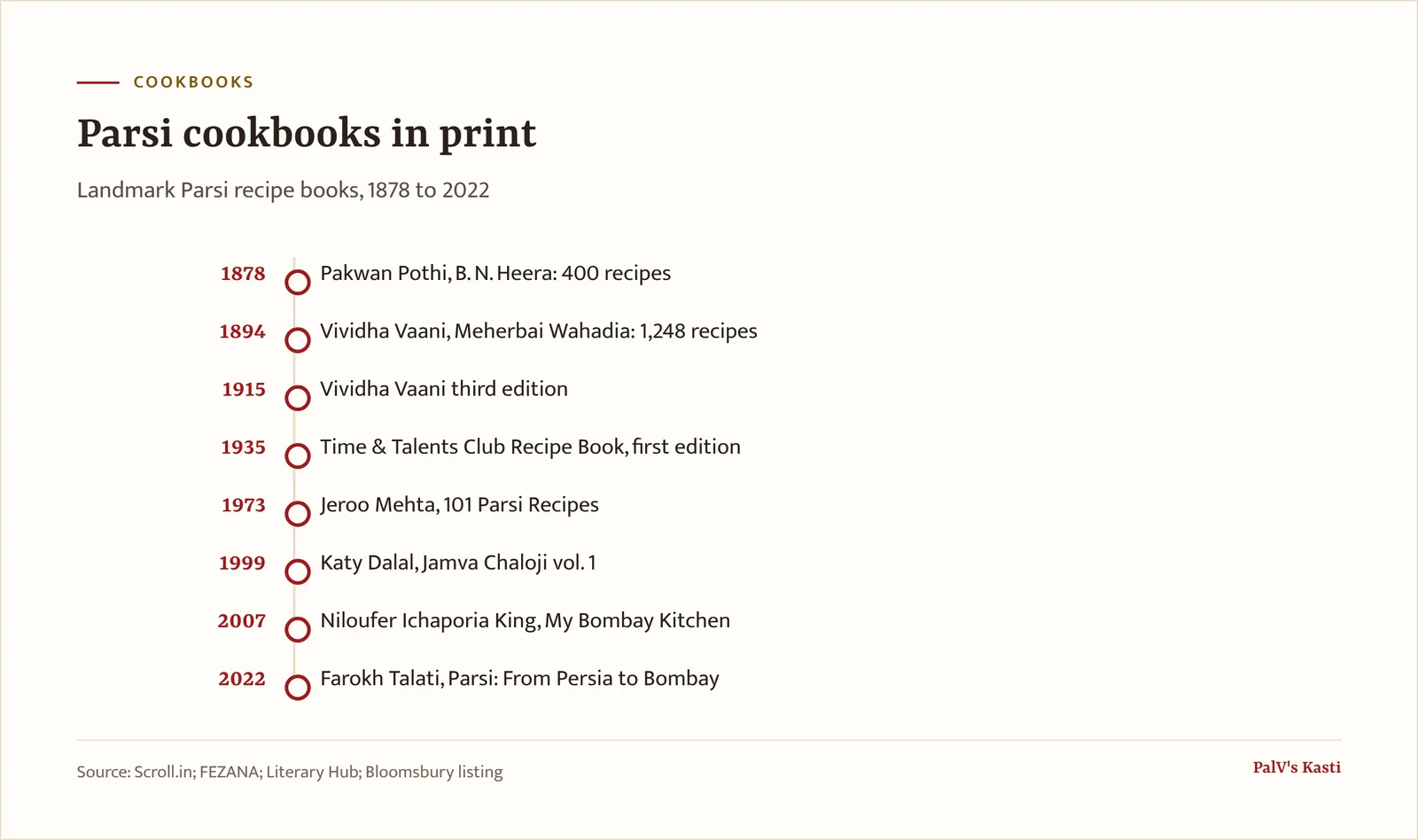

The Time & Talents Club was founded in 1934 by Gool Shavaksha, and its recipe book first appeared in 1935. Scroll.in reports that it was reissued six times between 1935 and 1975, runs to 500 pages and holds over 2,000 recipes. King called it "the Bombay Bible". How clubs like this kept recipes alive is the subject of Parsi community cooking clubs.
The FEZANA book names three modern books that carried Parsi food abroad: Jeroo Mehta's 101 Parsi Recipes (first published in 1973), Niloufer Ichaporia King's My Bombay Kitchen (University of California Press, 2007) and Katy Dalal's two-volume Jamva Chaloji (1999 and 2003). Mavalvala's The Vegetarian Parsi fills the vegetarian gap. A recent title is Farokh Talati's Parsi: From Persia to Bombay, which Bloomsbury's catalogue listing dates to December 2022 and describes as more than 150 recipes. See Farokh Talati's Parsi cookbook.
For a first shelf, we'd pair one of the old community books with one modern book written for cooks who didn't grow up beside a Parsi stove.
Frequently asked questions
Are there vegetarian Parsi recipes?
Yes. Niloufer Mavalvala calls the idea that Parsis never eat vegetables a myth and wrote a whole book, The Vegetarian Parsi. Laganshala, a vegetable stew, opens the traditional wedding menu, and vengna no patiyo is aubergine cooked like prawn patio. Watch for eggs in per eedu dishes and animal rennet in topli nu paneer.
Which Parsi recipe is easiest for a beginner?
Start with eggs on potatoes and onions from The Time & Talents Club Recipe Book. You fry onions and potatoes in ghee, spread them in a dish, crack six eggs on top and cook gently until set. Scroll.in's testers called it very forgiving. It also teaches the per eedu method used across Parsi cooking.
What are Parsi egg recipes called?
Most belong to the per eedu (or par eeda) family, which means eggs cooked on top of something. The base can be potatoes, okra, tomatoes, spinach, mince or even potato wafers, so you get papeta par eedu, bhida per eedu, tamota per eedu and kheema per eedu. Dhondy's list in Outlook names five of them in one breath.
What is 101 Parsi Recipes?
101 Parsi Recipes is a cookbook by Jeroo Mehta, first published in 1973 by Popular Prakashan. FEZANA's 2012 community cookbook calls it seminal and lists it with Niloufer Ichaporia King's My Bombay Kitchen (2007) and Katy Dalal's Jamva Chaloji as books that introduced Parsi cooking to readers worldwide.
Which Parsi dishes suit a weeknight dinner?
Plan around a pot of daar. Niloufer Mavalvala writes that it is usually served with rice and patio, fried fish or cutlets, and often just a pickle. Masala fried fish, mince cutlets with tomato gravy, khichri with fish in sauce, and mutton with greens all fit a normal working week.


